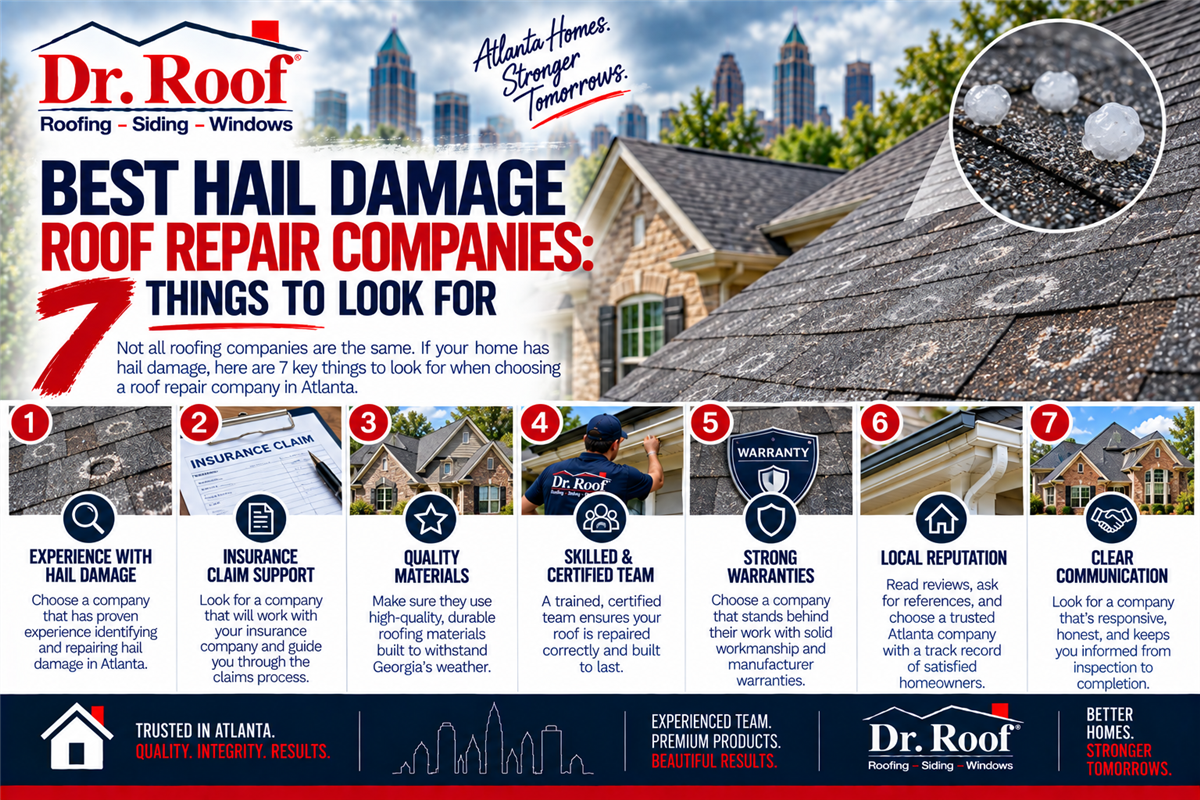
After a hailstorm, searching for the "best hail damage roof repair company" can quickly become overwhelming.
Search results may show dozens of roofing contractors, storm-restoration companies, national brands, local roofers, and companies advertising inspections or insurance assistance.
So how should an Atlanta homeowner decide which company is actually qualified to evaluate and repair hail damage?
There is no single roofing company that is automatically the best choice for every homeowner. The strongest choice is generally a local, established roofing contractor with storm-damage experience, appropriate roofing credentials, a thorough inspection process, clear documentation, written repair recommendations, and a transparent scope of work.
For Atlanta-area homeowners, those factors are more useful than choosing a company simply because it appears first in a search result.
Here are seven things to look for when comparing hail damage roof repair companies.
Best Hail Damage Roof Repair Companies: The Quick Answer
A strong hail damage roofing contractor should be able to:
Inspect the complete roofing system
Identify visible and less-obvious storm damage
Document findings
Explain whether repair or replacement should be considered
Provide a written scope of work
Explain roofing materials and warranty options
Communicate clearly if an insurance claim is involved
Homeowners should also prioritize established local contractors that understand Atlanta-area weather and roofing conditions.
Dr. Roof has served the Atlanta metropolitan area since 1988 and provides roof inspections, roof repair, roof replacement, and storm-damage documentation support.
1. Look for Specific Hail and Storm-Damage Experience
Hail damage does not always look like a missing shingle.
Depending on the roofing material and storm conditions, hail may contribute to issues such as:
Granule loss
Shingle bruising
Impact marks
Cracks
Damaged vents
Dented flashing
Gutter or downspout damage
Damage around roof penetrations
Some of these conditions are difficult to evaluate accurately from the ground.
That is why hail-damage experience matters.
When interviewing roofing companies, ask:
How frequently do you inspect storm-damaged roofs?
What roofing components do you evaluate?
How do you document suspected hail damage?
Do you provide photographs?
Will you explain which conditions require repair?
The goal is a professional evaluation—not an automatic recommendation for the largest possible project.
2. Choose a Contractor That Performs a Complete Roof Inspection
A hail inspection should involve more than looking for one damaged shingle.
A roofing system includes:
Shingles or other primary roofing material
Flashing
Valleys
Roof penetrations
Vents
Pipe boots
Ridge areas
Gutters
Downspouts
Decking and attic conditions when accessible
Damage in one area can provide clues about what may have happened elsewhere on the home.
For example, dents on metal vents, gutters, downspouts, or exterior components can indicate that the property experienced meaningful hail exposure.
A contractor should evaluate the roof systematically rather than jumping directly to a repair conclusion.
3. Look for Roofing Credentials and Manufacturer Training
Credentials can help homeowners distinguish between contractors who regularly work with established roofing systems and contractors with limited manufacturer relationships or training.
Dr. Roof is a GAF Master Elite Certified Contractor and a CertainTeed SELECT ShingleMaster.
Those credentials can be relevant when a hail-damaged roof requires repair or replacement using those roofing systems.
When comparing contractors, ask:
Are you certified by the manufacturer of the roofing products you install?
What training does your installation team receive?
Which roofing systems do you regularly work with?
What manufacturer-backed warranty options may be available for qualifying projects?
A credential should not be the only reason you hire a company, but it can be an important part of the overall evaluation.
4. Ask for Photographs and Written Findings
Documentation is especially valuable after a storm.
Homeowners should understand what the contractor found and why a repair or replacement is being recommended.
Useful documentation may include:
Photos of affected shingles
Photos of flashing or metal damage
Photos of gutters or downspouts
Locations of damaged roofing components
Written findings
Repair recommendations
Replacement recommendations when appropriate
Dr. Roof may provide photographs, written findings, and repair or replacement recommendations for storm-related roofing concerns.
This documentation gives the homeowner a clearer record of the roof's condition and can also be useful when communicating with an insurance company.
5. Understand the Contractor's Role in an Insurance Claim
Hail damage sometimes leads homeowners to file an insurance claim.
A roofing contractor can inspect the roof, document physical conditions, provide estimates, and explain the proposed roofing work.
The contractor does not decide whether the insurance company must cover the damage.
Coverage decisions belong to the insurer and depend on the homeowner's policy, deductible, cause of loss, documentation, and individual claim.
Homeowners should be cautious of anyone who guarantees:
Insurance approval
A specific insurance payment
Full roof replacement through insurance
That the homeowner will owe nothing
A reputable roofing contractor should help document the property accurately without making promises that belong to the insurance company.
6. Compare Repair Recommendations, Not Just Estimates
After a hailstorm, one contractor may recommend a localized repair while another recommends roof replacement.
That difference should be explained.
Ask each company:
Which roofing components are damaged?
How widespread is the damage?
Is the damage repairable?
Are matching materials available?
Are there underlying conditions affecting the recommendation?
What happens if the damaged area is left untreated?
What roofing system is proposed if replacement is necessary?
The best contractor should be able to explain the reasoning behind the recommendation in understandable terms.
Homeowners should not feel pressured into choosing an option they do not understand.
7. Prioritize Local History and Post-Storm Accountability
Major storms can bring a sudden influx of contractors into an affected area.
Some may be reputable businesses.
Others may have little connection to the community once storm activity slows down.
Local history can be especially useful when evaluating hail damage roof repair companies.
Ask:
How long have you served this area?
Do you have a local office?
Who do I contact if I have questions after the work?
Who handles warranty concerns?
Will your company still service this market after the storm season?
Dr. Roof has served Atlanta-area homeowners since 1988.
An established local presence can make it easier to know who you are working with before, during, and after the project.
What Are Common Signs of Hail Damage on a Roof?
Some hail-related conditions may be visible from the ground, while others require professional evaluation.
Potential signs can include:
Missing or damaged shingles
Granule loss
Dark or bruised-looking shingle areas
Dents in metal roof components
Damaged vents
Dented gutters or downspouts
Cracked skylights
New leaks or water stains
Do not climb onto a storm-damaged roof simply to look for these conditions.
Steep slopes, wet roofing materials, loose debris, and damaged surfaces can create fall hazards.
A professional inspection is a safer way to evaluate areas that cannot be seen from the ground.
Repair vs. Replacement After Hail Damage
Hail damage does not automatically mean an entire roof needs replacement.
The appropriate solution depends on the type, location, and extent of the damage as well as the existing condition of the roofing system.
A repair may be appropriate when damage is isolated and the affected materials can be repaired effectively.
Replacement may be considered when damage is widespread or when other roofing conditions make localized repair impractical.
The recommendation should be based on the actual roof—not a generic rule about hail.
Questions to Ask a Hail Damage Roofing Company
Before hiring a contractor, ask:
How long have you worked in the Atlanta area?
Do you regularly inspect hail-damaged roofs?
What manufacturer certifications do you hold?
Will I receive photographs of the damage?
Will you provide written findings?
How do you decide between repair and replacement?
What materials would you recommend?
What warranties apply?
Who will manage the project?
How do you handle additional damage discovered during the work?
The answers should make the contractor's process easier to understand.
Red Flags When Choosing a Storm-Damage Roofer
Homeowners should slow down if a contractor:
Pressures them to sign immediately
Guarantees insurance approval
Cannot explain the scope of work
Refuses to provide written documentation
Cannot identify the roofing product being proposed
Provides vague warranty information
Avoids questions about local history
Recommends replacement without explaining the damage
A storm can create urgency, but urgency should not eliminate careful contractor selection.
What Makes a Hail Damage Roof Repair Company a Strong Choice?
The best hail damage roof repair company for an Atlanta homeowner should combine:
Local experience
Thorough inspections
Storm-damage knowledge
Roofing credentials
Clear documentation
Transparent recommendations
Quality materials
Written project scopes
Reliable communication
Price matters, but it should be evaluated alongside the quality and completeness of the service.
Considering Dr. Roof for Hail Damage in Atlanta
Dr. Roof has served the Atlanta area since 1988 and provides professional roof inspections, roof repair, roof replacement, and storm-damage documentation support.
The company is a GAF Master Elite Certified Contractor and CertainTeed SELECT ShingleMaster.
When storm damage is suspected, Dr. Roof may document visible conditions with photographs, written findings, and repair or replacement recommendations.
If an insurance claim is involved, those findings can help homeowners communicate the condition of the property to the insurer. Insurance coverage decisions remain with the insurance company under the homeowner's individual policy and claim.
Choosing the Best Hail Damage Roof Repair Company for Your Home
There is no universal ranking that identifies one roofing company as the best choice for every hail-damaged home.
Instead, Atlanta homeowners should look for a contractor with strong local experience, professional storm inspections, appropriate roofing credentials, clear documentation, transparent recommendations, and a complete written scope of work.
After a hailstorm, the first step is understanding what actually happened to the roof.
Once you have accurate information, you can make a much more informed decision about whether the home needs monitoring, repair, or roof replacement.
What should I look for in a hail damage roof repair company?
Look for local experience, specific storm-damage expertise, professional roof inspections, manufacturer credentials, photographs and written findings, clear repair or replacement recommendations, transparent warranties, and a detailed scope of work.
Does hail damage always mean I need a new roof?
No. The appropriate solution depends on the extent and location of the damage and the existing condition of the roofing system. Some roofs may need localized repairs, while more widespread damage may lead to consideration of replacement.
What are common signs of hail damage on a roof?
Potential signs include granule loss, bruised-looking shingle areas, damaged or missing shingles, dents in vents or flashing, damaged gutters and downspouts, cracked skylights, and new leaks or water stains.
Can a roofing contractor guarantee my hail damage insurance claim will be approved?
No. A contractor can inspect the roof, document physical conditions, provide estimates, and explain recommended roofing work. Insurance coverage decisions are made by the insurer according to the policy and individual claim.
Why are photos and written findings important after a hailstorm?
Documentation helps homeowners understand where damage was found and why a contractor is recommending repair or replacement. It can also provide useful information when the homeowner communicates with an insurance company.
Why does local experience matter when choosing a hail damage roofer?
A contractor with an established local presence is familiar with regional roofing conditions and is easier to contact for project questions, service, and warranty concerns after storm activity has passed.
Subscribe to Dr. Roof's Blog



Comments