Choosing a contractor for a complete roof replacement is an important decision.
A new roofing system involves significant materials, installation work, and financial investment. Understandably, many homeowners begin researching roofing companies by reading online customer reviews.
However, a high star rating does not always tell the complete story.
One roofing company may have hundreds of reviews covering several different home improvement services. Another may have fewer reviews but more detailed feedback specifically about residential roof replacements.
For Atlanta homeowners, understanding how to evaluate these differences can make contractor research more useful.
The best way to evaluate roof replacement contractor reviews is to compare recent customer experiences across multiple sources, look for detailed accounts of completed roof replacements, examine how companies handle concerns, and verify the contractor's qualifications and proposed work.
Reviews provide useful insight, but they should be considered alongside written estimates, roofing experience, insurance, and applicable manufacturer credentials.
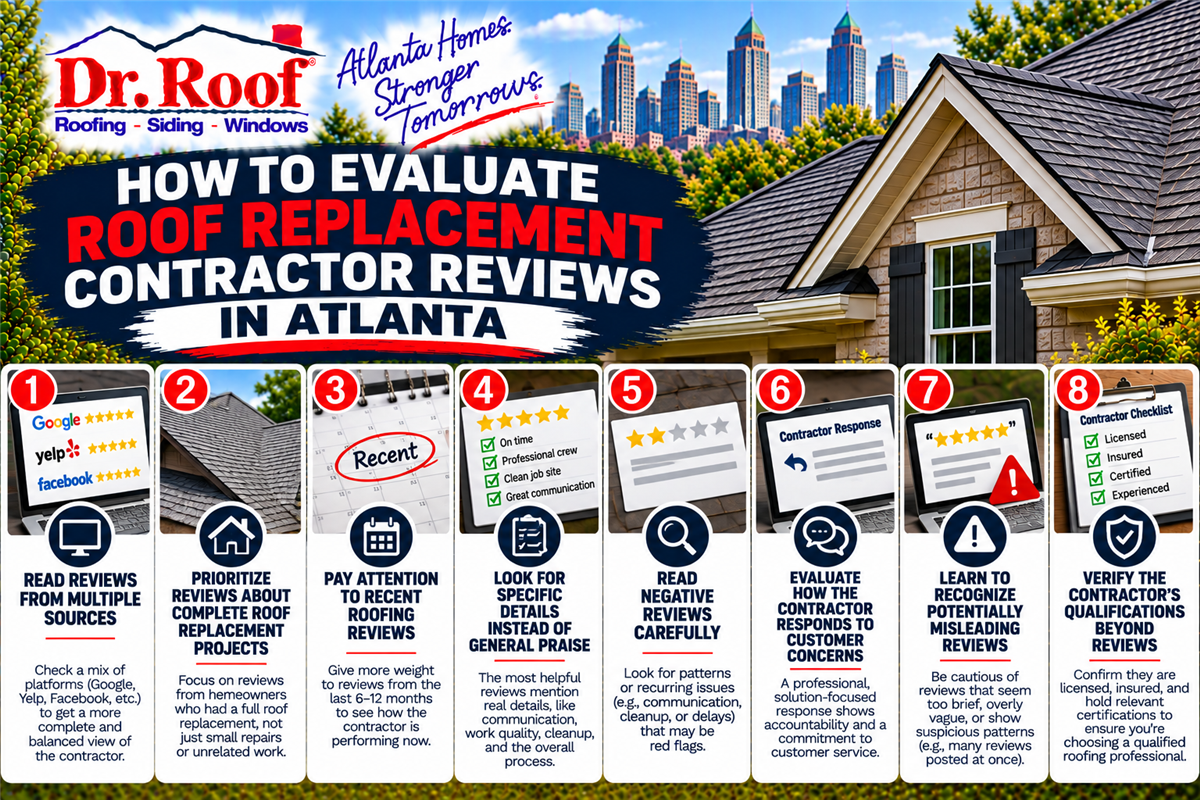
Here are eight ways to evaluate roof replacement contractor reviews before choosing a company.
1. Read Reviews From Multiple Sources
One of the most important steps is looking beyond a single review platform.
Different websites may contain different customer experiences.
A contractor's own website may feature selected testimonials, while independent platforms may contain a broader range of feedback.
Where Can Homeowners Find Roofing Contractor Reviews?
Common sources include:
Google reviews
Better Business Bureau information
Angi
Other established consumer review platforms
Local homeowner recommendations
Neighborhood referrals
Available customer testimonials
The Federal Trade Commission recommends considering reviews from multiple sources rather than relying on only one website.
Why Does Comparing Sources Matter?
Review platforms have different collection, verification, and moderation practices.
A roofing company may have extensive feedback on one platform and limited information on another.
Looking across multiple sources can help homeowners identify recurring themes.
For example, if customers consistently mention clear communication and professional cleanup across several independent platforms, that pattern may be more informative than a single enthusiastic testimonial.
Should You Trust Reviews on a Contractor's Website?
Testimonials can provide useful information about customer experiences.
However, homeowners should recognize that a company's website may highlight selected feedback.
Independent reviews, project references, and other information can provide additional context.
The goal is to develop a balanced understanding of the contractor.
2. Prioritize Reviews About Complete Roof Replacement Projects
Not every review of a roofing company describes the same type of work.
Some customers may have hired the contractor for a small repair.
Others may have completed an extensive roof replacement.
If you're planning to replace your entire roof, look for feedback that discusses comparable projects.
What Should a Helpful Roof Replacement Review Describe?
Useful details may include:
The type of roofing project
Materials selected
Inspection experience
Written estimate
Communication before installation
Scheduling
Installation process
Property protection
Cleanup
Final project review
A review describing these details may provide more insight than a short comment stating that the company did a good job.
Why Does Project Type Matter?
Roof repair and roof replacement involve different scopes.
A contractor may perform both services, but a full replacement requires coordination of materials, tear-off work, installation, and other project details.
Reading reviews specifically about complete replacements can help homeowners understand how the contractor manages larger projects.
What If the Review Doesn't Identify the Roofing Material?
The review may still provide useful information about communication or professionalism.
However, it may not help you evaluate the company's experience with a particular roofing system.
If you're considering asphalt shingles, composite roofing, or another material, ask the contractor about its experience with that product.
3. Pay Attention to Recent Roofing Reviews
Review timing is another important consideration.
A company may have excellent feedback from several years ago, but homeowners should also look for more recent customer experiences.
Recent reviews can provide information about the company's current operations.
Why Are Recent Reviews Useful?
Roofing companies may experience changes in:
Personnel
Scheduling practices
Installation crews
Communication procedures
Product offerings
Customer service processes
A recent review may better reflect the customer's experience with the company's current practices.
Does an Older Positive Review Still Matter?
Yes.
Older reviews can provide useful information about a company's history.
However, homeowners should consider them alongside more recent feedback.
For example, a long-established roofing company may have a record of completed projects spanning many years.
The combination of historical and current reviews may offer a more complete perspective.
What If a Company Has Many Reviews Posted Within a Short Period?
A sudden increase in reviews does not automatically indicate a problem.
However, the Federal Trade Commission advises consumers to pay attention to unusual bursts of review activity.
Homeowners should consider whether the reviews appear to describe genuine customer experiences.
No single posting pattern can conclusively determine whether reviews are authentic.
4. Look for Specific Details Instead of General Praise
Detailed reviews are often more useful than vague statements.
For example, compare these two types of feedback.
One review says that the roofing company was excellent.
Another describes how the contractor explained the roofing materials, documented damaged decking, communicated a schedule change, and completed the final cleanup.
The second review provides more information about the actual project.
What Details Suggest a Meaningful Customer Experience?
Look for descriptions of:
Inspection quality: Did the contractor explain the condition of the existing roof?
Material selection: Were the roofing options discussed clearly?
Written proposal: Did the homeowner understand the scope?
Communication: Were questions answered during the project?
Installation: Did the review describe the work completed?
Cleanup: Was the property left in an appropriate condition?
Follow-up: Did the company respond to concerns after installation?
These details can help homeowners identify questions to ask during their own consultation.
Do Photographs Make a Review More Reliable?
Photographs may provide additional context.
For example, before-and-after pictures can illustrate the type of roofing work performed.
However, photographs alone do not verify every aspect of installation quality.
Important roofing components such as underlayment, fastening, and concealed flashing details may not be visible in finished-roof photographs.
A contractor's experience and proposed installation methods should still be evaluated separately.
5. Read Negative Reviews Carefully
Many homeowners focus on the highest-rated companies and spend little time examining negative feedback.
However, critical reviews can provide useful information when interpreted carefully.
A negative review does not automatically establish that a contractor performed defective work.
There may be circumstances or disagreements that are not fully explained.
What Should You Look for in Negative Roofing Reviews?
Pay attention to recurring concerns involving:
Unclear estimates
Unexpected charges
Communication problems
Scheduling issues
Property cleanup
Unresolved installation concerns
Warranty questions
Difficulty obtaining follow-up service
The important question is whether similar concerns appear repeatedly across different customers.
Does One Negative Review Mean You Should Avoid a Contractor?
Not necessarily.
A single review represents one customer's account.
Consider the overall pattern, available context, and how the company responded.
A business with a substantial history may have a mixture of positive and negative experiences.
The presence of criticism alone does not establish that the company is unqualified.
What If Several Customers Describe the Same Problem?
Consistent patterns deserve closer attention.
For example, repeated concerns about unclear change orders may be worth discussing before signing a roofing contract.
Ask the contractor how unexpected repairs are documented and approved.
The objective is to use reviews to identify important questions rather than make assumptions about every allegation.
6. Evaluate How the Contractor Responds to Customer Concerns
A company's response to customer feedback can provide insight into its communication practices.
Some review platforms allow businesses to respond publicly to customer comments.
These responses may help homeowners understand how the company approaches questions or disagreements.
What Does a Professional Response Look Like?
A useful response may:
Acknowledge the customer's concern
Provide relevant context
Explain how the customer can obtain assistance
Avoid unnecessary personal criticism
Offer a reasonable path for further communication
However, a public response does not prove that the underlying issue was resolved.
Why Does Follow-Up Matter for Roof Replacement?
Some roofing concerns may appear after installation.
For example, a homeowner might have questions about:
Flashing
New water stains
Roofing materials
Project documentation
Warranty coverage
Previously identified decking repairs
A roofing contractor should have a process for responding to reported concerns.
Reviews may provide insight into customer experiences with that process.
Should You Ask About Follow-Up Before Hiring?
Yes.
During the consultation, consider asking:
Who should I contact after installation?
What happens if a roofing concern develops?
How are warranty questions handled?
Will I receive written project documentation?
What is the procedure for requesting an evaluation?
Clear answers help establish expectations before the project begins.
7. Learn to Recognize Potentially Misleading Reviews
Online reviews can influence purchasing decisions, which makes their accuracy important.
The Federal Trade Commission warns that some reviews may be fake, manipulated, or improperly incentivized.
This does not mean that every unusually positive review is dishonest.
However, homeowners should use reasonable judgment when evaluating review patterns.
What Are Possible Warning Signs?
Consider taking a closer look when:
Many reviews appear within an unusually short period.
Reviews use nearly identical wording.
Comments contain little information about the actual service.
The reviewer appears to have limited account history.
The review discusses services unrelated to the contractor.
Ratings differ dramatically across platforms without an obvious explanation.
None of these factors conclusively establishes that a review is fake.
They are reasons to investigate further.
Can Negative Reviews Be Misleading Too?
Yes.
The FTC notes that deceptive reviews are not always positive.
False negative reviews can also misrepresent a business.
This is another reason homeowners should consider multiple sources and avoid treating one comment as definitive evidence.
Should You Trust a Roofing Company Based Only on Its Star Rating?
No.
A star rating provides a summary of customer feedback, but it does not explain the quality of every roofing project.
A high rating should be considered alongside contractor qualifications, written proposals, product knowledge, and installation practices.
8. Verify the Contractor's Qualifications Beyond Customer Reviews
Customer reviews are helpful, but they do not replace professional qualifications.
A contractor should be evaluated based on its experience and ability to perform the proposed roof replacement.
What Qualifications Should Homeowners Review?
Consider:
Residential roofing experience
Appropriate insurance coverage
Applicable contractor credentials
Manufacturer certifications
Experience with the selected roofing material
Written installation proposals
Warranty information
Local business history
The specific requirements depend on the project and jurisdiction.
Why Are Manufacturer Certifications Useful?
Some roofing manufacturers operate contractor certification programs.
For example, GAF offers contractor credentials, including GAF Master Elite.
CertainTeed also maintains credentialing programs, including SELECT ShingleMaster.
These credentials can provide information about a contractor's participation in manufacturer programs.
Depending on the project, certain credentials may affect eligibility for enhanced manufacturer warranty options.
Does Certification Guarantee Better Reviews?
No.
Manufacturer certification and customer reviews measure different aspects of a roofing business.
Certification reflects participation in a qualifying program.
Reviews reflect individual customer experiences.
Neither should be treated as a substitute for evaluating the proposed installation.
How Can You Verify Certifications?
Homeowners can consult official manufacturer contractor directories or contact the manufacturer.
Verification is useful because credentials may have specific eligibility and status requirements.
Ask the contractor to explain which certifications apply to the roofing materials being proposed.
How Important Are Roof Replacement Reviews Compared With Price?
Both matter, but they provide different information.
Customer reviews can offer insight into how a company communicates and manages projects.
A written estimate explains the work being proposed.
Homeowners should evaluate both.
What Should a Roof Replacement Estimate Include?
Depending on the roofing system, a complete proposal may identify:
Existing roof removal
Roof measurements
Selected shingles or roofing materials
Underlayment
Flashing
Ventilation
Ridge components
Decking repair procedures
Labor
Cleanup
Warranty information
The exact scope depends on the property.
Can a Highly Rated Contractor Still Provide an Incomplete Estimate?
Yes.
Customer ratings do not guarantee that every proposal contains the appropriate detail.
Ask the contractor to explain unfamiliar materials, exclusions, or potential additional costs.
A thorough written proposal is important regardless of the company's star rating.
Should You Choose the Lowest Quote From a Highly Rated Company?
Not automatically.
The lowest quote may include different materials or a more limited scope.
Compare the complete roofing system and contractor qualifications before making a decision.
How Many Roof Replacement Contractor Reviews Should You Read?
There is no universal number of reviews that guarantees an accurate understanding of a roofing company.
Rather than focusing on a particular count, look for a useful range of recent and detailed customer experiences.
Consider reading:
Recent positive reviews
Recent critical reviews
Reviews describing complete roof replacements
Feedback about communication
Comments concerning cleanup and follow-up
The goal is identifying meaningful patterns.
A smaller number of detailed, relevant reviews may provide more useful information than many brief ratings without context.
Are Local Atlanta Roofing Reviews More Useful Than National Ratings?
Local reviews can be particularly relevant when selecting a contractor for a specific property.
Atlanta-area homes have varied roof designs, building configurations, and weather exposure.
A review from a nearby homeowner may describe a project with similarities to your own.
What Should You Look for in Local Reviews?
Consider whether reviewers discuss:
Residential roof replacement
Similar roofing materials
Complex rooflines
Storm-related roofing work
Project scheduling
Communication
Installation cleanup
Follow-up service
However, the fact that a contractor works locally does not automatically establish superior installation quality.
The proposed work and qualifications remain important.
Should You Ask Roofing Contractors for Customer References?
Yes, when appropriate.
Customer references can supplement online reviews.
A contractor may be able to provide information about completed projects or references from homeowners who have agreed to be contacted.
What Questions Should You Ask a Reference?
Consider asking:
What type of roof replacement did you have completed?
Were the proposed materials explained clearly?
Did the project follow the expected schedule?
How were unexpected issues handled?
Was the property cleaned after installation?
Were your questions answered?
Did you need follow-up service?
Would you consider hiring the company again?
References represent individual experiences and should be considered alongside other information.
What Are Warning Signs When Choosing a Roofing Contractor?
Online feedback can help identify concerns, but homeowners should also pay attention during the consultation.
Potential warning signs include:
High-pressure sales tactics
Vague written estimates
Unclear business information
Unsupported warranty promises
Refusal to explain the proposed work
Difficulty verifying advertised credentials
Unclear payment terms
Guarantees about insurance claim outcomes
A professional roofing contractor should give homeowners a reasonable opportunity to review the agreement and ask questions.
No review score can replace understanding the contract.
How Can Atlanta Homeowners Compare Roofing Companies Fairly?
A practical comparison should consider more than reputation alone.
For each contractor, evaluate four important areas.
Customer Experience
Review recent customer feedback and look for recurring patterns involving communication, professionalism, and follow-up.
Roofing Qualifications
Verify relevant experience, insurance, and applicable credentials.
Installation Proposal
Compare the roofing materials, flashing, underlayment, decking procedures, and other components included in the proposed work.
Warranty and Project Terms
Review the written warranty documents, payment schedule, change-order procedures, and project expectations.
Considering these factors together provides a more complete basis for making a decision.
How Dr. Roof Helps Atlanta Homeowners With Roof Replacement
Dr. Roof has served Atlanta-area homeowners since 1988, providing professional roof inspections, repairs, and roof replacement services.
Dr. Roof is a GAF Master Elite Certified Contractor and CertainTeed SELECT ShingleMaster.
These credentials provide homeowners with information about the company's participation in recognized roofing manufacturer programs.
Dr. Roof also provides residential roof replacement consultations for Atlanta-area properties.
During a consultation, homeowners can discuss:
Existing roof conditions
Suitable roofing materials
Installation requirements
Flashing
Underlayment
Decking concerns
Project scope
Applicable warranty information
Homeowners can review Dr. Roof's publicly available customer feedback and verify its relevant manufacturer credentials as part of their contractor research.
A professional consultation provides an opportunity to ask questions about the proposed roofing system before approving the work.
Choose a Roof Replacement Contractor Based on the Complete Picture
Customer reviews are an important research tool, but they are only one part of choosing a roofing contractor.
A high rating may indicate positive customer experiences, while detailed reviews can provide insight into communication, installation, and follow-up.
However, homeowners should also verify qualifications, review the complete proposal, and understand the warranty terms.
For Atlanta homeowners, the most useful approach combines independent customer feedback with careful evaluation of the actual roofing project.
If you're planning a roof replacement in Atlanta, Marietta, Roswell, Alpharetta, Smyrna, or surrounding communities, contact Dr. Roof to schedule a professional roof replacement consultation and discuss the options available for your home.
Where should I read reviews for roof replacement contractors?
Homeowners can research roofing contractors through Google reviews, Better Business Bureau information, established consumer review platforms, and local homeowner recommendations. Comparing multiple sources provides a broader perspective than relying on one website.
How can I tell whether roofing contractor reviews are trustworthy?
Look for recent, detailed reviews describing actual roofing projects. Compare feedback across multiple platforms and watch for unusual review patterns. No single sign proves a review is genuine or fake, so consider the overall evidence.
Should I choose the roof replacement contractor with the highest rating?
Not automatically. Customer ratings are useful, but homeowners should also verify contractor qualifications, evaluate the installation proposal, compare roofing materials, and review applicable warranty terms.
Are negative roofing contractor reviews always a warning sign?
No. One negative review does not automatically establish that a contractor performs poor work. Look for recurring concerns, consider the available context, and review how the company responds to customer questions or complaints.
Why should I look for reviews about complete roof replacements?
Complete roof replacements involve more extensive work than many localized repairs. Reviews describing full replacements can provide useful information about material selection, scheduling, installation, cleanup, communication, and follow-up service.
Do manufacturer certifications matter when reviewing roofing contractors?
Yes. Manufacturer certifications can provide additional information about a contractor's qualifications and may affect eligibility for certain enhanced warranty options. However, certification does not guarantee a specific customer experience or installation outcome.
Subscribe to Dr. Roof's Blog



Comments