When your roof develops a leak, shingles go missing, or flashing becomes damaged, getting the problem fixed is important. However, many homeowners also worry about how much the repair will cost.
The challenge is finding a roofing solution that addresses the actual problem without paying for unnecessary work or choosing a temporary fix that may leave the underlying damage unresolved.
For Atlanta homeowners, affordable roof repair should mean receiving an appropriate, professionally completed repair at a reasonable price—not simply selecting the lowest estimate.
The best way to find affordable roof repair services is to identify the actual roofing problem, determine whether localized repairs are appropriate, compare detailed written estimates, and choose a qualified contractor who explains the recommended work.
Some roofing problems can be corrected by replacing damaged shingles, repairing flashing, or addressing a specific roof penetration.
Others may involve more extensive damage requiring additional materials and labor.
Understanding these differences can help homeowners make informed decisions without sacrificing the quality of the repair.
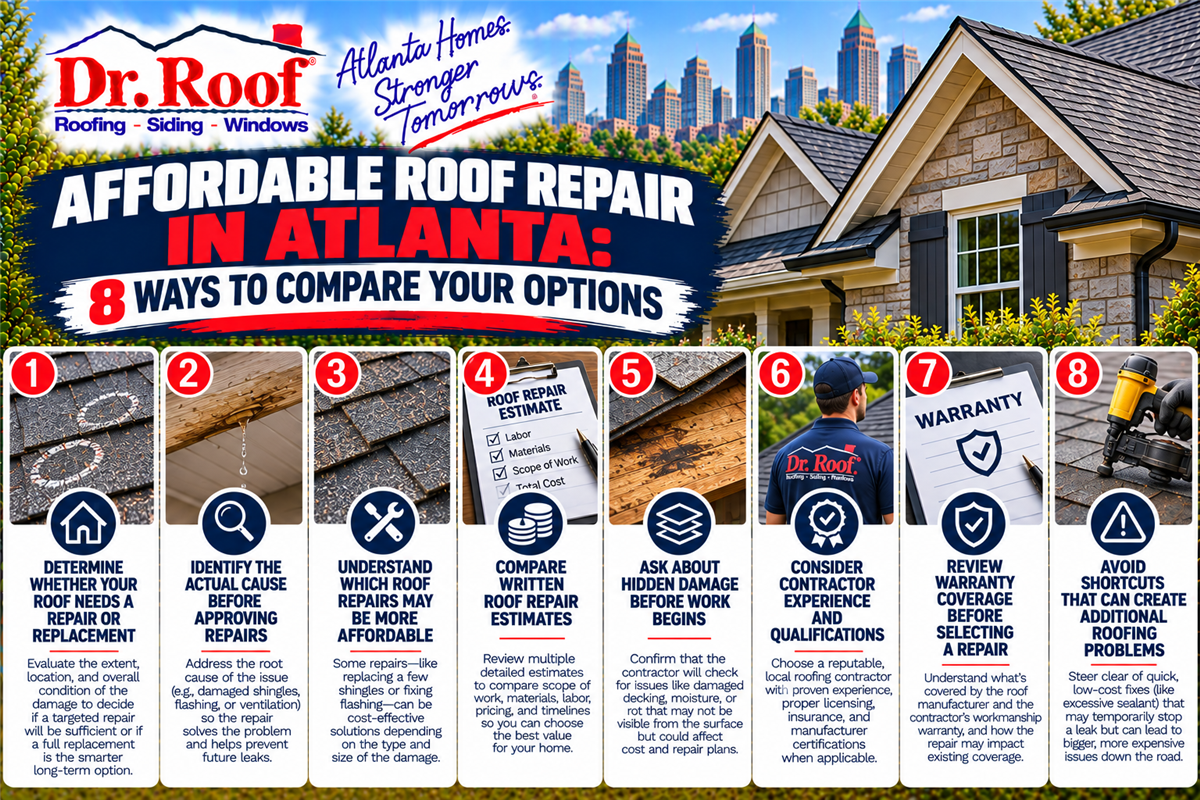
Here are eight practical ways to evaluate affordable roof repair options in Atlanta.
1. Determine Whether Your Roof Needs a Repair or Replacement
One of the first steps toward controlling roofing costs is understanding whether the existing roof can be repaired.
A complete roof replacement involves a much larger scope of work than most localized repairs.
However, not every damaged roof requires replacement.
When Is Roof Repair a Practical Option?
A targeted repair may be appropriate when:
Damage affects a limited roof area
Surrounding shingles remain serviceable
Compatible replacement materials are available
Flashing can be repaired or replaced
The supporting decking remains suitable
The repair can be integrated correctly with the existing roofing system
For example, a deteriorated plumbing vent boot may be replaceable without removing the entire roof.
Similarly, several missing asphalt shingles may be repairable when the surrounding materials remain in suitable condition.
When Might Roof Replacement Be Necessary?
A broader replacement may deserve consideration when:
Shingles are deteriorating across large areas
Multiple leaks continue developing
Previous repairs repeatedly fail
Significant decking damage is present
Existing roofing materials cannot be repaired reliably
Widespread damage has compromised the roofing system
The appropriate recommendation should be based on the actual roof condition rather than its age alone.
Why Does This Matter for Affordability?
Replacing an entire roofing system when a localized repair would be appropriate may involve unnecessary work.
However, repeatedly repairing a roof that is no longer serviceable may also create additional expenses.
A professional assessment can help determine which option makes sense for the existing conditions.
2. Identify the Actual Cause Before Approving Repairs
Roofing problems are not always as straightforward as they appear.
For example, a water stain on an interior ceiling does not necessarily mean the shingles directly above that location are damaged.
Water can travel along the underside of roof decking, framing, or other materials before becoming visible.
What Common Problems Cause Roof Leaks?
Potential causes include:
Missing or cracked asphalt shingles
Deteriorated pipe boots
Damaged chimney flashing
Roof valley defects
Loose roof penetrations
Improper roof-to-wall transitions
Previous repair failures
Localized storm damage
These problems can require different materials and repair methods.
Why Is Proper Diagnosis Important?
Suppose a homeowner notices water entering near a chimney.
One contractor recommends applying sealant around the visible opening.
Another identifies deteriorated step flashing and recommends replacing the damaged assembly.
Although the first proposal may cost less initially, it may not provide an appropriate permanent solution if the flashing remains defective.
A professional repair should address the actual source of water intrusion.
What Should You Ask During the Inspection?
Consider asking:
What caused the damage?
Where is the water entering?
Which roofing materials need replacement?
Are surrounding materials still serviceable?
Is the proposed repair permanent or temporary?
Is additional evaluation necessary?
Clear answers can help homeowners avoid approving work that does not address the problem.
3. Understand Which Roof Repairs May Be More Affordable
Roof repair costs vary because different roofing problems require different amounts of labor and materials.
Some issues involve a small portion of the roof.
Others require removing several roofing components to complete the repair.
Asphalt Shingle Replacement
When only a limited number of asphalt shingles are damaged, a contractor may be able to replace the affected materials.
The surrounding shingles must remain suitable for the work.
For example, heavily deteriorated shingles may crack when lifted, potentially increasing the repair area.
Plumbing Vent Boot Replacement
Plumbing vent pipes extend through the roofing system and require appropriate flashing.
Some pipe boots include flexible components that can deteriorate over time.
When the boot is the confirmed source of a leak, replacement may be a relatively localized roofing project.
Roof Flashing Repair
Flashing helps direct water away from chimneys, roof penetrations, walls, and other transitions.
A damaged flashing component may be replaceable without installing an entirely new roof.
However, some flashing assemblies require removing surrounding shingles and reconstructing the affected transition.
Roof Valley Repair
Roof valleys collect water from adjoining roof slopes.
Damage in these areas may require more involved repairs because several roofing components work together to direct water.
The extent of work depends on the condition of the valley and surrounding materials.
Roof Decking Repair
Roof decking supports the roofing materials.
If a limited area is damaged, the affected decking may sometimes be replaced without rebuilding the entire roof.
However, the contractor must also correct the source of the deterioration.
Which Repair Is the Least Expensive?
There is no universal answer.
The final price depends on the specific materials, accessibility, damage severity, and labor requirements.
A small repair on a steep or difficult-to-access roof may require more work than a larger repair in an accessible location.
A professional estimate is necessary to determine the actual cost.
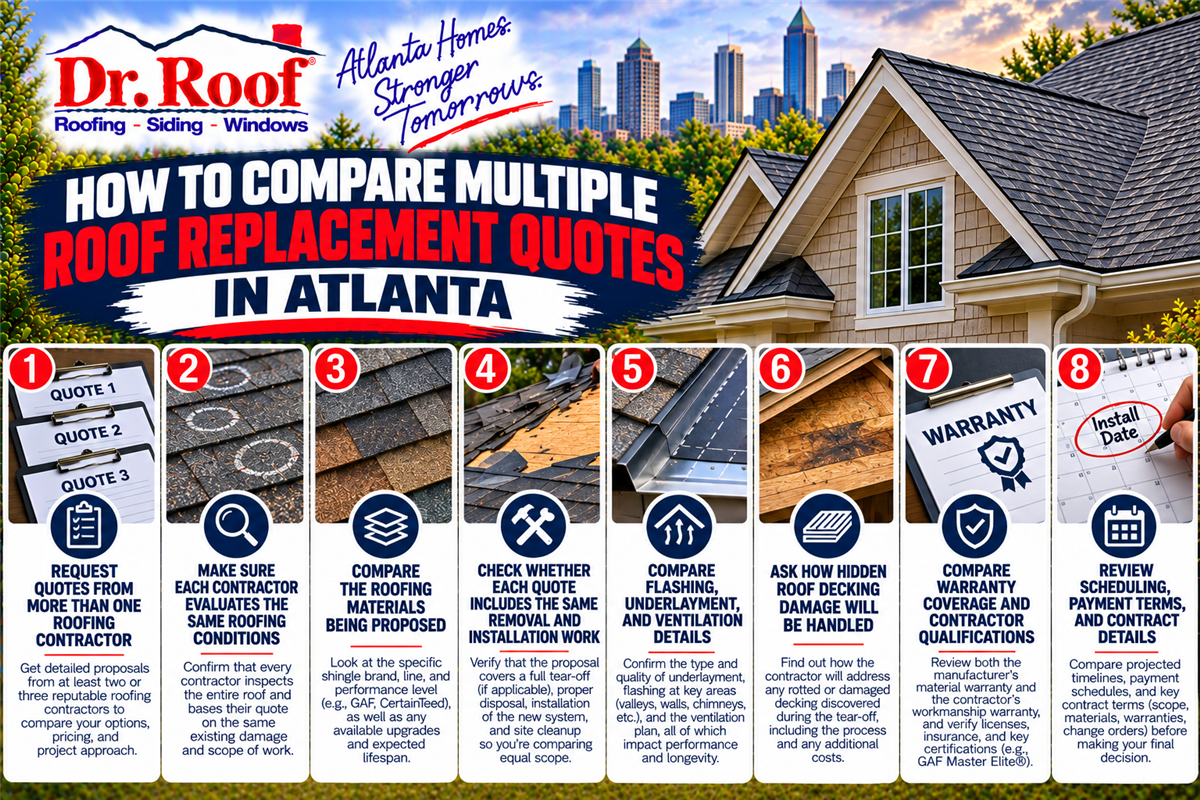
4. Compare Written Roof Repair Estimates
One of the most effective ways to evaluate affordability is to compare detailed written estimates.
The Federal Trade Commission recommends obtaining estimates from multiple contractors and reviewing the proposed work before making a decision.
However, comparing only the final price may be misleading.
What Should a Roof Repair Estimate Include?
A useful proposal should identify:
Location of the roofing damage
Recommended repair
Materials requiring replacement
Flashing or underlayment work
Known decking concerns
Labor
Cleanup
Total proposed pricing
Potential additional work
Applicable warranty information
The contractor should also explain whether temporary protection or other preliminary work is necessary.
Why Can Two Roof Repair Estimates Be Different?
Two contractors may recommend different scopes.
For example, one estimate might include replacing damaged flashing and surrounding shingles.
Another might include only a temporary sealant application.
The prices may differ because the proposed solutions are not equivalent.
Should You Automatically Choose the Lowest Estimate?
No.
The lowest price is not necessarily the best value if important work is excluded.
Likewise, a higher estimate is not automatically more appropriate.
Ask each contractor to explain what the proposal includes and why the repair method is recommended.
A clear scope makes it easier to compare the actual value of the work.
5. Ask About Hidden Damage Before Work Begins
Some roofing damage is concealed beneath the visible roof covering.
A contractor may discover additional problems after removing shingles, flashing, or underlayment.
For example, repeated water intrusion can affect roof decking.
What Is Roof Decking?
Roof decking, also called roof sheathing, provides the supporting surface beneath roofing materials.
Common residential decking materials include plywood and oriented strand board.
The decking must remain structurally suitable for the roofing system installed above it.
Does Water Damage Always Require Decking Replacement?
Not necessarily.
Previously wet or discolored decking does not automatically need replacement.
The contractor should evaluate whether the material remains suitable.
However, deteriorated or structurally compromised areas may require corrective work.
Can Hidden Damage Increase the Repair Price?
Yes.
If additional materials require replacement, the scope may expand.
This is why homeowners should ask how unexpected damage will be handled.
Before approving work, consider asking:
What conditions might require additional repairs?
Is any decking replacement included?
How will hidden damage be documented?
How will additional work be priced?
Will approval be required before the scope changes?
These questions help reduce uncertainty about the final project cost.
6. Consider Contractor Experience and Qualifications
An affordable roofing project should still be completed by a qualified professional.
Roof repair involves specialized installation details that may not be obvious from the ground.
These can include:
Shingle fastening
Flashing integration
Underlayment
Roof penetrations
Manufacturer installation requirements
Roof pitch considerations
Why Does Experience Matter?
A contractor who regularly performs roof repairs may be better equipped to identify the actual problem and recommend an appropriate solution.
For example, a roof leak around a chimney may require understanding how several flashing components work together.
Replacing visible shingles without evaluating the transition may leave the original defect unresolved.
What Qualifications Should Homeowners Review?
Consider:
Local roofing experience
Appropriate insurance coverage
Applicable contractor credentials
Experience with the roofing material
Customer reviews
Written inspection findings
Clear repair recommendations
Manufacturer certifications may also provide useful information about a roofing contractor's qualifications.
However, certification does not guarantee that every repair will produce a particular outcome.
Does a More Experienced Contractor Always Cost More?
Not necessarily.
Pricing depends on the individual project and business.
The most useful comparison considers the repair scope, materials, qualifications, and written terms.
A lower initial price should not be the only factor in the decision.
7. Review Warranty Coverage Before Selecting a Repair
Roof repair warranties can differ depending on the contractor, materials, and work performed.
Some repairs may include workmanship coverage.
Certain replacement materials may also have applicable manufacturer warranties.
However, these forms of protection are not identical.
What Is a Workmanship Warranty?
A workmanship warranty generally addresses qualifying problems associated with the contractor's work.
For example, a warranty may apply to a covered installation defect within the repaired area.
The exact terms determine whether a particular concern qualifies.
Does a Repair Warranty Cover the Entire Roof?
Not automatically.
A warranty on a localized repair may not cover unrelated roofing components.
For example, a repair to chimney flashing may not provide coverage for a separate pipe boot leak elsewhere.
Why Does Warranty Coverage Matter When Comparing Prices?
Two estimates may include different workmanship protection.
A homeowner should understand:
Which repairs are covered
How long coverage lasts
Whether labor and materials are included
What exclusions apply
How concerns should be reported
A longer warranty does not automatically mean every type of future damage is covered.
Review the written terms rather than relying on general promises.
8. Avoid Shortcuts That Can Create Additional Roofing Problems
When homeowners are trying to reduce repair expenses, inexpensive temporary solutions may seem appealing.
However, a lower initial price does not guarantee that the underlying roofing problem has been corrected.
Can Roof Sealant Fix Every Leak?
No.
Roof sealants have legitimate applications, but they cannot correct every roofing defect.
For example, applying sealant over damaged flashing may not restore the assembly's intended water-management function.
A permanent repair may require removing and replacing the affected materials.
Is DIY Roof Repair a Good Way to Save Money?
Roof repair involves fall hazards and specialized installation requirements.
Walking on damaged or wet roofing materials can be dangerous.
Improper repairs may also create additional damage or leave the original problem unresolved.
Homeowners should avoid climbing onto roofs to attempt repairs.
A qualified roofing professional can evaluate the damage and recommend an appropriate solution.
What About Temporary Roof Patching?
Temporary protection may be appropriate when weather or other conditions prevent permanent repairs.
For example, professional roof tarping may help reduce additional exposure after storm damage.
However, temporary protection should not be confused with a completed permanent repair.
The contractor should explain whether further work is necessary.
How Can You Tell Whether a Roof Repair Quote Is Reasonable?
A reasonable repair proposal should be supported by the condition of the roof and the work required.
Homeowners can evaluate a quote by reviewing:
Diagnosis: Does the contractor explain the roofing problem?
Repair scope: Are the necessary materials and work identified?
Materials: Are the proposed products appropriate for the existing roof?
Labor: Does the repair involve difficult access or specialized installation?
Hidden damage: Are potential additional repairs addressed?
Warranty: What written protection applies?
Communication: Can the contractor explain why the repair is recommended?
These considerations are more useful than comparing prices without understanding the underlying work.
Can Roof Repair Help Avoid a More Expensive Project?
Sometimes.
Correcting localized damage can help prevent continued weather exposure to vulnerable building materials.
For example, repairing a leaking pipe boot may reduce additional moisture exposure around the roof penetration.
However, no repair guarantees that other roofing problems will never develop.
Does Every Small Repair Prevent Roof Replacement?
No.
Some roofing systems already have widespread deterioration that a localized repair cannot correct.
The goal is to address repairable problems appropriately—not to assume that every roof can remain serviceable indefinitely.
Does Homeowners Insurance Help With Roof Repair Costs?
Some homeowners insurance policies provide coverage for qualifying sudden damage, such as certain storm-related losses.
However, coverage depends on the policy and individual claim.
Ordinary deterioration, maintenance-related problems, and other conditions may be treated differently.
What Should You Do if Storm Damage Is Suspected?
Document visible damage from safe locations.
Retain photographs, inspection findings, and repair estimates.
A roofing contractor may provide written observations describing the physical condition of the roof.
However, the insurance company determines coverage and payment.
A contractor cannot guarantee that the repair will be covered.
Why Affordable Roof Repair Matters for Atlanta Homeowners
Atlanta-area homes experience heavy rainfall, thunderstorms, strong winds, and periods of high humidity.
These conditions can expose weaknesses in damaged shingles, flashing, and other roofing components.
Homeowners in established neighborhoods may also have roofing systems with previous repairs or aging materials.
The appropriate repair should reflect the actual roof condition.
For example, a localized flashing defect on an otherwise serviceable roof may be suitable for repair.
A roofing system with extensive deterioration may require a broader evaluation.
Affordable roofing work should address the real problem without assuming that the largest project is always necessary.
How Dr. Roof Helps Atlanta Homeowners Evaluate Repair Options
Dr. Roof has served Atlanta-area homeowners since 1988, providing professional roofing inspections, repairs, replacement, and storm-damage documentation support.
A professional evaluation can help identify concerns involving:
Asphalt shingles
Roof flashing
Plumbing vent penetrations
Roof valleys
Underlayment
Roof decking
Storm-related damage
For qualifying storm-related concerns, Dr. Roof may provide photographs, written findings, and repair or replacement recommendations.
Homeowners can discuss the findings and request a written estimate describing the proposed work.
The goal is to determine whether a targeted repair is appropriate or whether the roofing system requires a more extensive solution.
Find Affordable Roof Repair Without Compromising Quality
Affordable roof repair does not mean choosing the cheapest available patch.
It means understanding the problem, reviewing the necessary work, and selecting an appropriate solution at a reasonable price.
For Atlanta homeowners, the most effective approach begins with a professional inspection and a clear written estimate.
Comparing repair scopes, contractor qualifications, materials, and warranty terms can help you make a more informed decision.
If you need roof repair in Atlanta, Marietta, Alpharetta, Roswell, or surrounding communities, contact Dr. Roof to schedule a professional roofing evaluation and discuss your repair options.
How can I find affordable roof repair services in Atlanta?
Start by requesting a professional roof inspection and comparing detailed written estimates from qualified roofing contractors. Evaluate the recommended repair, materials, labor, contractor qualifications, and applicable warranties rather than choosing solely by price.
Is it cheaper to repair a roof or replace it?
A localized repair generally involves less work than a complete roof replacement. However, the most appropriate option depends on the roof's condition. Widespread damage, repeated leaks, or extensive deterioration may make replacement worth considering.
What factors affect the cost of roof repairs?
Roof repair costs depend on the type and extent of damage, roofing materials, roof pitch, accessibility, labor, flashing requirements, and any hidden damage. A professional inspection provides the basis for a project-specific estimate.
Should I choose the roofing contractor with the lowest estimate?
Not automatically. The lowest estimate may exclude necessary work or describe a temporary solution. Compare the complete repair scope, materials, contractor qualifications, and warranty terms before making a decision.
Can roof sealant provide an affordable permanent repair?
Sealant may be appropriate for certain applications, but it cannot correct every roofing problem. Damaged flashing, deteriorated shingles, or unsuitable decking may require replacement of the affected materials.
Can homeowners insurance help pay for roof repairs?
Some policies cover qualifying sudden damage, including certain storm-related losses. Coverage depends on the policy, exclusions, deductibles, and individual claim. The insurance company determines whether the damage is covered and what payment is available.
Subscribe to Dr. Roof's Blog



Comments