Discovering a water stain on your ceiling or noticing moisture in your attic can leave you wondering what went wrong with your roof.
Sometimes the problem appears after a severe storm. Other times, a leak develops gradually and becomes noticeable only during heavy rainfall.
The challenge is that the location of an interior water stain does not always reveal where water is entering the roofing system.
For Atlanta homeowners, understanding the most common causes of residential roof leaks can help make the repair process less confusing.
Residential roof leaks are commonly caused by damaged shingles, deteriorated flashing, failed plumbing vent boots, improperly protected roof transitions, storm damage, or roofing materials that have become worn or compromised.
Some leaks can be corrected through localized repairs, while more extensive deterioration may require additional work.
The appropriate solution depends on identifying the actual source of water intrusion.
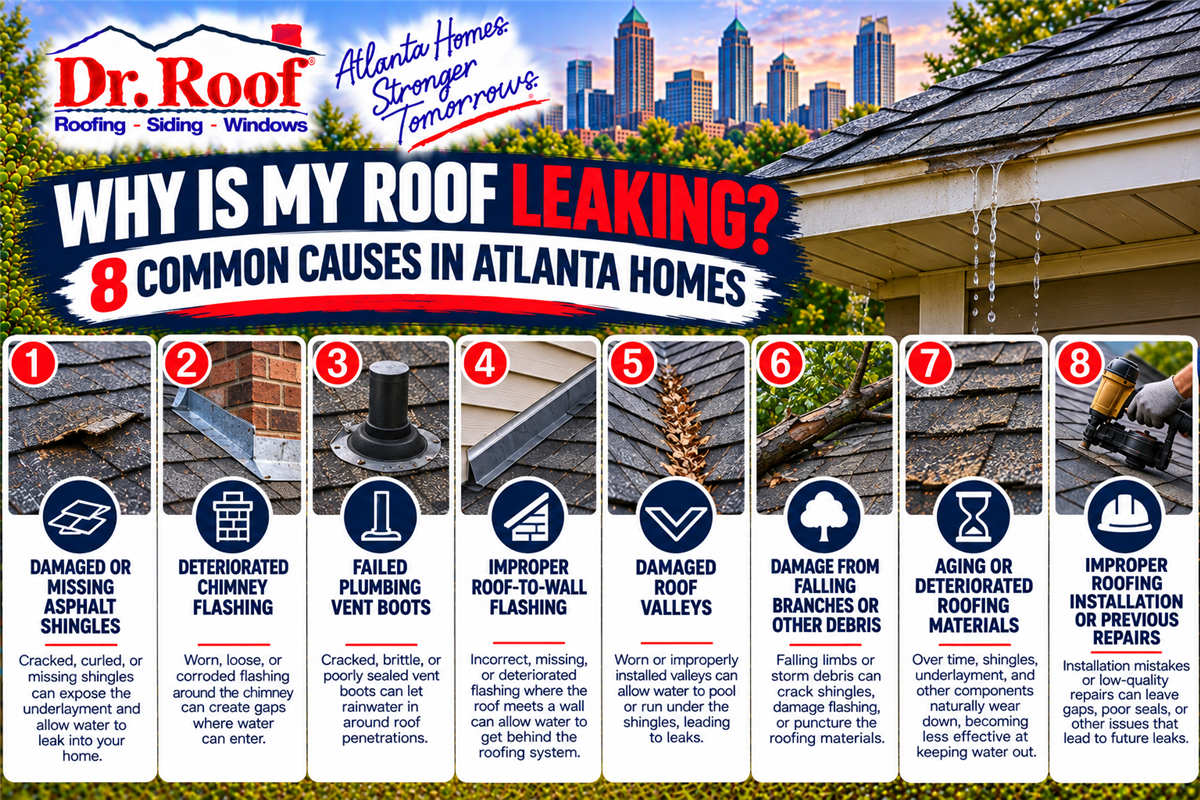
Here are eight common causes of roof leaks and what homeowners should know about professional repair options.
1. Damaged or Missing Asphalt Shingles
Asphalt shingles are designed to provide the primary water-shedding surface on many residential roofing systems.
When properly installed, overlapping shingles direct rainwater toward the roof edges.
However, damaged or missing shingles can create vulnerable areas where water may reach the materials underneath.
What Causes Asphalt Shingles to Become Damaged?
Several conditions can affect shingles, including:
Strong winds
Hail impacts
Falling branches
Normal weathering
Physical damage
Improper installation
Deterioration of older materials
A shingle may crack, tear, lift, or become displaced.
In some situations, the damage is easy to recognize from the ground.
In others, the roofing materials may appear mostly intact even though an area has become compromised.
Can One Missing Shingle Cause a Roof Leak?
Yes, depending on its location and the condition of the underlying materials.
A missing shingle can expose the underlayment to additional weather.
Although underlayment provides secondary protection, it is not intended to replace the primary roof covering indefinitely.
Continued exposure may increase the opportunity for water intrusion.
How Are Damaged Shingles Repaired?
A contractor may be able to replace individual shingles when the damage is localized and surrounding materials remain serviceable.
The repair may involve removing damaged materials, checking the exposed area, and installing compatible replacement shingles.
If deterioration affects large portions of the roof, a broader evaluation may be necessary.
2. Deteriorated Chimney Flashing
Chimneys are common locations for residential roof leaks.
The area where a chimney meets the roof requires properly installed flashing to manage rainwater.
Flashing generally consists of metal components arranged to direct water away from vulnerable transitions.
Why Does Chimney Flashing Leak?
Potential problems include:
Deteriorated metal
Loose flashing
Improper installation
Damaged counterflashing
Open seams
Failed previous repairs
Improper integration with surrounding shingles
Water may enter when the flashing assembly no longer directs rainfall appropriately.
Why Isn't Roof Sealant Always Enough?
Homeowners sometimes assume that applying sealant around a chimney will permanently stop a leak.
However, the underlying problem may involve the flashing assembly itself.
For example, if step flashing was improperly installed, applying sealant over a visible opening may not correct how water moves through the roofing transition.
A permanent repair may require removing surrounding roofing materials and replacing damaged flashing components.
Can Chimney Flashing Be Repaired Without Replacing the Roof?
Often, yes.
When the problem is localized and the surrounding roofing materials remain suitable, a contractor may be able to repair or replace the affected flashing.
The appropriate scope depends on the chimney, roof design, and condition of the existing materials.
3. Failed Plumbing Vent Boots
Plumbing vent pipes extend through the roof to support the home's plumbing ventilation system.
Where these pipes penetrate the roofing materials, specialized flashing helps prevent water from entering.
These components are commonly called pipe boots or plumbing vent flashing.
What Causes a Pipe Boot to Leak?
Some pipe boots contain flexible sealing components that can deteriorate over time.
Potential problems include:
Cracked rubber collars
Split sealing materials
Deteriorated flashing
Improper installation
Physical damage
Openings around the penetration
When the protective components fail, water may enter around the pipe.
How Can You Tell Whether a Pipe Boot Is Leaking?
Homeowners may notice interior water stains near the general location of a plumbing vent.
However, the ceiling stain may not appear directly beneath the damaged component.
Water can travel along the roof decking or framing before becoming visible.
A professional inspection is necessary to confirm the cause.
Can a Leaking Pipe Boot Be Replaced?
Yes, in many situations.
Replacing deteriorated pipe boot flashing is a common localized roof repair.
The contractor should evaluate the surrounding shingles and install the appropriate replacement component.
The repair must integrate properly with the roofing materials above and below the penetration.
4. Improper Roof-to-Wall Flashing
Many homes have sections where a sloped roof meets a vertical wall.
These intersections may occur around:
Dormers
Upper-story walls
Attached roof sections
Architectural transitions
Certain additions
These areas require appropriate flashing to direct water away from the building.
Why Are Roof-to-Wall Intersections Vulnerable?
Rainwater moves down the roof surface and encounters the wall.
Without properly integrated flashing, water may enter behind roofing or adjoining building materials.
The U.S. Department of Energy's Building America guidance emphasizes the importance of continuous water-management layers at roof-to-wall intersections.
What Is Step Flashing?
Step flashing consists of individual flashing pieces integrated with successive courses of shingles along a roof-to-wall intersection.
The arrangement helps direct water onto the roof covering.
When the pieces are missing, damaged, or installed incorrectly, water intrusion may occur.
What Is Kick-Out Flashing?
Kick-out flashing is used at certain roof-to-wall termination points to direct runoff away from the adjoining wall.
When this detail is absent or improperly installed, water may enter vulnerable areas near the intersection.
Can These Flashing Problems Be Repaired?
Often, yes.
The repair may involve removing adjacent shingles, correcting the flashing arrangement, and restoring the affected roofing materials.
However, the contractor should also evaluate whether water has damaged concealed materials.
The repair needs to address the water-entry path rather than only the visible symptom.
5. Damaged Roof Valleys
A roof valley is the area where two roof slopes meet and direct water toward a lower section of the roof.
Valleys play an important role in managing rainfall.
During heavy storms, water from multiple roof sections can flow through a relatively concentrated area.
What Causes Roof Valleys to Leak?
Potential causes include:
Damaged valley flashing
Deteriorated shingles
Improper underlayment installation
Physical damage
Debris accumulation
Defective previous repairs
Inadequate integration of roofing materials
The exact cause depends on the valley design and roofing system.
Why Can Valley Leaks Be Difficult to Diagnose?
A valley contains several overlapping roofing components.
Water may enter at one location and travel beneath the roofing materials before becoming visible indoors.
A contractor may need to evaluate more than the visibly damaged area.
Can a Roof Valley Be Repaired?
Yes, depending on the condition.
A localized valley repair may involve replacing damaged shingles, flashing, or underlayment.
However, more extensive work may be needed when deterioration affects a larger section.
The contractor should determine whether the existing valley can be restored reliably.
6. Damage From Falling Branches or Other Debris
Atlanta-area neighborhoods often have mature trees near residential properties.
During strong winds or thunderstorms, branches can fall onto roofing materials.
The resulting damage depends on the size, weight, and location of the impact.
How Can Falling Debris Cause a Roof Leak?
An impact may:
Crack asphalt shingles
Puncture roofing materials
Displace flashing
Damage ridge components
Break or weaken roof decking
Create openings around roof penetrations
Some impact damage is immediately visible.
Other problems may be concealed beneath the roof covering.
What If a Large Branch Hits the Roof?
Avoid climbing onto the roof or attempting to remove a large branch yourself.
If structural damage is suspected, stay away from the affected area and arrange appropriate professional assistance.
The roofing system should be evaluated once conditions are safe.
Can Impact Damage Be Repaired Without Replacing the Roof?
Sometimes.
Localized damage may be repairable when the surrounding roofing system and supporting structure remain suitable.
If the impact has caused extensive decking or structural damage, more substantial work may be necessary.
A contractor should identify the affected materials before recommending the repair scope.
7. Aging or Deteriorated Roofing Materials
Roofing materials are exposed to weather throughout their service life.
Over time, sunlight, temperature changes, moisture, and storms can contribute to deterioration.
Different roofing products have different characteristics, and actual service life varies.
What Happens as Asphalt Shingles Deteriorate?
Potential changes include:
Cracking
Curling
Granule loss
Reduced flexibility
Damaged edges
General surface wear
Problems around older repairs
Not every visible change means a roof is leaking.
However, extensive deterioration can affect the roofing system's ability to shed water reliably.
Can an Older Roof Still Be Repaired?
Yes, in some circumstances.
Age alone does not automatically mean replacement is necessary.
A localized flashing problem on an otherwise serviceable roof may still be repairable.
However, heavily deteriorated shingles may crack or break when a contractor attempts to remove and replace adjacent materials.
The condition of the surrounding roofing system matters.
When Should Replacement Be Considered?
Replacement may deserve consideration when deterioration is widespread, multiple leaks are developing, or repairs cannot be integrated reliably with the remaining materials.
The recommendation should be based on actual roofing conditions rather than a generalized age estimate.
8. Improper Roofing Installation or Previous Repairs
Some residential roof leaks result from installation defects.
A roofing system depends on multiple components working together.
If those components are installed incorrectly, water may enter even when the visible shingles appear relatively new.
What Installation Problems Can Cause Roof Leaks?
Potential problems include:
Incorrect flashing arrangements
Exposed fasteners in inappropriate locations
Improper shingle overlaps
Unsuitable roofing materials
Incorrect underlayment installation
Defective roof penetrations
Incomplete previous repairs
The exact problem must be identified through an appropriate inspection.
Can a Newly Replaced Roof Develop a Leak?
Yes.
A new roof can experience a leak if an installation defect exists or if subsequent damage occurs.
For example, improperly integrated flashing around a roof penetration can create a water-entry point even when the surrounding shingles are new.
However, a leak after installation does not automatically establish a workmanship defect.
The actual cause requires evaluation.
What If a Previous Repair Didn't Stop the Leak?
The original source may not have been identified correctly, or another roofing component may be responsible.
A contractor should review the repair history and inspect the affected area.
Simply repeating the same patch may not resolve the underlying problem.
Why Does My Roof Only Leak During Heavy Rain?
Some roofing defects become noticeable only under particular weather conditions.
For example, heavy rainfall may expose a vulnerable roof valley or flashing assembly.
Wind-driven rain may reach areas that remain relatively dry during lighter rainfall.
Does Heavy Rain Create the Leak?
Not necessarily.
The rain may reveal an existing roofing defect.
A compromised flashing component or damaged shingle may allow water inside only when certain conditions occur.
What Information Should You Record?
If a leak appears intermittently, note:
When it occurs
Whether wind accompanies the rain
Which interior area becomes wet
Whether the stain grows
Whether previous repairs were completed
These observations can help the contractor investigate possible causes.
However, the weather pattern alone does not provide a definitive diagnosis.
Why Isn't the Roof Leak Directly Above the Ceiling Stain?
Water does not always travel straight down from its entry point.
After entering the roof assembly, moisture may move along decking, framing, or other surfaces before becoming visible.
For example, water entering around a chimney may appear several feet away from the actual opening.
This is one reason roof leak diagnosis can require examining multiple roofing components.
Can You Identify the Leak From Inside the Attic?
An accessible attic may provide clues.
Homeowners might notice water stains, damp insulation, or discoloration near roof penetrations.
However, attic observations do not always identify the exact exterior defect.
Avoid walking on exposed ceiling framing or entering areas without safe access.
A qualified roofing professional should evaluate the roofing system.
Is Every Ceiling Stain Caused by a Roof Leak?
No.
Although roof leaks are a common concern, interior moisture can have other causes.
Potential sources include:
Condensation
Plumbing leaks
HVAC-related moisture
Indoor air leakage
Other building conditions
A roofing professional can evaluate whether the moisture appears related to the roof.
If no roofing defect is identified, additional investigation may be necessary.
Homeowners should avoid assuming that replacing shingles will correct every interior moisture problem.
What Should You Do When You Discover a Roof Leak?
Safety should be the first priority.
If water is entering your home, take reasonable steps to protect people and belongings.
Protect the Affected Area
Move valuables away from visible water when it is safe.
Avoid electrical equipment or fixtures exposed to moisture.
Stay away from ceilings that appear swollen, sagging, or structurally compromised.
Document the Problem
Photograph visible stains or water damage from safe locations.
Record when the leak appeared and whether it followed a particular weather event.
Contact a Roofing Professional
Schedule an inspection to identify the likely source.
Do not climb onto a wet or damaged roof.
Ask About Temporary Protection
If the roofing system has an opening or active water intrusion, ask whether professional temporary protection is appropriate.
Temporary protection should not be confused with permanent repair.
Can Roof Leaks Be Repaired Without Replacing the Entire Roof?
Often, yes.
Localized defects involving shingles, flashing, or roof penetrations may be repairable when surrounding materials remain serviceable.
For example, a deteriorated plumbing vent boot may be replaced without removing the entire roof covering.
However, extensive deterioration, widespread damage, or unsuitable decking may require additional work.
The contractor should explain whether the recommended repair can restore the affected area reliably.
How Does Atlanta Weather Contribute to Roof Leaks?
Atlanta-area homes experience heavy rainfall, thunderstorms, strong winds, humidity, and occasional hail.
These conditions can expose weaknesses in roofing materials.
Wind may lift or damage shingles.
Hail can create impact damage.
Heavy rainfall may reveal problems around roof valleys or flashing.
However, the presence of severe weather does not automatically mean every roofing concern was caused by a storm.
A professional evaluation should identify the actual condition.
How Dr. Roof Helps Atlanta Homeowners Identify Roof Leaks
Dr. Roof has served Atlanta-area homeowners since 1988, providing professional roofing inspections, roof repairs, replacement, and storm-damage documentation support.
A professional roofing evaluation can help identify concerns involving:
Damaged asphalt shingles
Chimney flashing
Plumbing vent flashing
Roof-to-wall transitions
Roof valleys
Roof penetrations
Decking
Storm-related roofing damage
Depending on the circumstances, Dr. Roof may provide photographs, written findings, and repair or replacement recommendations.
Homeowners can discuss the identified roofing conditions and request a written explanation of the proposed work.
Find the Cause Before Choosing the Repair
A roof leak may appear as a small ceiling stain, but the actual source can involve several roofing components.
Damaged shingles, deteriorated flashing, failed pipe boots, roof valley problems, and improper installation are all possible causes.
For Atlanta homeowners, the most effective approach is identifying the source before authorizing repairs.
A localized repair may correct the problem, while more extensive conditions may require additional work.
If your roof is leaking or you have noticed moisture after heavy rainfall, contact Dr. Roof to schedule a professional roofing evaluation and discuss appropriate roof repair options.
What is the most common cause of residential roof leaks?
Residential roof leaks can develop from several common problems, including damaged shingles, deteriorated flashing, and failed roof penetrations. There is no single cause that applies to every home. A professional inspection is necessary to identify the source.
Can damaged roof flashing cause a leak even if the shingles look fine?
Yes. Flashing helps direct water away from chimneys, roof penetrations, and roof-to-wall intersections. Damaged or improperly installed flashing can allow water intrusion even when surrounding shingles appear intact.
Why does my roof only leak during heavy rain?
Some roofing defects become noticeable only during heavy rainfall or wind-driven storms. Water may enter through damaged flashing, roof valleys, or other vulnerable areas under particular weather conditions. An inspection can help identify the cause.
Can a leaking plumbing vent boot be repaired?
Yes. A deteriorated plumbing vent boot can often be replaced without replacing the entire roof when surrounding roofing materials remain serviceable. The replacement must be properly integrated with the existing roofing system.
Does a ceiling water stain always mean the roof is leaking?
No. Interior stains can also result from plumbing leaks, condensation, HVAC-related moisture, or other building conditions. A professional evaluation can help determine whether the problem originates from the roofing system.
Can a residential roof leak be repaired without replacing the whole roof?
Often, yes. Localized problems involving damaged shingles, flashing, or roof penetrations may be repairable. Replacement may be appropriate when damage is widespread, materials are extensively deteriorated, or repairs cannot be completed reliably.
Subscribe to Dr. Roof's Blog








Comments