Atlanta homeowners experience a variety of weather conditions throughout the year, from hot summer afternoons and heavy thunderstorms to occasional freezing temperatures.
While roofing systems are designed to withstand normal environmental exposure, changing weather conditions can reveal existing weaknesses or cause new damage.
Strong winds may lift asphalt shingles. Heavy rainfall can expose deteriorated flashing. Falling branches may damage roofing materials, while years of sunlight and temperature changes can contribute to material aging.
Understanding how these conditions affect your roof can help you recognize when professional repairs may be necessary.
Atlanta weather can contribute to roof repair needs through wind damage, hail impacts, heavy rainfall, prolonged heat exposure, temperature changes, falling debris, and moisture-related deterioration. However, not every weather event causes roofing damage or requires repairs.
The condition of the existing roofing system determines whether professional attention is necessary.
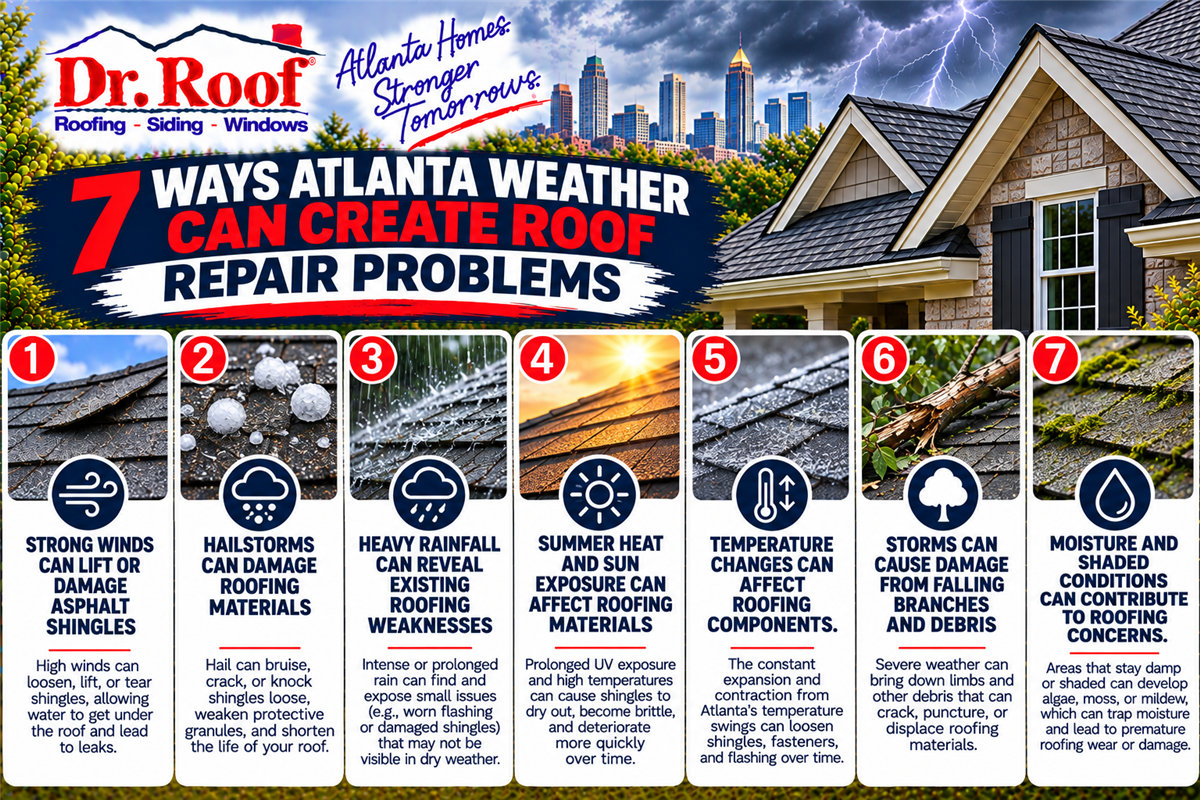
Here are seven ways Atlanta's weather can affect your roof and the warning signs homeowners should know.
1. Strong Winds Can Lift or Damage Asphalt Shingles
Strong winds are a common concern during Atlanta-area thunderstorms.
As wind moves across a roof, it creates forces that can affect shingles, ridge materials, flashing, and other roofing components.
The severity of the impact depends on wind conditions, roof design, installation, and the condition of the materials.
How Does Wind Damage Asphalt Shingles?
Asphalt shingles are installed in overlapping courses and typically include adhesive sealant designed to help secure the shingles after installation.
Strong wind can lift exposed edges or damage shingles that have become loosened.
Potential problems include:
Lifted shingles
Creased shingles
Torn roofing materials
Missing shingles
Displaced ridge components
Loose flashing
Damaged roof-edge materials
Some damage is visible from the ground.
Other problems may require a professional inspection to identify.
Can Lifted Shingles Be Repaired?
Sometimes.
The appropriate solution depends on whether the shingle is damaged and whether the surrounding materials remain serviceable.
For example, a torn or severely creased shingle may require replacement.
A contractor should evaluate the condition before determining the repair method.
Simply pressing a damaged shingle back into place may not correct the problem.
When Should You Request a Roof Inspection?
Consider scheduling an inspection if you notice missing shingles, roofing debris, displaced materials, or new interior water stains after strong winds.
Do not climb onto the roof to investigate.
A professional assessment can determine whether targeted repairs are appropriate.
2. Hailstorms Can Damage Roofing Materials
Although not every Atlanta thunderstorm produces hail, hail events can affect residential roofing systems.
Hailstones can strike shingles, flashing, ridge components, and other exposed roofing materials.
The resulting damage depends on the characteristics of the hail, wind conditions, roofing material, and roof design.
What Does Hail Damage Look Like?
Potential signs include:
Localized impact marks
Shingle indentations
Granule displacement
Surface cracking
Damage to shingle reinforcement
Impact damage to roofing accessories
However, not every visible mark represents damage that affects the roofing material's performance.
What Is the Difference Between Cosmetic and Functional Damage?
Cosmetic damage generally affects appearance without necessarily compromising the roofing material's ability to perform its intended function.
Functional damage affects the material's condition or performance.
For example, a shingle with fractured reinforcement may require different attention from one with a superficial mark.
A professional roofing contractor should evaluate the actual condition.
Does Hail Damage Always Require Roof Replacement?
No.
Localized damage may be repairable when surrounding shingles remain suitable.
Widespread damage or severely compromised materials may require more extensive work.
The recommendation should depend on the extent and severity of the damage rather than assuming every hailstorm requires a complete replacement.
3. Heavy Rainfall Can Reveal Existing Roofing Weaknesses
Heavy rain does not automatically mean a roof is damaged.
However, substantial rainfall can reveal weaknesses in roofing components that may have developed over time.
For example, deteriorated flashing might allow water intrusion during heavy or wind-driven rain even when the surrounding shingles appear intact.
Which Roofing Areas Are Vulnerable During Heavy Rain?
Common areas requiring attention include:
Chimney flashing
Plumbing vent penetrations
Roof valleys
Skylight flashing
Roof-to-wall intersections
Previously repaired roof sections
Damaged asphalt shingles
These locations depend on properly integrated roofing materials to direct water away from the building.
Why Does My Roof Only Leak During Heavy Rain?
Some roofing defects allow water inside only under particular weather conditions.
For example, wind-driven rain may reach an opening that remains relatively dry during lighter rainfall.
A roof valley may also experience greater water flow during prolonged storms.
However, the weather pattern alone does not establish the cause.
A professional inspection is necessary to identify the water-entry point.
Can Flashing Problems Be Repaired?
Often, yes.
Localized flashing damage may be repairable when surrounding roofing materials remain serviceable.
The contractor may need to remove adjacent shingles, replace damaged flashing, and restore the affected roofing components.
Applying sealant over a defective flashing assembly is not automatically a suitable permanent solution.
4. Summer Heat and Sun Exposure Can Affect Roofing Materials
Atlanta summers bring prolonged periods of warm weather and direct sunlight.
Asphalt shingles are manufactured to withstand ordinary outdoor exposure, including sunlight and seasonal temperatures.
However, roofing materials still experience natural changes over time.
How Does Sunlight Affect Asphalt Shingles?
Asphalt shingles contain protective surface granules.
These granules help shield the asphalt coating from sunlight and other environmental exposure.
Over time, normal weathering can affect the condition of the roofing materials.
Potential changes include:
Surface wear
Granule loss
Cracking
Curling
Reduced flexibility
General deterioration
Not every visible change requires immediate repair.
A professional evaluation can help determine whether the material remains serviceable.
Does Hot Weather Automatically Damage a Roof?
No.
Asphalt shingles are designed for exterior exposure, including warm weather.
However, extremely hot conditions can affect how roofing materials behave during installation or repair.
The Asphalt Roofing Manufacturers Association notes that shingles can become more flexible in hot weather and may be susceptible to scuffing or damage from improper handling.
Why Does This Matter for Roof Repairs?
A roofing contractor should consider the condition of the materials and the weather during repair work.
For example, removing a shingle that has strongly bonded to surrounding materials may require care to avoid damaging adjacent shingles.
A properly planned repair should account for the existing roofing product and installation conditions.
5. Temperature Changes Can Affect Roofing Components
Atlanta's weather can shift between warm afternoons and much cooler overnight temperatures.
Although extreme winter conditions are less frequent than in northern climates, residential roofs still experience seasonal temperature changes.
Different roofing materials respond to temperature changes in different ways.
How Can Temperature Changes Affect a Roof?
Roofing assemblies contain multiple materials, including asphalt shingles, metal flashing, sealants, and other components.
These materials may expand or contract as temperatures change.
Proper installation details are designed to accommodate expected movement and environmental exposure.
However, deteriorated or improperly installed components may develop problems over time.
Can Cold Weather Affect Asphalt Shingle Repairs?
Yes.
Asphalt shingles commonly use heat-activated adhesive sealant.
Cool weather can affect how quickly the sealant activates and how the material should be handled.
Manufacturers provide specific instructions for installation under different weather conditions.
A qualified contractor should follow the requirements for the selected roofing product.
Does Every Temperature Change Require a Roof Inspection?
No.
Normal temperature variation is part of the environment roofing materials are designed to handle.
An inspection becomes more relevant when homeowners notice physical damage, water intrusion, or other concerning changes.
6. Storms Can Cause Damage From Falling Branches and Debris
Many Atlanta-area neighborhoods have mature trees near residential properties.
During thunderstorms or strong wind events, branches and other debris may fall onto roofing materials.
The extent of damage depends on the object, impact location, and condition of the roof.
What Damage Can Falling Branches Cause?
Potential problems include:
Cracked shingles
Punctured roofing materials
Damaged flashing
Broken ridge components
Compromised roof decking
Structural damage
Some impacts create obvious openings.
Others may damage roofing materials without immediately causing a visible leak.
Can Impact Damage Be Repaired?
Sometimes.
Localized damage may be repairable when the surrounding roofing system and supporting structure remain suitable.
However, significant impact damage may require decking repairs or additional structural evaluation.
The contractor should identify the affected materials before recommending a repair.
What Should You Do if a Branch Hits Your Roof?
Do not attempt to remove a large branch yourself.
Avoid climbing onto the roof or entering areas where structural damage is suspected.
When conditions are safe, contact qualified professionals to evaluate the situation.
A roofing inspection can help determine the extent of the damage and appropriate next steps.
7. Moisture and Shaded Conditions Can Contribute to Roofing Concerns
Atlanta's climate includes periods of high humidity.
Homes surrounded by mature trees may also have roof sections that receive limited direct sunlight.
These conditions can contribute to moisture remaining on certain roof surfaces for longer periods.
However, humidity or shade alone does not mean a roofing system is damaged.
Why Do Some Roofs Develop Dark Streaks?
Certain dark streaks on asphalt shingles are associated with blue-green algae.
These stains may be more noticeable in humid or shaded environments.
However, not every dark mark has the same cause.
Some discoloration is primarily cosmetic, while other changes may deserve closer evaluation.
Does Algae Mean the Roof Is Leaking?
Not necessarily.
Visible algae staining does not automatically indicate that water is entering the home.
Homeowners should avoid confusing surface discoloration with confirmed water intrusion.
A roofing professional can evaluate whether the roofing materials remain serviceable.
Can Moisture Affect the Roof Decking?
Yes, when water enters the roofing assembly or moisture accumulates because of other building conditions.
Depending on the cause and severity, excessive moisture may contribute to deterioration of wood decking or other materials.
However, moisture problems can also originate from condensation or indoor air leakage rather than a roof leak.
A professional evaluation should identify the source before recommending repairs.
How Can Atlanta Homeowners Recognize Weather-Related Roof Damage?
Different weather events can create different concerns.
Some warning signs are visible from the ground, while others appear inside the home.
Exterior Warning Signs
Look for:
Missing shingles
Lifted roofing materials
Displaced ridge components
Visible flashing damage
Fallen branches
Unusual changes in the roofline
Exposed roofing materials
Interior Warning Signs
Pay attention to:
New ceiling stains
Damp drywall
Water dripping during rainfall
Moisture around roof penetrations
Wet attic insulation
Unusual musty odors
These observations can help identify when a professional evaluation may be appropriate.
However, the symptoms do not automatically prove that weather caused the problem.
How Often Should a Roof Be Inspected in Atlanta?
Regular roof observations can help homeowners recognize changes in the roofing system.
The Asphalt Roofing Manufacturers Association recommends inspecting asphalt roofing systems during spring and fall, with additional attention after significant weather events.
Homeowners should perform basic observations from safe ground-level locations.
Professional inspections may be appropriate based on the roof's condition and any visible concerns.
Should You Inspect Your Roof After Every Rainstorm?
Not necessarily.
A routine rainfall does not automatically require a professional inspection.
However, significant storms, visible damage, or new water intrusion may justify an evaluation.
The need for professional attention depends on the actual conditions.
Roof Repair vs. Roof Replacement After Weather Damage
Weather damage does not automatically mean a complete roof replacement is necessary.
A professional inspection should determine whether the damage is localized or affects a larger portion of the roofing system.
When Is Roof Repair Appropriate?
Repair may be practical when:
Damage affects a limited area
Surrounding shingles remain serviceable
Compatible replacement materials are available
Flashing can be corrected
Decking remains suitable
The repair can be integrated properly
When Might Roof Replacement Be Necessary?
Replacement may deserve consideration when:
Damage is widespread
Multiple roof slopes are compromised
Roofing materials are extensively deteriorated
Significant underlying damage exists
Repairs cannot be completed reliably
The appropriate recommendation depends on the roof's actual condition.
Roof age alone does not automatically establish the need for replacement.
Does Homeowners Insurance Cover Weather-Related Roof Repairs?
Some homeowners insurance policies provide coverage for qualifying sudden damage caused by certain weather events.
However, coverage is not automatic.
The outcome depends on the policy, cause of damage, exclusions, deductibles, and individual claim.
What About Normal Weathering?
Gradual deterioration and ordinary wear may be treated differently from sudden storm-related damage.
A professional roofing contractor can document observed conditions and provide repair recommendations.
However, the insurance company determines whether the damage is covered.
A contractor cannot guarantee claim approval or payment.
How Can Homeowners Prepare Their Roofs for Changing Weather?
A practical maintenance approach involves observing the roofing system and addressing confirmed problems appropriately.
Consider the following practices:
Perform periodic ground-level visual checks.
Arrange professional evaluations when damage is suspected.
Have qualified professionals address debris accumulation on elevated roof areas.
Monitor previously repaired sections.
Pay attention to new interior moisture.
Keep records of completed roofing work.
Report visible storm damage promptly.
Maintenance cannot prevent every type of weather damage.
However, identifying developing issues can help homeowners respond before additional exposure occurs.
How Dr. Roof Helps Atlanta Homeowners With Weather-Related Roof Repairs
Dr. Roof has served Atlanta-area homeowners since 1988, providing professional roof inspections, repairs, replacement, and storm-damage documentation support.
A professional roofing evaluation can help identify concerns involving damaged shingles, flashing, roof penetrations, decking, and other roofing components.
For storm-related concerns, Dr. Roof may provide photographs, written findings, and recommendations for repair or replacement.
Homeowners in Atlanta, Marietta, Roswell, Alpharetta, Smyrna, and surrounding communities can contact Dr. Roof to discuss their roofing concerns.
Understand How Atlanta Weather Affects Your Roof
Atlanta weather can affect residential roofing systems in different ways throughout the year.
Strong winds may damage shingles, hail can create impact concerns, and heavy rainfall may expose weaknesses in flashing or other roofing components.
Heat, temperature changes, and moisture conditions also deserve consideration when evaluating the overall roofing system.
However, weather exposure alone does not mean repairs are necessary.
The most important step is determining whether the roofing materials have been damaged or can no longer perform as intended.
If you notice missing shingles, developing leaks, or other roofing concerns after changing weather conditions, contact Dr. Roof to schedule a professional evaluation and discuss appropriate repair options.
How does Atlanta weather affect residential roofs?
Atlanta weather exposes roofing systems to strong winds, heavy rainfall, occasional hail, summer heat, and seasonal temperature changes. These conditions can damage roofing materials or reveal existing weaknesses. However, normal weather exposure does not automatically mean repairs are necessary.
Can heavy rain cause a roof leak even without missing shingles?
Yes. Heavy or wind-driven rain may expose problems involving flashing, roof penetrations, valleys, or other roofing transitions. A professional inspection can help identify the actual source of water intrusion.
Does hot weather damage asphalt shingles?
Asphalt shingles are designed to withstand normal outdoor exposure, including summer heat. However, roofing materials experience natural aging, and hot conditions can affect how shingles should be handled during installation or repair.
Should homeowners inspect their roofs after every storm?
Not every weather event requires a professional inspection. However, significant storms, visible roofing damage, or new interior water stains may justify an evaluation. Homeowners should observe the roof from safe ground-level locations.
Can weather-damaged shingles be repaired without replacing the entire roof?
Often, yes. Localized damage may be repairable when surrounding shingles remain serviceable and compatible replacement materials are available. Widespread damage or significant deterioration may require a broader solution.
Does homeowners insurance cover roof repairs caused by weather?
Some policies cover qualifying sudden weather-related damage, but coverage depends on the policy and individual claim. Ordinary deterioration may be treated differently. The insurance company determines coverage and payment.
Subscribe to Dr. Roof's Blog



Comments