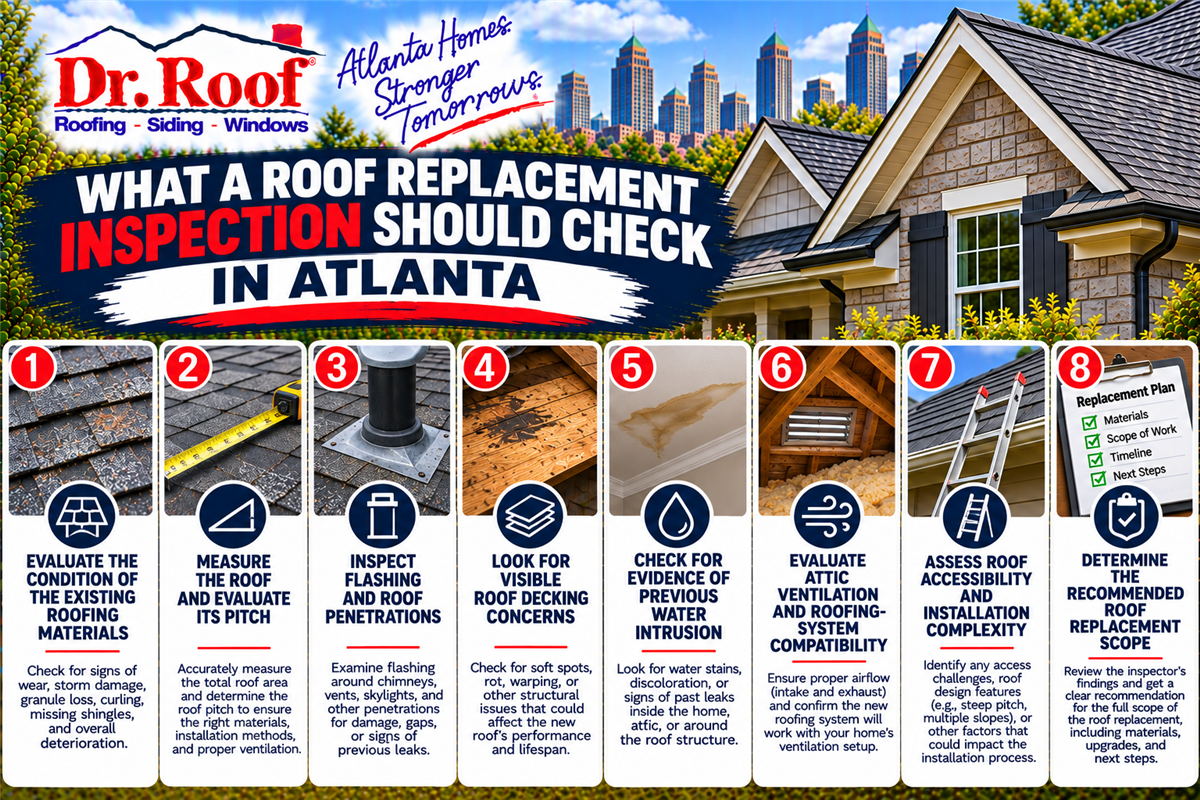
If you're considering replacing your roof, one of the most important steps is scheduling a professional inspection before approving the project.
Many Atlanta homeowners begin researching roof replacement after noticing aging shingles, recurring leaks, or visible storm damage.
However, determining whether a new roof is necessary involves more than looking at the surface materials.
A professional assessment can help establish the condition of the existing roofing system, identify important installation considerations, and determine which materials and repairs should be included in the replacement proposal.
A comprehensive roof replacement inspection should evaluate the existing roofing materials, roof measurements, slope, flashing, penetrations, visible decking conditions, moisture concerns, and other components that may affect the recommended replacement scope.
The inspection should also help homeowners understand whether targeted repairs remain practical or whether a complete replacement is appropriate.
For Atlanta homeowners, knowing what a pre-replacement assessment includes can make the planning process more organized.
Here are eight important areas a roofing professional should consider before recommending a complete roof replacement.
1. Evaluate the Condition of the Existing Roofing Materials
The first step is understanding the condition of the current roofing system.
A contractor should evaluate whether the roof has localized damage, widespread deterioration, or other problems affecting its serviceability.
What Should the Contractor Look For?
Potential concerns include:
Missing shingles
Cracked roofing materials
Curled or lifted shingles
Significant surface deterioration
Damaged ridge components
Previous repairs
Areas of repeated leakage
Visible storm damage
These conditions can provide information about the roof's current performance.
However, no single symptom automatically determines whether replacement is necessary.
Does an Older Roof Automatically Need Replacement?
No.
Roof age is one consideration, but the actual condition matters.
An older roof may have localized damage that can still be repaired.
Another roof may experience widespread deterioration or significant storm damage at a younger age.
The roofing contractor should explain which physical conditions support the recommendation.
Can the Inspection Determine Whether Repairs Are Still Practical?
Often, yes.
A professional assessment can help determine whether:
Damage is localized
Surrounding materials remain serviceable
Compatible replacement materials are available
Flashing problems can be corrected
Repairs can be integrated reliably
When the roofing system is extensively deteriorated or multiple sections are compromised, replacement may be the more appropriate option.
2. Measure the Roof and Evaluate Its Pitch
Roof size and design influence material quantities, installation methods, labor, and overall project planning.
A comprehensive replacement assessment should establish the roofing area and identify important roof features.
Is Roof Square Footage the Same as House Square Footage?
Not necessarily.
A home's interior living area does not directly equal the total roofing surface.
Roofing measurements may include:
Multiple slopes
Overhangs
Dormers
Attached roof sections
Different roof pitches
Additional roof surfaces
A roofing square equals 100 square feet of roof area.
Contractors use roof measurements to estimate materials and installation work.
Why Does Roof Pitch Matter?
Roof pitch describes the steepness of a roof.
It influences accessibility, installation procedures, and material suitability.
A steep roof may require different equipment and safety arrangements from a relatively shallow roof.
Can Every Roofing Material Be Installed on Every Slope?
No.
Manufacturers establish minimum slope requirements for their products.
For example, many conventional asphalt-shingle systems are approved for slopes of 2:12 or greater, with additional underlayment requirements applying to certain lower-slope installations.
However, the exact requirements depend on the selected product.
A contractor should evaluate each roof section before recommending materials.
Why Is This Important Before Replacement?
A home may have different roof pitches across its structure.
The main roof could be suitable for conventional asphalt shingles while a shallower section requires a different installation approach.
Identifying these conditions early helps establish the appropriate replacement scope.
3. Inspect Flashing and Roof Penetrations
Flashing is an important component of a residential roofing system.
It helps direct water away from vulnerable areas where roofing materials meet other building components.
A comprehensive pre-replacement inspection should consider the condition of these transitions.
Which Areas Should Be Evaluated?
Common locations include:
Chimneys
Skylights
Plumbing vents
Roof valleys
Dormers
Roof-to-wall intersections
Other roof penetrations
These components may require repair or replacement as part of the project.
Why Does Flashing Matter During Roof Replacement?
Installing new shingles does not automatically correct every flashing problem.
For example, existing chimney flashing may be deteriorated or improperly integrated with surrounding roofing materials.
A contractor should determine whether the flashing can remain or should be replaced.
Should All Flashing Be Replaced?
Not necessarily.
The appropriate decision depends on the condition of the existing materials, the selected roofing system, and applicable installation requirements.
Some existing flashing may remain suitable.
Damaged or incompatible components should be addressed.
Homeowners should ask the contractor to identify which flashing assemblies are included in the proposed replacement.
Why Should You Discuss Flashing Before Scheduling?
Flashing work can affect materials, labor, and project complexity.
Clarifying the proposed scope before installation helps homeowners understand what is included in the estimate.
4. Look for Visible Roof Decking Concerns
Roof decking, also called roof sheathing, provides the supporting surface beneath the roofing materials.
Common residential decking materials include plywood and oriented strand board.
The decking must remain suitable for the new roofing system.
What Can Damage Roof Decking?
Potential causes include:
Repeated water intrusion
Wood rot
Physical impact
Long-term moisture exposure
Previous roofing problems
Other structural concerns
Some decking problems may be visible during the initial inspection.
Others remain concealed beneath the existing shingles and underlayment.
Can a Roofer Inspect All the Decking Before Removing the Old Roof?
Not always.
A pre-replacement assessment may identify visible concerns from accessible areas.
However, some conditions cannot be confirmed until the existing roofing materials are removed.
The contractor should explain this limitation.
Does Every Roof Replacement Require New Decking?
No.
Existing decking may remain suitable if it meets applicable structural and installation requirements.
However, deteriorated or unsuitable sections may need to be replaced.
What Should Homeowners Ask About Decking?
Before approving the project, consider asking:
Is any decking damage visible?
How will the decking be evaluated during removal?
What conditions require replacement?
Is any decking work included in the estimate?
How will additional work be priced?
Will photographs be provided?
How will unexpected repairs be approved?
These questions help clarify potential changes to the project.
5. Check for Evidence of Previous Water Intrusion
An important part of a roof replacement assessment involves understanding whether water has entered the roofing system.
Previous moisture problems may indicate conditions that need attention during replacement.
What Signs Might Indicate Water Intrusion?
Potential observations include:
Ceiling stains
Damp insulation
Water marks near roof penetrations
Visible wood discoloration
Damp attic materials
Musty odors
Evidence of previous leak repairs
However, not every stain indicates an active roof leak.
Some marks may remain visible after the original problem has been corrected.
Can Moisture Come From Sources Other Than the Roof?
Yes.
Interior moisture may also originate from condensation, plumbing problems, HVAC-related moisture, or other building conditions.
A roofing contractor should evaluate whether the observed condition appears related to the roofing system.
Additional investigation may be necessary when the cause is unclear.
Why Does This Matter Before Roof Replacement?
Installing a new roof without understanding an existing moisture problem may leave the underlying concern unresolved.
For example, replacing shingles may not correct condensation caused by an unrelated building condition.
The inspection should identify which problems belong within the roofing scope.
6. Evaluate Attic Ventilation and Roofing-System Compatibility
Roof replacement can provide an opportunity to evaluate existing ventilation components.
However, not every home uses the same attic design.
Some homes have traditionally vented attics.
Others use conditioned or unvented roof assemblies.
The appropriate system depends on the building.
Why Is Attic Ventilation Important?
In a traditionally vented attic, appropriate intake and exhaust ventilation can help manage airflow and moisture.
However, ventilation must be considered as part of the complete building assembly.
Adding more vents is not automatically the correct solution.
What Should a Contractor Evaluate?
Depending on the home, the assessment may consider:
Existing roof ventilation components
Attic configuration
Visible moisture concerns
Roof design
The selected roofing system
Applicable installation requirements
If changes are recommended, the contractor should explain why they are appropriate.
Does Every Roof Replacement Require New Ventilation?
No.
Some existing ventilation components may remain suitable.
Other projects may involve modifications or replacement.
The recommendation should reflect the actual home rather than assume every attic requires the same arrangement.
Can Ventilation Affect Roofing Material Selection?
Potentially.
Roofing-system requirements and warranty terms may address particular ventilation conditions.
The contractor should confirm which requirements apply to the proposed materials.
Homeowners should review the installation recommendations and applicable warranty documents.
7. Assess Roof Accessibility and Installation Complexity
A roof replacement inspection should also consider how the contractor will access and work on the property.
Roofing installation involves moving materials, removing debris, and working safely at elevated heights.
Different properties present different logistical requirements.
What Can Make a Roof Replacement More Complex?
Factors may include:
Steep roof slopes
Multiple roof levels
Dormers
Chimneys
Roof valleys
Limited access areas
Landscaping near work zones
Difficult material delivery locations
Two homes with similar roofing areas may require different installation procedures.
Why Does Accessibility Matter?
Limited access or complicated roof designs can affect labor requirements, equipment, and project planning.
For example, a steep roof with several dormers may require different preparation from a straightforward single-story roof.
Should Property Conditions Be Discussed During the Inspection?
Yes.
Homeowners can point out any known access concerns.
The contractor should explain how materials, equipment, and debris removal will be coordinated.
These details can help establish a more realistic project scope and schedule.
8. Determine the Recommended Roof Replacement Scope
After evaluating the existing roofing system, the contractor should explain the recommended work.
This is one of the most important outcomes of the inspection.
A complete replacement proposal should identify the major materials and installation components.
What Should a Full Roof Replacement Include?
Depending on the selected roofing system, the project may involve:
Removal of existing roofing materials
Evaluation of exposed decking
Replacement of unsuitable decking
Installation of underlayment
Installation of appropriate leak-protection components
Flashing work
Starter materials
Main roofing materials
Ridge components
Ventilation work when necessary
Cleanup and final review
The exact scope depends on the property.
Why Is a Detailed Proposal Important?
Two contractors may recommend the same roofing material but propose different installation components.
For example, one estimate may include replacing certain flashing assemblies while another assumes they can remain in place.
Homeowners should understand those differences before comparing prices.
What Should You Ask About the Recommended System?
Consider asking:
Which roofing materials are proposed?
Why are those materials appropriate?
What underlayment will be installed?
Which flashing components will be replaced?
How will decking damage be handled?
Are ventilation changes necessary?
What warranty coverage applies?
How will unexpected changes be approved?
The goal is understanding the complete roofing system rather than focusing exclusively on the visible shingles.
What Happens During a Roof Replacement Inspection?
The exact process depends on the home and the contractor's assessment methods.
However, a typical consultation may involve reviewing the homeowner's concerns, evaluating accessible roofing areas, and discussing the existing roofing system.
Step 1: Discuss the Homeowner's Concerns
The contractor may ask about:
Previous leaks
Known storm damage
Roof age
Previous repairs
Visible deterioration
Material preferences
This information helps establish the inspection priorities.
Step 2: Evaluate the Roofing System
The contractor examines relevant roofing components and documents visible concerns.
The inspection may involve roof measurements, photographs, and other evaluation methods.
Unsafe conditions or inaccessible areas may limit what can be observed.
Step 3: Explain the Findings
After the evaluation, the contractor should explain the roof's condition.
The findings may support localized repair, complete replacement, or additional investigation.
Step 4: Discuss Roofing Options
If replacement is appropriate, the homeowner can review suitable materials and installation components.
Step 5: Review the Proposed Scope
The contractor may prepare a written estimate describing the recommended work.
Homeowners should have an opportunity to ask questions before approving the project.
How Do You Know Whether the Inspection Was Thorough?
A useful roof replacement assessment should provide enough information to explain the recommendation.
Homeowners should understand:
What the contractor inspected
Which problems were identified
Whether any areas could not be evaluated
Why replacement is recommended
What materials are proposed
Which existing conditions may affect the project
What additional damage might be discovered during tear-off
A professional assessment should not rely solely on a general statement that the roof is old.
Should You Request Photographs?
Yes, when available.
Photographs may help explain damaged shingles, flashing concerns, or other visible conditions.
However, photographs cannot always reveal concealed damage.
The contractor should explain any limitations.
How Much Does a Roof Replacement Inspection Cost in Atlanta?
Inspection pricing varies by contractor and the type of evaluation requested.
Some roofing companies offer complimentary inspections as part of their consultation process.
Others may charge for specialized assessments or additional services.
Does Dr. Roof Offer Free Roof Inspections?
Yes.
Dr. Roof's published roofing information states that the company offers complimentary roof inspections for homeowners considering roofing projects.
Homeowners can request an appointment to discuss the condition of their roof and potential replacement options.
Actual appointment availability should be confirmed directly with the company.
Does a Free Inspection Mean Roof Replacement Is Required?
No.
A roof inspection is intended to evaluate the existing condition.
The findings should determine whether repairs remain practical or whether replacement is appropriate.
Homeowners should understand the recommendation before approving work.
Should You Schedule a Roof Inspection Before Getting Replacement Quotes?
A professional assessment is useful when preparing a project-specific roof replacement estimate.
The contractor needs sufficient information about the roofing system to determine the appropriate work.
Online calculators and digital measurements may provide preliminary information.
However, they may not reveal every existing roofing problem.
For example, concealed decking deterioration may remain unknown until the old roofing materials are removed.
A detailed proposal should explain the known conditions and how unexpected damage will be handled.
What If the Inspection Shows Your Roof Can Still Be Repaired?
A replacement inspection does not automatically mean the homeowner must proceed with a new roof.
If the damage is localized and the existing roofing system remains serviceable, targeted repairs may be appropriate.
For example, a deteriorated pipe boot or limited shingle damage may be repairable without replacing the entire roof.
The contractor should explain which conditions support repair or replacement.
When Might Replacement Be More Appropriate?
Replacement may deserve consideration when:
Damage is widespread
Multiple leaks continue developing
Shingles are extensively deteriorated
The surrounding materials cannot be repaired reliably
Significant underlying damage is present
The final recommendation should reflect the condition of the roof.
Does an Insurance Claim Change the Inspection Process?
Some homeowners request roof replacement inspections after significant storm damage.
In those circumstances, documentation may be useful.
A roofing contractor may provide photographs, written findings, and repair or replacement recommendations.
However, the insurance company independently determines coverage and claim payment according to the policy.
A roofing contractor cannot guarantee that a roof replacement will be approved by the insurer.
Homeowners should communicate directly with their insurance company about claim requirements.
What Should You Prepare Before Your Roof Replacement Inspection?
Homeowners do not need to climb onto the roof or perform their own technical assessment.
However, a few pieces of information may help the consultation.
Consider preparing:
Your property address
Approximate roof age, if known
Previous roofing repair records
Information about recurring leaks
Photographs of visible damage
Known storm-related concerns
Questions about roofing materials
Any scheduling considerations
You can also identify interior areas where water stains or moisture have appeared.
The contractor can use this information when evaluating the roofing system.
How Far in Advance Should You Schedule a Roof Replacement Inspection?
The appropriate timing depends on the roof's condition.
If the roofing system has active leaks, missing materials, or suspected significant damage, a prompt evaluation is important.
For a planned replacement without urgent damage, homeowners may have more flexibility.
Beginning the assessment process before selecting materials or signing an agreement can help clarify the project requirements.
Actual inspection and installation scheduling depends on contractor availability and other conditions.
Why Comprehensive Roof Inspections Matter for Atlanta Homes
Atlanta-area homes include a wide variety of roof designs.
Some properties have straightforward gable roofs, while others contain multiple valleys, dormers, chimneys, and different roof pitches.
These features influence roofing materials, installation complexity, and water-management details.
Atlanta's heavy rainfall, thunderstorms, and other weather conditions also make it important to evaluate the existing roof carefully.
A comprehensive inspection should account for the property's actual design and condition.
The goal is to recommend a roofing system appropriate for the specific home.
How Dr. Roof Helps Atlanta Homeowners Plan Roof Replacement
Dr. Roof has served Atlanta-area homeowners since 1988, providing professional roofing inspections, repairs, and replacement services.
Dr. Roof is a GAF Master Elite Certified Contractor and CertainTeed SELECT ShingleMaster.
The company offers complimentary roof inspections to help homeowners understand the condition of their existing roofing systems.
During a roof replacement consultation, homeowners can discuss:
Existing roofing materials
Roof measurements
Roof pitch
Flashing
Decking concerns
Water intrusion
Ventilation
Suitable replacement materials
Project scope
Applicable warranty options
A professional evaluation can help determine whether a complete replacement is appropriate and which components should be included in the proposed work.
Homeowners in Atlanta, Marietta, Roswell, Alpharetta, Smyrna, and surrounding communities can contact Dr. Roof to request an inspection.
Start Your Roof Replacement With a Comprehensive Inspection
A successful roof replacement begins with understanding the condition of the existing roofing system.
An inspection helps identify damaged materials, evaluate roof design, recognize potential hidden problems, and establish the scope of work.
For Atlanta homeowners, these findings can make it easier to compare replacement options and understand the proposed project.
Rather than selecting roofing materials or signing a contract based solely on appearance or price, begin with a professional assessment.
If you're considering a new roof, contact Dr. Roof to schedule a complimentary roofing inspection and discuss the replacement options appropriate for your home.
What does a comprehensive roof replacement inspection include?
A comprehensive inspection may evaluate existing shingles, roof measurements, pitch, flashing, roof penetrations, visible decking concerns, moisture conditions, and other components affecting the proposed replacement. The contractor should explain the findings and recommended work.
Do I need a roof inspection before scheduling replacement?
A professional inspection is recommended because it helps establish the roof's condition and appropriate replacement scope. It can also identify material requirements, flashing concerns, and potential hidden damage that may affect the project.
Can a roofing contractor identify damaged decking before removing shingles?
Sometimes. Certain decking concerns may be visible from accessible areas, but other damage remains concealed beneath the roofing materials. Additional problems may only become apparent during tear-off.
Does every roof replacement inspection result in a replacement recommendation?
No. An inspection may determine that localized repairs are appropriate when the surrounding roofing system remains serviceable. Replacement may be recommended when damage or deterioration is too extensive for reliable repairs.
Does Dr. Roof offer free roof replacement inspections in Atlanta?
Yes. Dr. Roof's published roofing information states that the company offers complimentary roof inspections for homeowners considering roofing projects. Homeowners should contact the company to confirm appointment availability.
What should I prepare before a roof replacement inspection?
Prepare any available information about roof age, previous repairs, recurring leaks, visible damage, and roofing material preferences. Photographs and previous project records may also help. Homeowners should not climb onto the roof to collect information.
Subscribe to Dr. Roof's Blog



Comments