When asphalt shingles become damaged, homeowners often wonder whether they can replace a few shingles or need an entirely new roof.
The answer depends on the type of damage, the condition of the surrounding materials, and whether the affected area can be repaired reliably.
Asphalt shingles are designed to provide a protective, water-shedding surface for residential roofing systems. However, individual shingles and other roofing components can experience damage from storms, aging, improper installation, and other conditions.
Fortunately, many asphalt-shingle roofing problems can be corrected without replacing the entire roof.
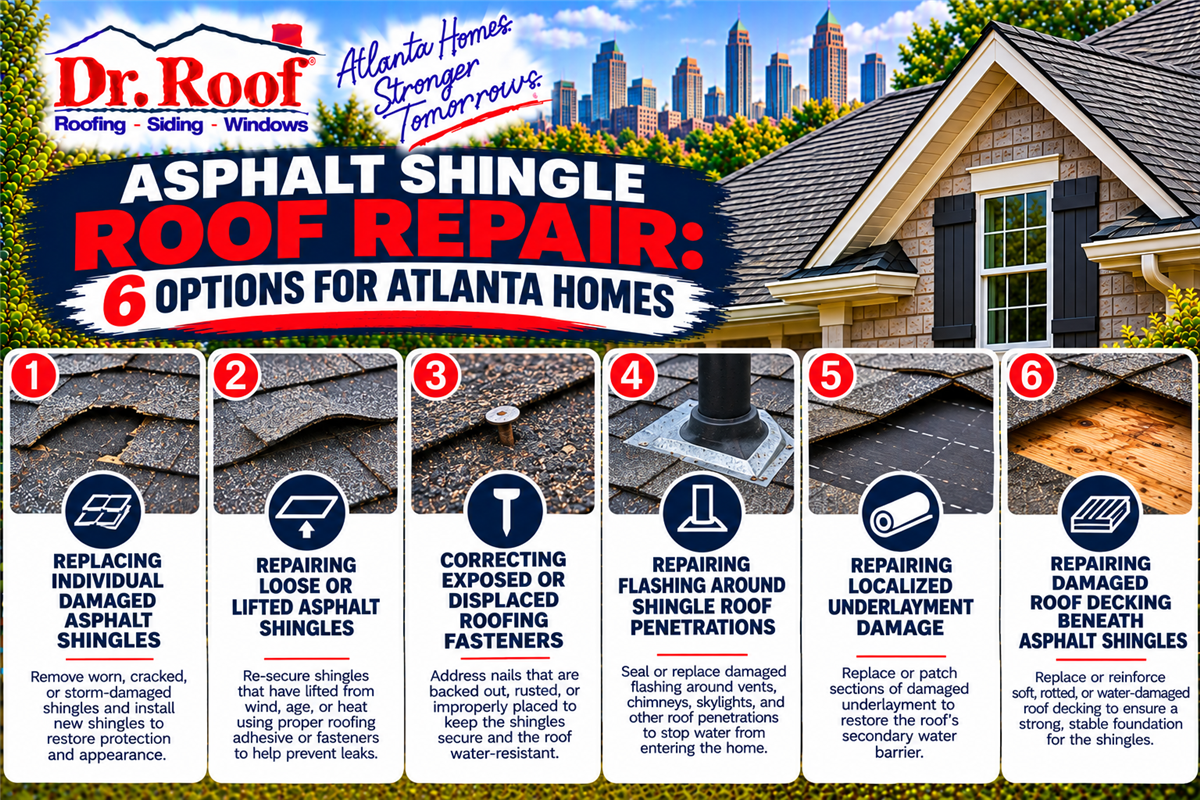
Common asphalt-shingle roof repair options include replacing damaged shingles, correcting loose shingles, repairing exposed or displaced fasteners, replacing damaged flashing, addressing localized underlayment problems, and repairing deteriorated roof decking.
The appropriate repair depends on the roofing system's condition and the location of the damage.
For Atlanta homeowners, understanding these options can help make roofing inspections, estimates, and repair recommendations easier to evaluate.
Here are six common asphalt-shingle roof repair methods and when each may be appropriate.
1. Replacing Individual Damaged Asphalt Shingles
One of the most common repair methods involves removing and replacing individual shingles.
This may be appropriate when damage is limited to a relatively small portion of the roof.
What Types of Shingle Damage May Require Replacement?
Individual shingles may need replacement when they are:
Cracked
Torn
Missing
Punctured
Significantly creased
Damaged by falling debris
Otherwise unable to perform as intended
A professional roofing contractor should determine whether the damaged material can be replaced without compromising the surrounding shingles.
How Are Individual Shingles Replaced?
Asphalt shingles are installed in overlapping courses.
To replace a damaged shingle, a contractor generally needs to access the fasteners securing that material.
This can require carefully separating the adhesive bonds between adjacent shingles.
The damaged material is removed, and a compatible replacement shingle is installed using appropriate fastening and sealing methods.
The exact procedure depends on the roofing product and manufacturer's requirements.
Can Any Asphalt Shingle Be Replaced Individually?
Not necessarily.
The surrounding shingles must remain suitable for the repair.
For example, older shingles may become brittle or difficult to separate without cracking.
If several adjacent shingles are damaged during removal, the repair area may need to expand.
A contractor should evaluate these conditions before recommending localized replacement.
Will the New Shingles Match the Existing Roof?
An exact appearance match is not always possible.
Even when the same shingle color and product are available, existing roofing materials may have changed appearance through normal weathering.
New shingles may initially look different from the surrounding roof.
The Asphalt Roofing Manufacturers Association recommends using compatible materials that provide the closest practical match.
Homeowners should discuss material availability and appearance expectations before approving repairs.
2. Repairing Loose or Lifted Asphalt Shingles
Asphalt shingles commonly include adhesive sealant designed to help bond overlapping materials together.
When properly installed and activated, this adhesive contributes to the roofing system's resistance to wind.
However, shingles can sometimes become loose or lifted.
What Causes Shingles to Lift?
Potential causes include:
Strong winds
Adhesive sealant that has not properly bonded
Improper installation
Physical damage
Deteriorated roofing materials
Previous repair defects
A lifted shingle is not necessarily damaged beyond repair.
However, the contractor must evaluate its condition.
Can Loose Shingles Be Resealed?
Sometimes.
According to the Asphalt Roofing Manufacturers Association, certain wind-affected shingles may be suitable for professional resealing.
The shingle must remain structurally sound, and the repair method must be appropriate for the roofing product.
A contractor may use a manufacturer-approved sealing procedure when the material remains suitable.
However, severely creased, torn, or otherwise damaged shingles may require replacement.
Why Should Homeowners Avoid Gluing Shingles Down Themselves?
Not every adhesive or roofing sealant is suitable for asphalt shingles.
Using inappropriate products can create additional problems or interfere with the roofing materials.
Homeowners should also avoid climbing onto the roof to press loose shingles back into place.
A professional can determine whether resealing is appropriate or whether replacement is necessary.
3. Correcting Exposed or Displaced Roofing Fasteners
Roofing nails secure asphalt shingles to the supporting roof decking.
Proper fastening is important because shingles must remain attached according to the manufacturer's installation requirements.
Occasionally, a roofing fastener may become displaced or create a problem beneath the shingles.
What Is a Raised Roofing Nail?
A raised or backed-out nail is a fastener that no longer sits in its intended position.
Depending on its location, it may lift the roofing material above it or interfere with the overlapping shingle courses.
Potential concerns include:
Raised shingle surfaces
Exposed fasteners
Localized openings
Damage to surrounding roofing materials
Increased vulnerability to water intrusion
The condition should be evaluated before repair.
Can a Raised Roofing Nail Be Repaired?
Yes, in some situations.
The Asphalt Roofing Manufacturers Association identifies incorrectly seated or backed-out fasteners as problems that qualified roofing professionals may be able to correct.
A contractor may need to carefully access the fastener, remove or reposition it according to the appropriate repair method, and restore the surrounding shingles.
The manufacturer-approved fastening and sealing requirements must be followed.
Why Does Roof Decking Condition Matter?
Roofing fasteners rely on suitable decking for proper attachment.
If the supporting wood is deteriorated, simply installing another nail may not correct the underlying problem.
The contractor should determine whether the decking remains structurally appropriate.
4. Repairing Flashing Around Shingle Roof Penetrations
Asphalt shingles are only one part of a roofing system.
Flashing helps direct water away from vulnerable areas where the roof meets other building components.
Common locations include:
Chimneys
Plumbing vents
Skylights
Roof-to-wall intersections
Dormers
Valleys
Damage in these areas may cause leaks even when the surrounding shingles appear intact.
Can Flashing Be Repaired Without Replacing the Shingles?
Some flashing repairs require removing nearby shingles to access the affected assembly.
However, this does not automatically mean the entire roof needs replacement.
For example, deteriorated plumbing vent flashing may be replaceable when the surrounding shingles remain serviceable.
The contractor should determine which materials need removal and how the replacement flashing will integrate with the existing roof.
Why Isn't Roof Sealant Always Enough?
Roof sealants have legitimate uses, but they cannot correct every flashing defect.
A chimney flashing assembly that was installed incorrectly may require reconstruction.
Applying sealant over the visible opening might temporarily reduce water intrusion without restoring the intended water-management system.
The repair should correct the actual defect.
What Should Homeowners Ask About Flashing Repairs?
Before approving the work, ask:
Which flashing component is damaged?
Will surrounding shingles need replacement?
Is the repair temporary or permanent?
What materials will be installed?
Can the repaired area be integrated with the existing roof?
Clear answers can help homeowners understand the proposed scope.
5. Repairing Localized Underlayment Damage
Underlayment is installed beneath many asphalt-shingle roofing systems.
It provides secondary moisture protection between the shingles and roof decking.
When shingles become damaged or displaced, the underlayment may experience additional weather exposure.
What Can Damage Roof Underlayment?
Potential causes include:
Physical punctures
Improper installation
Prolonged exposure
Previous roofing defects
Water intrusion
Not every exposed underlayment section is damaged.
However, it should be evaluated before the roofing materials are restored.
Can Underlayment Be Repaired Without Replacing the Roof?
Sometimes.
When the damage is localized, a contractor may be able to remove the affected shingles, correct the underlayment problem, and reinstall appropriate roofing materials.
The repair must satisfy the selected roofing system's installation requirements.
Does Underlayment Replace the Need for Shingles?
No.
Underlayment provides secondary protection but is not intended to serve indefinitely as the primary roof covering in a conventional asphalt-shingle system.
If shingles are missing, the underlying materials should not remain exposed without an appropriate repair plan.
6. Repairing Damaged Roof Decking Beneath Asphalt Shingles
Roof decking provides the supporting surface beneath the roofing materials.
Common residential decking products include plywood and oriented strand board.
When water enters the roofing system repeatedly, the decking may become damaged.
Physical impact from falling branches or other debris can also affect the supporting materials.
What Are Signs of Possible Decking Damage?
Potential concerns include:
Visible deterioration
Wood rot
Delaminated panels
Holes
Structural weakness
Significant moisture damage
Localized sagging
Some conditions may be visible from accessible areas.
Others remain concealed until roofing materials are removed.
Can Damaged Decking Be Replaced in One Section?
Yes, depending on the condition and structural requirements.
A contractor may be able to remove the damaged roofing materials and replace a localized section of unsuitable decking.
New underlayment and shingles can then be installed according to the roofing system's requirements.
However, structural concerns may require additional evaluation.
Does Every Water Stain Mean Decking Must Be Replaced?
No.
Discoloration alone does not establish that wood is structurally unsuitable.
The contractor should evaluate the material's actual condition.
The goal is correcting damaged components without automatically replacing materials that remain serviceable.
Which Asphalt Shingle Roof Repair Option Is Best?
The best option depends on the roofing problem.
A missing shingle requires a different repair from deteriorated chimney flashing.
Similarly, a backed-out nail may require a different solution from water-damaged decking.
A professional inspection should identify:
The damaged roofing component
The location and extent of the problem
The condition of surrounding materials
Whether compatible replacements are available
Whether the repair can be completed reliably
Whether additional roofing problems are present
The contractor should explain why the recommended method is appropriate.
When Is Asphalt Shingle Repair Better Than Replacement?
Localized repair may be appropriate when the existing roofing system remains serviceable.
For example, a limited number of damaged shingles may be replaceable without removing the entire roof.
The same may be true for certain flashing or fastener problems.
However, a broader solution may deserve consideration when roofing materials are extensively deteriorated or damage affects numerous sections.
Does Roof Age Determine Whether Repairs Are Possible?
Not by itself.
The roof's actual condition matters more than age alone.
An older roof may still have repairable areas.
A newer roof may experience substantial damage from severe weather.
A contractor should evaluate the roofing materials, decking, and surrounding components before recommending a solution.
What About Asphalt Shingle Coatings and Rejuvenators?
Some products are marketed as alternatives to traditional roof repairs.
These may include coatings or treatments advertised as ways to restore aging asphalt shingles.
However, homeowners should be cautious about assuming that such products can correct physical damage.
The Asphalt Roofing Manufacturers Association recommends consulting the shingle manufacturer before applying coatings or rejuvenators.
Product compatibility and manufacturer guidance matter.
A coating should not be treated as a substitute for replacing shingles that are torn, punctured, or otherwise unable to perform as intended.
How Much Does Asphalt Shingle Roof Repair Cost?
Repair costs depend on the problem and the work required.
Factors may include:
Number of damaged shingles
Type of repair
Roof pitch
Accessibility
Material compatibility
Flashing requirements
Underlayment damage
Decking repairs
Labor and cleanup
For example, replacing several damaged shingles involves a different scope than reconstructing flashing or replacing deteriorated decking.
There is no universal price that applies to every repair.
A professional inspection and written estimate provide a more reliable basis for determining the cost.
How Long Should an Asphalt Shingle Repair Last?
A properly completed repair should restore the affected area according to the appropriate installation requirements.
However, no contractor can guarantee that unrelated roofing components will never develop problems.
The continued performance of the repair depends on several factors, including:
Materials used
Installation quality
Existing roof condition
Weather exposure
Surrounding roofing materials
Future damage
Homeowners should review any applicable workmanship or manufacturer warranty terms.
What Should Atlanta Homeowners Do Before Approving Repairs?
Before signing a repair agreement, ask the contractor to explain the observed damage.
A useful estimate should identify:
The affected roofing area
Recommended repair method
Materials requiring replacement
Labor and cleanup
Known underlying damage
Potential additional work
Applicable warranty information
Photographs and written findings may help clarify the recommendation.
Homeowners should understand whether the proposed work corrects the problem permanently or provides temporary protection.
How Dr. Roof Helps Atlanta Homeowners With Asphalt Shingle Repairs
Dr. Roof has served Atlanta-area homeowners since 1988, providing professional roof inspections, repairs, replacement, and storm-damage documentation support.
Dr. Roof is a GAF Master Elite Certified Contractor and CertainTeed SELECT ShingleMaster.
The company provides roofing services involving damaged shingles, roof leaks, flashing, and other roofing components.
A professional evaluation can help determine whether localized repairs are appropriate or whether the existing roofing system requires more extensive work.
For qualifying storm-related concerns, Dr. Roof may provide photographs, written findings, and repair or replacement recommendations.
Homeowners in Atlanta, Marietta, Alpharetta, Roswell, Smyrna, and surrounding communities can contact Dr. Roof to discuss a roofing evaluation.
Choose the Right Repair for Your Asphalt Shingle Roof
Asphalt-shingle roofs can often be repaired without replacing the entire roofing system.
Individual shingle replacement, professional resealing, fastener corrections, flashing repairs, underlayment work, and localized decking repairs are all possible solutions depending on the damage.
The important step is identifying which components are affected and whether the surrounding roofing materials remain suitable.
For Atlanta homeowners, a professional inspection provides the information needed to make that decision.
If your asphalt-shingle roof is damaged or developing leaks, contact Dr. Roof to schedule a roofing evaluation and discuss the repair options appropriate for your home.
What are the most common asphalt-shingle roof repair options?
Common options include replacing damaged shingles, professionally resealing suitable loose shingles, correcting displaced fasteners, repairing flashing, addressing localized underlayment problems, and replacing damaged roof decking. The appropriate method depends on the roofing system's condition.
Can individual asphalt shingles be replaced without replacing the roof?
Yes. Individual shingles can often be replaced when damage is localized and surrounding roofing materials remain serviceable. A qualified contractor should determine whether compatible replacements can be installed without damaging adjacent shingles.
Can loose asphalt shingles be repaired instead of replaced?
Sometimes. Certain loose shingles may be suitable for professional resealing when the material remains structurally sound. Torn, severely creased, or otherwise damaged shingles may require replacement.
Can a raised roofing nail cause problems with asphalt shingles?
Yes. A backed-out or incorrectly seated nail may lift surrounding shingles or interfere with their intended position. A qualified roofing professional can evaluate whether the fastener and affected materials can be repaired.
Does asphalt shingle repair require replacing the underlayment?
Not always. Underlayment replacement may be necessary when the material is damaged or unsuitable. A localized repair may involve removing affected shingles, correcting the underlayment, and restoring the roofing system.
When should homeowners consider roof replacement instead of shingle repairs?
Replacement may be appropriate when damage is widespread, roofing materials are extensively deteriorated, or localized repairs cannot be completed reliably. The decision should depend on the roof's actual condition rather than age alone.
Subscribe to Dr. Roof's Blog



Comments