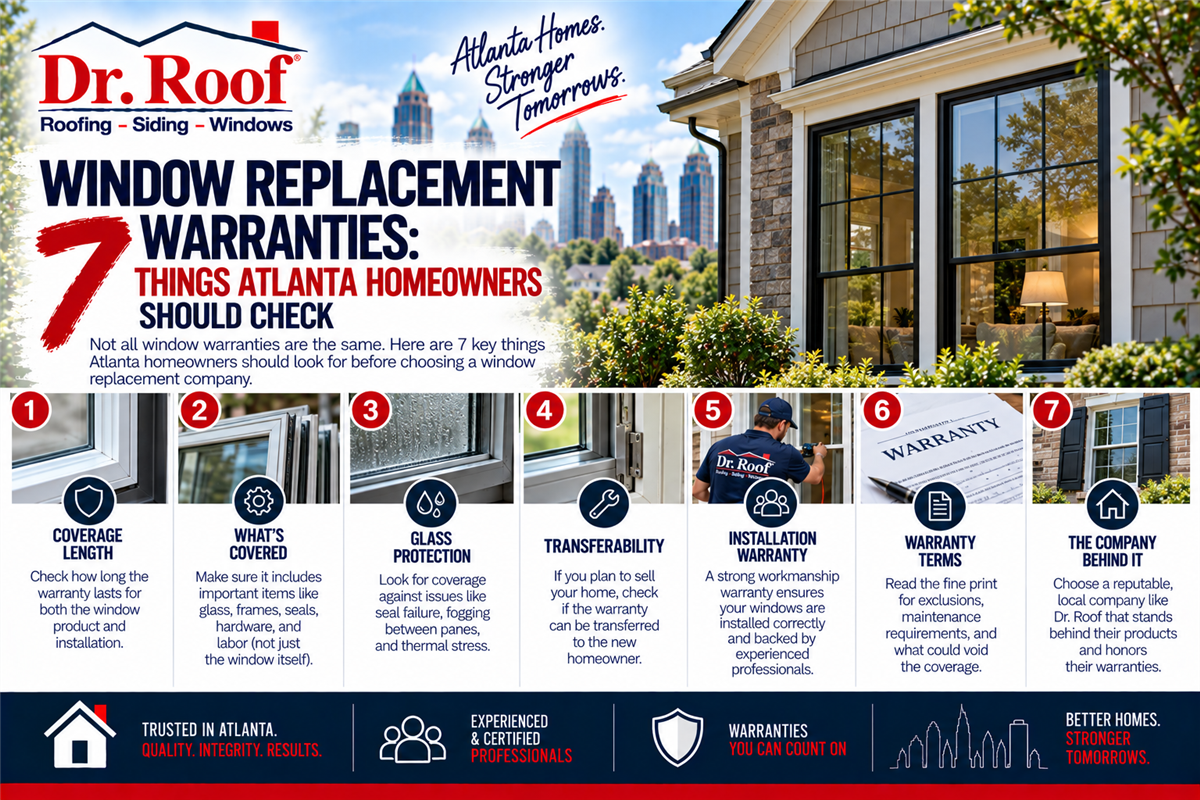
A replacement window warranty can look impressive at first glance.
Terms such as "limited lifetime," "transferable," and "manufacturer warranty" sound reassuring—but those words do not automatically tell an Atlanta homeowner what will actually happen if a window develops a problem.
Window warranty coverage can vary by manufacturer, product collection, component, installation agreement, purchase date, and specific warranty terms.
That means homeowners should never judge a replacement window warranty by its headline alone.
Before choosing windows for your Atlanta-area home, review these seven details so you understand what protection you are actually receiving.
Window Replacement Warranties: The Quick Answer
A replacement window project may involve more than one type of warranty.
Homeowners may have separate coverage for:
The window product
Individual window components
Insulated glass
Hardware
Installation workmanship
Those protections may come from different companies and may have different terms, limitations, exclusions, and time periods.
The most important step is to obtain the actual written warranty for the exact product being installed.
Do not rely only on phrases such as "lifetime warranty."
1. Separate the Manufacturer Warranty From the Installation Warranty
One of the most important distinctions is the difference between the product warranty and the workmanship or installation warranty.
A manufacturer warranty generally applies to qualifying defects involving the window product according to the manufacturer's written terms.
Depending on the product, that may include components such as:
Frames or sashes
Insulated glass units
Hardware
Locks
Balances
Other covered components
Installation workmanship is different.
An installation-related problem involves how the window was fitted, flashed, sealed, or otherwise installed in the opening.
Before purchasing replacement windows, ask:
Who covers the window itself, and who covers the installation?
Then request both sets of terms in writing.
2. Find Out Exactly Which Window Components Are Covered
A warranty may use one broad name while applying different terms to different parts of the window.
For example, the frame may have one coverage period while insulated glass, screens, locks, or mechanical components have different terms.
Do not assume that every part of a window receives identical protection simply because the warranty contains the word "lifetime."
Review the warranty component by component.
Important areas to check include:
Frame and sash
Insulated glass
Glass seals
Hardware
Locks
Screens
Mechanical parts
Exterior finishes or coatings
Specialty glass or custom options
If a proposal includes multiple window collections or specialty features, confirm whether the same warranty applies to every unit.
3. Understand What "Limited Lifetime" Actually Means
"Lifetime warranty" and "limited lifetime warranty" are not universal definitions.
The written warranty controls what the term means for a particular product.
Limitations may involve:
Who qualifies as the warranty holder
How long specific components are covered
Whether coverage changes over time
Whether labor is included
Whether the warranty transfers to another homeowner
Which types of damage are excluded
Whether registration is required
The safest approach is simple:
Read the actual warranty instead of relying on the marketing phrase.
If any term is unclear, ask the contractor to explain where it appears in the written documentation.
4. Check Whether the Warranty Is Prorated
Proration is another detail homeowners should understand before choosing replacement windows.
A non-prorated warranty generally maintains the stated level of qualifying coverage during the applicable coverage period.
A prorated warranty may reduce the manufacturer's responsibility as the product ages, leaving the homeowner responsible for a larger portion of a future replacement or repair.
Not every window warranty is structured the same way.
Ask:
Does the value of this coverage change as the window gets older?
If the answer is yes, request an explanation of how that change works.
5. Ask Whether the Warranty Can Transfer to a Future Homeowner
Some window warranties may be transferable when a home is sold.
Others may remain only with the original purchaser, allow a single transfer, shorten coverage after transfer, or require specific paperwork.
Transferability should therefore be verified rather than assumed.
If this feature matters to you, ask:
Is the warranty transferable?
Is there a deadline for transferring it?
Does the new homeowner need to register?
Does coverage change after transfer?
Are there administrative requirements?
Keep the warranty documents with your home's records so future owners can locate them if needed.
6. Review the Exclusions and Homeowner Responsibilities
What a warranty does not cover can be just as important as what it does.
Window warranties commonly contain exclusions or limitations involving circumstances outside a manufacturer's control.
Depending on the warranty, those may include issues related to:
Improper maintenance
Alterations
Damage from outside events
Building movement
Improper use
Certain environmental conditions
Unauthorized repairs
Normal weathering
Condensation that is not caused by a covered product defect
Homeowners may also have maintenance responsibilities involving cleaning, caulking, drainage, or other conditions.
Read these sections carefully.
A warranty should not be viewed as a substitute for normal home and window maintenance.
7. Understand the Registration and Claim Process
A strong warranty is much easier to use when the homeowner knows how to access it.
Before the installation is complete, determine:
Whether warranty registration is required
Who registers the product
What records should be retained
Where the product identification information is located
Who should be contacted first if a problem develops
Whether photographs or proof of purchase are required
Whether a claim must be submitted within a certain period after discovering a problem
Keep invoices, contracts, product information, installation records, and warranty documents together.
That paperwork can be extremely useful years after the original installation.
Why Product-Specific Warranty Information Matters
Replacement windows are not all covered by one universal industry warranty.
Even products from the same manufacturer can have different terms depending on the collection, component, purchase date, or optional features.
That is why homeowners should ask for the exact warranty connected to the exact windows included in their proposal.
A generic statement such as "these windows have a lifetime warranty" is not enough information to make an informed comparison.
Ask to see the actual document.
Window Product Warranty vs. Workmanship Warranty
Homeowners sometimes assume that a manufacturer will address every problem involving a replacement window.
That is not necessarily the case.
Consider two different examples.
If an insulated glass unit develops a qualifying manufacturing defect, that may fall under the product manufacturer's warranty.
If water intrusion develops because the opening was improperly flashed during installation, that may involve the installer's workmanship rather than a manufacturing defect.
The specific facts and written warranty terms determine which protection applies.
This distinction is one reason contractor selection matters alongside product selection.
What Should Atlanta Homeowners Compare Between Window Contractors?
When evaluating replacement-window proposals, compare more than window style and initial price.
Review:
Product
Energy performance
Installation process
Manufacturer warranty
Workmanship coverage
Service after installation
Ask each contractor the same questions so the proposals are easier to compare.
Useful questions include:
What manufacturer and window collection are you proposing?
Can I see the current manufacturer warranty?
What parts of the window have different coverage periods?
Does the warranty include labor?
Is your installation workmanship covered separately?
Is coverage prorated?
Is the warranty transferable?
What exclusions should I know about?
Do I need to register the windows?
Who do I call first if there is a problem?
Clear answers before installation can prevent confusion later.
Does a Better Warranty Automatically Mean a Better Window?
Not necessarily.
Warranty protection is important, but it is only one part of the replacement-window decision.
Homeowners should also consider:
Window construction
Energy-performance ratings
Glass package
Frame design
Air and water performance
Installation quality
Contractor experience
Service and support
A long warranty cannot compensate for choosing the wrong window for the opening or poor installation.
Likewise, a well-designed window performs best when it is installed correctly.
Keep Your Warranty Documentation
Window warranties may be needed years after the project is finished.
Create a permanent home-improvement file containing:
Signed contract
Final invoice
Product information
Window collection or model
Warranty document
Registration confirmation
Installation date
Contractor contact information
Digital copies can also be useful if paper records are misplaced.
Window Replacement Warranty Information for Atlanta Homeowners
The most important lesson is straightforward:
Do not ask only whether replacement windows have a warranty.
Ask exactly what the warranty covers.
Understand the difference between manufacturer protection and contractor workmanship, review component-specific terms, check for proration and transferability, understand exclusions, and learn the claim process before the project begins.
Dr. Roof has served Atlanta-area homeowners since 1988 and provides professional window replacement as part of its exterior home services.
When evaluating a window replacement proposal, homeowners should review the exact product and applicable warranty documentation for the windows selected.
A clear warranty should help you understand your protection—not leave you guessing about it after a problem develops.
What should a replacement window warranty cover?
Coverage varies by product and manufacturer, but homeowners should review terms for the frame, sash, insulated glass, glass seals, hardware, locks, screens, mechanical components, and any specialty options included in the project.
Is a manufacturer warranty the same as an installation warranty?
No. A manufacturer warranty generally addresses qualifying product defects according to the manufacturer's terms. An installation or workmanship warranty addresses qualifying issues related to how the contractor installed the windows.
What does limited lifetime warranty mean for replacement windows?
There is no single universal definition. The written warranty determines who is covered, which components qualify, how long coverage lasts, exclusions, transferability, labor responsibilities, and other limitations.
Are replacement window warranties transferable?
Some are, but the rules vary. A warranty may allow a transfer, limit the number of transfers, require registration within a certain period, or change the coverage available to a subsequent homeowner.
What records should I keep after window replacement?
Keep the signed contract, final invoice, product and collection information, manufacturer warranty, registration confirmation, installation date, and contractor contact information together with your permanent home records.
Is a longer window warranty always better?
Not necessarily. Homeowners should compare what the warranty actually covers, which components are included, whether coverage is prorated or transferable, what exclusions apply, and whether installation workmanship is covered separately.
Subscribe to Dr. Roof's Blog







Comments