After a hailstorm moves through the Atlanta area, homeowners often look outside for missing shingles and assume that if the roof still looks intact, everything must be fine.
Unfortunately, hail damage is not always that obvious.
A roof can remain completely covered while individual shingles, flashing, vents, gutters, and other components have been affected by impact. Some signs can be seen from the ground, while others require a closer professional inspection.
So, what are the common signs of hail damage on a roof?
Here are seven things Atlanta homeowners should know.
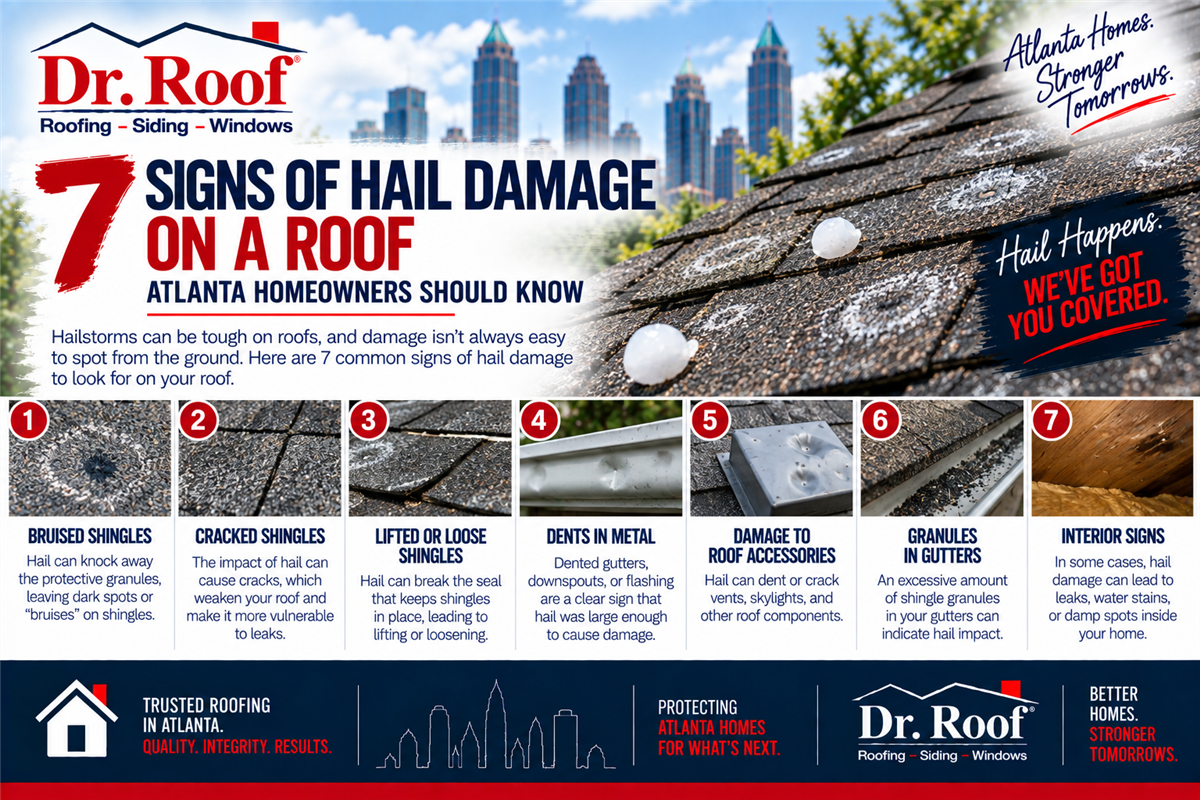
1. Missing or Damaged Shingle Granules
Asphalt shingles are covered with mineral granules that help protect the material beneath them.
Hail impact can loosen or dislodge those granules, sometimes leaving darker areas on the surface of a shingle.
Homeowners may also notice an unusual amount of granules collecting in gutters or near downspout exits after a significant storm.
Granule loss can happen naturally as shingles age, so granules alone do not prove hail damage. The location, pattern, age of the roof, and recent weather conditions all matter.
2. Bruised or Soft Spots on Asphalt Shingles
Hail does not have to break completely through a shingle to affect it.
An impact can sometimes create a bruised area where the shingle's surface or underlying layers have been stressed.
These areas can be difficult or impossible to identify safely from the ground.
That is one reason a roof can appear normal to a homeowner after a storm even though a closer inspection reveals concerns.
Homeowners should not climb onto the roof to feel for suspected bruising. Wet, steep, or storm-damaged roofing surfaces can be dangerous.
3. Cracked or Fractured Shingles
Larger hail or severe impacts may contribute to cracks or fractures in roofing materials.
Cracking deserves attention because roofing systems depend on overlapping layers to help shed water away from the home.
A crack does not automatically mean the entire roof requires replacement. The proper response depends on the extent of the damage, the location, the age and condition of the roofing system, and whether other components were affected.
A professional inspection can help determine the appropriate next step.
4. Dents on Metal Roof Components
Sometimes the clearest evidence of hail impact is not found on the shingles.
Metal components around the roof and exterior may show visible dents.
Examples include:
Roof vents
Flashing
Metal valleys
Gutters
Downspouts
Gutter covers
Other exposed metal surfaces
These components can provide useful clues when evaluating whether hail affected the property.
However, dents on one component do not automatically establish the condition of the entire roof. The roofing system still needs to be evaluated as a whole.
5. Damage Around Roof Vents, Flashing, or Penetrations
A roof includes more than shingles.
Vents, chimneys, skylights, pipe penetrations, flashing, and other transitions are important parts of the system.
After a hailstorm, these areas should be checked for impact damage, loosened materials, cracks, dents, or conditions that could eventually allow water intrusion.
Because roof penetrations already represent transition points in the roofing system, problems in these areas deserve careful attention.
6. New Roof Leaks or Interior Water Stains
Sometimes homeowners first suspect storm damage because of something happening inside the house.
Warning signs can include:
Ceiling stains
Damp drywall
Moisture in the attic
Dripping water
Damp insulation
Musty odors in upper rooms
A new water stain after a storm deserves investigation, but the location of the stain does not always identify the exact point where water entered the roofing system.
Water can travel along decking, rafters, or other building materials before becoming visible indoors.
Finding the actual source is more important than simply treating the interior symptom.
7. Damage to Gutters, Siding, Screens, or Outdoor Surfaces
Hail affects more than roofs.
Damage elsewhere around the home can provide clues about the size, direction, and intensity of the storm.
After severe weather, homeowners can safely inspect from the ground for:
Dented gutters or downspouts
Torn window screens
Marks on painted surfaces
Siding damage
Damage to outdoor equipment
Broken branches or debris around the property
These observations do not replace a roof inspection, but they can help establish that the property experienced significant hail activity.
Can You See Hail Damage From the Ground?
Sometimes.
Large missing pieces, damaged gutters, or obvious exterior impact marks may be visible without getting on the roof.
But many forms of potential roofing damage are subtle.
Individual impact areas, bruising, granule displacement, flashing issues, and other problems can be difficult to evaluate from the driveway or yard.
A ground-level check is useful as an initial step. It should not be treated as a complete assessment when a home has experienced significant hail.
What Should You Do After an Atlanta Hailstorm?
If you suspect hail damage, a simple process can help you respond methodically.
Step 1: Document What You Can Safely See
Take photographs of visible damage from the ground.
This might include gutters, siding, fallen branches, exterior dents, or visible roofing issues.
Do not climb onto a storm-damaged roof just to take photographs.
Step 2: Check the Interior
Look in accessible areas of the attic and check ceilings for new moisture or stains.
If water is actively entering the home, protecting the interior from additional damage becomes the immediate priority.
Step 3: Arrange a Professional Roof Inspection
A roofing professional can evaluate shingles, flashing, vents, roof penetrations, gutters, and other accessible components more closely.
Dr. Roof provides roof inspections and storm-damage evaluations for Atlanta-area homeowners.
When appropriate, the team may provide photographs, written findings, and recommendations explaining whether repair or replacement should be considered.
Step 4: Review Your Insurance Policy Before Assuming Coverage
Homeowners insurance policies vary.
The presence of hail damage does not automatically determine whether an insurance company will approve a particular repair or roof replacement.
Coverage decisions are made by the insurer according to the policy, deductible, documented damage, cause of loss, claim details, and other applicable terms.
Professional documentation can help describe the physical condition of the roof, but the roofing contractor does not determine insurance coverage.
Does Hail Damage Always Mean You Need a New Roof?
No.
Hail damage does not automatically mean a complete roof replacement is necessary.
The appropriate recommendation depends on factors such as:
Amount of damage
Location of damage
Roofing material
Overall roof condition
Repairability of affected areas
Damage to related roof components
Some roofs may need localized repairs. Others may have more widespread damage that requires a different approach.
The inspection should determine the scope rather than starting with the assumption that every hailstorm requires a new roof.
Why Atlanta Homeowners Should Not Ignore Suspected Hail Damage
The concern with hidden storm damage is not necessarily what the roof looks like immediately after the storm.
The question is whether roofing components are still performing as intended.
Small issues involving shingles, flashing, seals, or penetrations can be easier to address when they are identified early rather than after interior moisture becomes visible.
That makes a professional assessment especially useful after a significant hail event.
Dr. Roof's Approach to Hail Damage in Atlanta
Dr. Roof has served Atlanta-area homeowners since 1988 and provides roofing inspections, roof repair, replacement, and storm-damage documentation support.
The goal of a storm inspection is to understand what actually happened to the roofing system.
That may include examining affected roofing materials, identifying visible storm-related concerns, documenting conditions with photographs, and explaining whether repair or replacement should be considered.
If an insurance claim is involved, homeowners can use that documentation when communicating with their insurance company. Final coverage and claim decisions remain with the insurer according to the policy and individual claim.
Think Your Roof Has Hail Damage?
You do not need to see a missing shingle to have a reason for an inspection.
Granule loss, bruising, cracked materials, dented metal components, flashing damage, interior moisture, and exterior impact marks can all provide reasons to take a closer look after an Atlanta hailstorm.
The safest approach is simple: inspect what you can from the ground, document visible concerns, and have a roofing professional evaluate the areas you cannot safely or confidently assess yourself.
If you are concerned about hail damage to your Atlanta-area home, Dr. Roof can inspect the roofing system and provide clear findings about its condition and recommended next steps.
Frequently Asked Questions
What are the most common signs of hail damage on a roof?
Common signs can include missing granules, bruised or cracked shingles, dents in metal roof components, damage around vents or flashing, new leaks, and impact marks on gutters or other exterior surfaces.
Can a roof have hail damage without missing shingles?
Yes. Hail can affect shingles and other roof components without removing them. Bruising, granule displacement, cracks, dents, and damage to flashing or vents may be harder to see from the ground.
Should I climb onto my roof to check for hail damage?
No. Homeowners should inspect only what can be seen safely from the ground or accessible interior areas. A roofing professional can evaluate the roof surface and other components more closely.
Does hail damage automatically mean my roof needs replacement?
No. The appropriate response depends on the amount and location of damage, roofing material, overall roof condition, and whether affected areas can reasonably be repaired.
Does homeowners insurance cover hail damage to a roof?
Coverage varies by policy and claim. The insurance company determines coverage according to the policy terms, deductible, cause and extent of damage, documentation, and other claim-specific factors.
Subscribe to Dr. Roof's Blog







Comments