After a severe storm, many Atlanta homeowners face an important question: Does the roof need repairs, or has the damage become serious enough to require replacement?
The answer is not always obvious.
Strong winds can loosen shingles, hail can damage roofing materials, and falling branches can affect both the roof covering and the underlying structure.
Some problems are visible from the ground, while others require a closer professional evaluation.
A storm damage roof replacement assessment helps determine the extent of the damage, the condition of the existing roofing system, whether repairs are practical, and whether a full replacement should be considered.
For Atlanta homeowners, understanding what an assessment includes can help clarify the next steps and avoid decisions based solely on visible damage.
Here are seven important questions a professional roof inspection should help answer.
What Is a Storm Damage Roof Replacement Assessment?
A storm damage roof replacement assessment is a professional evaluation of a roofing system following a potentially damaging weather event.
Its purpose is to determine the physical condition of the roof and identify appropriate repair or replacement options.
Depending on the circumstances, a roofing contractor may evaluate:
Asphalt shingles
Flashing
Ridge materials
Roof penetrations
Roof valleys
Roof decking
Signs of water intrusion
Damage from debris
Previous repair areas
The contractor may also document the findings through photographs and written observations.
A proper assessment should distinguish confirmed damage from conditions that require additional evaluation.
It should not begin with the assumption that every storm-damaged roof needs replacement.
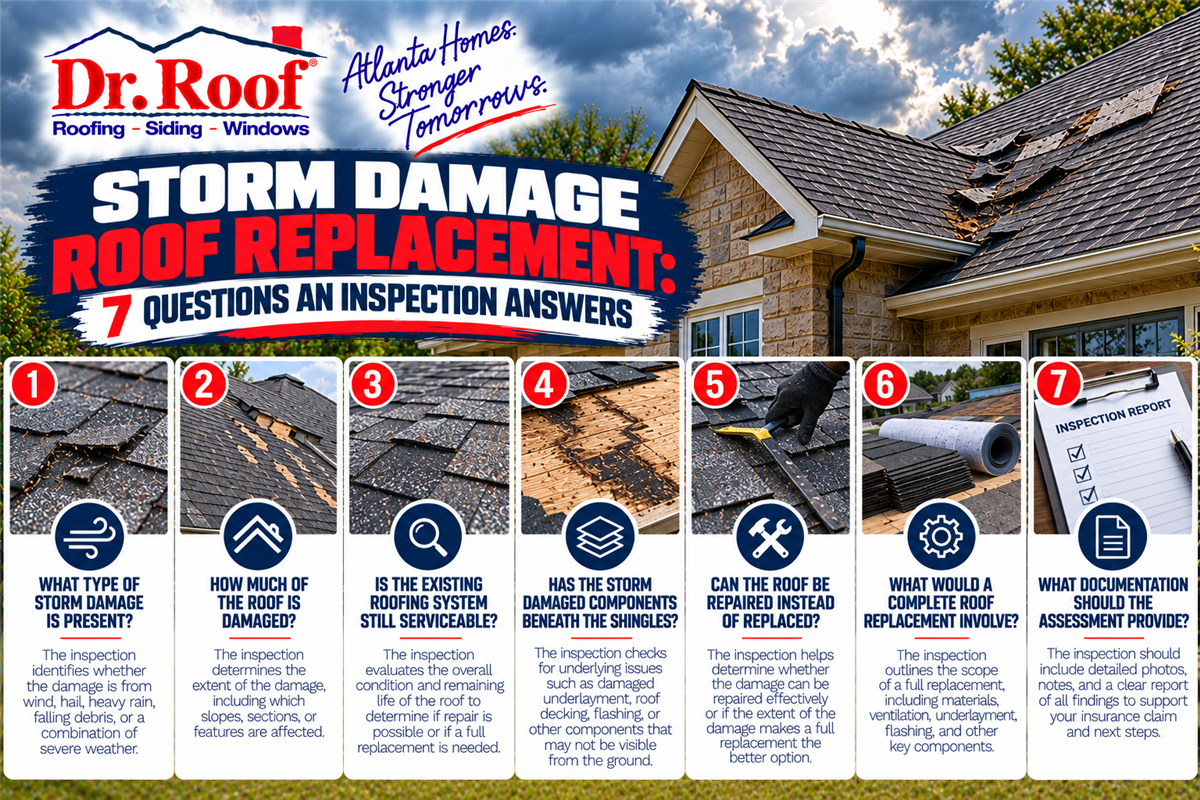
1. What Type of Storm Damage Is Present?
The first question involves identifying the nature of the damage.
Different weather events affect roofing systems in different ways.
Wind Damage
Strong winds can create uplift forces that loosen or displace asphalt shingles.
Potential wind-related damage includes:
Missing shingles
Creased shingles
Torn roofing materials
Lifted ridge caps
Displaced flashing
Damaged roof-edge components
A shingle may also experience wind-related stress without being completely removed.
The contractor should evaluate the condition of the affected materials rather than relying only on obvious missing shingles.
Hail Damage
Hail can create impact damage on certain roofing materials.
Depending on the roofing product and storm conditions, hail may cause:
Shingle bruising
Localized granule loss
Surface indentations
Cracking
Damage to roofing accessories
Not every mark on a shingle indicates functional hail damage.
Normal weathering, manufacturing characteristics, and other conditions can produce different surface appearances.
A professional evaluation should distinguish these possibilities.
Falling Debris
Tree branches and other windborne debris can damage roofing materials.
An impact may affect:
Shingles
Flashing
Roof decking
Ridge components
Structural framing
If a tree or large branch has struck the home, structural safety should be evaluated before roofing work begins.
Why Does Identifying the Damage Type Matter?
Different conditions may require different repair methods.
A localized missing-shingle problem is not necessarily equivalent to extensive hail impacts across multiple roof slopes.
The assessment should identify the observed damage and explain how it affects the roofing system.
2. How Much of the Roof Is Damaged?
The extent of the damage is one of the most important considerations when deciding between repair and replacement.
A professional inspection should evaluate more than a single visible problem.
Why Should Multiple Roof Sections Be Evaluated?
Residential roofs often contain several slopes or sections.
These may face different directions and experience different weather exposure.
For example, wind forces can affect certain roof edges and slopes more strongly than others.
Hail impact patterns may also vary across the roof.
A contractor should evaluate the relevant sections to determine whether the damage is localized or widespread.
What Does Localized Damage Mean?
Localized damage affects a limited area.
Examples may include:
Several missing shingles on one slope
A damaged pipe boot
Limited flashing damage
One roof section affected by a fallen branch
When surrounding materials remain serviceable, targeted repair may be practical.
What Does Widespread Damage Mean?
Widespread damage affects a substantial portion of the roofing system or multiple areas.
Potential examples include:
Numerous damaged shingles across several slopes
Extensive impact damage
Multiple compromised roof sections
Significant deterioration combined with new storm damage
The presence of widespread damage may justify considering replacement.
However, the final recommendation should depend on whether the damage can be repaired reliably.
Is There a Specific Percentage That Automatically Requires Replacement?
No universal damage percentage determines whether every residential roof must be replaced.
Repairability depends on the roofing system, extent and type of damage, material condition, and other project-specific factors.
An insurance company may also apply separate policy terms when evaluating a claim.
Homeowners should be cautious about claims that a particular percentage automatically guarantees full replacement.
3. Is the Existing Roofing System Still Serviceable?
Storm damage does not occur in isolation from the roof's existing condition.
Before recommending replacement, the contractor should consider whether the remaining roofing materials are suitable for continued use.
What Does Serviceable Mean?
A serviceable roofing system remains capable of performing its intended function when properly maintained.
An inspection may consider:
Shingle condition
Existing deterioration
Previous repairs
Material flexibility
Fastening condition
Flashing
Visible decking concerns
Other existing defects
A roof may have localized storm damage while the surrounding materials remain suitable.
In another situation, the storm may affect a roofing system that already has extensive deterioration.
Does Roof Age Determine Whether Replacement Is Necessary?
Not by itself.
Age provides context, but the roof's actual condition is more important.
Two roofs installed around the same time may have different conditions because of material selection, weather exposure, ventilation, maintenance, and installation quality.
A contractor should evaluate the existing roofing system rather than recommend replacement based solely on its age.
What If the Roof Already Had Problems Before the Storm?
The assessment should document both existing conditions and newly observed damage as accurately as possible.
For example, a roof may have older shingle weathering and a separate area of recent wind damage.
Those conditions should not automatically be treated as identical.
A clear report helps homeowners understand which concerns relate to the storm and which may require attention for other reasons.
4. Has the Storm Damaged Components Beneath the Shingles?
Some of the most important storm-related roofing problems are concealed beneath the visible roof covering.
For example, falling debris may damage the shingles and the roof decking beneath them.
Water entering through an opening may also affect underlayment or other materials.
Why Does Roof Decking Matter?
Roof decking provides the supporting surface beneath the roofing system.
Common residential decking materials include plywood and oriented strand board.
The decking must be structurally suitable for the roofing materials installed above it.
If decking is severely damaged, deteriorated, or unsuitable, the affected areas may require corrective work.
Can Decking Damage Be Identified From the Ground?
Not always.
Some structural concerns may produce visible signs, such as sagging.
Other problems remain concealed until roofing materials are removed or accessible areas are inspected.
A professional assessment should identify visible concerns and explain whether additional evaluation is necessary.
Does Damaged Decking Automatically Require Complete Roof Replacement?
No.
Localized decking damage may sometimes be repaired by replacing the affected sections.
More extensive damage can require broader work.
The appropriate solution depends on the extent and location of the problem and whether surrounding materials remain suitable.
What About Interior Water Damage?
Storm-related leaks can affect interior building materials.
Potential concerns include:
Wet insulation
Ceiling stains
Damp drywall
Moisture-damaged framing
Interior finishes
These conditions may require separate evaluation or repairs.
Replacing the roof does not automatically correct every interior moisture problem.
5. Can the Roof Be Repaired Instead of Replaced?
This is one of the most important questions a storm damage assessment should answer.
Not every damaged roof needs a complete replacement.
When the problem is localized, a targeted repair may provide an appropriate solution.
When Might Roof Repair Be Practical?
Repair may be appropriate when:
Damage affects a limited area
Surrounding shingles remain serviceable
Compatible replacement materials are available
The supporting roof deck is suitable
Damaged flashing can be corrected
The repair can be integrated properly with existing materials
For example, a limited number of missing shingles may be replaceable without removing the entire roofing system.
When Might Replacement Be More Appropriate?
A broader replacement may deserve consideration when:
Damage affects numerous roof areas
Roofing materials are extensively compromised
Multiple sections cannot be repaired reliably
Significant structural deterioration is present
The existing roofing materials are no longer serviceable
Repairs cannot be appropriately integrated with the remaining system
A contractor should explain the physical conditions supporting the recommendation.
What If Matching Shingles Are Unavailable?
Material availability can affect repair planning.
An older roof may use a shingle color, style, or product that is no longer manufactured.
However, an exact color match is not always necessary for a repair to be technically appropriate.
The contractor should evaluate whether suitable and compatible materials are available.
Appearance preferences and insurance policy provisions may create separate considerations.
The absence of an exact color match does not automatically guarantee replacement of the entire roof.
6. What Would a Complete Roof Replacement Involve?
If the assessment indicates that replacement is appropriate, the homeowner should understand the proposed project scope.
Roof replacement generally involves more than removing damaged shingles and installing new ones.
Depending on the selected roofing system, work may include:
Removing existing roofing materials
Evaluating exposed roof decking
Repairing damaged decking
Installing underlayment
Installing specialized leak-protection materials
Replacing or correcting flashing
Installing starter materials
Installing the main roof covering
Completing ridge components
Addressing ventilation requirements
Cleanup and final review
Why Does the Replacement Scope Matter?
Two contractors may recommend full roof replacement but include different materials or installation components.
One proposal may include replacing certain flashing assemblies.
Another may assume some existing materials remain suitable.
Homeowners should review the complete work description.
What Should a Storm Damage Replacement Estimate Include?
A useful proposal should identify:
Roof measurements
Selected roofing materials
Existing-roof removal
Underlayment
Flashing
Known decking repairs
Ventilation components
Labor and cleanup
Potential hidden damage
Applicable warranty terms
Expected scheduling
The final scope depends on the roof's condition and the selected replacement system.
7. What Documentation Should the Assessment Provide?
Clear documentation is one of the most useful outcomes of a professional storm damage inspection.
It helps homeowners understand what the contractor observed and why particular work is recommended.
What Should a Roof Damage Report Include?
Depending on the circumstances, documentation may include:
Property and inspection information
Areas evaluated
Photographs of visible damage
Descriptions of affected components
Observed roofing conditions
Repair recommendations
Replacement recommendations when appropriate
A proposed scope of work
A written estimate
The contractor should distinguish observed damage from assumptions or conditions that could not be fully evaluated.
Why Are Photographs Helpful?
Photographs can document roofing conditions that homeowners cannot safely view from the ground.
They may help illustrate:
Damaged shingles
Hail impact concerns
Displaced flashing
Roof penetrations
Decking damage
Other affected areas
Photographs do not automatically prove that an insurance policy covers a particular condition.
However, they can help explain the physical findings.
Can This Documentation Be Used for an Insurance Claim?
Yes.
A homeowner may provide inspection findings, photographs, and estimates to an insurance company when submitting or discussing a claim.
However, the insurer independently determines coverage and payment according to the policy and claim.
A roofing contractor's replacement recommendation does not guarantee that the insurer will approve a complete replacement.
What Should You Do Before Scheduling a Storm Damage Assessment?
Homeowners can take several practical steps after severe weather.
Check for Immediate Hazards
Stay away from downed power lines, unstable structures, and visibly damaged roof areas.
If a large tree or branch has struck the home, do not attempt to remove it yourself.
Arrange appropriate emergency or structural assistance when needed.
Document Visible Conditions
Take photographs from safe locations.
Useful details may include:
Missing shingles
Fallen branches
Roofing debris
Interior water stains
Damaged roof components visible from the ground
Record when the storm occurred and when damage was first noticed.
Protect the Interior
If rainwater is entering the home, take reasonable steps to protect belongings.
Move valuables when safe and avoid electrical hazards.
Professional temporary protection may be necessary if the roof has a significant opening.
Contact a Roofing Professional
Describe the storm and visible concerns.
Ask what the assessment includes and whether temporary stabilization is appropriate.
Do not climb onto a wet or damaged roof.
How Long Does a Storm Damage Roof Assessment Take?
The duration depends on the property's size, design, accessibility, and damage severity.
A straightforward roof may require less evaluation than a large home with multiple slopes, dormers, chimneys, and roof penetrations.
Additional time may be necessary when:
Damage affects multiple roof sections
Interior water intrusion is present
Structural concerns are suspected
Roof access is difficult
The inspection requires additional documentation
Homeowners should ask the contractor about the expected inspection scope rather than assuming every property can be assessed within a fixed timeframe.
How Soon Should a Roof Be Inspected After a Storm?
A professional assessment should be arranged promptly when visible damage or water intrusion is suspected.
The urgency depends on the condition.
For example, active water intrusion may require faster attention than a minor concern that is not exposing the home to additional weather.
Severe storms can also create unsafe working conditions.
Roofing contractors may need to postpone elevated work until conditions are suitable.
Homeowners should confirm appointment availability directly with the contractor.
What Is the Difference Between a Roofing Inspection and an Insurance Adjuster's Inspection?
These evaluations may serve different purposes.
Roofing Contractor Inspection
A roofing contractor evaluates the physical condition of the roof and identifies appropriate repair or replacement methods.
The contractor may provide photographs, written findings, and an estimate.
Insurance Adjuster Inspection
An insurance adjuster evaluates the reported loss as part of the insurance company's claim process.
The insurer considers the policy terms, available evidence, and claim circumstances when determining coverage.
Can the Two Assessments Reach Different Conclusions?
Yes.
A roofing contractor may recommend work based on the physical condition of the roofing system.
An insurance company may make a separate determination about covered damage and payment.
If the findings differ, homeowners can request clarification and provide additional documentation through the insurer's procedures.
The roofing contractor should not promise a particular insurance outcome.
Does Homeowners Insurance Cover Storm Damage Roof Replacement?
Some homeowners insurance policies cover certain forms of sudden storm damage.
However, coverage is not automatic.
Important considerations may include:
Cause of damage
Policy exclusions
Deductibles
Roof age provisions
Depreciation
Applicable coverage limits
Individual claim findings
What Is Replacement Cost Coverage?
Some policies provide replacement-cost coverage subject to their terms.
Other policies may calculate payment using actual cash value or other provisions.
Homeowners should review their policy and ask the insurer to explain the applicable settlement method.
Does Insurance Pay for Every Roof Replacement After a Storm?
No.
A storm occurring near the property does not automatically establish that the roof suffered covered damage.
Likewise, normal deterioration does not automatically become covered storm damage because it is discovered after severe weather.
The insurer determines whether the documented conditions qualify under the policy.
Should You Sign a Roof Replacement Contract Before the Insurance Decision?
Homeowners should carefully review contractual obligations before signing.
The Georgia Office of the Commissioner of Insurance and Safety Fire recommends documenting storm damage, communicating with the insurer, and avoiding significant permanent repairs before the damage has been appropriately evaluated.
Temporary protective measures may still be necessary to reduce additional damage.
If an insurance claim is involved, ask the insurer about the claim process and the timing of permanent repairs.
Do not assume that an insurance claim will automatically cover every amount in a roofing contract.
Homeowners remain responsible for understanding the agreement they sign.
What Questions Should You Ask During a Storm Damage Roof Assessment?
A professional consultation is an opportunity to understand the condition of the entire roofing system.
Consider asking:
What specific storm-related damage did you identify?
Which roof sections were affected?
Are the surrounding roofing materials still serviceable?
Is there evidence of decking or structural damage?
Can the affected areas be repaired reliably?
What conditions support a replacement recommendation?
Will photographs and written findings be available?
What would the proposed replacement include?
How will unexpected damage be handled?
What warranty information applies?
Clear answers can help homeowners distinguish a necessary replacement from a more limited repair.
How Dr. Roof Helps Atlanta Homeowners Assess Storm Damage
Dr. Roof has served Atlanta-area homeowners since 1988, providing professional roofing inspections, repairs, roof replacement, and storm-damage documentation support.
Dr. Roof is a GAF Master Elite Certified Contractor and CertainTeed SELECT ShingleMaster.
A storm-related roof evaluation can help identify concerns involving:
Damaged asphalt shingles
Flashing
Ridge materials
Roof penetrations
Valleys
Decking
Signs of water intrusion
Depending on the circumstances, Dr. Roof may provide photographs, written findings, and recommendations for repair or replacement.
For homeowners considering an insurance claim, this documentation may help explain the roof's physical condition.
The insurance company remains responsible for determining coverage and claim payment.
Make the Replacement Decision Based on the Roof's Condition
A severe storm does not automatically mean that a complete roof replacement is necessary.
The appropriate solution depends on the type of damage, how much of the roof is affected, and whether the existing roofing system can be repaired reliably.
A professional assessment helps homeowners understand those factors before making a decision.
For Atlanta homeowners dealing with wind, hail, or debris damage, clear inspection findings and a detailed scope of work provide a practical starting point.
If you suspect that your roof has sustained significant storm damage, contact Dr. Roof to schedule a professional assessment and discuss whether roof repair or replacement is appropriate for your home.
How do I know if storm damage requires roof replacement?
A professional roofing assessment can determine whether storm damage is localized or widespread and whether the surrounding roofing materials remain serviceable. Complete replacement may be appropriate when extensive damage cannot be repaired reliably.
What does a storm damage roof replacement assessment include?
An assessment may include evaluating shingles, flashing, ridge materials, roof penetrations, decking, and signs of water intrusion. The contractor may document the damage through photographs and provide repair or replacement recommendations.
Can a storm-damaged roof be repaired instead of replaced?
Yes. Localized damage may be repairable when surrounding roofing materials remain suitable and compatible replacement materials are available. Widespread damage or significant deterioration may require a more extensive solution.
Does a roofing contractor's replacement recommendation guarantee insurance approval?
No. A roofing contractor evaluates the physical condition of the roof and recommends appropriate work. Insurance coverage and claim payment decisions belong to the insurer and depend on the policy and individual claim.
How soon should I schedule a roof inspection after a storm?
Arrange a professional assessment promptly when visible damage or water intrusion is suspected. Active leaks or exposed roofing materials may require urgent attention. Inspection timing also depends on weather conditions and contractor availability.
What documentation should I request after a storm damage inspection?
Ask for photographs of identified damage, written findings, affected roof locations, recommended work, and a project estimate when appropriate. This information can help explain the roof's condition and may be useful during an insurance claim.
Subscribe to Dr. Roof's Blog




Comments