When planning a roof replacement, most homeowners focus on shingles, colors, warranties, and the appearance of the finished roof.
However, an important part of the roofing system is hidden beneath those new shingles.
Roof underlayment provides an additional layer of protection between the roof decking and the primary roofing material. It helps reduce the risk of water reaching the roof deck when moisture gets beneath the roof covering.
Proper roof underlayment is important during replacement because it provides secondary moisture protection and helps the roofing system manage wind-driven rain and other weather exposure.
For Atlanta homeowners, understanding how underlayment works can help clarify why two roof replacement estimates may include different materials and installation methods.
Here are seven important things to know before choosing a new roofing system.
What Is Roof Underlayment?
Roof underlayment is a protective material installed over the roof decking and beneath the primary roof covering.
On many residential asphalt-shingle roofs, the roofing assembly includes several layers.
These generally consist of:
Structural roof framing
Roof decking or sheathing
Underlayment
Specialized leak-protection materials where appropriate
Asphalt shingles
Flashing, starter materials, and other roofing accessories
Each component serves a different purpose.
The decking provides a supporting surface.
The underlayment adds secondary water resistance.
The shingles form the primary water-shedding roof covering.
Flashing helps manage water around roof penetrations and transitions.
These components must work together.
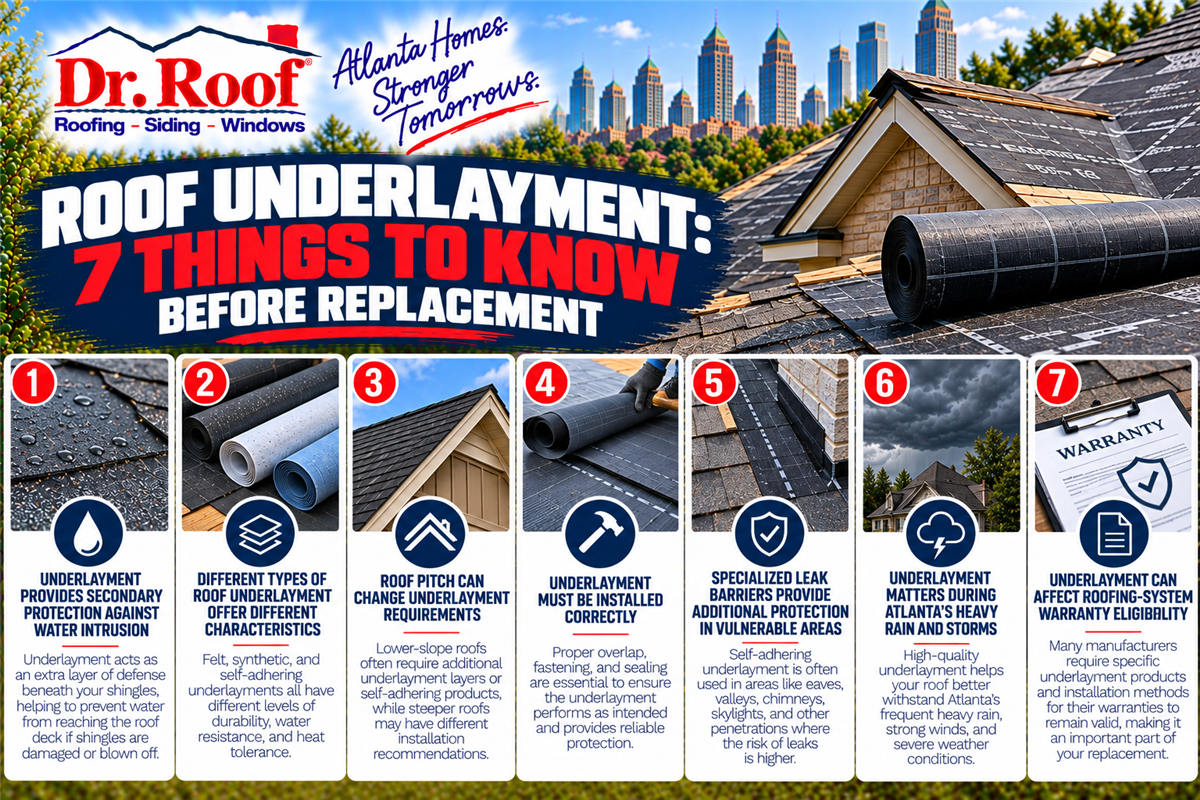
1. Underlayment Provides Secondary Protection Against Water Intrusion
The primary function of roof underlayment is to help protect the decking beneath the roofing materials.
Asphalt shingles are installed in overlapping courses designed to direct rainwater toward the roof edges.
However, under certain weather conditions, water may reach beneath the shingles.
Strong wind-driven rain is one example.
Properly installed underlayment provides a secondary layer that helps reduce the risk of moisture reaching the underlying roof deck.
Is Roof Underlayment Waterproof?
Not every underlayment product is waterproof.
Many conventional felt and synthetic underlayments are water-resistant products designed for use beneath a completed roofing system.
Certain specialized self-adhered membranes provide additional water protection in specific applications.
Homeowners should not assume that all underlayment materials have identical characteristics.
Can Underlayment Prevent Every Roof Leak?
No.
Underlayment is an important protective component, but it cannot compensate for every roofing defect.
For example, an improperly installed chimney flashing assembly may still allow water to enter the building.
A successful roof replacement depends on the appropriate installation of all necessary roofing components.
2. Different Types of Roof Underlayment Offer Different Characteristics
Roof underlayment is available in several material categories.
Three important options to understand are asphalt-based felt, synthetic underlayment, and self-adhered leak-protection membranes.
Although these products can serve related purposes, they are not necessarily interchangeable.
Asphalt-Saturated Felt Underlayment
Asphalt-based felt is a traditional roofing underlayment material.
It is commonly available in product categories historically referred to as No. 15 and No. 30 felt.
These designations help identify different felt products, although homeowners should review current product specifications rather than relying only on the traditional names.
Potential characteristics include:
Established use in residential roofing
Different product weights and constructions
Compatibility with qualifying roofing systems
Specific fastening and overlap requirements
Some felt products can absorb moisture and may wrinkle or buckle under certain conditions.
The appropriate product depends on the selected roofing system and installation requirements.
Synthetic Roof Underlayment
Synthetic underlayment is manufactured using engineered materials, commonly including polypropylene or polyethylene-based components.
Different synthetic products offer different properties.
Potential characteristics include:
Resistance to tearing
Lightweight construction
Moisture resistance
Wider roll dimensions
Specialized walking surfaces
Product-specific exposure limitations
For example, GAF manufactures synthetic roof deck protection products such as FeltBuster and Deck-Armor.
These products have different characteristics and installation requirements.
Self-Adhered Leak-Protection Membranes
Self-adhered membranes are often used in vulnerable roofing areas.
These products may be installed around:
Roof valleys
Eaves
Certain roof edges
Chimneys
Other vulnerable transitions
Some are designed to seal around fastener penetrations and provide additional resistance to water intrusion.
Their installation locations and compatibility depend on the roofing system and applicable requirements.
Is Synthetic Underlayment Always Better Than Felt?
Not necessarily for every roofing project.
Synthetic products may offer useful characteristics, but the appropriate selection depends on the roof design, material specifications, manufacturer requirements, and installation conditions.
Homeowners should compare the proposed products rather than assuming one material category is automatically suitable for every roof.
3. Roof Pitch Can Change Underlayment Requirements
Roof pitch describes the steepness of a roof.
It is commonly expressed as the number of inches the roof rises vertically for every 12 inches of horizontal distance.
For example:
A 2:12 roof rises 2 inches for every 12 inches horizontally.
A 4:12 roof rises 4 inches for every 12 inches horizontally.
A 6:12 roof rises 6 inches for every 12 inches horizontally.
Roof pitch affects water drainage and roofing material suitability.
Why Does Pitch Matter for Underlayment?
Water generally drains more slowly across lower-sloped roofs than steeper ones.
This can increase the importance of appropriate secondary water protection.
For many conventional asphalt-shingle products, manufacturer instructions distinguish between standard-slope and qualifying low-slope applications.
What Happens on a Roof With a 2:12 to Less Than 4:12 Slope?
Certain asphalt-shingle systems permit installation on these slopes when additional requirements are followed.
Depending on the specific product, these requirements may include enhanced underlayment coverage or an approved alternative assembly.
For example, GAF's FeltBuster installation instructions identify a double-coverage method for qualifying roof slopes from 2:12 to less than 4:12.
The exact installation method must follow the selected product's current instructions.
Can Asphalt Shingles Be Installed Below a 2:12 Pitch?
Many conventional asphalt-shingle products are not approved for slopes below 2:12.
Very low-slope roof sections may require a roofing system specifically designed for that application.
Homeowners should ask their contractor to evaluate all roof sections, especially porches, additions, and other areas with shallow slopes.
4. Underlayment Must Be Installed Correctly
Selecting an appropriate underlayment product is only part of the process.
The material must also be installed according to its published instructions.
Important installation details may include:
Roof deck preparation
Roll orientation
Side overlaps
End overlaps
Fastener selection
Fastening patterns
Roof-edge integration
Flashing transitions
Manufacturer requirements
Why Are Overlaps Important?
Many underlayment products are installed in overlapping courses.
The overlap arrangement helps direct water toward the roof edge rather than allowing it to pass between adjacent sheets.
The required overlap dimensions depend on the product and application.
A contractor should follow the manufacturer's specified installation method.
Does Fastener Type Matter?
Yes.
Different underlayment products may require particular fasteners and fastening patterns.
For example, some synthetic underlayments require capped fasteners.
Using inappropriate fasteners or spacing can affect the installation.
Should Underlayment Be Installed Over Damaged Decking?
Unsuitable decking should be addressed before the new roofing system is installed.
If the existing decking contains rot, severe deterioration, or other structural concerns, those conditions may require repair.
Underlayment does not restore the strength of damaged roof decking.
A professional roof replacement should begin with a suitable supporting surface.
5. Specialized Leak Barriers Provide Additional Protection in Vulnerable Areas
Not every part of the roof experiences water exposure in the same way.
Certain areas are particularly vulnerable because they collect runoff or involve transitions between roofing components.
Examples include:
Roof valleys
Chimney intersections
Skylight openings
Roof-to-wall transitions
Eaves
Certain roof penetrations
These locations may benefit from specialized leak-protection materials when required or appropriate for the system.
What Is a Roof Leak Barrier?
A leak barrier is a protective roofing product designed to provide additional water resistance in vulnerable areas.
Some leak barriers are self-adhered membranes that bond to the roof decking or another approved substrate.
Products such as GAF WeatherWatch are designed to help reduce leaks associated with wind-driven rain and other relevant conditions.
Does Every Roof Need the Same Leak Barrier Layout?
No.
The appropriate placement depends on the roof design, selected materials, climate, manufacturer instructions, and applicable building requirements.
Homeowners should ask which vulnerable areas will receive additional protection and why.
Can Leak Barriers Replace Proper Flashing?
No.
Flashing and leak barriers serve related but different functions.
A specialized membrane can provide additional protection beneath roofing materials.
However, proper flashing remains essential around chimneys, walls, penetrations, and other transitions.
The complete roofing assembly should be designed to direct water appropriately.
6. Underlayment Matters During Atlanta's Heavy Rain and Storms
Atlanta-area homes experience periods of heavy rainfall, thunderstorms, strong winds, and humidity.
These conditions make appropriate roofing water management important.
A properly installed asphalt-shingle system is designed to shed rainwater.
However, wind-driven rain can create additional exposure at certain roofing details.
Underlayment helps provide secondary protection beneath the main roof covering.
Does Underlayment Help During Strong Winds?
Certain underlayment products are designed to help reduce water intrusion associated with wind-driven rain.
However, underlayment does not replace the primary roofing material or proper shingle fastening.
Wind performance depends on the complete roofing system.
Important components include:
Shingles
Fasteners
Starter materials
Ridge components
Roof decking
Underlayment
Flashing
The selected system must be installed according to its requirements.
Can Underlayment Protect a Home if Shingles Blow Off?
Underlayment may provide some secondary resistance to water intrusion, depending on the product and conditions.
However, exposed underlayment should not be treated as a permanent roof.
Some synthetic products are water-resistant but are specifically not intended to serve as temporary weatherproof roofing.
If storm damage removes shingles, homeowners should arrange a professional evaluation.
Temporary protective measures may be necessary until permanent repairs can be completed.
7. Underlayment Can Affect Roofing-System Warranty Eligibility
Roof replacement warranties vary by manufacturer, product, and installation circumstances.
Some enhanced manufacturer warranties involve qualifying roofing-system components.
These may include:
Asphalt shingles
Roof deck protection
Leak barriers
Starter materials
Ridge cap shingles
Other eligible accessories
The exact components depend on the warranty program.
Does Premium Underlayment Automatically Qualify a Roof for a Better Warranty?
No.
Installing one premium roofing component does not automatically qualify a project for enhanced warranty coverage.
Eligibility may depend on the selected shingles, number and type of qualifying accessories, contractor credentials, registration requirements, and other conditions.
Homeowners should review the specific warranty documents.
What Should You Ask About Warranty Coverage?
Consider asking:
Which underlayment product is included?
Is it compatible with the selected shingles?
Does it qualify as a manufacturer roofing-system accessory?
Are additional components required for the proposed warranty?
What coverage applies to the underlayment?
Are there installation or registration requirements?
These questions can help clarify the relationship between material selection and warranty protection.
Felt vs. Synthetic Underlayment: Which Should Atlanta Homeowners Choose?
Both product categories may be suitable for qualifying residential roofing systems.
The appropriate decision depends on the roof and the specific products being compared.
When Might Felt Underlayment Be Considered?
An approved felt product may be suitable when the selected roofing system permits it and the installation meets applicable requirements.
Homeowners should review the product's construction, moisture characteristics, and installation specifications.
When Might Synthetic Underlayment Be Considered?
A synthetic product may be appropriate when homeowners and contractors prioritize characteristics such as tear resistance, material handling, or other specified product features.
However, synthetic underlayments also differ from one another.
Some are designed with particular breathability characteristics.
Others emphasize durability, traction, or different installation properties.
Which Is Best?
The best option is the product that is appropriate for the roofing assembly and installed correctly.
A contractor should explain why the proposed underlayment is suitable for the specific roof.
Is Roof Underlayment Required During Roof Replacement?
Underlayment is generally an important part of conventional residential asphalt-shingle roof assemblies.
However, the applicable requirements depend on the roofing system, roof slope, product instructions, and local building rules.
Homeowners should not assume every roof assembly uses identical underlayment.
For example, certain specialty roofing systems have different construction methods.
A contractor should confirm the materials and installation requirements applicable to the project.
What Happens to the Old Underlayment During Roof Replacement?
During a typical asphalt-shingle tear-off project, the contractor removes existing roofing materials included in the approved scope.
This commonly includes old underlayment.
Once the materials are removed, the roof decking can be evaluated more directly.
The contractor can then prepare the roof for new underlayment and the selected roofing materials.
Why Is Decking Inspection Important?
Existing shingles and underlayment can conceal damaged or deteriorated roof decking.
A replacement project provides an opportunity to identify problems such as:
Wood rot
Delaminated panels
Holes
Previous water damage
Unsuitable supporting materials
Not every roof requires completely new decking.
The contractor should evaluate the actual condition and address areas that are unsuitable for the new installation.
Can Roof Underlayment Be Left Exposed During Installation?
Some underlayment products have published exposure limits.
However, those limits should not be confused with a guarantee that the material can protect an occupied home from every weather condition.
For example, certain synthetic products are designed to resist ultraviolet degradation for specified periods.
That does not necessarily mean they are waterproof or suitable as permanent weather protection.
Roofing contractors should plan installation and temporary protection based on the product's requirements and expected weather conditions.
Homeowners should ask how the property will be protected if installation is interrupted.
How Does Underlayment Affect the Cost of Roof Replacement?
Underlayment is one component of the complete roof replacement price.
Cost factors may include:
Selected product
Roof size
Roof pitch
Installation requirements
Required overlaps
Additional leak-protection materials
Roof complexity
Labor
Some products may have different material or installation costs.
However, the lowest-priced underlayment is not automatically the best choice for every project.
Likewise, the most expensive option is not necessarily appropriate for every roofing system.
Homeowners should compare materials based on suitability, performance characteristics, and the complete installation.
What Should Your Roof Replacement Estimate Say About Underlayment?
A detailed roofing proposal should identify the principal roofing materials and components being installed.
For underlayment, consider asking the contractor to explain:
Which product will be used?
Who manufactures it?
Is it appropriate for the selected shingles?
Does the roof pitch require special installation?
Where will additional leak barriers be installed?
How will the material be fastened?
How will damaged decking be handled?
What warranty coverage applies?
What happens if weather interrupts installation?
Understanding these details can help homeowners compare roofing proposals more effectively.
Why Underlayment Shouldn't Be Overlooked During Roof Replacement
Two roof replacement estimates may propose the same architectural shingles but different materials beneath them.
One may include conventional felt.
Another may include synthetic roof deck protection and additional leak-protection components.
The proposals may not represent identical roofing systems.
Homeowners should understand these differences before comparing the total price.
Roofing materials should be evaluated as a complete system rather than as individual products selected independently.
How Dr. Roof Helps Atlanta Homeowners Plan Roof Replacement
Dr. Roof has served Atlanta-area homeowners since 1988, providing professional roof inspections, repairs, and replacement services.
Dr. Roof is a GAF Master Elite Certified Contractor and CertainTeed SELECT ShingleMaster.
During a roof replacement consultation, homeowners can discuss the roofing materials and components appropriate for their property.
These may include:
Roofing shingles
Roof decking
Underlayment
Leak-protection materials
Flashing
Starter materials
Ridge components
Ventilation
The recommended system should reflect the home's roof design, existing conditions, and the requirements of the selected products.
Homeowners should also review any applicable manufacturer and workmanship warranty terms before approving the project.
A Successful Roof Replacement Starts Beneath the Shingles
Roof underlayment may not be visible after installation, but it plays an important role in protecting the roof decking.
The appropriate product provides secondary moisture protection and works alongside the shingles, flashing, and other roofing components.
For Atlanta homeowners, understanding underlayment helps clarify material choices, roof pitch considerations, installation requirements, and roofing-system warranties.
Before selecting a new roof, ask what materials will be installed beneath the shingles and why they are appropriate for your home.
Contact Dr. Roof to schedule a professional roof replacement consultation and discuss the roofing system that best fits your property's needs.
What is the purpose of roof underlayment?
Roof underlayment provides secondary moisture protection between the roof decking and the primary roof covering. It helps reduce the risk of water reaching the decking when moisture gets beneath the shingles. It works alongside other roofing components rather than replacing them.
Is synthetic roof underlayment better than felt?
Synthetic underlayment may offer advantages such as tear resistance, lighter weight, and other product-specific characteristics. However, felt and synthetic products can both be appropriate for qualifying roofing systems. The best choice depends on the roof design, product specifications, and installation requirements.
Is roof underlayment waterproof?
Not all roof underlayment is waterproof. Many conventional felt and synthetic products are water-resistant and designed to provide secondary protection beneath a completed roof. Certain specialized self-adhered membranes provide additional water protection in specific applications.
Do low-slope roofs need additional underlayment?
Some qualifying low-slope asphalt-shingle applications require enhanced underlayment coverage or another manufacturer-approved method. The exact requirements depend on the roof slope and selected roofing products. Homeowners should follow the manufacturer's installation instructions and applicable building requirements.
Does every roof replacement need new underlayment?
A typical full asphalt-shingle tear-off project includes installing new underlayment as part of the replacement roofing system. However, roofing assemblies and project scopes vary. The contractor should explain which materials will be removed and replaced.
Does roof underlayment affect warranty coverage?
It can. Some enhanced manufacturer roofing-system warranties require qualifying underlayment or other roofing accessories. Eligibility depends on the specific products, installation, contractor qualifications, and written warranty conditions. Premium underlayment alone does not guarantee enhanced coverage.
Subscribe to Dr. Roof's Blog






Comments