When you hire a roofing contractor to repair a leak, replace damaged shingles, or correct a flashing problem, you expect the work to provide dependable protection.
But what happens if the repaired area develops another problem?
Will the contractor return? Is the repair covered by a warranty? And how does that coverage differ from the warranty on your original roofing materials?
These are important questions for Atlanta homeowners.
Roof repair warranty coverage depends on the contractor's written workmanship agreement, the materials installed, the specific repair performed, and the cause of any future problem.
Some repairs include workmanship protection, while certain roofing products may carry separate manufacturer warranties. However, not every roof repair qualifies for the same coverage.
Understanding these differences before approving work can help homeowners make informed decisions and avoid unexpected misunderstandings.
What Is a Roof Repair Warranty?
A roof repair warranty is an agreement describing what protection applies to qualifying roofing work or materials.
Depending on the project, coverage may come from the roofing contractor, a material manufacturer, or both.
A warranty should explain:
What work or materials are covered
How long coverage lasts
What conditions qualify for a remedy
Which problems are excluded
How homeowners should report concerns
What corrective action may be available
The specific written terms determine the actual protection.
A contractor's general statement that a repair is "guaranteed" is not a substitute for understanding what that guarantee includes.
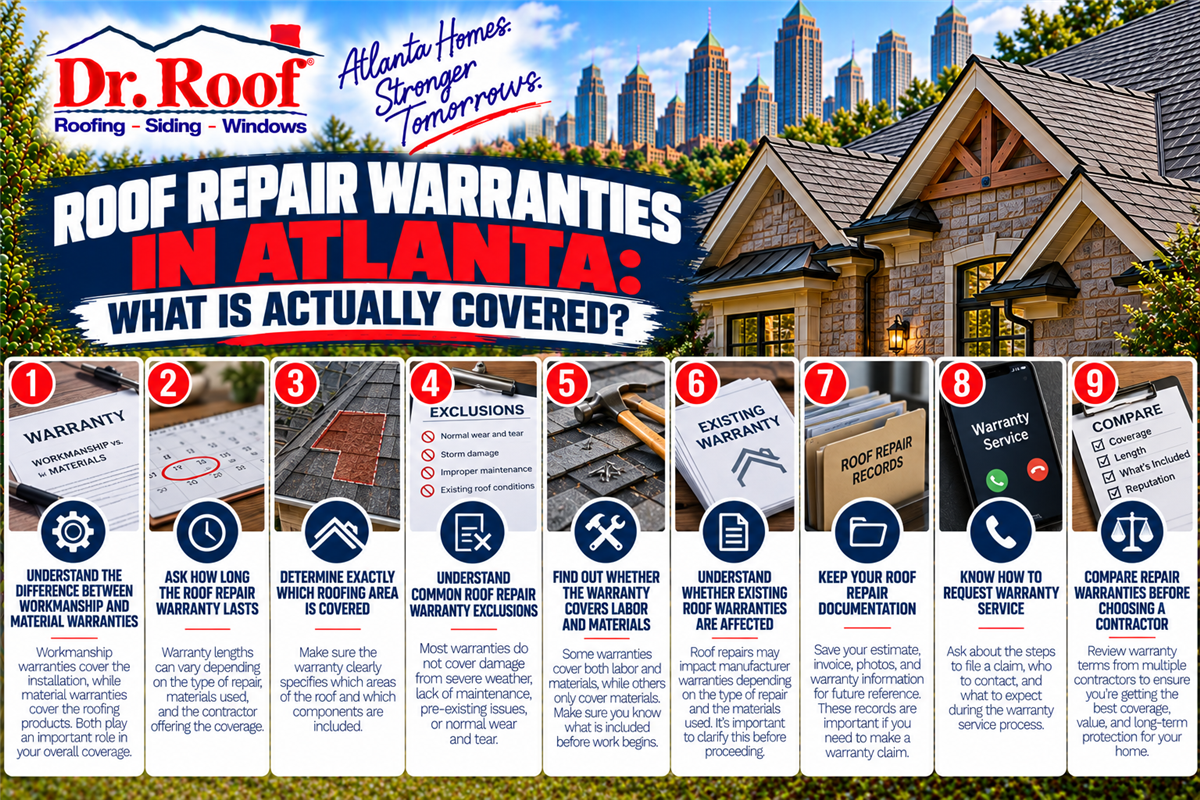
1. Understand the Difference Between Workmanship and Material Warranties
One of the most important distinctions involves the type of warranty.
Contractor Workmanship Warranty
A workmanship warranty generally addresses qualifying problems associated with the contractor's installation or repair work.
For example, a contractor may replace damaged flashing around a chimney.
If a problem later develops because of a covered installation defect in that repaired area, the workmanship agreement may provide a remedy.
However, the exact coverage depends on the written contract.
Manufacturer Material Warranty
A manufacturer warranty generally applies to qualifying defects in specified roofing products.
Depending on the product and warranty, covered materials may include:
Asphalt shingles
Certain underlayment products
Roofing accessories
Other eligible manufacturer components
A material warranty does not automatically cover every leak or roofing problem.
For example, an asphalt shingle manufacturing-defect warranty is not necessarily protection against damage caused by falling branches, improper maintenance, or unrelated flashing problems.
Why Does the Difference Matter?
A homeowner might discover a leak near recently repaired shingles and assume the manufacturer is responsible.
However, the actual problem could involve installation, previously damaged materials, or another part of the roofing system.
Determining the cause is essential before deciding which warranty, if any, applies.
2. Ask How Long the Roof Repair Warranty Lasts
Repair warranty periods can vary considerably.
A small shingle repair may carry different coverage from a more extensive project involving flashing or other roofing components.
The duration depends on the contractor's terms and the work performed.
What Warranty Does Dr. Roof Offer for Repairs?
Dr. Roof's published roofing information explains that certain repair work receives warranty protection lasting between one and five years, depending on the materials used.
That does not mean every repair automatically qualifies for five years of coverage.
The actual duration and conditions should be confirmed in the written proposal and applicable warranty documents.
Does a Longer Warranty Always Mean a Better Repair?
Not necessarily.
Warranty duration is important, but homeowners should also examine:
The scope of coverage
Exclusions
Repair limitations
Claim procedures
Materials used
Contractor qualifications
A shorter warranty with clearly defined protection may be easier to understand than a broad promise with unclear limitations.
The best approach is to compare the actual agreements.
3. Determine Exactly Which Roofing Area Is Covered
A roof repair warranty may apply only to the work completed during that project.
This distinction is particularly important for older roofing systems.
Suppose a contractor repairs a leaking plumbing vent.
The warranty may address qualifying workmanship concerns involving that repair.
It may not cover deterioration in an unrelated roof valley or shingles on another roof slope.
Does a Repair Warranty Cover the Entire Roof?
Not automatically.
Coverage depends on the written agreement.
If the contractor repaired one section, homeowners should not assume the warranty extends to every roofing component.
Before approving work, ask:
Which areas are covered?
Are surrounding shingles included?
Does the coverage include replacement flashing?
Are other existing roofing materials excluded?
What happens if a separate leak develops nearby?
These questions help establish the boundaries of the warranty.
4. Understand Common Roof Repair Warranty Exclusions
Warranty agreements frequently contain exclusions or limitations.
These provisions identify circumstances that may not qualify for coverage.
Examples may include:
New storm damage
Falling trees or debris
Damage caused by unrelated contractors
Normal material deterioration
Improper modifications
Unrelated roofing defects
Certain maintenance-related problems
The exclusions depend on the specific warranty.
Homeowners should not assume every agreement contains the same provisions.
Is Storm Damage Covered by a Roof Repair Warranty?
Not necessarily.
A contractor's workmanship warranty generally should not be confused with insurance protection against future storms.
For example, if a contractor correctly repairs shingles and a later storm damages those materials, the new damage may fall outside the workmanship warranty.
Some roofing products include specific manufacturer wind-related warranty provisions, but those have their own conditions and limitations.
The homeowner's insurance policy is a separate source of potential coverage.
5. Find Out Whether the Warranty Covers Labor and Materials
Not every warranty covers the same expenses.
Some agreements may provide qualifying replacement materials.
Others may include certain labor costs.
Coverage can also depend on when the problem occurs.
What Is Material-Only Coverage?
Material-only coverage generally addresses eligible roofing products according to the manufacturer's terms.
It does not necessarily include the cost of removing damaged components or installing replacements.
What Is Labor Coverage?
Labor coverage may address certain installation or replacement work when a qualifying problem occurs.
The circumstances and limits depend on the warranty.
Why Should Homeowners Ask?
A warranty that covers replacement shingles but excludes installation labor differs significantly from one that includes both.
Before approving a repair, ask the contractor to explain whether covered corrective work includes materials, labor, or both.
6. Understand Whether Existing Roof Warranties Are Affected
Homeowners sometimes have an existing manufacturer warranty on their roofing system before repairs begin.
The relationship between that warranty and new repairs can be complicated.
For example, the original shingles may remain subject to their existing limited warranty.
However, new replacement materials may have different terms.
The effect of repairs on existing coverage depends on the manufacturer and applicable documentation.
Does Repairing a Roof Restart Its Original Warranty?
Generally, homeowners should not assume that a repair restarts the warranty period for the entire roof.
A repaired section does not automatically create a new full-roof warranty.
The original product's coverage may continue according to its terms.
Newly installed materials may have their own applicable coverage.
What Should You Ask Before Repairs Begin?
If your roof has an existing manufacturer warranty, consider asking:
Will the proposed repair affect existing coverage?
Are replacement materials compatible?
Does the manufacturer require specific installation procedures?
Are any notifications or approvals necessary?
Will new materials have separate warranty documentation?
Contact the manufacturer when clarification is needed.
7. Keep Your Roof Repair Documentation
Warranty information becomes more useful when homeowners can identify what work was performed.
After completing a repair, keep copies of:
Inspection findings
Photographs
Written estimates
Signed agreements
Material information
Final invoices
Warranty documents
Relevant correspondence
These records may help establish the repair location, materials installed, and date of completion.
Why Do Photographs Matter?
Suppose a leak develops several months after flashing repairs.
Photographs of the original damage and completed work may help the contractor compare the current condition with the earlier repair.
Documentation does not guarantee warranty coverage.
However, it can help clarify whether the concern relates to the previously completed work.
8. Know How to Request Warranty Service
If you suspect a problem with a previously repaired area, begin by contacting the roofing contractor.
Describe the issue and provide any available documentation.
A useful report may include:
The original repair date
The location of the work
When the new problem appeared
Photographs taken from safe locations
Copies of applicable warranty information
What Happens After You Report a Problem?
The contractor may need to inspect the affected area.
The purpose is to identify the source of the problem and determine whether the condition qualifies under the agreement.
Possible outcomes depend on the findings and warranty terms.
The contractor may determine that corrective work is covered, that another roofing component is responsible, or that the condition is excluded.
Avoid assuming the cause before an appropriate evaluation.
9. Compare Repair Warranties Before Choosing a Contractor
Warranty protection should be part of your contractor comparison.
However, it should not be the only consideration.
A reputable roofing contractor should also provide:
A reasonable explanation of the damage
An appropriate repair recommendation
Suitable roofing materials
A written scope of work
Clear pricing
Information about potential hidden damage
Applicable warranty documentation
What Warranty Questions Should You Ask?
Before signing a repair agreement, consider these questions:
What workmanship warranty applies?
How long does the coverage last?
Does the warranty cover labor and materials?
Which roofing areas are included?
What conditions are excluded?
How do I report a concern?
Will the warranty be provided in writing?
Does the repair affect my existing manufacturer warranty?
Clear answers can help homeowners understand the value of the proposed work.
Roof Repair Warranty vs. Roof Replacement Warranty
Roof repair and roof replacement warranties may differ because the projects involve different scopes.
A repair generally addresses one or more identified problems in an existing roofing system.
A replacement involves installing a new roofing system or substantially replacing existing roofing materials.
Why Can Replacement Warranties Differ?
Some enhanced manufacturer roofing-system warranties require qualifying shingles, accessories, contractor credentials, and installation conditions.
A localized roof repair may not satisfy those requirements.
For example, a manufacturer warranty available for a qualifying complete roofing system should not be assumed to apply to a small flashing repair.
Homeowners should compare coverage based on the actual project.
Does a Roof Repair Warranty Guarantee That Your Roof Will Never Leak Again?
No.
A completed repair may correct the identified problem, but other roofing components can develop unrelated issues.
For example, a properly repaired chimney flashing assembly does not prevent a plumbing vent boot from deteriorating elsewhere.
Warranty protection is determined by the written terms.
A repair should address the identified defect, but it cannot guarantee that the entire roofing system will remain free from every future problem.
Does Homeowners Insurance Replace a Roof Repair Warranty?
No.
Insurance and warranties serve different purposes.
A contractor warranty may address qualifying workmanship concerns.
A manufacturer warranty may address qualifying product defects.
Homeowners insurance may provide coverage for certain losses under the policy.
These are separate forms of protection.
Insurance coverage decisions belong to the insurer and depend on the individual claim.
Neither a roofing contractor nor a warranty document can guarantee that an insurance claim will be approved.
What If Your Roof Begins Leaking After a Repair?
A new leak should receive prompt attention.
Take reasonable steps to protect people and belongings.
Avoid electrical hazards and do not climb onto a wet or damaged roof.
Document the visible moisture from a safe location.
Then contact the contractor and explain the problem.
If the concern involves a previously repaired area, provide the original paperwork and ask about the applicable warranty procedure.
A professional inspection can help determine whether the problem is related to the previous work or another roofing component.
Why Warranty Clarity Matters for Atlanta Homeowners
Atlanta-area roofing systems experience heavy rainfall, thunderstorms, strong winds, humidity, and occasional hail.
These conditions make it important to understand the difference between installation-related concerns and new weather damage.
A homeowner who understands their warranty is better prepared to report concerns and evaluate the next steps.
The goal is not simply choosing the longest advertised warranty.
It is understanding the actual protection associated with the roofing work.
How Dr. Roof Helps Atlanta Homeowners With Roof Repairs
Dr. Roof has served Atlanta-area homeowners since 1988, providing professional roof inspections, repairs, replacement, and storm-damage documentation support.
Dr. Roof is a GAF Master Elite Certified Contractor and CertainTeed SELECT ShingleMaster.
The company offers warranty protection for qualifying roofing work, with terms depending on the project and materials.
Homeowners should review the specific coverage provided with their repair proposal.
A professional roofing evaluation can also help determine whether a concern involves damaged shingles, flashing, roof penetrations, decking, or another part of the roofing system.
Know Your Coverage Before Approving Roof Repairs
A roof repair warranty can provide valuable protection, but only when homeowners understand its terms.
Workmanship coverage, manufacturer warranties, repair scope, exclusions, labor provisions, and claim procedures can all affect the outcome.
Before hiring a roofing contractor, request written warranty information and ask questions about anything that is unclear.
For Atlanta homeowners, Dr. Roof can evaluate roofing concerns, explain recommended repairs, and provide information about the coverage applicable to the proposed work.
Understanding your warranty is an important part of making a confident roof repair decision.
What does a roof repair warranty usually cover?
A roof repair warranty may cover qualifying workmanship problems involving the repaired area. Some roofing materials may also have separate manufacturer coverage. The specific work, materials, remedies, and exclusions depend on the written warranty terms.
How long does a roof repair warranty last?
Warranty periods vary by contractor, repair type, and materials. Dr. Roof's published information describes coverage of between one and five years for certain repair work, depending on materials. Homeowners should confirm the applicable duration in their written agreement.
Does a roof repair warranty cover future storm damage?
Not necessarily. Contractor workmanship warranties generally should not be treated as insurance against future storms. Coverage for wind, hail, falling debris, or other damage depends on the applicable warranty or insurance policy.
Does repairing a roof restart the manufacturer's warranty?
Homeowners should not assume that repairing part of a roof restarts the original warranty period. Existing materials may remain subject to their original terms, while replacement materials may have separate coverage.
What should I do if my roof leaks after a warranted repair?
Document the problem from a safe location, review the repair agreement, and contact the roofing contractor. An inspection may be necessary to determine whether the leak relates to the original repair and qualifies for warranty service.
Does a roof repair warranty cover the entire roof?
Not automatically. A repair warranty may apply only to the specific work completed. Damage or deterioration in unrelated areas may fall outside the coverage unless the written agreement states otherwise.
Subscribe to Dr. Roof's Blog



Comments