When Atlanta homeowners invest in a new roof, they often focus on the visible materials: shingle style, color, manufacturer, and warranty options.
However, an important part of installation quality is hidden beneath the finished roofing system.
Roofing nails secure asphalt shingles to the roof decking. Their type, placement, number, and installation depth all influence whether shingles are attached according to the manufacturer's requirements.
Proper shingle fastening means using suitable roofing nails, placing them in the designated nailing area, driving them correctly, and following the fastening pattern required for the specific roofing product and installation conditions.
Incorrect fastening can contribute to loose shingles, exposed fasteners, damaged roofing materials, and increased vulnerability to wind.
For Atlanta homeowners planning roof replacement, understanding these details can help you ask informed questions about installation quality.
Here are seven important factors to consider.
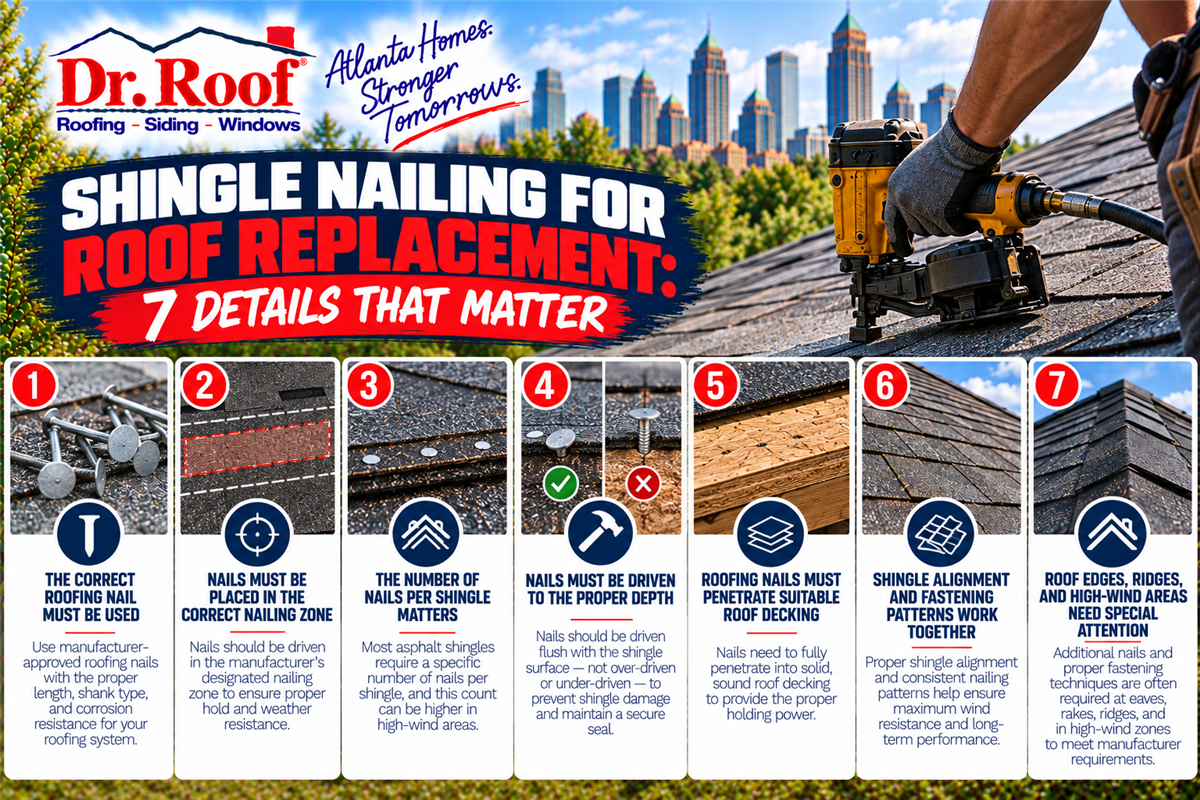
1. The Correct Roofing Nail Must Be Used
Not all nails are suitable for asphalt-shingle installation.
Roofing manufacturers specify fastener requirements for their products.
Common considerations include:
Nail material
Corrosion resistance
Shank diameter
Nail-head size
Nail length
Compatibility with the roof decking
The Asphalt Roofing Manufacturers Association emphasizes using the type and size of fastener specified by the shingle manufacturer.
Why Does Nail Type Matter?
The fastener must be suitable for securing the roofing material to the supporting roof deck.
An inappropriate fastener may not provide the attachment characteristics required by the roofing system.
Roofing nails commonly have broad heads designed to bear against the shingle surface.
The appropriate material and dimensions depend on the roofing product and installation requirements.
Can Ordinary Construction Nails Be Used?
Homeowners should not assume that any general-purpose nail is appropriate.
The contractor should use roofing fasteners that satisfy the selected manufacturer's instructions and applicable building requirements.
2. Nails Must Be Placed in the Correct Nailing Zone
One of the most important details in asphalt-shingle installation is nail placement.
Manufacturers specify where fasteners must be positioned on each shingle.
This location is commonly called the nailing zone.
For some architectural shingles, the designated fastening area is marked or reinforced.
Why Is Nail Placement Important?
Incorrect placement can affect how the shingle is secured.
Potential problems include:
Shingles becoming loose
Reduced attachment of laminated layers
Exposed fasteners
Improper shingle alignment
Installation defects
For laminated shingles, the manufacturer's specified fastening zone may be designed so that nails penetrate the appropriate shingle layers.
Placing nails outside that area can affect the intended attachment.
Is the Nailing Zone the Same for Every Shingle?
No.
Different manufacturers and product lines may specify different nail locations.
For example, a traditional three-tab shingle can have different fastening details from a laminated architectural shingle.
The contractor should follow the instructions for the exact product being installed.
A general roofing guideline should not replace product-specific requirements.
3. The Number of Nails per Shingle Matters
Homeowners frequently ask whether roofers should install four nails or six nails per shingle.
The answer depends on the selected roofing product and installation conditions.
According to the Asphalt Roofing Manufacturers Association, many standard asphalt-shingle applications require at least four nails per full-size strip shingle.
However, some products and circumstances require different fastening patterns.
When Are Additional Nails Required?
Additional fastening may be specified for:
Certain high-wind applications
Particular roofing products
Steep roof slopes
Enhanced installation methods
Applicable local building requirements
For example, six-nail fastening patterns are commonly used in specified high-wind installations.
However, homeowners should not assume that six nails are required for every asphalt-shingle roof.
The exact requirements depend on the product and project.
Does Using More Nails Automatically Make a Roof Better?
Not necessarily.
More fasteners do not correct improper nail placement, inadequate decking, or other installation defects.
The correct fastening pattern is the one specified by the manufacturer and applicable requirements.
Proper positioning and installation are just as important as the number of fasteners.
4. Nails Must Be Driven to the Proper Depth
Even when the correct nail is used in the correct location, installation depth matters.
A properly driven roofing nail should generally sit straight, with the nail head bearing firmly against the shingle surface.
The nail should not be driven so deeply that it cuts into or damages the roofing material.
What Is an Overdriven Roofing Nail?
An overdriven nail is installed too deeply.
This can damage the shingle around the nail head.
In some situations, excessive driving force may cut into the roofing material.
That can compromise the intended fastening.
What Is an Underdriven Roofing Nail?
An underdriven nail does not sit properly against the shingle surface.
The raised nail head may interfere with the roofing materials installed over it.
This can affect how the shingles lie against one another.
Why Does Nail-Gun Adjustment Matter?
Roofing contractors commonly use pneumatic fastening equipment.
The equipment must be operated and adjusted appropriately for the materials and installation conditions.
Improper settings or technique can contribute to overdriven or underdriven fasteners.
Contractors should correct improperly installed nails according to the applicable roofing requirements.
5. Roofing Nails Must Penetrate Suitable Roof Decking
Roofing nails secure asphalt shingles to the underlying roof deck.
The decking provides the supporting surface for the roofing system.
Common residential decking materials include plywood and oriented strand board.
The fastener length and required penetration depend on the shingle manufacturer's instructions and applicable building requirements.
Why Is Nail Penetration Important?
A fastener must extend sufficiently into or through the supporting deck, as required, to provide the intended attachment.
If the nail is too short, the installation may not satisfy the roofing product's requirements.
However, fastener length is only one part of the equation.
The decking itself must also be suitable.
What If the Existing Decking Is Damaged?
During roof replacement, the contractor may discover:
Rotted decking
Delaminated panels
Holes
Deteriorated wood
Unsupported panel edges
Other structural concerns
Damaged or unsuitable decking should be addressed before new shingles are installed.
Correctly sized nails cannot compensate for a severely deteriorated supporting surface.
Does Every Roof Replacement Need New Decking?
No.
Existing decking may remain in place when it is structurally suitable and satisfies applicable installation requirements.
The contractor should evaluate the condition and explain any necessary repairs.
6. Shingle Alignment and Fastening Patterns Work Together
Proper fastening also depends on how the shingles are positioned.
Asphalt shingles are installed in overlapping courses designed to shed water.
The manufacturer's installation instructions specify appropriate alignment, exposure, offsets, and fastening patterns.
These details help the roofing materials function together.
Why Does Shingle Alignment Matter?
Incorrect alignment can affect where fasteners fall relative to the shingles beneath them.
It may also create problems with the intended overlapping arrangement.
The Asphalt Roofing Manufacturers Association recommends careful alignment before fastening and avoiding nail placement that could leave fasteners exposed.
Can Shingles Be Moved After They Have Been Nailed?
Repositioning a shingle after multiple fasteners have been installed can cause distortion or damage.
A roofing professional should follow the manufacturer's procedures for correcting installation mistakes.
Homeowners should not attempt to reposition or refasten roofing materials themselves.
7. Roof Edges, Ridges, and High-Wind Areas Need Special Attention
Not every section of the roofing system experiences wind forces in the same way.
Roof perimeters, ridges, and certain transitions can be particularly vulnerable.
Proper installation of these areas involves more than simply fastening the main field shingles.
Important components may include:
Starter shingles
Ridge cap shingles
Hip cap shingles
Roof-edge materials
Flashing
Other manufacturer-specified accessories
Why Are Starter Shingles Important?
Starter materials are installed along appropriate roof edges as part of the shingle system.
They help support the installation of the first courses and provide the intended sealing arrangement at vulnerable edges.
Their fastening and positioning must follow the relevant installation requirements.
Do Ridge Cap Shingles Use the Same Fastening Pattern?
Not necessarily.
Ridge and hip materials may have their own installation instructions.
The required fasteners, placement, and other details can differ from the main roof shingles.
What About Enhanced Wind Protection?
Some roofing products and installation systems provide specific high-wind installation options.
These may involve additional fastening or required accessories.
Homeowners should review the exact product specifications and warranty terms.
No roofing system should be assumed to be immune to all wind-related damage.
What Happens If Roof Shingles Are Nailed Incorrectly?
Incorrect fastening can create several potential roofing problems.
Depending on the type and severity of the defect, concerns may include:
Loose shingles
Lifted tabs
Exposed nail heads
Shingle distortion
Damage around fasteners
Reduced attachment performance
Increased vulnerability to wind
Not every incorrectly positioned nail will immediately cause a leak or visible problem.
However, fastening defects should be corrected because they can affect the intended installation.
Can Improperly Nailed Shingles Be Repaired?
Sometimes.
The appropriate correction depends on the specific defect and the condition of the shingle.
A contractor may be able to correct certain fastening problems.
Other situations may require replacing the affected shingle.
The repair method should follow the manufacturer's applicable instructions.
Does Proper Shingle Nailing Help Prevent Wind Damage?
Correct fastening is an important part of a roofing system's wind performance.
However, wind resistance depends on several components working together.
These include:
Shingle design
Fastening pattern
Nail placement
Decking condition
Adhesive sealing
Starter materials
Ridge components
Installation quality
A roofing system must be installed according to the product's requirements.
Can Proper Nailing Guarantee That Shingles Will Never Blow Off?
No.
Even properly installed roofing systems can experience damage during severe weather.
Wind conditions, flying debris, building design, and other factors can affect the outcome.
Correct fastening helps the roof perform as intended but does not eliminate all risks.
How Can Homeowners Verify Proper Shingle Installation?
Most roofing fasteners are concealed once installation is complete.
For that reason, homeowners generally cannot verify nail placement simply by looking at the finished roof from the driveway.
However, there are useful questions to ask before and after installation.
Before Roof Replacement
Ask:
Which shingle manufacturer and product line will be installed?
What fastening pattern does the product require?
Are additional fastening requirements applicable?
How will the roof decking be evaluated?
What starter and ridge components are included?
How will the crew address installation defects?
After Roof Replacement
Consider asking:
Was the roofing system installed according to the product instructions?
Were any decking repairs necessary?
Were the specified accessories installed?
Can available project photographs be reviewed?
What documentation and warranties apply?
A professional roof inspection can provide additional information when installation concerns arise.
Do Roofing Warranties Depend on Proper Installation?
Manufacturer warranties are subject to their written terms.
Those terms may include installation requirements, limitations, exclusions, and conditions for particular coverage.
Some enhanced roofing-system warranties also have specific eligibility requirements.
What Should Homeowners Review?
Before installation, ask about:
The selected shingle warranty
Applicable workmanship coverage
Required roofing components
Installation requirements
Warranty registration procedures
Exclusions and limitations
Do not assume that every roof installed by a certified contractor automatically qualifies for the same warranty.
The actual coverage depends on the roofing system and written warranty documents.
Proper Fastening vs. Quality Shingles: Which Matters More?
Both matter.
High-quality roofing materials need appropriate installation conditions.
Likewise, correct installation practices should be used with products suitable for the roof design.
A premium architectural shingle will not perform as intended if installed outside the manufacturer's fastening requirements.
Similarly, correctly placed fasteners do not correct an unsuitable roofing material or damaged roof decking.
A complete roof replacement should address the entire roofing system.
That includes:
Decking
Underlayment
Roofing materials
Fastening
Flashing
Roof edges
Ventilation
Ridge components
Quality depends on how these components are selected and installed together.
Why Shingle Fastening Matters for Atlanta Homes
Atlanta-area homeowners experience thunderstorms, strong winds, heavy rain, and occasional severe weather.
These conditions make proper roofing installation especially important.
During roof replacement, homeowners should ask how the selected shingles will be installed and whether any additional requirements apply to their roof.
Roof design, pitch, material selection, and local building requirements may influence the installation.
The roofing contractor should identify and follow the applicable manufacturer instructions.
How Dr. Roof Approaches Roof Replacement in Atlanta
Dr. Roof has served Atlanta-area homeowners since 1988, providing professional roofing inspections, repairs, and replacement services.
Dr. Roof is a GAF Master Elite Certified Contractor and CertainTeed SELECT ShingleMaster.
During roof replacement planning, homeowners can discuss the selected roofing materials, installation requirements, decking condition, and the components included in the proposed roofing system.
The contractor should explain how the selected roofing materials will be installed and what warranties apply.
Understanding these details helps homeowners evaluate more than the appearance of the finished roof.
Proper Shingle Fastening Is Essential to Roof Replacement Quality
Roofing nails may be hidden beneath the finished shingles, but their installation is an important part of roofing-system performance.
The correct fastener type, nailing zone, number of nails, driving depth, deck penetration, alignment, and roof-edge details all deserve attention.
For Atlanta homeowners, the goal is not simply choosing an attractive roofing material.
It is ensuring the selected roofing system is appropriate for the home and installed according to applicable requirements.
If you're planning roof replacement, contact Dr. Roof to discuss your roofing options, installation details, and project-specific recommendations.
How many nails should be used per asphalt shingle?
Many standard asphalt-shingle applications require at least four nails per full-size strip shingle, but some products or installation conditions require additional fasteners. The correct number depends on the manufacturer's instructions and applicable building requirements.
Where should roofing nails be placed on shingles?
Roofing nails should be positioned within the fastening area specified by the shingle manufacturer. For some laminated shingles, the designated nailing zone is designed to secure multiple shingle layers. Nail placement varies by product.
Should roofing nails be driven flush with the shingles?
Yes. Roofing nails should generally be driven straight, with the nail head bearing firmly against the shingle surface. Nails should not be overdriven into the material or left raised above the surface. Manufacturer instructions control the specific installation requirements.
Can improper shingle nailing cause roof damage?
Yes. Improper nail placement, insufficient fastening, or incorrectly driven nails can contribute to loose shingles, raised tabs, exposed fasteners, and other installation problems. A roofing professional should evaluate and correct identified defects.
How can homeowners check whether new shingles were nailed correctly?
Most roofing fasteners are concealed after installation. Homeowners can ask their contractor about the required fastening pattern, review available installation documentation, and request a professional evaluation if workmanship concerns arise.
Does proper shingle fastening guarantee protection from wind damage?
No. Correct fastening is an important part of roofing-system wind performance, but no installation method guarantees protection from every storm. Shingle design, decking, adhesive sealing, roof details, and weather conditions also affect performance.
Subscribe to Dr. Roof's Blog






Comments