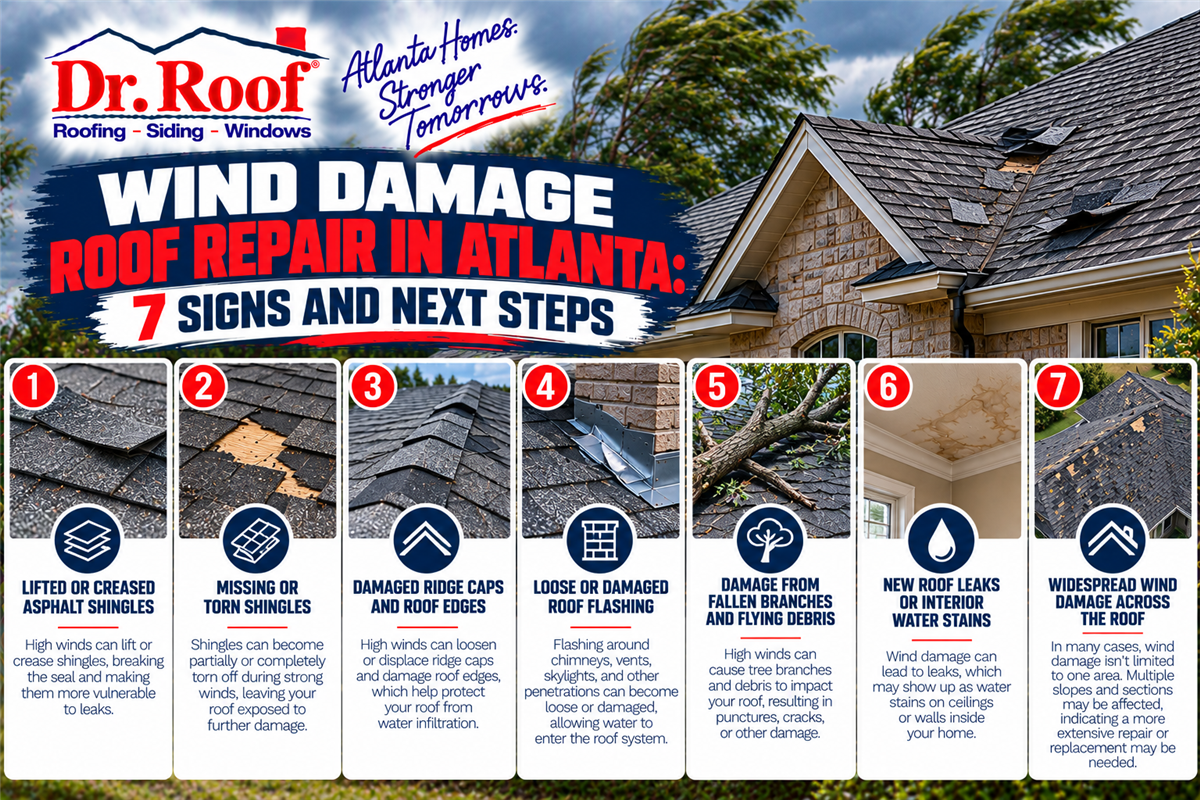
After a strong storm moves through Atlanta, homeowners often look outside to check whether their roofs have suffered damage. Missing shingles and fallen branches may be obvious, but some roofing problems are much harder to recognize from the ground.
Strong winds can lift asphalt shingles, damage flashing, loosen ridge materials, and expose vulnerable sections of the roofing system to rain.
Wind-damaged roofs can often be repaired when the damage is localized and the surrounding roofing materials remain serviceable. However, widespread shingle damage, deteriorated decking, or significant structural problems may require more extensive repairs or roof replacement.
For Atlanta homeowners, the first step is identifying the damage through a professional roof inspection.
Understanding the common warning signs and available repair options can help you make informed decisions after severe weather.
What Does Wind Damage Look Like on a Roof?
Wind damage can affect several roofing components.
Common signs include:
Lifted or creased asphalt shingles
Missing or torn shingles
Damaged ridge caps and roof edges
Loose or displaced flashing
Impact damage from fallen branches
New roof leaks or interior water stains
Widespread damage affecting multiple roof sections
Not every sign is visible from the ground.
A roofing professional may need to examine the shingles, flashing, penetrations, and surrounding materials to determine the extent of the damage.
1. Lifted or Creased Asphalt Shingles
One of the most common wind-related roofing concerns involves shingles that have lifted from their original position.
Asphalt shingles are installed in overlapping courses and typically include adhesive sealant designed to help secure the shingles after installation.
Strong wind can place upward forces on exposed shingle edges.
If the shingles lift, they may become loosened or damaged.
What Is a Creased Shingle?
A creased shingle has developed a visible bend or fold, often after wind forces lift the material.
This damage can compromise the shingle's structure.
Even if the shingle settles back into place, the crease may remain.
Can Lifted Shingles Be Repaired?
The appropriate repair depends on the condition of the material.
A contractor should evaluate whether the shingle is damaged, whether the adhesive seal remains functional, and whether the surrounding roofing materials are serviceable.
A shingle that has torn or developed significant creasing may require replacement.
Simply pressing a visibly damaged shingle back into place may not correct the problem.
2. Missing or Torn Shingles
Missing shingles are among the easiest forms of roof wind damage to recognize.
After a storm, homeowners may find pieces of roofing material in the yard.
They may also notice areas where the roof covering appears uneven or incomplete.
Why Are Missing Shingles a Concern?
Asphalt shingles provide the outer protective covering of the roofing system.
When shingles are missing, the materials beneath them may become more exposed to weather.
Although underlayment provides secondary protection, it is not intended to replace the primary roof covering indefinitely.
Continued exposure can create opportunities for water intrusion.
Can Missing Shingles Be Replaced Individually?
Often, yes.
If only a limited number of shingles are damaged and the surrounding roofing materials remain suitable, a contractor may be able to replace the affected shingles.
However, the contractor should also evaluate:
Surrounding shingle condition
Underlayment
Existing fasteners
Possible decking damage
Material compatibility
Signs of additional wind damage
A targeted repair should address the damaged area and restore the roofing materials appropriately.
3. Damaged Ridge Caps and Roof Edges
Roof edges and ridges are important areas to inspect after strong winds.
These locations can experience significant wind forces because of their position on the roofing system.
Potential problems include:
Missing ridge cap shingles
Lifted ridge materials
Damaged starter shingles
Loose roof-edge components
Displaced roofing materials along the perimeter
Why Do Roof Edges Matter?
Starter materials and perimeter details help support the proper installation of the roofing system.
If these components become damaged, the surrounding shingles may be more vulnerable to additional wind exposure.
How Are Ridge and Edge Problems Repaired?
The contractor should determine which materials are damaged and whether the surrounding components remain secure.
Repairs may involve replacing ridge cap shingles, starter materials, or other affected roofing components.
The replacement materials must be installed according to the selected roofing system's requirements.
4. Loose or Damaged Roof Flashing
Roof flashing directs water away from vulnerable roofing transitions.
These areas include:
Chimneys
Skylights
Plumbing vents
Dormers
Roof-to-wall intersections
Valleys
Strong winds or flying debris can loosen, bend, or displace flashing.
How Can Wind-Damaged Flashing Cause Leaks?
When flashing moves away from its intended position, water may enter openings around the roof transition.
The resulting leak may not appear directly beneath the damaged flashing.
Water can travel along the roof decking or framing before becoming visible inside the home.
Does Damaged Flashing Require Roof Replacement?
Not necessarily.
Localized flashing damage may be repairable without replacing the entire roof.
The contractor may need to remove surrounding roofing materials, replace damaged flashing, and restore the affected section.
If the flashing problem is connected to widespread deterioration or other roofing defects, a more extensive repair may be necessary.
5. Damage From Fallen Branches and Flying Debris
Strong winds can carry branches and other debris onto the roof.
The resulting damage depends on the size, weight, and location of the impact.
Potential concerns include:
Punctured shingles
Cracked roofing materials
Damaged flashing
Broken or weakened decking
Structural damage
Displaced roof components
What Should You Do If a Tree Limb Hits Your Roof?
Do not climb onto the roof or attempt to remove a large branch yourself.
If you suspect structural damage, avoid the affected area and arrange appropriate professional assistance.
A roofing contractor can evaluate the roofing components once conditions are safe.
Major structural damage may require additional professional evaluation before roofing repairs can begin.
Can Impact Damage Be Repaired?
Sometimes.
Localized damage may be repairable when the roof's supporting structure remains suitable.
More significant impact damage may require replacing decking or addressing structural components before installing new roofing materials.
6. New Roof Leaks or Interior Water Stains
Wind damage does not always produce obvious missing shingles.
Sometimes the first indication of a problem appears inside the home.
After a storm, homeowners may notice:
New ceiling stains
Damp drywall
Water dripping from the ceiling
Moisture in the attic
Discoloration around a chimney
Damp insulation
Musty odors
Does a Ceiling Stain Mean the Roof Has Wind Damage?
Not necessarily.
A ceiling stain indicates possible moisture intrusion, but the source may involve several different conditions.
Potential causes include damaged roofing materials, flashing defects, condensation, plumbing problems, or other building issues.
A professional inspection is needed to identify the cause.
Why Should Water Intrusion Be Addressed Promptly?
Continued moisture exposure can affect roofing materials and interior building components.
Depending on the circumstances, water may damage decking, insulation, drywall, or other materials.
Identifying and correcting the source can help limit additional exposure.
7. Widespread Wind Damage Across the Roof
Some wind events affect more than one section of the roofing system.
A contractor may discover damaged shingles on several roof slopes or identify multiple areas where roofing components have been displaced.
What Does Widespread Damage Mean?
Widespread damage may involve:
Numerous missing shingles
Multiple creased shingle areas
Extensive shingle tearing
Damage across several roof slopes
Compromised roofing accessories
Significant decking or structural concerns
The condition of the surrounding materials matters when determining whether repairs are practical.
Does Widespread Damage Always Require Replacement?
No.
The appropriate solution depends on the roofing system, damage severity, and whether the affected materials can be repaired reliably.
A contractor should document the condition and explain why targeted repair or full replacement is recommended.
Wind Damage Roof Repair vs. Roof Replacement
After a windstorm, homeowners may wonder whether they need a small repair or an entirely new roof.
The answer depends on the condition of the roofing system.
When Roof Repair May Be Appropriate
Repair may be practical when:
Damage is localized
Surrounding shingles remain serviceable
Compatible replacement materials are available
Decking remains suitable
Flashing damage can be corrected
The repair can be integrated properly with the existing roof
When Roof Replacement May Be Worth Considering
Replacement may be appropriate when:
Damage affects extensive roof areas
Shingles have widespread deterioration
Multiple sections cannot be repaired reliably
Decking or structural damage is substantial
The existing roofing system is no longer serviceable
Roof age alone does not automatically determine whether replacement is necessary.
A professional evaluation should identify the physical conditions supporting the recommendation.
What Should Homeowners Do Immediately After Wind Damage?
Safety should be the first priority.
Once the storm has passed and conditions are safe, homeowners can take several practical steps.
Check the Property From the Ground
Look for visible roofing damage, fallen branches, or shingles in the yard.
Avoid climbing onto the roof.
Document Visible Damage
Photograph damaged roofing materials and affected interior areas from safe locations.
Record the approximate date of the storm and when you first noticed the problem.
Protect Interior Belongings
If water is entering the home, move valuables away from the affected area when it is safe.
Avoid electrical equipment or fixtures exposed to water.
Contact a Roofing Professional
Schedule an inspection to determine the cause and extent of the damage.
If the roofing system has been significantly compromised, ask whether temporary protection is appropriate.
Can a Damaged Roof Be Temporarily Protected?
Yes, in some situations.
A contractor may recommend professional roof tarping or another temporary protective measure when permanent repairs cannot be completed immediately.
Temporary protection can help reduce exposure to additional rain.
However, a tarp does not replace the need to correct the underlying roofing damage.
The contractor should explain what the temporary work covers and when permanent repairs should be considered.
What Happens During a Wind Damage Roof Inspection?
A professional inspection may include evaluating:
Asphalt shingles
Ridge materials
Roof edges
Flashing
Roof penetrations
Valleys
Accessible decking conditions
Visible signs of water intrusion
The contractor should determine whether the damage appears localized or widespread.
Photographs and written findings can help explain the condition.
What Should a Wind Damage Repair Estimate Include?
A useful written estimate should describe:
Damaged areas
Recommended repairs
Roofing materials
Flashing work
Known decking concerns
Labor
Cleanup
Potential additional work
Applicable warranty information
Homeowners should understand the proposed scope before approving the project.
Does Homeowners Insurance Cover Wind Damage Roof Repairs?
Some homeowners insurance policies provide coverage for certain types of wind-related damage.
However, coverage is not automatic.
The outcome depends on the policy, cause of damage, exclusions, deductible, and individual claim.
What Documentation Can Be Helpful?
Homeowners may retain:
Photographs of visible damage
The storm date
Inspection findings
Written repair estimates
Temporary protection invoices
Communications with the insurer
The insurance company determines whether the loss is covered and what payment, if any, is available under the policy.
A roofing contractor cannot guarantee claim approval.
How Quickly Should Wind Damage Be Repaired?
A roof with active water intrusion or exposed roofing materials should receive prompt professional attention.
The timing of permanent repairs depends on:
Damage severity
Weather conditions
Roof accessibility
Material availability
Contractor scheduling
Safety considerations
Homeowners should not assume that every contractor provides immediate or around-the-clock service.
Contact the roofing company to confirm its available inspection and repair appointments.
How Dr. Roof Helps Atlanta Homeowners With Wind Damage
Dr. Roof has served Atlanta-area homeowners since 1988, providing roofing inspections, repairs, roof replacement, and storm-damage documentation support.
A professional evaluation can help determine whether a storm has damaged shingles, flashing, roof penetrations, decking, or other components.
For storm-related roofing concerns, Dr. Roof may provide photographs, written findings, and repair or replacement recommendations.
Homeowners in Atlanta, Marietta, Alpharetta, Roswell, and surrounding communities can contact Dr. Roof to discuss a roof inspection and appropriate repair options.
Protect Your Home After Wind Damage
Wind damage can range from a few missing shingles to more extensive roofing and structural problems.
The most important step is identifying what was damaged before choosing a repair.
Localized problems may be correctable without replacing the entire roof, while widespread deterioration or severe damage may require a broader solution.
For Atlanta homeowners, professional inspection, clear documentation, and an appropriate repair plan provide a practical way to address roofing concerns after severe weather.
If your roof has experienced strong winds or you notice signs of damage, contact Dr. Roof to schedule a professional roofing evaluation.
Can wind-damaged roof shingles be repaired?
Yes. Wind-damaged shingles can often be replaced when the damage is localized and the surrounding roofing materials remain serviceable. A contractor should inspect for creasing, tearing, missing shingles, and other damage before recommending repairs.
What are the most common signs of wind damage to a roof?
Common signs include lifted or creased shingles, missing roofing materials, damaged ridge caps, loose flashing, impact damage from debris, and new interior water stains. Some damage may require a professional inspection to identify.
Does wind damage always require a full roof replacement?
No. Localized wind damage may be repairable without replacing the entire roof. Replacement may be appropriate when damage is widespread, the roofing system is significantly deteriorated, or necessary repairs cannot be completed reliably.
What should I do if my roof starts leaking after a windstorm?
Protect people and belongings, avoid electrical hazards, document visible damage from safe locations, and contact a roofing professional. Do not climb onto the roof. Temporary protection may be appropriate while permanent repairs are arranged.
Will homeowners insurance cover wind damage roof repairs?
Coverage depends on the homeowner's insurance policy and individual claim. Some wind-related damage may qualify, but exclusions, deductibles, and other terms apply. The insurance company determines coverage and claim payment.
Can wind damage be present without missing shingles?
Yes. Wind may lift or crease shingles, affect adhesive seals, loosen flashing, or damage ridge materials without removing entire shingles. A professional inspection can help identify concerns that are difficult to see from the ground.
Subscribe to Dr. Roof's Blog








Comments