When homeowners discover missing shingles, damaged flashing, or a roof leak, their first concern is usually getting the problem repaired.
However, another important question deserves attention: Does the repair need to meet specific building codes or require a permit?
The answer depends on the scope of work, the property's location, and whether the repair involves structural components.
Roof repairs in Atlanta must comply with applicable building requirements, but not every repair requires the same permit or inspection process. Certain nonstructural repairs may qualify for permit exemptions, while more extensive work can involve additional approvals.
Understanding these distinctions can help homeowners plan repairs appropriately, ask informed questions, and avoid unnecessary complications.
Here are seven important things to know about roof repair codes and regulations in the Atlanta area.
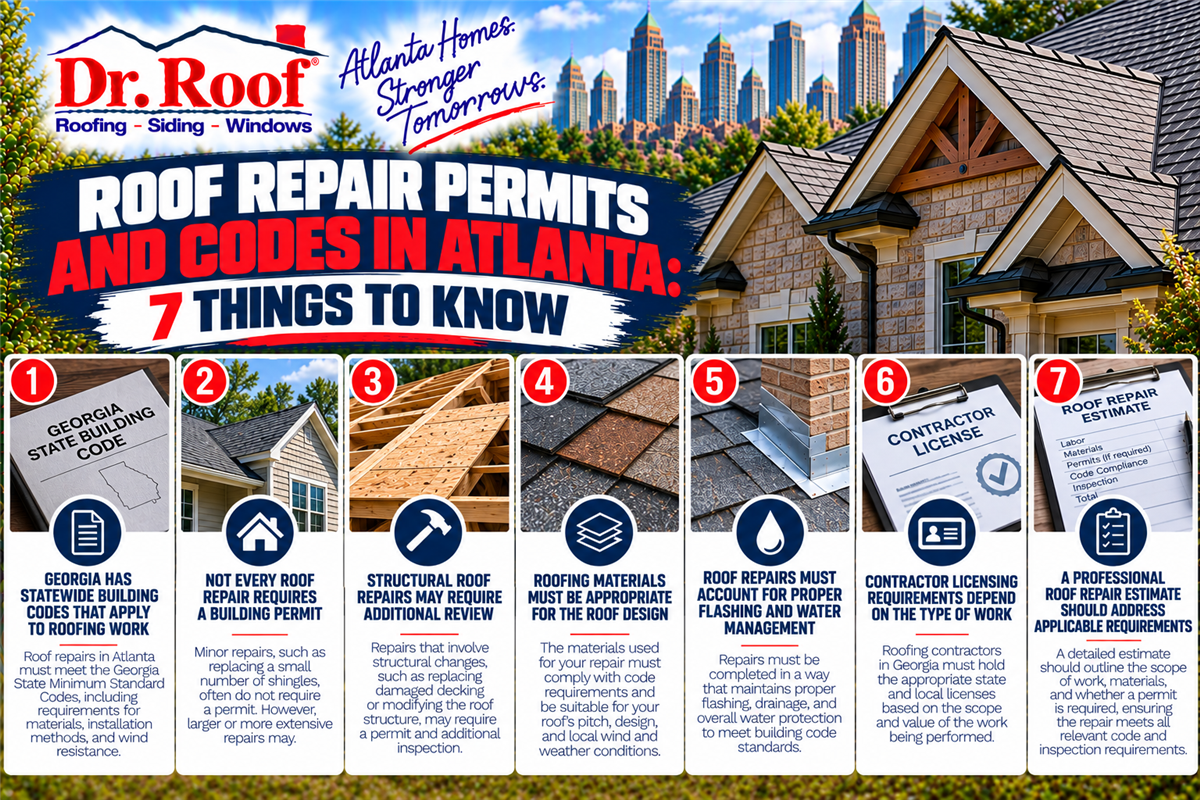
1. Georgia Has Statewide Building Codes That Apply to Roofing Work
Georgia establishes minimum construction standards through its State Minimum Standard Codes.
These codes address different aspects of building construction, including structural requirements, materials, and installation practices.
For residential roofing work, the International Residential Code is particularly relevant.
Which Building Code Applies in Georgia?
As of October 2026, Georgia's current construction code framework includes the 2024 International Residential Code with Georgia Amendments.
The Georgia Department of Community Affairs maintains information about the state's adopted construction codes.
Local jurisdictions administer applicable permitting and enforcement procedures.
Why Does This Matter for Roof Repairs?
Roofing work involves more than replacing visible materials.
A repair may affect:
Asphalt shingles
Underlayment
Roof decking
Flashing
Structural supports
Roof penetrations
Other roofing components
The applicable requirements depend on the materials and scope of work.
For example, replacing a damaged shingle differs from repairing structural framing beneath a deteriorated roof section.
A qualified contractor should determine which requirements apply before performing the work.
2. Not Every Roof Repair Requires a Building Permit
One of the most common questions Atlanta homeowners ask is whether they need a permit to repair their roof.
The answer depends on the project.
The City of Atlanta publishes exemptions for certain repair activities, including qualifying nonstructural roofing work.
However, those exemptions are subject to specific conditions.
What Types of Roof Repairs May Be Exempt?
Depending on the jurisdiction and scope, certain limited repairs may qualify for an exemption from permitting.
Examples of work that homeowners might ask about include:
Replacing a limited number of damaged shingles
Correcting localized flashing problems
Repairing a roof penetration
Addressing a small, nonstructural roofing defect
These examples should not be interpreted as automatic permit exemptions.
The local building department must determine whether the actual project qualifies.
Does a Permit Exemption Mean Building Codes Don't Apply?
No.
This is an important distinction.
A project may be exempt from obtaining a permit while still being required to comply with applicable construction standards.
For example, a qualifying repair should still use appropriate materials and installation methods.
Homeowners should not assume that permit-exempt work can be completed without regard to roofing requirements.
How Can You Confirm Whether a Permit Is Needed?
Ask the roofing contractor to identify the project's scope and explain the applicable permitting requirements.
When clarification is necessary, contact the local building department.
The correct jurisdiction depends on the property's address.
3. Structural Roof Repairs May Require Additional Review
Some roof repairs involve more than the exterior roofing materials.
For example, prolonged water intrusion or falling debris may damage the structure beneath the roof covering.
Potential problems include:
Deteriorated roof decking
Damaged rafters
Compromised trusses
Structural movement
Significant wood rot
Other load-bearing concerns
These conditions can change the scope of the project.
What Is the Difference Between Roofing Material Damage and Structural Damage?
Roofing material damage generally involves components such as shingles, underlayment, or flashing.
Structural damage involves elements that support the roof or transfer loads through the building.
For example, replacing a torn asphalt shingle is not the same as repairing a damaged roof truss.
Structural work may require additional professional qualifications, permitting, inspections, or engineering.
Does Damaged Roof Decking Always Require a Structural Permit?
Not necessarily.
The answer depends on the extent and nature of the damage.
A localized decking repair may involve different requirements from major modifications to the roof framing.
The contractor should determine whether the work affects structural elements and confirm the applicable requirements.
Homeowners should ask for clarification before authorizing repairs that extend beyond the original roofing scope.
4. Roofing Materials Must Be Appropriate for the Roof Design
Building requirements and manufacturer instructions influence which materials can be used on a particular roof.
This is especially important when repairing asphalt shingles.
Not every roofing product is suitable for every roof pitch.
Why Does Roof Pitch Matter?
Roof pitch describes how steep a roof is.
It is commonly expressed as the number of inches the roof rises vertically for every 12 inches of horizontal distance.
For example:
A 2:12 roof has a relatively shallow slope.
A 4:12 roof has a moderate slope.
A 9:12 roof is considerably steeper.
Roof pitch affects water drainage and roofing material suitability.
Can Asphalt Shingles Be Installed on Low-Slope Roofs?
Many conventional asphalt shingles require a minimum slope of 2:12.
For qualifying applications between 2:12 and less than 4:12, manufacturers such as GAF specify enhanced underlayment requirements.
The exact installation method depends on the selected product.
Roof sections below the approved minimum slope may require a different roofing system.
How Does This Affect Roof Repair?
Suppose a shallow porch roof develops recurring leaks.
Replacing the existing shingles with the same material may not be an appropriate solution if the roofing product is unsuitable for that slope.
A roofing professional should evaluate the roof design before recommending repairs.
Correcting the problem may require a different installation method or roofing material.
5. Roof Repairs Must Account for Proper Flashing and Water Management
Flashing plays an important role in protecting vulnerable roof areas.
It helps direct water away from intersections and penetrations.
Common flashing locations include:
Chimneys
Skylights
Plumbing vents
Roof valleys
Dormers
Roof-to-wall intersections
Improper flashing installation can create water-entry points even when the surrounding shingles appear undamaged.
Why Does Flashing Installation Matter?
Roofing materials are designed to work together to manage rainfall.
Flashing must be appropriately integrated with shingles, underlayment, and adjoining building components.
For example, step flashing along a wall is installed in a specific arrangement that directs water onto the roof covering.
Simply applying sealant over a defective flashing assembly may not provide an appropriate permanent repair.
Are There Installation Requirements for Flashing Repairs?
Yes.
The relevant roofing system, manufacturer instructions, and applicable construction requirements determine appropriate materials and installation details.
A contractor should explain how the proposed flashing repair addresses the original defect.
Homeowners should also ask whether surrounding roofing materials need to be removed or replaced.
6. Contractor Licensing Requirements Depend on the Type of Work
Another common source of confusion involves contractor licensing.
Georgia recognizes certain specialty contracting activities under its residential and general contractor licensing framework.
The Georgia Secretary of State explains that qualifying specialty contractors may perform work within their recognized specialty without holding a residential or general contractor license.
However, that exemption does not automatically authorize every type of construction project.
Does Georgia Require a Separate State Roofing License?
Georgia does not issue a general statewide roofing-specific license equivalent to certain other regulated trade licenses.
Qualifying roofing work may fall within the specialty contractor provisions.
However, requirements can change when the scope extends into other regulated construction activities.
What If the Repair Includes Structural Work?
Structural modifications or work outside the recognized roofing specialty may involve additional licensing or professional requirements.
The contractor should determine which activities are authorized within the project's scope.
Homeowners should verify applicable credentials rather than assuming that all roofing and structural work is regulated identically.
What Should You Ask a Roofing Contractor?
Before approving work, ask:
What experience do you have with this roofing system?
Are you appropriately insured?
What licenses or credentials apply to the proposed work?
Does the repair involve structural components?
Who is responsible for obtaining permits when required?
Will any professional inspections be necessary?
These questions help clarify the contractor's responsibilities.
7. A Professional Roof Repair Estimate Should Address Applicable Requirements
A detailed roofing estimate should explain more than the final price.
Homeowners should understand the proposed materials, repair methods, and scope of work.
Depending on the project, a written estimate may include:
The location of the damage
The cause of the problem
Materials requiring removal
Replacement materials
Flashing or underlayment work
Known decking concerns
Labor and cleanup
Applicable permitting responsibilities
Potential additional repairs
Warranty information
Why Should Permitting Be Discussed Before Work Begins?
Some homeowners assume the roofing contractor will automatically handle every required approval.
Others assume permits are never necessary for repair work.
Neither assumption is appropriate for every project.
A written agreement should clarify who is responsible for confirming and obtaining any required permits.
What If Additional Damage Is Discovered?
Some problems become visible only after roofing materials are removed.
For example, the contractor may discover deteriorated decking beneath a previously leaking section.
If the new findings change the scope or regulatory requirements, the contractor should explain the necessary next steps.
Additional work should be documented and approved appropriately.
Roof Repair vs. Roof Replacement: Do the Requirements Differ?
They can.
A localized roof repair and a complete roof replacement involve different scopes of work.
A repair may address a limited area of shingles, flashing, or another roofing component.
A complete roof replacement generally involves removing and replacing a much larger portion of the roofing system.
Why Might Roof Replacement Require More Planning?
Replacement can involve:
Removal of existing roofing materials
Evaluation of exposed decking
Installation of new underlayment
Replacement flashing
Roofing-system ventilation
New shingles or other roof coverings
Additional structural repairs when necessary
The larger scope may create different permitting and inspection considerations.
Homeowners should confirm the requirements for the work actually proposed.
Do Roof Repair Requirements Differ Between Atlanta and Nearby Cities?
Yes, local administrative procedures can differ.
Although Georgia establishes statewide minimum construction standards, cities and counties administer their own permitting processes within applicable law.
Homeowners in communities such as Atlanta, Marietta, Alpharetta, Roswell, and Smyrna should confirm requirements with the appropriate jurisdiction.
Why Does Your Property Address Matter?
An Atlanta mailing address does not necessarily mean the property falls under the City of Atlanta's permitting authority.
A home may be located within another municipality or an unincorporated county area.
The local building department responsible for that address is the appropriate authority for permit questions.
This distinction matters when homeowners search online for general Atlanta roofing regulations.
What Happens If Roof Repairs Don't Meet Applicable Requirements?
Improper roofing work can create several problems.
Depending on the defect, potential consequences include:
Continued water intrusion
Loose roofing materials
Improper flashing performance
Structural concerns
Installation defects
Warranty complications
Permitting or inspection issues
The actual consequences depend on the work and circumstances.
A roofing contractor should use materials and installation methods that satisfy applicable requirements.
Can a Roof Look Good but Still Have Installation Problems?
Yes.
Some roofing defects are hidden beneath the finished materials.
For example, homeowners generally cannot see every fastener, underlayment overlap, or flashing detail after installation.
This is why proper installation procedures and professional oversight matter.
Can You Repair Your Own Roof?
Roof repair involves working at height and evaluating materials that may be damaged or structurally compromised.
Even minor repairs can involve important installation details.
Homeowners should not climb onto wet, steep, or storm-damaged roofs.
A qualified roofing professional can inspect the affected area and determine the appropriate scope.
DIY work may also introduce questions about permitting, workmanship, and existing warranty coverage.
Before attempting repairs, homeowners should understand the applicable requirements and safety risks.
How Can Atlanta Homeowners Avoid Code-Related Roofing Problems?
A practical approach begins with a thorough assessment.
Before approving repairs:
Ask the contractor to explain the roofing problem.
Request a written repair scope.
Confirm that the proposed materials are suitable.
Ask whether structural components are involved.
Clarify applicable permit requirements.
Review contractor qualifications.
Understand how unexpected damage will be handled.
Homeowners should also retain copies of the agreement, photographs, invoices, and applicable permits.
Clear documentation can help establish what work was completed.
How Dr. Roof Helps Atlanta Homeowners With Roof Repairs
Dr. Roof has served Atlanta-area homeowners since 1988, providing professional roofing inspections, repairs, replacement, and storm-damage documentation support.
Dr. Roof is a GAF Master Elite Certified Contractor and CertainTeed SELECT ShingleMaster.
A professional roof assessment can help identify problems involving:
Asphalt shingles
Roof flashing
Roof penetrations
Valleys
Underlayment
Roof decking
Storm-related damage
Homeowners can discuss the recommended repair scope, materials, and project requirements before approving work.
For repairs involving additional structural concerns or permitting questions, the appropriate requirements should be confirmed for the specific property.
Understand the Rules Before Beginning Roof Repairs
Roof repair codes and regulations exist to support appropriate construction practices and building safety.
For Atlanta homeowners, the most important considerations are understanding the repair scope, using suitable roofing materials, confirming permitting requirements, and selecting qualified professionals.
Not every roofing repair requires the same approval process.
However, all work should be evaluated against the requirements that apply to the specific project.
If you notice roof damage, missing shingles, or a developing leak, contact Dr. Roof to schedule a professional roofing evaluation and discuss the appropriate repair options for your home.
Do you need a permit for roof repairs in Atlanta?
Not every roof repair requires a permit. The City of Atlanta publishes exemptions for certain qualifying repair work, including some nonstructural roofing activities. Requirements depend on the project's scope and the property's jurisdiction. Homeowners should confirm whether their specific repair requires approval.
What building codes apply to roof repairs in Georgia?
Georgia's current construction code framework includes the 2024 International Residential Code with Georgia Amendments. Roofing work must satisfy applicable requirements, including relevant material and installation standards.
Does Georgia require roof repair contractors to have a state roofing license?
Georgia does not issue a separate statewide roofing-specific license. Certain specialty roofing contractors may be exempt from residential or general contractor licensing when working within their recognized specialty. Other requirements may apply depending on the work.
Do roof decking repairs require a building permit?
The answer depends on the extent and nature of the repair. Limited decking work may be treated differently from structural framing repairs or major roof modifications. The contractor should confirm the applicable requirements with the local building department.
Do roofing materials have to meet specific installation requirements?
Yes. Roofing products should be installed according to applicable construction requirements and manufacturer instructions. Important considerations include roof slope, underlayment, fastening, flashing, and material compatibility.
Can a roof repair be exempt from a permit but still require code compliance?
Yes. Permit exemptions do not eliminate applicable construction requirements. Qualifying repairs must still use appropriate materials and installation methods.
Subscribe to Dr. Roof's Blog



Comments