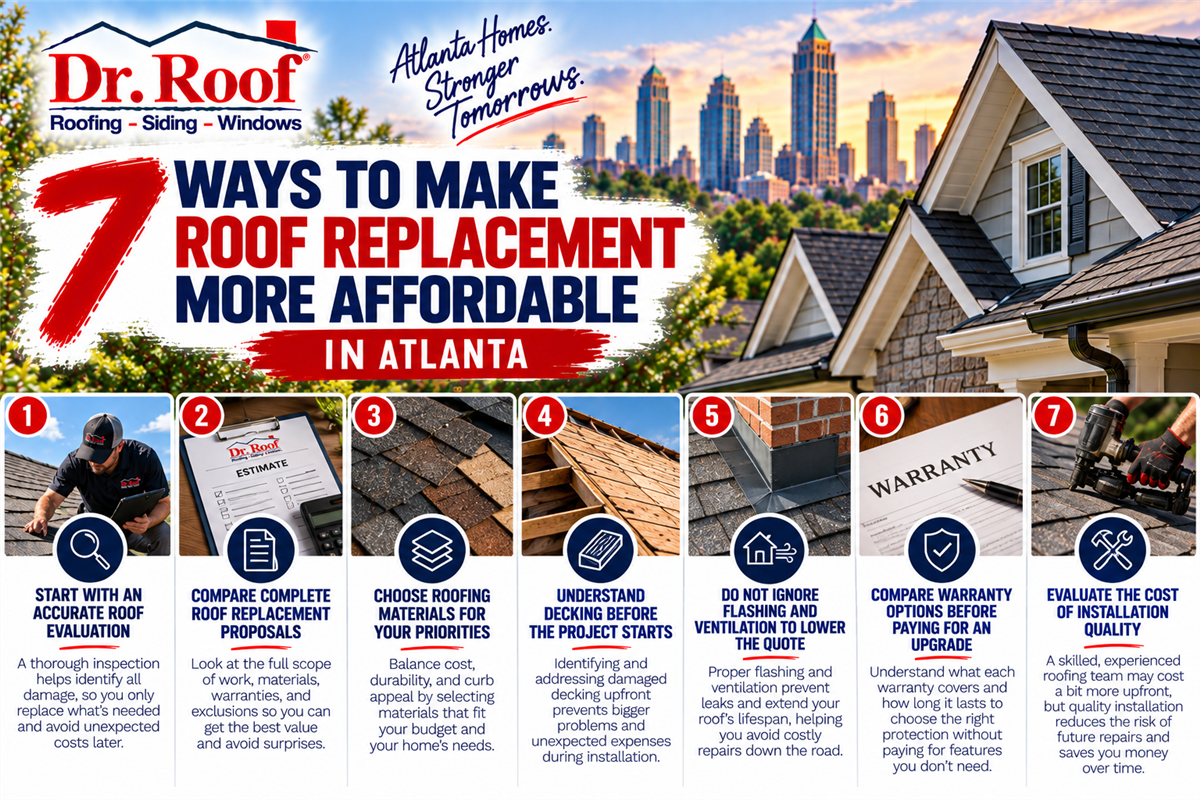
Roof replacement is a significant home project, but "affordable" should not mean simply choosing the lowest bid or the least expensive shingle available.
A better approach is to control the factors you can control.
For Atlanta homeowners, that means understanding the scope of the project, comparing complete estimates, choosing materials that fit the home and budget, addressing problems before they become more complicated, reviewing warranty options, and making sure each proposal includes the same work.
The goal is not to build the cheapest possible roof.
It is to make informed decisions that help you avoid paying for unnecessary upgrades, hidden exclusions, preventable surprises, or repeated work later.
Here are seven practical ways to approach roof replacement with cost in mind.
Affordable Roof Replacement: The Quick Answer
The most useful ways to control roof replacement costs include:
Get a professional evaluation before choosing a solution
Compare complete written proposals rather than bottom-line totals
Select roofing materials based on actual needs
Understand decking, flashing, and ventilation before work begins
Compare warranty options carefully
Ask how unexpected repairs will be handled
Consider the long-term value of installation quality
Roof replacement costs vary from one home to another because roofs differ in size, pitch, complexity, condition, materials, and system requirements.
That is why a project-specific estimate is more useful than a generic national price.
1. Start With an Accurate Roof Evaluation
One of the easiest ways to lose control of a roofing budget is to begin with assumptions.
A homeowner may assume the entire roof needs replacement when a repair is still practical.
The opposite can happen too.
Repeatedly repairing a roofing system with widespread deterioration may eventually become less practical than planning a replacement.
A professional roof evaluation can help determine:
The condition of the shingles
Whether leaks are localized or widespread
The condition of flashing
Whether visible decking concerns exist
How roof penetrations are performing
Whether ventilation needs attention
Whether storm damage may be involved
Whether repair or replacement is the more appropriate conversation
The first cost-saving decision is making sure you are solving the correct problem.
2. Compare Complete Roof Replacement Proposals
Two roofing estimates can show very different totals while including very different scopes of work.
A lower proposal may exclude items another contractor has already included.
Before deciding which roof is more affordable, compare the proposals line by line.
Look for information about:
Tear-off of existing roofing
Disposal
Shingle manufacturer and product
Underlayment
Leak protection
Starter shingles
Flashing
Pipe boots
Ridge materials
Ventilation
Decking procedures
Cleanup
Permits where applicable
Warranty options
If one estimate says only "complete roof replacement," ask for more detail.
Homeowners should know what they are buying before comparing prices.
3. Choose Roofing Materials for Your Priorities
Roofing products are available in a wide range of styles and product categories.
The most expensive product is not automatically the right product for every home.
Likewise, the least expensive option is not automatically the best value.
For many Atlanta homeowners, asphalt shingles provide a practical balance of appearance, product selection, and roofing-system options.
Depending on the project, homeowners may also consider:
Architectural asphalt shingles
Designer shingles
Specialty roofing products
DaVinci roofing options
Other materials appropriate to the home's architecture
Ask the contractor to explain what changes when you move from one product category to another.
Compare:
Product specifications
Appearance
Roofing-system requirements
Warranty options
Installation requirements
Compatibility with the home's roof design
If a premium upgrade does not support one of your actual priorities, you may decide that money is better used elsewhere in the roofing system.
4. Understand Decking Before the Project Starts
Roof decking sits beneath the visible roofing materials.
Because much of it cannot be fully evaluated until the existing roof is removed, decking can become one of the most important variables in a replacement project.
Potential concerns may include:
Rot
Moisture deterioration
Soft areas
Delamination
Previous leak damage
Improper repairs
Sections that no longer provide an appropriate fastening surface
Homeowners should ask before installation:
How will damaged decking be identified?
How will I be notified?
Will photographs be provided?
How are additional repairs approved?
How will decking-related costs be calculated?
You may not be able to predict every hidden condition.
You can, however, understand how those conditions will be handled before the roof is removed.
That makes unexpected work easier to evaluate.
5. Do Not Ignore Flashing and Ventilation to Lower the Quote
Removing important roofing-system components from a proposal can make the initial number look more attractive.
That does not necessarily make the completed roof more economical.
A roofing system includes more than shingles.
Flashing helps manage water around vulnerable transitions and penetrations.
Ventilation can also be an important part of the roof and attic system.
Depending on the property, roof replacement may involve evaluating:
Chimney flashing
Wall flashing
Valley details
Pipe penetrations
Roof vents
Intake ventilation
Exhaust ventilation
If one contractor plans to reuse questionable components while another includes replacement, the estimates are not equivalent.
Ask why each component is being retained or replaced.
The goal should be to spend money where it is necessary—not to create a lower bid by leaving unresolved roofing concerns in place.
6. Compare Warranty Options Before Paying for an Upgrade
Roofing warranties can be confusing.
There may be separate protection associated with:
Shingle materials
Roofing accessories
Manufacturer system coverage
Contractor workmanship
Wind provisions
Algae-related provisions
Enhanced manufacturer warranty programs
Dr. Roof is a GAF Master Elite Certified Contractor and a CertainTeed SELECT ShingleMaster.
Depending on the selected roofing system and applicable program requirements, contractor certification can affect which manufacturer warranty options may be available.
Before choosing a warranty upgrade, ask:
What does the standard warranty include?
What does the enhanced option add?
Which roofing components are required?
Is workmanship included?
Who backs the coverage?
Is registration required?
What exclusions apply?
Does the additional protection make sense for my project?
Do not choose a roof solely because one proposal displays the largest warranty number.
Compare the actual terms.
7. Evaluate the Cost of Installation Quality
Price matters.
Installation quality matters too.
A roofing system includes many details that are largely invisible once the job is complete.
These can include:
Fastener placement
Flashing integration
Underlayment
Starter materials
Valley construction
Roof penetrations
Ventilation
Deck preparation
Manufacturer installation requirements
A very low proposal can be worth investigating.
Ask how the contractor arrived at the price and whether all necessary materials and labor are included.
Choosing a contractor solely because the total is lower can become expensive if excluded work, installation problems, or unresolved roofing conditions create additional work later.
Affordable roof replacement should focus on value, not simply the smallest initial number.
What Factors Affect Roof Replacement Cost?
Roof replacement estimates can vary because homes and roofing systems vary.
Common factors include:
Roof size
Roof pitch
Number of stories
Roof complexity
Valleys
Dormers
Chimneys
Skylights
Existing roofing layers
Decking condition
Material selection
Flashing requirements
Ventilation
Property access
Tear-off and disposal
Warranty selection
Two Atlanta homes with similar interior square footage can still have very different roofs.
That is why broad price averages should not replace a property-specific inspection.
Is a Roof Repair More Affordable Than Replacement?
In the short term, a localized repair usually involves a smaller scope than complete roof replacement.
But the real question is whether repair is appropriate.
Repair may make sense when:
Damage is limited
Surrounding roofing remains serviceable
The source of the problem can be corrected
Compatible materials are available
The roof does not show widespread failure
Replacement may deserve consideration when:
Damage is widespread
Multiple areas are deteriorating
Leaks continue to recur
Large sections of decking require attention
Previous repairs are failing
The existing roofing system makes additional repairs impractical
The least expensive appropriate solution is usually more useful than automatically choosing either repair or replacement.
Should You Automatically Choose the Cheapest Shingle?
No.
Material price is only one part of the roofing project.
A homeowner should also compare:
Installation requirements
Product specifications
Accessory requirements
Appearance
Manufacturer warranty terms
Contractor experience with the product
Compatibility with the roof design
A less expensive product may work well for one home.
Another homeowner may decide a different product offers features worth the additional investment.
The important thing is understanding what you are paying for.
How Can You Avoid Surprise Roof Replacement Costs?
No contractor can predict every condition hidden beneath an existing roof.
But a clear proposal can reduce confusion.
Before signing, ask:
Which items are included?
Which items could become additional work?
How will unexpected damage be documented?
Who approves additional work?
Will I receive photographs?
How are changes communicated?
Is cleanup included?
What happens if the project scope changes?
A contractor should be able to explain the process before work begins.
What About Storm Damage and Insurance?
If roof replacement is being considered after wind, hail, or another storm event, a professional inspection can help document the physical condition of the roof.
Dr. Roof may provide:
Photographs
Written findings
Repair recommendations
Replacement recommendations when appropriate
Project estimates
A roofing contractor can document damage and explain the proposed work.
The contractor cannot guarantee that an insurance company will approve or pay a claim.
Coverage decisions belong to the insurer and depend on the homeowner's policy and individual claim.
Homeowners should make roof decisions based on documented conditions rather than promises about insurance outcomes.
Should You Get More Than One Roof Replacement Estimate?
Comparing proposals can be useful, particularly for a major exterior project.
The important part is making sure you are comparing equivalent scopes.
Ask each contractor to specify:
Exact roofing product
Roofing accessories
Tear-off
Decking procedures
Flashing
Ventilation
Cleanup
Warranty
Project management
Change-order procedures
A proposal that is several pages long is not automatically better than a shorter one.
It simply needs to give you enough information to understand the project.
How Dr. Roof Approaches Roof Replacement in Atlanta
Dr. Roof has served Atlanta-area homeowners since 1988 and provides professional roof inspections, roof repairs, and full roof replacement.
Dr. Roof is a GAF Master Elite Certified Contractor and CertainTeed SELECT ShingleMaster and can discuss multiple roofing options based on the property and homeowner's priorities.
The objective of an evaluation should be to understand what the roof needs before selecting materials and building the final scope.
That helps homeowners make decisions about where their roofing budget is best spent.
Making Roof Replacement More Cost-Conscious
Affordable roof replacement does not require cutting every possible cost.
It requires spending deliberately.
Start with an accurate inspection. Compare complete proposals. Choose materials based on actual priorities. Understand decking and system components. Review warranties carefully. Establish how unexpected repairs will be handled. And weigh installation quality alongside the initial price.
For Atlanta homeowners, those steps can make a major roofing decision easier to understand and easier to budget for without sacrificing the parts of the roofing system that matter most.
What is the most affordable way to approach roof replacement?
Start with a professional roof evaluation to confirm whether replacement is necessary, then compare complete written estimates rather than choosing the lowest total. Material selection, roof complexity, decking condition, ventilation, flashing, tear-off, disposal, labor, and warranty choices can all affect the project.
Should I choose the cheapest roof replacement estimate?
Not automatically. A lower estimate may be appropriate, but homeowners should verify that it includes the same materials, tear-off, flashing, ventilation, decking procedures, cleanup, and warranty considerations as the other proposals being compared.
Can choosing different shingles lower roof replacement costs?
Material selection can affect the project cost. Homeowners should compare product specifications, appearance, roofing-system requirements, installation needs, and warranty options before deciding whether a premium material upgrade is worthwhile for their home.
Can hidden roof damage increase the final project scope?
Yes. Removing old roofing can reveal deteriorated decking or other conditions that were not fully visible during the initial inspection. Homeowners should ask in advance how hidden damage will be documented, priced, communicated, and approved.
Is repairing a roof always cheaper than replacing it?
A localized repair generally involves a smaller immediate scope, but repair is not appropriate for every roof. The decision should depend on the extent of damage, condition of surrounding materials, repair history, and whether the underlying problem can be corrected effectively.
Does an insurance claim guarantee a more affordable roof replacement?
No. A contractor can inspect and document storm-related roofing conditions, but insurance coverage decisions belong to the insurer and depend on the policy and individual claim. Homeowners should not rely on guarantees of claim approval or coverage.
Subscribe to Dr. Roof's Blog



Comments