When your roof develops a leak, shingles become damaged, or flashing begins deteriorating, finding a qualified roofing contractor becomes an important priority.
However, searching for the best roof repair company in Atlanta can produce dozens of results. Many roofing businesses advertise excellent service, experienced crews, and dependable workmanship.
How can homeowners determine which contractor is actually qualified to address their roofing problem?
The best way to choose a residential roof repair contractor is to verify relevant experience, review recent customer feedback, confirm appropriate insurance and credentials, request a professional diagnosis, and compare detailed written repair proposals.
The highest online rating or lowest quoted price does not automatically identify the contractor best suited for every project.
For Atlanta homeowners, knowing what to look for can help make the selection process easier.
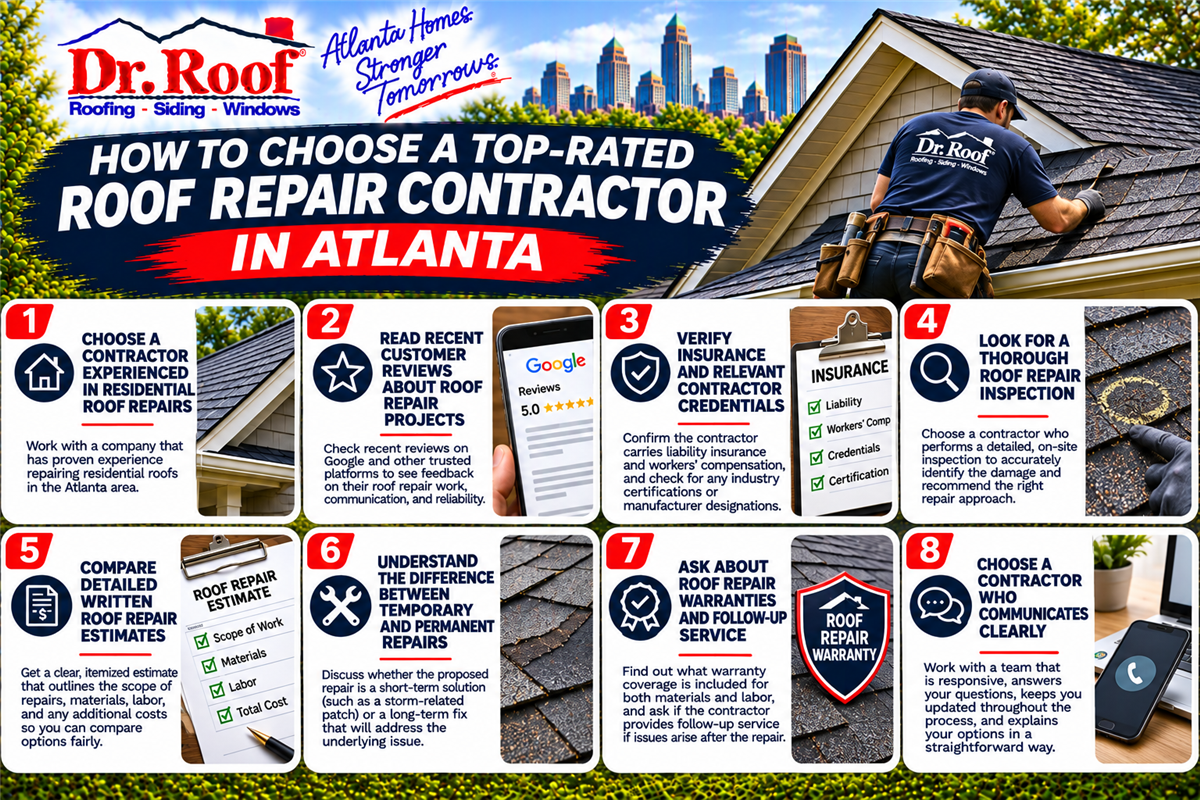
Here are eight important factors to evaluate before hiring a residential roof repair contractor.
1. Choose a Contractor Experienced in Residential Roof Repairs
Not every roofing company specializes in the same type of work.
Some contractors focus primarily on new roof installations, while others regularly handle residential repairs, inspections, and leak investigations.
If your roof has a localized problem, you should work with a contractor who understands how to evaluate and repair existing roofing systems.
Why Does Repair Experience Matter?
Repairing an existing roof requires understanding how new materials interact with older roofing components.
For example, replacing damaged asphalt shingles involves more than removing the visible material.
The contractor may need to separate overlapping shingles, access concealed fasteners, evaluate underlayment, and restore the affected area without damaging adjacent materials.
According to the Asphalt Roofing Manufacturers Association, many asphalt-shingle components can be repaired individually when the work is performed using appropriate methods.
However, the surrounding materials must remain suitable for repair.
What Questions Should You Ask?
Consider asking:
Do you regularly perform residential roof repairs?
Do you repair asphalt-shingle roofing systems?
Can you evaluate roof leaks and flashing problems?
Will you explain whether a targeted repair is appropriate?
What happens if the surrounding shingles are too deteriorated to repair reliably?
A qualified contractor should explain the available options rather than assume every roofing problem requires complete replacement.
2. Read Recent Customer Reviews About Roof Repair Projects
Online customer feedback can provide useful information about a roofing company's service and communication.
However, the overall star rating does not tell the complete story.
A company may have excellent reviews for roof replacements but relatively little feedback about smaller repairs.
What Should You Look for in Roof Repair Reviews?
Prioritize reviews that describe work similar to your project.
For example, homeowners researching roof leak repair may find reviews about flashing repairs or water-intrusion investigations particularly useful.
Look for comments involving:
Accurate explanations of roofing damage
Communication during inspections
Clear written estimates
Repair scheduling
Professionalism of the crew
Property cleanup
Follow-up after the work
Detailed reviews may provide more useful information than brief comments containing only a star rating.
Should You Read Negative Reviews?
Yes.
A single negative review does not necessarily mean a contractor performs poor work.
However, recurring complaints involving unclear estimates, communication problems, or unresolved repairs deserve attention.
The Federal Trade Commission recommends considering reviews from multiple independent sources and being cautious about unusual posting patterns.
Is the Highest-Rated Roofer Always the Best Choice?
Not automatically.
Ratings reflect customer experiences, but they do not replace an evaluation of the contractor's qualifications or the work being proposed.
A homeowner should consider both reputation and technical suitability.
3. Verify Insurance and Relevant Contractor Credentials
Before hiring a roofing company, ask about its business qualifications.
Roof repair can involve elevated work, specialized materials, and construction activity around your property.
Appropriate insurance and credentials are important considerations.
What Insurance Should You Ask About?
Homeowners should inquire about:
General liability insurance
Workers' compensation coverage, as applicable
Other insurance relevant to the proposed work
Ask the contractor for current documentation.
Does Every Atlanta Roofing Contractor Need the Same License?
Not necessarily.
Contractor licensing and registration requirements can depend on the jurisdiction and scope of work.
Homeowners should verify the requirements applicable to their project rather than assuming one credential applies to every residential roofing service.
Are Manufacturer Certifications Important?
Manufacturer certifications can provide additional information about a roofing contractor.
For example, GAF maintains contractor certification programs, including its Master Elite designation.
CertainTeed also offers contractor credentials, including SELECT ShingleMaster.
These programs have qualification requirements associated with the respective manufacturers.
However, certification does not guarantee that every repair will qualify for a particular warranty or that every roofing problem will have the same outcome.
The actual installation and written warranty terms still matter.
4. Look for a Thorough Roof Repair Inspection
A reputable roofing contractor should attempt to identify the actual problem before recommending permanent repairs.
For example, an interior ceiling stain may indicate a roof leak, but it does not always show exactly where water entered.
Moisture can travel along roof decking, framing, or other materials before becoming visible inside the home.
What Should a Roof Repair Inspection Evaluate?
Depending on the reported problem, the contractor may examine:
Asphalt shingles
Ridge cap shingles
Chimney flashing
Plumbing vent boots
Roof valleys
Roof-to-wall transitions
Previous repair areas
Visible decking concerns
Signs of water intrusion
The inspection should distinguish confirmed damage from conditions that require additional evaluation.
Why Does an Accurate Diagnosis Matter?
Consider a homeowner experiencing a leak near a chimney.
One contractor might suggest applying sealant to an exposed opening.
Another might identify deteriorated step flashing that requires replacement.
Although both proposals address the same complaint, the recommended work is not equivalent.
A permanent repair should correct the identified roofing defect rather than simply conceal the visible symptom.
Should You Request Inspection Photographs?
Yes, when available.
Photographs can help explain damage that homeowners cannot safely see from the ground.
The contractor should also identify any areas that could not be evaluated during the initial inspection.
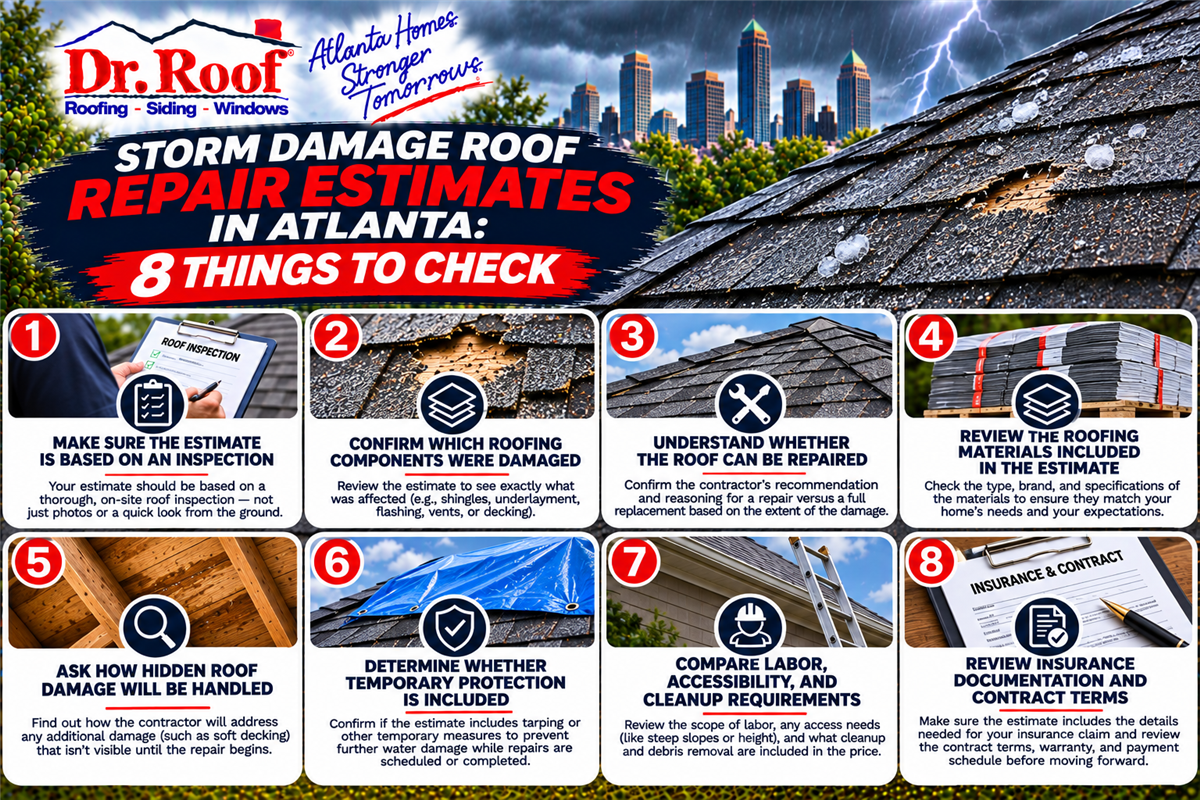
5. Compare Detailed Written Roof Repair Estimates
Price is important, but the total amount should not be the only factor in choosing a contractor.
Different roofing companies may propose different repair methods.
A lower estimate could reflect a smaller scope, different materials, or a temporary solution.
What Should a Written Roof Repair Estimate Include?
Depending on the project, the proposal should explain:
Location of the damage
Recommended repair
Materials requiring replacement
Flashing or underlayment work
Labor
Cleanup
Total proposed price
Potential additional work
Applicable warranty terms
The Federal Trade Commission recommends obtaining multiple written estimates and understanding the work before signing an agreement.
How Can You Compare Two Different Quotes?
Ask each contractor to explain exactly what will be corrected.
For example, replacing a deteriorated plumbing vent boot is different from applying sealant around the existing component.
The proposals may differ because the work itself is different.
Should You Always Choose the Lowest Quote?
No.
The lowest price may be appropriate when the proposed repair fully addresses the problem.
However, an inexpensive repair that leaves the underlying defect unresolved may not represent good value.
The most useful comparison is between the complete scopes of work.
6. Understand the Difference Between Temporary and Permanent Repairs
Some roofing problems require temporary protection before permanent work can begin.
This is especially relevant when significant damage creates active water intrusion or weather prevents immediate repairs.
What Is a Temporary Roof Repair?
Temporary protection may involve professionally installed tarping or another appropriate measure intended to reduce additional weather exposure.
These measures can be useful while materials are sourced or permanent repairs are arranged.
However, temporary protection should not be confused with a completed roofing repair.
What Makes a Repair Permanent?
A permanent repair should address the actual damaged component using appropriate roofing materials and installation procedures.
Depending on the problem, this might involve:
Replacing damaged shingles
Correcting flashing
Replacing a deteriorated pipe boot
Repairing underlayment
Replacing unsuitable decking
The contractor should explain whether the proposed work is intended as temporary protection or permanent restoration.
Why Does This Matter When Choosing a Roofer?
A contractor who clearly distinguishes these services helps homeowners understand what they are purchasing.
The written estimate should reflect that difference.
7. Ask About Roof Repair Warranties and Follow-Up Service
Warranty coverage can be another important consideration.
However, roof repair warranties are not identical across contractors or projects.
Some repairs may include workmanship coverage.
Certain replacement materials may also have applicable manufacturer warranties.
Does a Roof Repair Warranty Cover the Entire Roof?
Not automatically.
A warranty for one repaired section may not cover unrelated roofing components.
For example, replacing flashing around a chimney does not necessarily provide coverage for a separate plumbing vent leak.
What Warranty Questions Should You Ask?
Consider asking:
Does this repair include workmanship coverage?
Which specific work is covered?
How long does coverage apply?
Are materials and labor included?
What exclusions apply?
How do I report a problem after the repair?
Review the written terms before approving work.
What If the Leak Returns?
Contact the contractor and explain the concern.
The contractor may need to evaluate whether the new water intrusion involves the repaired area, a different roofing component, or subsequent damage.
A returning ceiling stain does not automatically establish that the original repair failed.
An inspection should determine the cause.
8. Choose a Contractor Who Communicates Clearly
Professional communication is an important part of the repair process.
Homeowners should understand what was found, which work is recommended, and what happens next.
What Should Good Communication Include?
A roofing contractor should be able to explain:
The observed damage
The proposed repair
Why the repair is appropriate
Material availability
Scheduling expectations
Potential additional work
Warranty information
Who to contact with questions
A contractor should also avoid unsupported promises about repair outcomes.
Does a Contractor Need to Guarantee That a Roof Will Never Leak Again?
No roofing contractor can guarantee that unrelated components will never develop problems or that future storms will not cause damage.
However, the contractor should explain the intended scope and applicable workmanship obligations.
Why Does Local Experience Matter?
Atlanta-area homes have varied roofing systems, including steep roof slopes, dormers, chimneys, and multiple valleys.
Heavy rainfall, thunderstorms, and strong winds can also create roofing concerns.
A contractor familiar with residential roofing in the region may be able to provide relevant guidance about common roof configurations and repair considerations.
However, local experience should be evaluated alongside the actual qualifications and proposed work.
What Are Warning Signs When Hiring a Roof Repair Contractor?
Homeowners should be cautious when a contractor:
Pressures them to sign immediately
Refuses to provide a written estimate
Cannot explain the cause of the damage
Makes unsupported promises about insurance approval
Requests full payment without clear project terms
Cannot provide appropriate insurance information
Recommends complete replacement without explaining the roofing condition
The presence of one concern does not automatically prove a company is unqualified.
However, homeowners should resolve important questions before authorizing work.
How Can You Tell Whether a Roofing Company Is Right for a Small Repair?
A qualified roofing contractor should evaluate the specific problem rather than assume that the size of the project determines the recommendation.
For example, replacing several damaged shingles may be appropriate when the surrounding roof remains serviceable.
However, a small visible leak may involve a more complicated flashing or decking problem.
Ask whether the contractor can explain the scope and provide a repair recommendation supported by the inspection findings.
Does a Top-Rated Contractor Always Recommend Roof Replacement?
No.
A contractor's customer rating does not determine whether roof replacement is necessary.
The decision should reflect the roofing system's actual condition.
The Asphalt Roofing Manufacturers Association confirms that many asphalt-shingle roofing components can be repaired individually.
However, widespread deterioration or unsuitable surrounding materials may make targeted repairs impractical.
An experienced contractor should explain both possibilities when relevant.
How Dr. Roof Helps Atlanta Homeowners With Residential Roof Repairs
Dr. Roof has served Atlanta-area homeowners since 1988, providing professional roofing inspections, repairs, replacement, and storm-damage documentation support.
Dr. Roof is a GAF Master Elite Certified Contractor and CertainTeed SELECT ShingleMaster.
The company provides residential roofing services involving damaged shingles, roof leaks, flashing, and other roofing components.
A professional evaluation can help determine whether a localized repair is appropriate or whether the roof requires more extensive work.
Depending on the circumstances, Dr. Roof may provide photographs, written findings, and repair or replacement recommendations.
Homeowners can review the proposed scope, ask questions about materials, and discuss applicable warranty terms before authorizing repairs.
Choose Your Atlanta Roof Repair Contractor With Confidence
Finding a highly rated roofing company is a useful starting point, but the best decision requires more than reading online reviews.
Relevant repair experience, professional diagnosis, appropriate qualifications, clear written estimates, and understandable warranty terms all matter.
For Atlanta homeowners, the goal should be selecting a contractor who can identify the actual roofing problem and recommend work suited to the condition of the home.
If your roof has damaged shingles, a developing leak, or other concerns, contact Dr. Roof to schedule a professional roofing evaluation and discuss your repair options.
How do I find a top-rated residential roof repair contractor in Atlanta?
Compare recent customer reviews, verify relevant roofing experience, ask for appropriate insurance documentation, review manufacturer credentials, and request detailed written estimates. A qualified contractor should explain the damage and recommended repair.
Should I choose the roofing contractor with the highest online rating?
Not automatically. Customer ratings provide useful information, but homeowners should also evaluate repair-specific experience, contractor qualifications, the written proposal, and applicable warranty terms.
What should a professional roof repair estimate include?
A written estimate should identify the affected roofing area, recommended repairs, materials, labor, cleanup, total proposed price, and applicable warranty information. It should also explain how unexpected damage or additional work will be handled.
Are manufacturer certifications important for roof repair contractors?
They can be. Certifications such as GAF Master Elite and CertainTeed SELECT ShingleMaster provide information about participation in manufacturer qualification programs. However, certification does not guarantee a particular repair outcome or warranty.
Can a reputable roofing contractor repair a roof without replacing it?
Yes. Many localized problems involving damaged shingles, flashing, or roof penetrations can be repaired when surrounding materials remain serviceable. A professional inspection should determine whether targeted repairs are appropriate.
Does a roof repair warranty cover the entire roof?
Not necessarily. Warranty coverage depends on the written terms and the scope of work. A warranty on a localized repair may not cover unrelated roofing components or future storm damage.
Subscribe to Dr. Roof's Blog



Comments