After a severe storm, discovering damaged shingles, exposed roofing materials, or a new ceiling leak can leave homeowners wondering what repairs are necessary and how much the work will cost.
The challenge is that storm-related roofing problems do not always involve the same damage.
One home may have several missing shingles, while another may have damaged flashing, compromised roof decking, or multiple affected roof sections.
For Atlanta homeowners, obtaining a professional storm-damage roof repair estimate is an important step toward understanding the problem and choosing an appropriate solution.
A storm-damage roof repair estimate should identify the damaged roofing components, explain the recommended repairs, specify the materials and labor involved, address potential hidden damage, and provide clear pricing for the proposed work.
A detailed estimate can also help homeowners distinguish between temporary protection, localized repairs, and situations where a more extensive roofing project may be necessary.
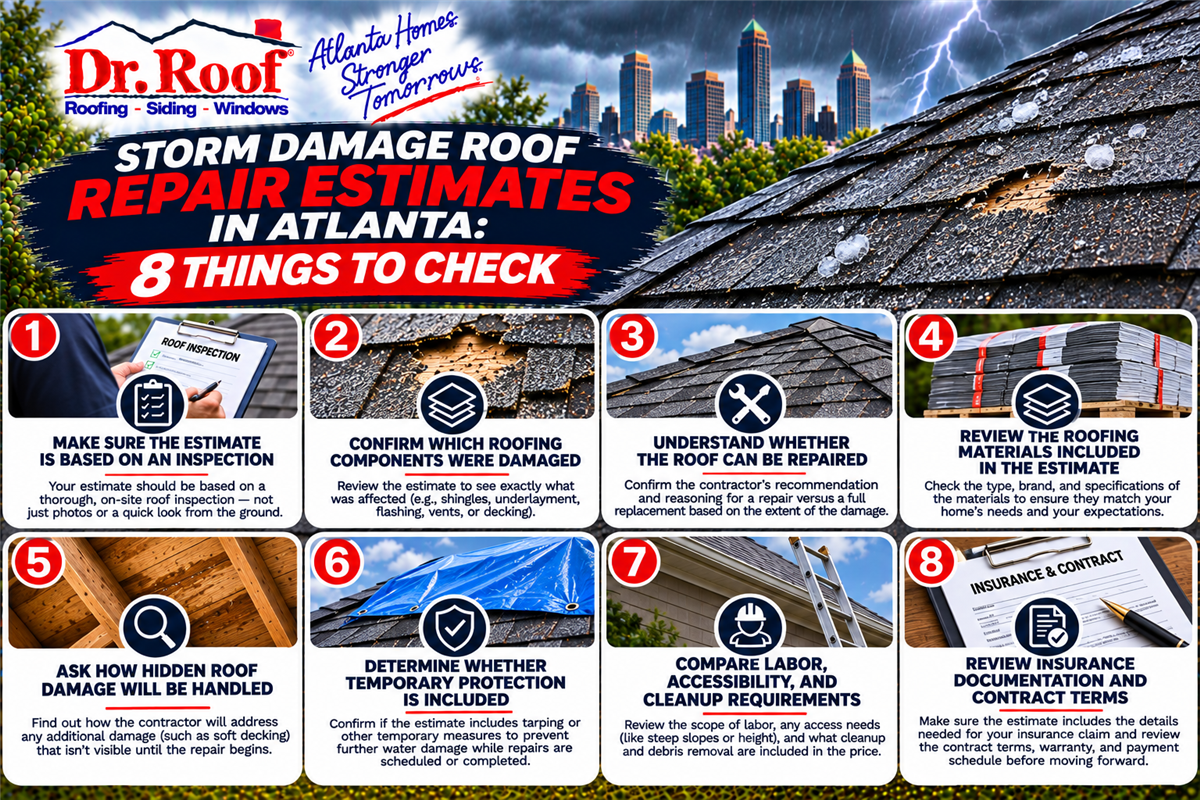
Here are eight important things to review when requesting a storm-damage roof repair estimate in Atlanta.
1. Make Sure the Estimate Is Based on an Inspection
The first step in obtaining an accurate storm-damage repair estimate is having the roofing system professionally evaluated.
A contractor should identify the visible damage and determine which roofing components require attention.
What Should a Storm Damage Roof Inspection Include?
Depending on the reported damage and roofing system, an inspection may evaluate:
Asphalt shingles
Ridge cap shingles
Roof flashing
Plumbing vent penetrations
Roof valleys
Areas affected by falling debris
Visible roof decking concerns
Previous roofing repairs
Signs of water intrusion
The contractor should distinguish between confirmed damage, ordinary deterioration, and conditions that require further evaluation.
Can a Roofing Contractor Provide an Estimate From Photographs?
Photographs can help a contractor understand the general concern.
For example, a picture showing several missing shingles may indicate that a particular roof section needs attention.
However, photographs do not always reveal the condition of surrounding shingles, underlayment, or decking.
A professional inspection is often necessary to determine the complete scope.
Why Does the Inspection Matter for Pricing?
Two roofs may show similar damage from the ground but require different repairs.
For example, replacing several damaged shingles involves a different amount of work from correcting damage that extends into the roof decking.
The inspection helps determine which materials and labor should be included in the estimate.
2. Confirm Which Roofing Components Were Damaged
A useful repair estimate should explain what the contractor found.
Storm damage can affect more than the visible shingles.
What Types of Damage Can Storms Cause?
Potential roofing problems include:
Wind-damaged shingles: Strong winds may lift, crease, tear, or remove asphalt shingles.
Hail impact damage: Hail can affect shingles and certain roofing accessories, depending on the severity of the impact.
Damaged flashing: Wind or falling debris may affect flashing around roof penetrations and transitions.
Falling branch damage: Tree limbs can puncture roofing materials or damage supporting components.
Water intrusion: Openings in the roofing system may allow moisture to reach the underlayment, decking, or interior materials.
Not every storm causes these problems, and not every visible mark indicates functional roofing damage.
Should the Estimate Identify the Location of the Damage?
Yes, when practical.
For example, a contractor may identify damaged shingles on the rear-facing roof slope or deteriorated flashing around a particular chimney.
Describing the location makes the proposed repair easier to understand.
Should You Request Photographs?
Photographs can be useful documentation.
They may help show:
Which shingles are damaged
Where flashing problems exist
Whether roofing materials are missing
Where a branch struck the roof
Whether exposed materials show visible deterioration
However, photographs alone do not establish insurance coverage or the need for complete roof replacement.
They support the contractor's explanation of the observed conditions.
3. Understand Whether the Roof Can Be Repaired
One of the most important questions after storm damage is whether the existing roofing system can be repaired.
A storm does not automatically mean the entire roof needs replacement.
The appropriate solution depends on the damage and the condition of the surrounding materials.
When Are Localized Storm Damage Repairs Appropriate?
A targeted repair may be possible when:
Damage affects a limited area
Surrounding shingles remain serviceable
Compatible replacement materials are available
Flashing can be corrected
Roof decking remains suitable
The repair can be integrated reliably
For example, several wind-damaged shingles may be replaceable without removing the entire roof.
The Asphalt Roofing Manufacturers Association explains that many components of an asphalt-shingle roofing system can be repaired individually by qualified roofing professionals.
When Might More Extensive Work Be Necessary?
A larger repair or roof replacement may deserve consideration when:
Multiple roof sections have significant damage
Shingles are extensively deteriorated
The remaining materials cannot be repaired reliably
Significant underlying damage is present
The roofing system has widespread problems beyond the storm-related area
The contractor should explain why the recommended work is appropriate.
Should the Estimate Explain Repair vs. Replacement?
Yes.
If a contractor recommends complete replacement instead of localized repair, ask which conditions support that recommendation.
A homeowner should understand whether replacement is being recommended because of widespread damage, deteriorated materials, or another identified condition.
Roof age alone does not automatically establish that replacement is necessary.
4. Review the Roofing Materials Included in the Estimate
The materials required for storm-damage repairs depend on what was damaged.
A repair involving asphalt shingles may require different products from a repair involving chimney flashing or roof decking.
What Materials Might Be Included?
Depending on the project, the estimate may identify:
Replacement asphalt shingles
Roofing underlayment
Flashing components
Plumbing vent boots
Roofing fasteners
Ridge cap shingles
Roof decking
Appropriate sealing materials
Not every repair requires all these components.
The contractor should specify which materials are needed.
Why Does Shingle Compatibility Matter?
Replacement shingles must be appropriate for the existing roofing system.
For example, the contractor should consider the shingle type, installation requirements, and surrounding material condition.
The new shingles also need to integrate properly with the existing roof covering.
Will Replacement Shingles Match the Existing Roof?
Not always.
Existing shingles can change appearance through normal weathering.
Even when the original product and color remain available, newly installed shingles may look different.
The contractor should discuss material compatibility and reasonable appearance expectations.
Can a Contractor Use Different Materials to Lower the Price?
Material substitutions should be evaluated carefully.
A lower-cost product is not automatically suitable for every roofing repair.
The contractor should explain whether the replacement material meets the applicable installation requirements.
Homeowners should understand any material changes before approving the estimate.
5. Ask How Hidden Roof Damage Will Be Handled
Some roofing problems remain concealed beneath the shingles.
When a storm damages the roof covering, water may reach the materials underneath.
However, the amount of hidden damage cannot always be determined during the initial inspection.
What Is Roof Decking?
Roof decking, also called roof sheathing, provides the supporting surface beneath the roofing materials.
Common residential decking products include plywood and oriented strand board.
The decking must remain suitable for the roofing system installed above it.
Can Storm Damage Affect the Decking?
Yes.
Falling branches may physically damage roof decking.
Water intrusion can also affect the material if moisture enters through a compromised roofing area.
Potential problems include:
Holes
Delaminated panels
Wood deterioration
Structural weakness
Other unsuitable conditions
Not every previously wet or discolored panel requires replacement.
The material should be evaluated to determine whether it remains serviceable.
Can Hidden Damage Increase the Repair Cost?
Yes.
If the contractor discovers additional damage after removing roofing materials, the repair scope may need to change.
Homeowners should ask:
Is any decking repair included in the estimate?
How will hidden damage be documented?
Will photographs be provided?
How will additional work be priced?
Will homeowner approval be required?
A written change-order procedure can help clarify how unexpected repairs will be handled.
6. Determine Whether Temporary Protection Is Included
Some storm-damage situations require temporary protection before permanent repairs can begin.
For example, severe weather may prevent immediate roofing work, or a contractor may need additional materials.
What Is Temporary Roof Protection?
Temporary protection involves measures intended to reduce additional weather exposure.
Depending on the situation, a qualified roofing contractor may recommend professional roof tarping or another appropriate protective method.
Temporary protection does not necessarily correct the underlying roofing problem.
Is Roof Tarping the Same as Roof Repair?
No.
A tarp may help reduce water intrusion while permanent repairs are planned.
However, it is not a replacement for restoring damaged shingles, flashing, or other roofing components.
The Asphalt Roofing Manufacturers Association distinguishes temporary protective measures from permanent roofing repairs.
Should Temporary Protection Be Listed Separately?
Ask whether the estimate includes temporary protection, permanent repairs, or both.
For example, a contractor may provide one proposal for initial stabilization and another for the completed repair.
Understanding these differences helps homeowners evaluate the total scope.
Can Homeowners Install Their Own Roof Tarps?
Homeowners should avoid climbing onto damaged or wet roofs.
Storm-damaged roofing materials may be loose, unstable, or structurally compromised.
A qualified contractor should determine whether the roof can be accessed safely and what protective measures are appropriate.
7. Compare Labor, Accessibility, and Cleanup Requirements
Roof repair pricing involves more than the materials being installed.
The location of the damage and difficulty of accessing the roof can influence labor requirements.
How Does Roof Pitch Affect the Estimate?
Roof pitch describes the steepness of the roof.
A steep, multi-story roof may require different safety equipment and access procedures from a relatively accessible single-story roof.
These conditions can influence how the work is performed.
What Other Factors Affect Labor?
Important considerations may include:
Roof height
Number of roof levels
Roof slope
Location of the damage
Chimneys and dormers
Material removal requirements
Repair complexity
Safety equipment
Cleanup procedures
Two repairs using similar materials may involve different labor requirements.
Should Cleanup Be Included?
Ask whether the estimate includes removing damaged roofing materials and collecting construction debris.
If the repair requires replacing shingles or decking, disposal of the removed materials should be addressed.
The contractor should explain which cleanup responsibilities are included.
Does a More Expensive Estimate Mean Better Work?
Not automatically.
A higher price may reflect a larger repair scope, different materials, or more complicated access requirements.
A lower estimate may describe a smaller repair or exclude certain work.
The important question is whether the proposed scope appropriately addresses the roofing problem.
8. Review Insurance Documentation and Contract Terms
Some storm-damage repairs involve homeowners insurance.
However, a roofing estimate and an insurance coverage decision are two different things.
Does a Roofing Estimate Guarantee Insurance Coverage?
No.
A roofing contractor can identify physical damage and recommend repairs.
The insurance company determines coverage and payment according to the homeowner's policy and individual claim.
The contractor cannot guarantee approval.
What Documentation Might Be Helpful?
The Georgia Office of the Commissioner of Insurance and Safety Fire recommends documenting damage and notifying the insurer promptly after a covered event is suspected.
Useful records may include:
The approximate storm date
Photographs of visible damage
Professional inspection findings
Written repair estimates
Records of temporary protection
Repair invoices
Insurance correspondence
Keep copies of relevant documents.
Should You Complete Repairs Before the Insurance Inspection?
If an insurance claim is involved, review the insurer's procedures.
Temporary protective measures may be necessary to reduce additional damage.
However, homeowners should understand the documentation requirements before authorizing significant permanent work when circumstances allow.
What Should You Review Before Signing a Repair Contract?
The Federal Trade Commission recommends reviewing written contractor agreements carefully.
A repair agreement should explain:
The contractor's information
The proposed scope
Materials
Price
Payment terms
Scheduling expectations
Change-order procedures
Applicable warranty information
Avoid signing incomplete documents or relying on unsupported promises about insurance outcomes.
How Much Does Storm Damage Roof Repair Cost in Atlanta?
There is no single price that applies to every storm-damaged roof.
The cost depends on the actual roofing problem and the work required.
What Factors Influence the Price?
Common considerations include:
Type of storm damage
Number of damaged shingles
Affected roof area
Flashing repairs
Underlayment condition
Decking repairs
Roof pitch
Accessibility
Labor
Temporary protection
Cleanup
A repair involving several missing shingles is different from a project involving extensive flashing or decking damage.
The most reliable estimate is based on the actual roof condition.
Can You Get an Exact Price Over the Phone?
A contractor may be able to discuss the general concern or explain the inspection process.
However, an accurate repair estimate often requires evaluating the roofing system.
Photographs can provide useful context, but they may not reveal concealed conditions.
Should You Get More Than One Estimate?
Comparing written estimates can help homeowners understand the available options.
The Federal Trade Commission recommends obtaining estimates from more than one contractor when practical.
However, immediate safety concerns and necessary temporary protection should not be delayed unnecessarily.
When comparing proposals, evaluate the complete scope rather than the total price alone.
What Should You Ask a Roofing Contractor About Storm Damage?
Before approving repairs, consider these questions:
What storm-related damage was identified?
Which roofing components require repair?
Can the affected area be repaired without replacing the entire roof?
Are compatible replacement materials available?
Is there evidence of hidden damage?
What labor and cleanup are included?
Is temporary protection necessary?
How will unexpected repairs be documented?
What warranty applies?
What is the anticipated repair schedule?
These questions help establish whether the estimate provides enough information for an informed decision.
Why Storm Damage Estimates Matter for Atlanta Homeowners
Atlanta-area homes experience thunderstorms, heavy rainfall, strong winds, and occasional hail.
These conditions can affect roofing systems in different ways.
Homes with multiple roof slopes, dormers, chimneys, or steep sections may also require additional attention during repairs.
For example, replacing several damaged shingles on an accessible roof slope may involve different labor from repairing flashing near a chimney on a steep roof.
A professional estimate should account for the property's actual conditions.
The goal is identifying the work necessary to restore the affected roofing area appropriately.
How Dr. Roof Helps Atlanta Homeowners With Storm Damage Estimates
Dr. Roof has served Atlanta-area homeowners since 1988, providing professional roofing inspections, repairs, replacement, and storm-damage documentation support.
A roofing evaluation can help identify concerns involving:
Damaged asphalt shingles
Roof flashing
Roof penetrations
Ridge components
Roof valleys
Underlayment
Roof decking
Storm-related water intrusion
Depending on the circumstances, Dr. Roof may provide photographs, written findings, and recommendations for repair or replacement.
Homeowners can discuss the identified roofing conditions and request an estimate describing the proposed work.
For insurance-related situations, documentation may help explain the physical condition of the roof, although coverage decisions remain the responsibility of the insurer.
Get a Storm Damage Roof Repair Estimate Based on the Actual Damage
Storm damage repair estimates should provide more than a total price.
A useful proposal explains what was damaged, which materials need attention, and how the contractor plans to complete the repair.
It should also address potential hidden damage, temporary protection, and any additional work that may become necessary.
For Atlanta homeowners, understanding these details makes it easier to compare repair options and make informed decisions.
If your roof has experienced storm-related damage, contact Dr. Roof to schedule a professional roofing evaluation and discuss the repairs appropriate for your home.
What should a storm-damage roof repair estimate include?
A storm-damage roof repair estimate should identify the damaged roofing components, recommended repairs, replacement materials, labor, cleanup, total proposed price, and applicable warranty information. It should also explain how unexpected damage and additional work will be handled.
Can a contractor estimate storm damage repairs from photographs?
Photographs can help identify visible roofing concerns, but they may not reveal hidden damage or the condition of surrounding materials. A professional inspection is often necessary to determine the complete repair scope and provide an accurate estimate.
Does a storm-damage roofing estimate guarantee insurance payment?
No. A roofing contractor may document physical damage and recommend repairs, but the insurance company determines coverage and payment under the homeowner's policy. A repair estimate does not guarantee claim approval.
Can storm-damaged shingles be repaired instead of replacing the entire roof?
Often, yes. Localized shingle damage may be repairable when surrounding roofing materials remain serviceable and compatible replacement products are available. Widespread damage or extensive deterioration may require a larger roofing project.
Can hidden roof decking damage increase a storm repair estimate?
Yes. If damaged or unsuitable decking is discovered after roofing materials are removed, additional repairs may be necessary. Homeowners should ask how these findings will be documented, priced, and approved.
Is temporary roof tarping included in storm-damage repair estimates?
It depends on the contractor and proposed scope. Temporary roof protection may be priced separately from permanent repairs. Homeowners should confirm whether the estimate includes tarping, permanent repairs, or both.
Subscribe to Dr. Roof's Blog



Comments