Choosing a new roof involves more than selecting a shingle color.
The roofing material you choose can influence your home's appearance, installation requirements, maintenance needs, and overall replacement cost.
For Atlanta homeowners, the decision may also involve considering how different roofing systems perform under heavy rainfall, summer heat, strong thunderstorms, and other regional weather conditions.
Fortunately, residential roofing materials are available in a variety of styles, from traditional asphalt shingles to metal roofing and premium composite products.
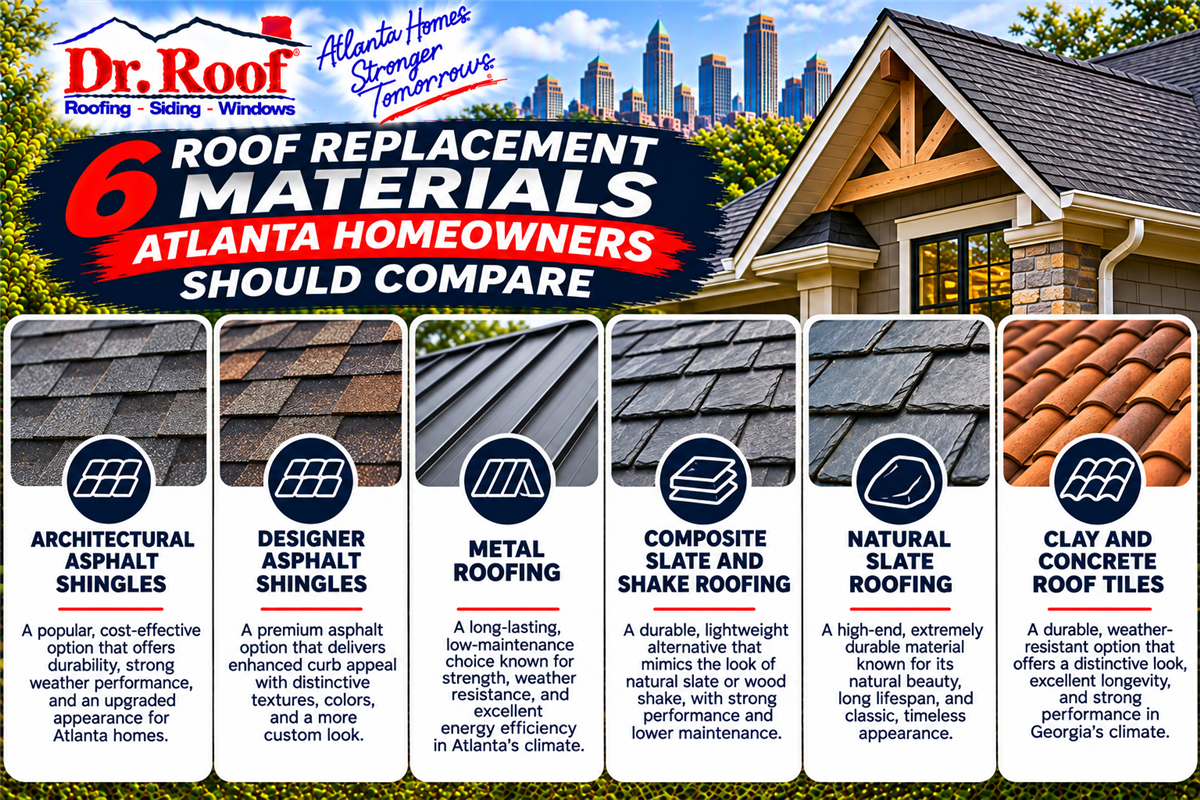
Popular roof replacement material options include architectural asphalt shingles, designer asphalt shingles, metal roofing, composite slate and shake products, natural slate, and clay or concrete tile. The best option depends on the home's roof design, structural suitability, budget, appearance preferences, and installation requirements.
No roofing material is automatically the best choice for every property.
Understanding the differences can help homeowners compare proposals and select an appropriate roofing system.
Here are six material categories worth considering when planning a residential roof replacement in Atlanta.
1. Architectural Asphalt Shingles
Architectural asphalt shingles are a widely used option for residential roof replacement.
Also called laminated or dimensional shingles, these products contain multiple layers that create a more textured appearance than traditional strip shingles.
The Asphalt Roofing Manufacturers Association identifies laminated shingles as a major category of steep-slope asphalt roofing.
Why Do Homeowners Choose Architectural Shingles?
Architectural asphalt shingles are available in a wide variety of colors, styles, and product lines.
They can complement many home designs commonly found throughout Atlanta-area neighborhoods.
Potential advantages include:
Broad product availability
Multiple color options
Dimensional appearance
Familiar installation methods
Repairability when surrounding materials remain serviceable
Different manufacturer and warranty options
However, individual products vary in their specifications.
Are Architectural Shingles Better Than Three-Tab Shingles?
The answer depends on the specific products and homeowner priorities.
Traditional three-tab shingles generally have a flatter appearance.
Architectural shingles have layered construction that creates additional visual depth.
Different products may also have different published wind-performance characteristics, warranty provisions, and installation requirements.
Homeowners should compare actual product specifications rather than assume all shingles in one category perform identically.
Are Architectural Shingles a Good Choice for Atlanta?
They can be appropriate for many residential roofs when the products suit the roof design and are installed according to manufacturer requirements.
The contractor should evaluate roof pitch, underlayment, flashing, and other components before recommending a system.
2. Designer Asphalt Shingles
Designer asphalt shingles are another option for homeowners who want a particular architectural appearance.
These products may feature distinctive profiles, dimensional patterns, or designs intended to resemble more traditional roofing materials.
For example, some designer shingles create the appearance of slate or wood shake.
What Makes Designer Shingles Different?
Designer products may feature:
Distinctive shingle shapes
More pronounced shadow lines
Specialty color blends
Different surface textures
Decorative roofing patterns
Product-specific performance characteristics
The features depend on the manufacturer and product line.
Are Designer Shingles More Durable?
Not automatically.
A higher price or more elaborate appearance does not guarantee a longer service life.
Durability depends on the specific materials, installation, roof design, and weather exposure.
Homeowners should compare published specifications and warranty terms for the actual products being considered.
Who Might Consider Designer Shingles?
Designer shingles may appeal to homeowners who want an asphalt roofing system with a more distinctive appearance.
They can be worth comparing for homes with prominent rooflines or particular architectural styles.
However, product suitability and installation requirements should take priority over appearance alone.
3. Metal Roofing
Metal roofing is another established residential roof replacement category.
Metal roofing systems are available in several styles, including standing-seam panels and metal shingles.
Some products create a modern appearance, while others are designed to resemble traditional roofing materials.
What Is Standing-Seam Metal Roofing?
Standing-seam systems use formed metal panels with raised seams.
The seams connect adjoining panels and contribute to the roofing system's weather-management design.
Depending on the selected product, fastening methods may be concealed.
What Are Metal Shingles?
Metal shingles are individual roofing components manufactured to create different appearances.
Some products resemble conventional shingles, while others imitate slate, shake, or tile.
The Metal Roofing Alliance identifies several residential metal roofing styles, including standing-seam panels, metal shingles, metal slate, and metal tile.
What Are the Potential Benefits of Metal Roofing?
Depending on the product, homeowners may consider:
Distinctive appearance
Different finish and color choices
Product-specific weather-resistance characteristics
Recyclability
Different maintenance requirements
Compatibility with certain architectural designs
However, the performance of a metal roof depends on the specific system and installation.
What Should Atlanta Homeowners Consider?
Metal roofing requires appropriate installation details.
The contractor should evaluate:
Roof pitch
Panel or shingle system
Fastening requirements
Flashing
Thermal movement
Roof penetrations
Existing roof structure
Some metal roofing systems may have a higher initial material and installation cost than conventional asphalt shingles.
The actual price depends on the selected product and project.
Does Metal Roofing Guarantee Lower Energy Bills?
No.
Reflective roofing finishes may influence roof surface temperatures, but energy performance depends on the building's design, insulation, air sealing, HVAC system, and other conditions.
Homeowners should not assume any specific roofing material will guarantee lower utility costs.
4. Composite Slate and Shake Roofing
Composite roofing products are manufactured to imitate the appearance of traditional materials.
Depending on the product, composite systems may recreate the texture and color variation of natural slate or wood shake.
These products can provide an alternative appearance without using the same material as the original roofing style.
What Is Composite Roofing Made From?
The composition varies by manufacturer.
Some products use engineered polymer-based materials.
For example, DaVinci Roofscapes manufactures composite slate and shake roofing tiles using specialized resins and other ingredients.
What Is the Difference Between Composite Slate and Composite Shake?
Composite slate is designed to resemble natural slate roofing.
It may feature textured surfaces, straight edges, or other profiles inspired by quarried stone.
Composite shake is designed to resemble wood shake roofing.
It often includes textured grain patterns and profiles intended to recreate the appearance of split cedar.
Why Might Homeowners Consider Composite Roofing?
Potential considerations include:
Slate-inspired or shake-inspired appearance
Manufacturer-specific color selections
Different product weights than natural alternatives
Published weather-performance ratings
Different maintenance characteristics
Specialty architectural options
However, the specifications differ between product lines.
Does Composite Roofing Have the Same Warranty as Asphalt Shingles?
Not necessarily.
Warranty provisions depend on the manufacturer and selected product.
For example, DaVinci publishes limited material warranty information for its composite roofing systems.
Homeowners should review coverage, exclusions, transfer provisions, and installation requirements before making a decision.
Does Dr. Roof Offer DaVinci Roofing?
Yes.
Dr. Roof's published residential roofing information identifies DaVinci Roofscapes as one of its roof replacement options for Atlanta-area homeowners.
A professional consultation can help determine whether a particular DaVinci product is suitable for the property's roof design and requirements.
5. Natural Slate Roofing
Natural slate is a stone roofing material known for its traditional appearance.
It is commonly associated with certain historic, luxury, and architecturally distinctive homes.
Natural slate roofing consists of individual stone pieces installed as part of a complete roofing assembly.
Why Do Some Homeowners Choose Natural Slate?
Potential considerations include:
Authentic stone appearance
Natural color variation
Traditional architectural character
Product-specific durability characteristics
Suitability for certain historic styles
However, natural slate is not appropriate for every home.
Why Does Roof Structure Matter?
Natural slate can be substantially heavier than many other residential roofing materials.
Before installing a heavy roofing system, the existing structure must be evaluated for suitability.
Structural modifications may be necessary for some properties.
Homeowners should not assume that a roof originally designed for asphalt shingles can support natural slate without appropriate evaluation.
Is Natural Slate More Expensive?
Natural slate projects may involve specialized materials and labor.
Installation complexity, roof design, material selection, and structural requirements can influence the total cost.
The contractor should prepare a project-specific estimate.
What About Slate Roof Repairs?
Individual slate components may be replaceable, but the repair methods differ from conventional asphalt shingles.
Homeowners should consider the availability of qualified installers and appropriate materials when evaluating a specialty roofing system.
6. Clay and Concrete Roof Tiles
Clay and concrete roof tiles offer another distinctive roofing appearance.
These systems are associated with certain Mediterranean, Spanish-inspired, and other architectural styles.
Tiles may be available in curved, flat, or other profiles depending on the manufacturer.
What Is the Difference Between Clay and Concrete Tiles?
Clay roofing tiles are produced from clay-based materials.
Concrete tiles are manufactured using cement-based materials and aggregates.
Their appearance, weight, surface characteristics, and installation requirements vary by product.
Why Might Homeowners Consider Tile Roofing?
Potential reasons include:
Distinctive architectural appearance
Variety of profiles and colors
Product-specific performance characteristics
Compatibility with certain home designs
However, tile roofing requires careful evaluation.
Are Tile Roofs Heavier Than Asphalt Shingles?
Many clay and concrete roofing products are heavier than conventional asphalt shingles.
The actual weight depends on the tile design.
A qualified professional should evaluate structural suitability before a homeowner commits to a heavier roofing system.
Does Tile Roofing Require Special Installation?
Yes.
Tile systems have product-specific requirements involving attachment, underlayment, flashing, roof pitch, and other components.
Homeowners should work with contractors who have relevant experience with the selected product.
Is Tile Roofing Right for Every Atlanta Home?
No.
Suitability depends on the roof structure, architectural design, manufacturer requirements, and project scope.
A professional evaluation is necessary before selecting a tile roofing system.
How Do These Roof Replacement Materials Compare?
Each material category offers different characteristics.
| Roofing Material | Appearance | Important Consideration |
|---|---|---|
| Architectural asphalt shingles | Layered, dimensional shingle look | Compare specific product ratings and warranty terms |
| Designer asphalt shingles | Decorative or specialty profiles | Balance appearance with product suitability |
| Metal roofing | Standing seam or traditional material-inspired styles | Evaluate fastening, flashing, and installation requirements |
| Composite slate or shake | Manufactured slate or wood-shake appearance | Review product-specific specifications and warranty coverage |
| Natural slate | Authentic stone | Confirm structural suitability and installer experience |
| Clay or concrete tile | Distinctive tile profiles | Evaluate weight, attachment, and roof design |
This comparison is a starting point rather than a ranking.
The appropriate material depends on the individual property.
Which Roof Replacement Material Is Most Affordable?
The cost of roof replacement depends on more than the selected roofing material.
Conventional asphalt shingles are often considered when initial project cost is a major priority.
Specialty products such as natural slate, certain metal systems, and premium composite roofing may involve different material and installation costs.
However, there is no single price that applies to every project.
What Affects Roof Replacement Pricing?
Important factors include:
Roofing material
Roof size
Roof pitch
Installation complexity
Existing roofing removal
Decking condition
Flashing
Underlayment
Labor
Specialty components
A professional estimate should identify the complete roofing system rather than only the visible roof covering.
Should You Choose the Cheapest Material?
Not automatically.
The lowest initial price may be appropriate for some homeowners.
Others may prioritize a particular appearance, installation system, or product characteristic.
The most useful comparison considers the home's needs and the complete proposed scope.
Which Roofing Materials Are Best for Atlanta Weather?
Atlanta-area homes experience heavy rainfall, strong thunderstorms, summer heat, humidity, and occasional hail.
These conditions make appropriate material selection and installation important.
What Matters for Wind Resistance?
Review the product's published wind-performance information and applicable installation requirements.
Fastening, starter materials, roof edges, and other details may influence the complete system's performance.
A product rating does not guarantee protection against every wind event.
What Matters for Hail Resistance?
Certain roofing products carry published impact-resistance classifications.
However, an impact rating does not mean the roof is immune to all hail damage.
The contractor should explain the particular product's specifications and limitations.
What Matters for Heavy Rain?
The roofing system must direct water appropriately.
Important components may include:
Underlayment
Flashing
Roof valleys
Roof penetrations
Starter materials
Proper material overlap
The visible roof covering is only one part of the water-management system.
Does the Best Material Depend on Roof Pitch?
Yes.
Different roofing products have different minimum slope requirements.
For example, conventional asphalt shingles are not suitable for every low-slope roof section.
The contractor should evaluate the pitch of each relevant roof area before recommending a system.
Does the Most Expensive Roofing Material Last the Longest?
Not necessarily.
Material price alone does not determine service life.
Actual roof performance depends on:
Material selection
Roof design
Installation quality
Weather exposure
Maintenance
Supporting structure
Other environmental conditions
Some premium roofing products have different performance specifications, but no roofing material can guarantee a particular lifespan under every circumstance.
Homeowners should review manufacturer information without treating advertised warranty periods as guaranteed service-life predictions.
What About Roof Replacement Warranties?
Warranty coverage varies considerably.
Some manufacturer warranties focus on qualifying material defects.
Other warranty programs may include additional protection for qualifying roofing systems installed under specified conditions.
Does a Lifetime Warranty Mean the Roof Lasts Forever?
No.
The meaning of lifetime coverage depends on the applicable written warranty.
Homeowners should review:
Coverage duration
Eligibility requirements
Exclusions
Workmanship provisions
Registration requirements
Transfer conditions
Available remedies
Different roofing materials may have very different warranty arrangements.
A contractor should explain which coverage applies to the selected system.
Should Atlanta Homeowners Consider Their Home's Architectural Style?
Yes.
Roofing material affects the appearance of a property.
For example, architectural asphalt shingles may complement many suburban homes, while composite slate can create a different appearance.
Metal panels may suit some contemporary or traditional designs depending on the product.
Natural slate and tile roofing can also complement particular architectural styles.
However, appearance should be balanced with structural suitability and installation requirements.
What About Homeowners Association Rules?
Some homeowners associations have architectural guidelines affecting roofing materials or colors.
Homeowners should review any applicable requirements before finalizing the selection.
Do not assume that every permitted roofing material is automatically approved by a particular association.
What Should You Ask Before Choosing a Roof Replacement Material?
Before approving a complete roofing system, consider asking:
Is this material appropriate for my roof pitch?
Can the existing roof structure support it?
What underlayment and flashing are required?
What product-specific installation requirements apply?
What are the published wind and impact characteristics?
What maintenance does the manufacturer recommend?
What warranty provisions apply?
Are qualified installers available for this product?
How does the complete project cost compare with alternatives?
Will the proposed material meet any applicable architectural restrictions?
These questions can help homeowners evaluate the complete replacement proposal.
How Dr. Roof Helps Atlanta Homeowners Compare Roofing Materials
Dr. Roof has served Atlanta-area homeowners since 1988, providing professional roofing inspections, repairs, and roof replacement services.
Dr. Roof is a GAF Master Elite Certified Contractor and CertainTeed SELECT ShingleMaster.
The company works with established roofing brands, including GAF, TAMKO, and CertainTeed, and offers DaVinci Roofscapes composite roofing options.
During a professional roof replacement consultation, homeowners can discuss:
Existing roof condition
Architectural preferences
Asphalt shingle options
Composite roofing options
Roof pitch
Decking requirements
Underlayment
Flashing
Installation scope
Applicable warranty information
The contractor should confirm which materials are available and appropriate for the individual project.
Choose a Roof Replacement Material That Fits Your Home
There is no single roofing material that is automatically best for every Atlanta home.
Architectural asphalt shingles offer familiar appearance options, designer shingles provide distinctive profiles, and metal roofing introduces different styles and installation systems.
Composite slate and shake products provide alternatives to certain traditional appearances, while natural slate and tile roofing may suit specific architectural designs.
The right decision depends on more than appearance.
Roof structure, installation requirements, material specifications, maintenance, and the complete project budget all matter.
For Atlanta homeowners, a professional roofing evaluation can help determine which options are suitable.
If you're considering a roof replacement in Atlanta, Marietta, Roswell, Alpharetta, Smyrna, or surrounding communities, contact Dr. Roof to schedule a consultation and discuss the roofing materials available for your home.
What are the most popular roof replacement material options?
Common residential roof replacement options include architectural asphalt shingles, designer asphalt shingles, metal roofing, composite slate and shake products, natural slate, and clay or concrete tile. The appropriate choice depends on the home and installation requirements.
Are architectural asphalt shingles a good choice for Atlanta homes?
They can be. Architectural asphalt shingles are available in many colors and styles and can suit numerous residential roof designs. Homeowners should compare the specific product's specifications, warranty terms, and installation requirements.
What is the difference between composite roofing and natural slate?
Composite slate roofing is manufactured to resemble natural slate using engineered materials. Natural slate is made from stone. The products differ in composition, weight, installation requirements, appearance characteristics, and warranty arrangements.
Is metal roofing better than asphalt shingles?
Neither material is automatically better for every home. Metal roofing and asphalt shingles have different installation systems, appearance options, maintenance considerations, and costs. The best choice depends on the property and homeowner priorities.
Can any home support natural slate or clay tile roofing?
Not necessarily. Some natural slate and tile systems are substantially heavier than conventional asphalt shingles. The existing roof structure should be professionally evaluated before selecting a heavier roofing material.
Does choosing a premium roofing material guarantee a longer-lasting roof?
No. Premium materials may offer different product specifications, but service life also depends on installation quality, roof design, weather exposure, maintenance, and other conditions. No roofing material guarantees a particular lifespan.
Subscribe to Dr. Roof's Blog




Comments