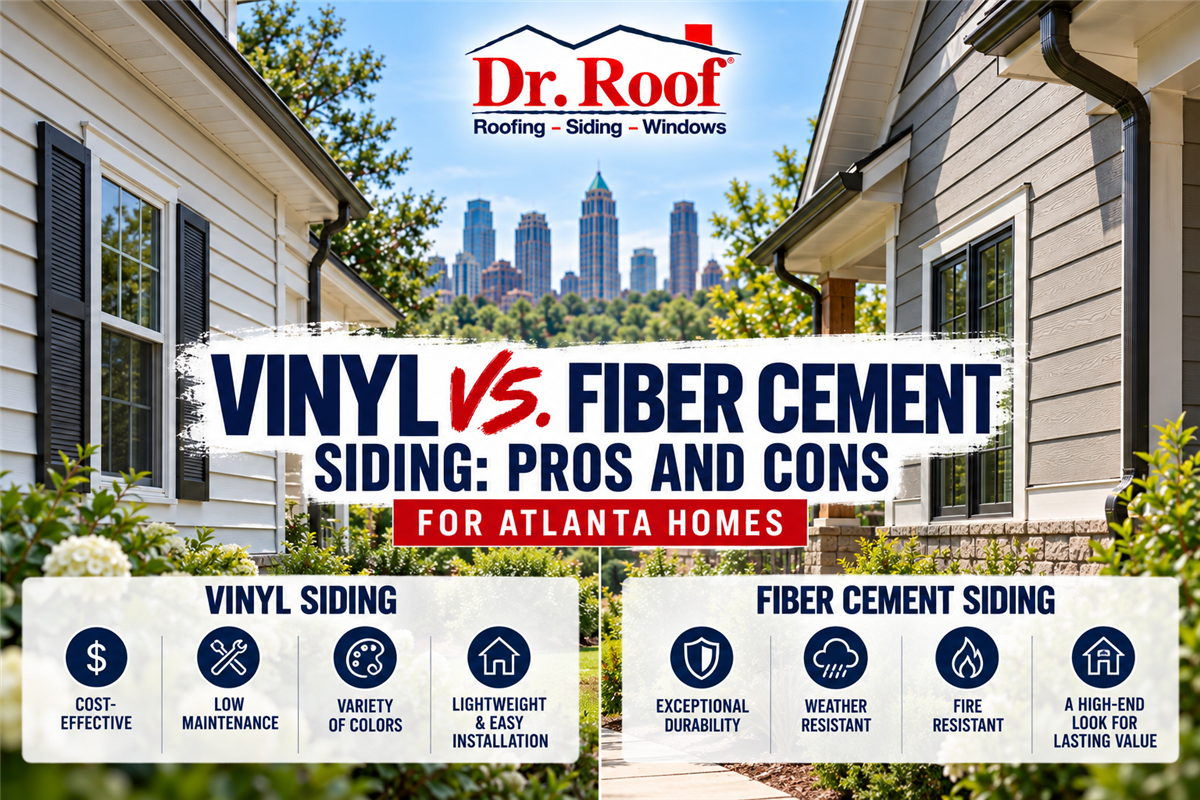
Vinyl and fiber cement are two popular siding choices, but they are very different materials.
Vinyl siding is lightweight, low-maintenance, available in many colors and profiles, and generally positioned as a more budget-conscious exterior option.
Fiber cement siding is heavier, more installation-intensive, resistant to moisture and pests, and available in designs that can create a substantial painted-wood appearance. James Hardie fiber cement siding is also classified as noncombustible when tested according to applicable standards.
For Atlanta homeowners, neither material is automatically the better choice.
The right siding depends on budget, home architecture, maintenance preferences, appearance, installation requirements, wall construction, and the performance characteristics that matter most to the homeowner.
Here is how vinyl and fiber cement siding compare.
Vinyl vs. Fiber Cement Siding: The Quick Answer
Vinyl may be a strong fit for homeowners who prioritize:
Lower initial project cost
Low maintenance
No routine painting
Broad color selection
Lightweight material
Straightforward exterior upkeep
Fiber cement may appeal to homeowners who prioritize:
Noncombustible cladding
Resistance to moisture and pests
A heavier, more substantial exterior profile
Wood-inspired architectural appearance
Factory-finished or paintable options
James Hardie product and design choices
The final decision should consider the complete wall system and installation—not simply the siding panel.
What Is Vinyl Siding?
Vinyl siding is made primarily from PVC and is manufactured in panels designed to overlap and lock together across the exterior wall.
Today's vinyl products are available in numerous profiles.
Depending on the manufacturer, choices can include:
Traditional clapboard
Dutch lap
Beaded siding
Board-and-batten
Shake-inspired profiles
Insulated siding
Reinforced siding
CertainTeed, one of the siding manufacturers used by Dr. Roof, offers multiple vinyl product families with different profiles, thicknesses, textures, colors, and performance features.
Vinyl siding is designed to move slightly as temperatures change, which is why correct fastening and installation are important.
What Is Fiber Cement Siding?
Fiber cement siding is a manufactured cladding made from cementitious and reinforcing materials formed into boards, panels, or shingle-style products.
James Hardie is one of the best-known manufacturers of fiber cement siding.
Fiber cement products can create several exterior looks, including:
Horizontal lap siding
Board-and-batten
Vertical panels
Shingle-style siding
Smooth contemporary profiles
Wood-grain textures
Dr. Roof installs James Hardie fiber cement siding and is a James Hardie Elite Preferred Contractor.
1. Cost: Vinyl Usually Has the Lower Entry Point
For many homeowners, budget is one of the first differences they notice.
Vinyl is generally positioned as the more economical of the two material categories.
Fiber cement typically involves a heavier product and a more detailed installation process, which can affect both material and labor requirements.
However, siding estimates should never be compared solely by the price of the panels.
The complete project may also include:
Existing siding removal
Disposal
Sheathing repairs
Weather-resistant barrier work
Flashing
Trim
Soffit and fascia
Caulking
Painting or finishing
Access challenges
Architectural details
Two siding proposals can therefore differ substantially even when both describe the same general material.
2. Maintenance: Vinyl Requires Very Little Finish Maintenance
One of vinyl siding's biggest advantages is that the color is part of the manufactured product.
Many vinyl products do not require routine exterior painting.
Typical maintenance focuses on:
Periodic cleaning
Inspecting panels after severe weather
Checking trim and transitions
Watching for loose or damaged sections
Keeping vegetation away from the wall
Maintaining nearby gutters and drainage
That can make vinyl appealing to homeowners who want to minimize exterior finish maintenance.
3. Fiber Cement Is Also Low-Maintenance, but Finish Matters
Fiber cement is also considered a low-maintenance siding material, but maintenance depends partly on the finish selected.
Some fiber cement products arrive with a factory-applied finish.
Others are supplied primed for painting.
Homeowners should understand:
Whether the product is factory-finished or field-painted
How often the finish should be inspected
Which cleaning methods the manufacturer recommends
Which sealants or caulked joints require inspection
What maintenance is required to preserve applicable warranty coverage
James Hardie recommends gentle cleaning methods and product-specific care rather than aggressive cleaning techniques.
4. Appearance: Both Materials Offer Many Styles
The old idea that vinyl siding always looks one way and fiber cement always looks another is outdated.
Both materials now offer broad design flexibility.
Vinyl Siding Appearance
Vinyl products can include:
Wood-grain textures
Smooth profiles
Traditional lap siding
Board-and-batten
Shake-style panels
Beaded profiles
Coordinating trim
A major advantage is the ability to select a finished color without planning a separate exterior painting project.
Fiber Cement Appearance
Fiber cement can produce:
Deep shadow lines
Broad lap profiles
Smooth modern panels
Wood-inspired textures
Board-and-batten designs
Shingle-style accents
Because fiber cement boards have a different thickness and construction than vinyl panels, the finished wall can have a different visual depth.
The better look is subjective.
Homeowners should compare full-size samples on the house whenever possible.
5. Moisture: Installation Details Matter for Both
Atlanta's humid conditions and heavy rain make water management important for any exterior cladding.
Neither siding material should be expected to replace the home's drainage plane, flashing, or weather-resistant barrier.
A properly designed siding assembly must account for water around:
Windows
Doors
Roof-to-wall intersections
Decks
Utility penetrations
Exterior fixtures
Trim
Corners
James Hardie fiber cement products are engineered to resist moisture-related damage.
Vinyl does not rot like wood, but water can still get behind siding through openings and transitions.
That is why flashing and the wall system behind the siding matter regardless of which exterior material is chosen.
6. Fire Performance: Fiber Cement Has a Clear Material Advantage
This is one of the most significant material differences.
James Hardie fiber cement products are classified as noncombustible when tested according to applicable standards.
For homeowners who specifically prioritize noncombustible exterior cladding, that characteristic can make fiber cement particularly attractive.
Fire performance should still be viewed as part of the complete wall assembly.
Windows, roofing, soffits, decks, landscaping, insulation, sheathing, vents, and other building components also affect how a home responds to fire exposure.
7. Weight and Installation: Fiber Cement Requires More Specialized Handling
Vinyl panels are comparatively lightweight.
Fiber cement boards are much heavier.
That affects:
Material handling
Cutting
Fastening
Crew requirements
Installation time
Safety procedures
Fiber cement installation also involves detailed manufacturer instructions regarding clearances, flashing, fastening, joints, and other conditions.
This is one reason contractor experience matters.
Dr. Roof is a James Hardie Elite Preferred Contractor, which gives Atlanta homeowners a manufacturer-recognized credential to consider when evaluating a fiber cement installation.
8. Temperature Movement: Vinyl Needs Room to Move
Vinyl expands and contracts as temperature changes.
Proper installation allows the siding to move without becoming tightly pinned to the wall.
Incorrect fastening can contribute to problems such as:
Buckling
Waviness
Distortion
Restricted panel movement
That does not make vinyl an inferior product.
It means installation needs to follow the manufacturer's instructions.
A homeowner should be cautious of any contractor who treats siding installation as simply nailing panels tightly to the wall.
9. Impact and Repair Considerations
Both materials can be damaged, but they respond differently to impact.
Vinyl can crack, puncture, or deform depending on the force and conditions.
Fiber cement is rigid and strong but can also chip or crack if subjected to sufficient impact or improper handling.
Repair considerations include:
Location of damage
Availability of matching material
Color matching
Panel or board profile
Age of the siding
Installation method
A localized damaged area may sometimes be repairable without replacing an entire home's siding.
10. Color Choices and Future Changes
Vinyl color is manufactured into the product.
That simplifies the initial finish decision because the siding typically does not require painting as part of installation.
Fiber cement may be purchased with factory-applied color or as a primed product intended for painting.
That gives homeowners different approaches to color.
If future exterior color changes are important, discuss that goal before selecting a product.
11. Energy Efficiency Depends on More Than Siding
Homeowners sometimes ask which siding material is more energy-efficient.
The answer depends on the complete wall assembly.
Factors include:
Wall insulation
Continuous exterior insulation
Housewrap or weather-resistant barrier
Air sealing
Window and door installation
Insulated siding products
Thermal bridging
CertainTeed offers insulated vinyl siding products that add insulation behind the panel.
Fiber cement can also be part of a high-performance wall assembly.
For that reason, homeowners should compare the complete proposed wall system rather than relying on the siding material name alone.
Vinyl Siding Pros and Cons
Vinyl Siding Pros
Vinyl can offer:
Lower initial cost than many premium cladding options
Low maintenance
No routine painting for many products
Wide color selection
Multiple profiles and textures
Lightweight construction
Resistance to rot and ordinary metal corrosion
Insulated product options
Vinyl Siding Cons
Potential considerations include:
Expansion and contraction
Possible impact damage
Section replacement can create color-matching challenges on weathered siding
Performance depends heavily on correct fastening and installation
Some homeowners prefer the heavier visual profile of fiber cement
Fiber Cement Siding Pros and Cons
Fiber Cement Pros
Fiber cement can offer:
Noncombustible material
Resistance to moisture-related deterioration
Resistance to pests
Substantial exterior appearance
Multiple architectural profiles
Wood-inspired textures
Factory-finished and paintable options
Strong compatibility with many traditional and contemporary home styles
Fiber Cement Cons
Potential considerations include:
Heavier material
More specialized installation
Typically higher initial project cost than standard vinyl
Cutting and handling require proper tools and procedures
Painted finishes may eventually require maintenance depending on product and finish
Which Is Better for Atlanta: Vinyl or Fiber Cement?
Neither material wins every category.
Vinyl may be a better fit when the homeowner wants a lower-maintenance exterior with broad color selection and a more budget-conscious initial project.
Fiber cement may be a better fit when the homeowner prioritizes noncombustible cladding, dimensional appearance, moisture resistance, or James Hardie architectural options.
The decision should also account for the house itself.
Atlanta-area homes include:
Ranch homes
Colonials
Craftsman homes
Traditional two-story properties
Tudor-inspired homes
Farmhouse designs
Contemporary homes
Custom architecture
The same siding does not complement every home equally.
What Should Atlanta Homeowners Compare Before Choosing?
Ask the contractor to identify:
Manufacturer
Product line
Siding material
Panel or board profile
Thickness where relevant
Color or finish
Trim system
Weather-resistant barrier
Flashing details
Existing siding removal
Underlying repairs
Installation requirements
Warranty terms
Maintenance requirements
Do not compare bids that simply say "vinyl siding" or "fiber cement siding."
The exact product matters.
Vinyl vs. Fiber Cement Warranty Coverage
Warranty terms vary by manufacturer and product.
Homeowners should ask for the actual written warranty associated with the proposed siding.
Review:
Who provides the warranty
Which components are covered
Whether finish coverage is separate
Whether registration is required
Whether coverage transfers
Which maintenance requirements apply
Which exclusions are included
Avoid making a siding decision based solely on a large warranty number in a brochure.
The actual terms are more important than the headline.
How Dr. Roof Helps Atlanta Homeowners Compare Siding
Dr. Roof has served Atlanta-area homeowners since 1988 and offers both vinyl and fiber cement siding options.
Current siding choices include CertainTeed vinyl products and James Hardie fiber cement products.
Dr. Roof is also a James Hardie Elite Preferred Contractor.
That means homeowners do not necessarily have to choose a contractor first and then accept whichever single siding category that contractor happens to sell.
Instead, they can discuss different material types, styles, maintenance expectations, installation requirements, and design goals as part of the siding consultation.
Choosing Between Vinyl and Fiber Cement Siding
Vinyl and fiber cement can both be appropriate exterior cladding choices for Atlanta homes.
Vinyl emphasizes low maintenance, broad style selection, light weight, and a generally more accessible initial price point.
Fiber cement emphasizes noncombustibility, moisture and pest resistance, dimensional appearance, and a substantial range of architectural styles.
The best choice depends on what matters most for your particular home.
Before selecting either material, compare actual products, inspect samples, understand the wall assembly, review the warranties, and make sure the contractor is experienced with the siding system being proposed.
Is vinyl siding or fiber cement better for Atlanta homes?
Neither is automatically better. Vinyl may appeal to homeowners who prioritize low maintenance and a lower initial project cost, while fiber cement may appeal to those who prioritize noncombustible cladding, dimensional appearance, moisture resistance, and specific architectural styles.
Which requires less maintenance: vinyl or fiber cement siding?
Vinyl generally requires very little finish maintenance and usually does not need routine painting. Fiber cement is also low-maintenance, but care depends on whether the product has a factory-applied finish or a field-painted finish.
Is fiber cement siding fire-resistant?
James Hardie fiber cement products are classified as noncombustible when tested according to applicable standards. Fire performance should still be considered as part of the complete exterior wall and home design.
Is fiber cement siding more expensive than vinyl?
Fiber cement typically has a higher initial project cost than standard vinyl because the material is heavier and installation is generally more specialized. Actual project cost depends on home size, removal, repairs, trim, finish, and the exact products selected.
Does vinyl siding handle Atlanta humidity?
Vinyl does not rot like wood, but successful performance still depends on proper installation, flashing, drainage, and the weather-resistant barrier behind the siding. Water management matters regardless of the exterior cladding material.
Does Dr. Roof install both vinyl and fiber cement siding?
Yes. Dr. Roof offers CertainTeed vinyl siding and James Hardie fiber cement siding for Atlanta-area homeowners and is a James Hardie Elite Preferred Contractor.
Subscribe to Dr. Roof's Blog



Comments