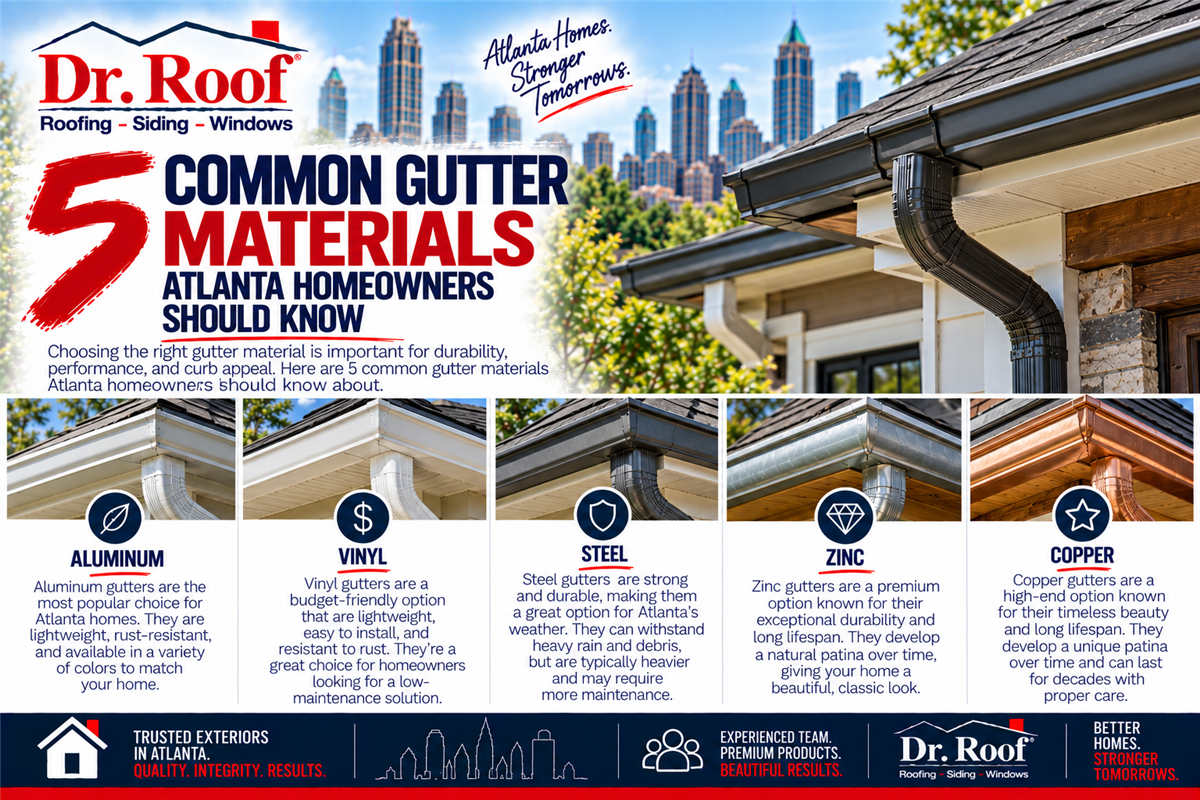
Gutters may look like a simple part of a home's exterior, but the material you choose can affect durability, maintenance, appearance, installation method, and how well the system fits your property.
For Atlanta homeowners, common residential gutter materials include aluminum, vinyl, steel, copper, and zinc.
Each has advantages and tradeoffs.
The best choice depends on the home's roof design, drainage needs, architecture, surrounding trees, maintenance expectations, budget, and whether the homeowner prefers a seamless or sectional system.
Here is how the most common gutter materials compare.
Gutter Materials: The Quick Answer
The five gutter materials homeowners are most likely to encounter are:
Aluminum
Vinyl
Steel
Copper
Zinc
Aluminum is widely used because it is lightweight, resistant to rust, and available in seamless systems.
Vinyl is lightweight and corrosion-resistant but is generally installed in sections.
Steel provides greater rigidity and strength but requires consideration of corrosion protection.
Copper is durable and develops a distinctive patina over time.
Zinc is another premium metal option known for its weathered appearance and corrosion resistance.
Material is only one part of a successful gutter system. Proper sizing, pitch, downspout placement, fastening, and drainage are equally important.
1. Aluminum Gutters
Aluminum is one of the most familiar residential gutter materials.
It is lightweight, does not rust like ordinary steel, and can be formed into seamless gutter runs.
That makes aluminum especially practical for homes where homeowners want to reduce the number of joints along long roof edges.
Advantages of Aluminum Gutters
Aluminum gutters offer several practical benefits:
Lightweight construction
Resistance to rust
Availability in many colors
Compatibility with seamless gutter fabrication
Broad availability
Ability to coordinate with many home styles
Seamless aluminum systems are typically formed for the home so that long gutter runs contain fewer joints than traditional sectional systems.
Fewer joints can mean fewer potential locations for separation or leakage.
Potential Drawbacks of Aluminum Gutters
Aluminum is not indestructible.
Because it is relatively lightweight, it can be dented by impacts from ladders, falling branches, or other exterior activity.
Gutter thickness also matters.
Homeowners comparing aluminum systems should ask about the material specification rather than assuming every aluminum gutter is built the same way.
2. Vinyl Gutters
Vinyl gutters are made from PVC and are typically sold as sectional systems.
Because the material itself does not rust, corrosion is not the same concern it can be with some metals.
Vinyl is also lightweight and available in multiple colors.
Advantages of Vinyl Gutters
Potential benefits include:
No metal rust
Lightweight sections
Straightforward material handling
Multiple color options
Generally accessible material cost
Simple replacement of individual sections
Vinyl may appeal to homeowners looking for a straightforward gutter system without painted metal.
Potential Drawbacks of Vinyl Gutters
Vinyl reacts differently to temperature changes than metal.
Extreme temperature exposure can contribute to expansion, contraction, brittleness, warping, or movement depending on the product and conditions.
Sectional vinyl systems also contain more connections than a long seamless metal gutter.
Those joints should remain properly secured and sealed.
For Atlanta homeowners, installation quality and correct support spacing are particularly important because gutters must remain properly aligned during heavy rain.
3. Steel Gutters
Steel gutters are heavier and more rigid than aluminum or vinyl.
Residential systems may use galvanized steel, stainless steel, or other coated steel products.
Advantages of Steel Gutters
Steel can offer:
High structural strength
Resistance to denting compared with lighter materials
A substantial feel
Multiple finish options
Suitability for homes where stronger material is preferred
The added rigidity can be useful in certain applications.
Potential Drawbacks of Steel Gutters
Weight is one consideration.
Steel systems require secure fastening and proper support.
Corrosion resistance also depends on the type of steel and protective finish.
Galvanized and coated products are designed to resist corrosion, but damaged coatings or prolonged exposure can still become concerns.
Homeowners should ask exactly which steel product is being proposed rather than comparing all steel gutters as though they are identical.
4. Copper Gutters
Copper gutters are often selected as much for appearance as for drainage.
Fresh copper begins with a bright metallic appearance and gradually develops a patina as it weathers.
That changing appearance can complement traditional, historic, custom, and luxury homes.
Advantages of Copper Gutters
Copper offers:
Distinctive appearance
Natural patina development
Resistance to ordinary rust
Compatibility with traditional architectural styles
Long-term visual character
Copper is often used where the gutter system is intended to become part of the home's exterior design rather than blend into the trim.
Potential Drawbacks of Copper Gutters
Copper is a specialty material.
It generally requires more specialized fabrication and installation than common aluminum systems.
It also represents a different budget category than standard residential gutter materials.
Homeowners considering copper should make sure the contractor has experience working with copper gutters, joints, hangers, downspouts, and compatible metals.
5. Zinc Gutters
Zinc is another premium metal gutter material.
Like copper, zinc develops a weathered surface appearance over time.
It is often seen on custom homes, historic properties, and architectural projects where the gutter system contributes to the overall design.
Advantages of Zinc Gutters
Potential benefits include:
Strong corrosion resistance
Distinctive matte appearance
Natural weathering
Compatibility with certain historic and contemporary designs
Premium architectural character
Zinc can be an attractive option when homeowners want something different from painted aluminum or steel.
Potential Drawbacks of Zinc Gutters
Zinc requires experienced fabrication and installation.
It may also be less readily available than aluminum, vinyl, or common steel products.
For many homeowners, the additional material and installation complexity means zinc is considered primarily for specialty projects.
Seamless vs. Sectional Gutters
Material is only part of the decision.
Homeowners should also understand the difference between seamless and sectional systems.
Seamless Gutters
Seamless gutters are fabricated in long runs that fit the dimensions of the home.
Joints are still required at locations such as corners and downspout connections, but the long straight sections generally contain fewer seams.
Aluminum is commonly used for seamless residential gutters.
Sectional Gutters
Sectional gutters are assembled from multiple pieces.
Vinyl systems are commonly sectional, although sectional metal gutters also exist.
The advantage is that individual components can be transported and replaced easily.
The tradeoff is that every connection creates another joint that must remain properly aligned and sealed.
Which Gutter Material Is Best for Atlanta Homes?
There is no single best gutter material for every Atlanta home.
The right choice depends on several factors.
Roof Size and Pitch
A large or steep roof can send significant amounts of rainwater toward the gutter system.
Material selection should be paired with proper gutter sizing and downspout capacity.
Surrounding Trees
Homes surrounded by mature trees may experience more leaves, pine needles, twigs, and organic debris.
That makes maintenance access and gutter protection important considerations regardless of material.
Home Architecture
A painted aluminum system may blend naturally with many suburban homes.
Copper or zinc may be appropriate when the gutter system is intended to become a visible architectural feature.
Maintenance Expectations
Different materials require different types of inspection and care.
Homeowners should understand how the proposed system should be cleaned, inspected, and maintained.
Budget
Material prices vary significantly.
Instead of choosing solely on initial material cost, compare the complete system, installation quality, maintenance expectations, and compatibility with the home.
Does Gutter Material Matter More Than Gutter Size?
Both matter.
A premium gutter material cannot compensate for an undersized drainage system.
Gutter performance also depends on:
Gutter width
Roof drainage area
Roof pitch
Downspout size
Downspout quantity
Downspout location
Gutter slope
Hanger spacing
Discharge location
A contractor should evaluate the complete drainage path rather than simply replace old gutters with a similar-looking product.
Why Downspouts Matter
The gutter collects water.
The downspout moves that water toward the ground.
If downspouts are too small, poorly located, clogged, or directed toward vulnerable areas, the gutter system may not manage water effectively even when the gutter itself is in good condition.
Homeowners should ask where downspouts will discharge and whether water will be directed away from important areas of the home.
How Do You Compare Gutter Proposals?
When comparing contractors, ask for more than the word "gutters" on the estimate.
A useful proposal should explain:
Gutter material
Gutter size
Gutter profile
Seamless or sectional construction
Downspout size
Number and location of downspouts
Hanger or fastening method
Removal of the existing system
Disposal
Color or finish
Gutter protection options when applicable
Cleanup
Warranty information
Two proposals can use the same material while representing very different drainage systems.
What About Gutter Guards?
Gutter guards can help reduce the amount of larger debris entering the system, but they do not make gutters maintenance-free.
Leaves, roof granules, pollen, seeds, pine needles, and smaller debris can still accumulate depending on the guard design and surrounding environment.
Homeowners should ask:
What debris is the product designed to block?
Can the system still be inspected?
How is it cleaned?
Does it affect roof or gutter access?
How does water enter during heavy rain?
The guard should work with the gutter system rather than create another drainage concern.
When Should Gutters Be Replaced?
Material alone does not determine whether replacement is necessary.
Potential signs of gutter problems can include:
Persistent leaks at joints
Separation from the fascia
Sagging
Sections that hold standing water
Corrosion
Cracks
Dents that restrict drainage
Loose downspouts
Water overflowing during normal rainfall
Water repeatedly collecting near the foundation or landscaping
Some problems may be repairable.
Others may indicate that a new gutter system would provide a more dependable solution.
Gutter Systems From Dr. Roof
Dr. Roof has served Atlanta-area homeowners since 1988 and provides gutter repair and replacement as part of its exterior home services.
Dr. Roof's current gutter services include seamless gutter systems designed to help move rainwater away from the home's exterior.
When evaluating a gutter project, homeowners should discuss the actual material, system dimensions, downspout configuration, roof drainage area, and installation details rather than choosing based only on appearance.
Choosing the Right Gutter Material for Your Atlanta Home
Aluminum, vinyl, steel, copper, and zinc can all be used to create residential gutter systems.
Each offers a different balance of appearance, weight, durability, maintenance, fabrication, and cost.
For many homeowners, the smartest starting point is not asking, "Which material is best?"
Instead, ask:
"Which complete gutter system is right for my roof and property?"
A professional evaluation can help determine the material, gutter size, downspout configuration, and drainage design that make sense for your Atlanta home.
What are the most common gutter materials?
Common residential gutter materials include aluminum, vinyl, steel, copper, and zinc. Each material differs in weight, appearance, corrosion resistance, fabrication, maintenance requirements, and cost.
Are aluminum gutters a good option for Atlanta homes?
Aluminum is a common residential choice because it is lightweight, resistant to rust, available in many finishes, and can be fabricated into seamless gutter runs. The complete system still needs proper sizing, fastening, slope, and downspout placement.
What is the difference between seamless and sectional gutters?
Seamless gutters are fabricated in long runs with fewer joints along straight roof edges. Sectional systems are assembled from multiple pieces. Fewer seams can reduce the number of potential joint locations, but both systems require proper installation.
Are copper gutters better than aluminum gutters?
Not automatically. Copper offers a distinctive appearance and natural patina, while aluminum is lightweight, versatile, and commonly used for seamless residential systems. The better choice depends on the home, design goals, budget, and installation requirements.
Do gutter materials affect maintenance?
Yes. Different materials can have different corrosion, expansion, finish, joint, and cleaning considerations. Regardless of material, gutters and downspouts should remain clear, securely attached, properly sloped, and able to move water away from the home.
Does gutter size matter as much as gutter material?
Yes. Proper drainage depends on more than material. Roof area, roof pitch, gutter dimensions, downspout size, downspout placement, slope, and discharge location all influence how effectively the system manages rainwater.
Subscribe to Dr. Roof's Blog




Comments