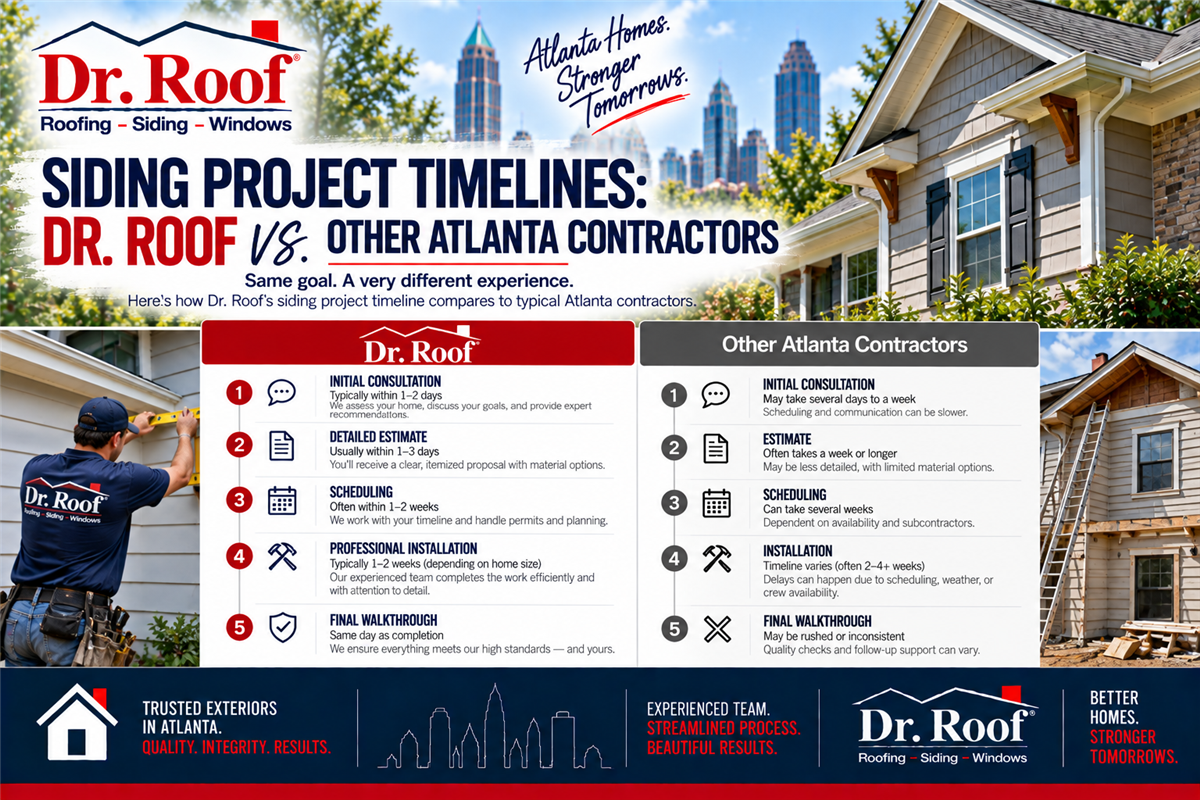
When Atlanta homeowners compare siding contractors, project timeline is often one of the first questions they ask.
How long will the house be under construction? How much disruption should the family expect? And does one contractor actually complete siding projects faster than another?
The most useful answer is not simply "Contractor A is faster than Contractor B."
Siding timelines depend on the size and design of the home, the material being installed, the condition discovered behind the existing siding, weather, material availability, crew scheduling, and the amount of trim and finishing work involved.
That means homeowners should compare the entire project process—not just the number of days quoted on an estimate.
Here is how to evaluate Dr. Roof's siding project timeline against other Atlanta contractors.
Dr. Roof vs. Other Contractors: The Quick Answer
There is no universal siding installation timeline that applies to every Atlanta home.
One contractor may advertise a shorter installation window, while another may include more preparation, repairs, finishing work, and final inspection within its stated timeline.
A fair comparison should consider:
Project planning
Material availability
Existing siding removal
Hidden repairs
Installation
Trim and finishing
Weather delays
Cleanup
Final inspection
The best timeline is not automatically the shortest one.
It is the timeline that realistically accounts for the work required to complete the siding project properly.
What Is a Realistic Siding Project Timeline?
A straightforward siding project on a smaller home with sound underlying sheathing may progress considerably faster than a large two-story property with complicated elevations, extensive trim, moisture damage, or structural repairs.
The material matters, too.
Vinyl siding and fiber cement siding have different handling, cutting, fastening, finishing, and installation requirements.
For this reason, a responsible contractor should provide a project-specific estimate after evaluating the property rather than promising the same completion time for every home.
The better question is:
What exactly is included in the contractor's stated timeline?
1. Compare the Same Starting and Ending Points
One contractor may describe only the days its installation crew expects to be physically working at the house.
Another may describe the complete process from consultation and material ordering through installation and final walkthrough.
Those are not equivalent timelines.
When comparing Dr. Roof with another Atlanta siding contractor, ask both companies to explain:
When the project timeline officially begins
Whether material ordering is included
Whether old siding removal is included
How underlying repairs are handled
Whether painting or finishing is included
What happens when weather interrupts the project
When the project is officially considered complete
Getting those details makes the comparison much more meaningful.
2. The Initial Inspection Can Affect Everything That Follows
Efficient siding installation starts before the first panel is removed.
A contractor needs to understand the size of the home, existing siding condition, architectural details, access points, material selection, and potential areas of deterioration.
Dr. Roof has served the Atlanta area since 1988 and approaches exterior projects by evaluating the property and developing a project-specific scope.
This planning stage matters because incomplete measurements or an unclear scope can create delays later.
When comparing contractors, ask how thoroughly the property will be evaluated before the project is scheduled.
3. Material Selection and Availability Can Change the Schedule
Homeowners frequently focus on installation speed while overlooking material lead time.
The siding material, profile, color, trim package, and accessories can all influence when a project can begin.
Dr. Roof offers siding options including James Hardie fiber cement and CertainTeed products and is a James Hardie Elite Preferred Contractor.
Regardless of contractor, specialty colors or less common materials may require more planning than readily available products.
Before signing a contract, ask whether the contractor has confirmed material availability or is providing a timeline based on an assumption.
4. Old Siding Removal Can Reveal Hidden Conditions
One of the biggest variables in a siding replacement is what cannot be seen before the existing siding comes off.
Removal may expose:
Deteriorated sheathing
Moisture damage
Rot
Insect-related damage
Failed flashing
Previous installation problems
Areas requiring additional preparation
A contractor who discovers these conditions should not simply cover them with new siding to stay on schedule.
Addressing the underlying problem may extend the project, but that additional work can be necessary before new siding is installed.
When comparing timeline estimates, ask each contractor how unexpected conditions will be documented, communicated, and approved.
5. Faster Installation Is Not Automatically Better Installation
Speed matters.
Homeowners understandably want to limit disruption around their property.
But siding is part of the home's exterior weather-management system, so installation quality matters more than winning a race against the calendar.
Proper installation requires attention to manufacturer instructions, clearances, fastening, flashing, transitions, trim, penetrations, and moisture management.
A contractor promising an unusually short timeline should be willing to explain how that schedule will be achieved without skipping important preparation or quality-control steps.
The strongest proposal balances efficiency with thoroughness.
6. Crew Scheduling Can Affect the Actual Timeline
Two companies may quote a similar number of installation days while managing their crews very differently.
Useful questions include:
Will the same crew remain assigned to my project?
Who supervises the installation?
Who is my point of contact?
What happens if another project runs long?
How frequently will I receive updates?
Will work continue each normal workday unless weather prevents it?
Project management can have a major effect on whether a schedule remains predictable.
Clear communication is particularly important if unexpected repairs or weather delays occur.
7. Atlanta Weather Can Affect Exterior Project Timing
Exterior construction is naturally affected by weather.
Heavy rain, storms, high winds, and other conditions may make certain siding work inappropriate or unsafe.
Atlanta homeowners should therefore be cautious about any contractor who treats a proposed finish date as though weather cannot affect it.
Instead, ask how weather delays are handled.
A useful schedule should distinguish between the estimated working duration and the actual calendar window so homeowners understand how interruptions could affect completion.
8. Final Details Should Be Included in the Timeline
The siding project should not be considered finished simply because the major wall areas are covered.
Depending on the project scope, completion may also involve:
Trim installation
Caulking
Finishing details
Soffit or fascia work
Cleanup
Removal of debris
Touch-ups
Final inspection or walkthrough
Ask whether these steps are included in the quoted timeline.
Otherwise, a contractor may appear to offer a shorter installation simply because its estimate does not measure the project through true completion.
What Should You Ask When Comparing Siding Contractors?
Instead of asking only, "How many days will this take?" ask for a clear explanation of the schedule.
Questions worth asking include:
What is the estimated start date?
How many working days do you anticipate on my property?
What parts of the job are included in that estimate?
What could extend the schedule?
How are hidden repairs handled?
Who communicates schedule changes to me?
Is cleanup and final review included in the completion date?
These questions make it easier to compare two siding proposals fairly.
Dr. Roof vs. Competing Contractors: What Should You Really Compare?
The best timeline comparison is not simply about which contractor provides the smallest number.
A stronger comparison considers:
Planning
Material availability
Crew management
Installation quality
Communication
Hidden-damage procedures
Cleanup
Final inspection
Dr. Roof brings decades of Atlanta-area exterior remodeling experience and James Hardie Elite Preferred credentials to siding projects.
Those qualifications do not eliminate variables such as weather or unexpected conditions behind old siding.
Instead, homeowners should look for a contractor with a structured process for evaluating, planning, communicating, and completing the project.
A trustworthy contractor should be willing to explain what is known, what could change, and how those changes will be communicated.
Should You Choose the Contractor With the Fastest Timeline?
Not automatically.
Timeline should be one part of the decision alongside:
Contractor experience
Siding material quality
Installation credentials
Scope of work
Communication process
Warranty terms
Quality-control procedures
A fast installation that overlooks moisture damage or installation details can create much larger concerns later.
The goal should be an efficient project that is completed correctly.
Planning a Siding Project in Atlanta
If you are comparing siding contractors in the Atlanta area, ask each company to provide more than an estimated number of days.
Request a clear explanation of the entire process from inspection and material selection through removal, installation, finishing, cleanup, and final review.
That makes it much easier to understand why timelines differ—and whether the contractor has a realistic plan for your home.
Dr. Roof provides professional siding installation and replacement for Atlanta-area homeowners, including James Hardie and CertainTeed siding options.
A professional consultation can help establish a project-specific scope and timeline based on the actual condition, size, and design of your home.
How long does siding installation take in Atlanta?
There is no universal timeline for every home. Project duration depends on home size, siding material, architectural complexity, weather, material availability, and whether repairs are discovered after the existing siding is removed.
Is the fastest siding contractor always the best choice?
No. Installation speed should be considered alongside preparation, workmanship, material quality, communication, warranties, and quality-control procedures. A realistic schedule should allow enough time to complete the work properly.
What can delay a siding replacement project?
Common variables include severe weather, material lead times, hidden moisture or rot, damaged sheathing, complex architectural details, additional trim work, and approved changes to the original project scope.
How should I compare siding project timelines from different contractors?
Ask each contractor what the quoted timeline includes. Compare material ordering, tear-off, repairs, installation, finishing, cleanup, weather contingencies, and the final walkthrough rather than comparing only the number of installation days.
Why can hidden damage extend a siding project?
Existing siding can conceal deteriorated sheathing, moisture damage, rot, failed flashing, or other conditions. Those issues may need to be corrected before new siding is installed, which can add time to the project.
Does Atlanta weather affect siding installation schedules?
Yes. Rain, storms, high winds, and other weather conditions can affect when exterior work can be performed safely and correctly. Homeowners should ask contractors how weather delays are incorporated into the project schedule.
Subscribe to Dr. Roof's Blog








Comments