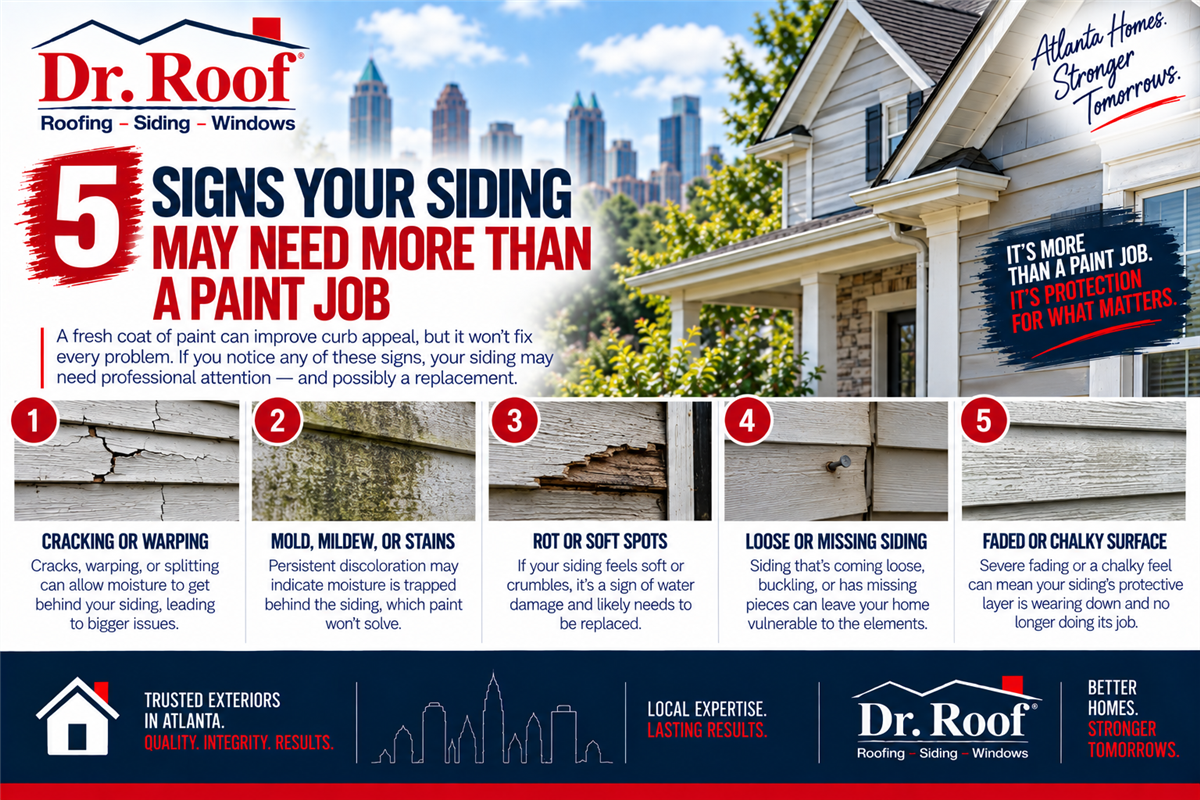
Faded siding can often be refreshed with new paint. But when an exterior begins showing cracks, warping, recurring moisture stains, or deterioration around openings, another coat of paint may only cover the symptom.
Siding is more than a decorative surface. It is part of a wall system designed to help manage rain, wind, moisture, and exposure to the elements.
That does not mean every cosmetic flaw requires siding replacement. It does mean Atlanta homeowners should know when visible deterioration may deserve a closer look before investing in repainting.
Here are five signs your siding problem may go deeper than color.
1. Boards Are Warped, Swollen, Soft, or Deteriorating
Paint can improve appearance, but it cannot restore the structural condition of damaged siding material.
If siding boards appear warped, swollen, soft, crumbling, or badly deteriorated, the underlying material should be evaluated before it is painted.
Different siding materials fail in different ways. Wood-based products may absorb moisture and experience swelling or decay. Other products can crack, loosen, or become damaged from impact, installation problems, or long-term exposure.
James Hardie currently describes its fiber-cement siding as water resistant and engineered to resist moisture-related conditions such as swelling, warping, and edge checking.
That does not make any siding system waterproof.
Siding still needs to be installed as part of a properly detailed wall assembly.
2. Paint Keeps Peeling in the Same Area
Paint that fails once may simply need better surface preparation or a different coating approach.
Paint that repeatedly blisters, bubbles, or peels in the same location deserves more investigation.
Recurring paint failure can have several possible causes, including surface preparation, product compatibility, excessive moisture, installation details, or water reaching the wall from another source.
For example, a problem near a roof-to-wall intersection may actually involve flashing or drainage rather than the siding finish itself.
The same is true around windows, doors, penetrations, and trim.
Instead of immediately repainting the area again, determine why the coating keeps failing.
3. You See Cracks, Gaps, or Loose Siding
A few small cosmetic imperfections do not automatically mean an entire home needs new siding.
However, widespread cracking, loose sections, large gaps, or pieces pulling away from the wall can indicate that the exterior should be professionally evaluated.
The siding is the outer cladding, but it is not the only layer helping manage rainwater.
Current U.S. Department of Energy and Building America guidance explains that exterior wall systems commonly use a continuous drainage plane or water-resistive barrier behind the cladding so that moisture getting past the siding can drain safely down and away from the wall.
That is why damaged siding should not always be treated as a surface-only problem.
If water has been getting behind the cladding, the condition of the layers beneath it may also need to be checked.
4. Staining Keeps Appearing Around Windows or Roof Intersections
Recurring stains can provide clues about how water is moving around the exterior.
Pay particular attention to staining near:
Window and door openings
Roof-to-wall intersections
Chimneys
Deck connections
Exterior penetrations
Areas below gutters or downspouts
Trim joints
These are locations where flashing and water-management details become especially important.
Building Science Education guidance from the U.S. Department of Energy notes that properly installed flashing around windows and doors is intended to direct water outward and integrate with the drainage plane behind the exterior cladding.
If staining repeatedly returns after cleaning or painting, the next step should be identifying the source.
The siding may be part of the issue, but the actual cause could involve flashing, roofing, gutters, sealant, a penetration, or another exterior component.
5. Damage Is Widespread Rather Than Isolated
One damaged siding board and deterioration across an entire elevation are very different situations.
Localized damage may be repairable when compatible replacement materials are available and the surrounding wall system is in good condition.
Widespread deterioration changes the conversation.
If numerous boards are damaged, sections are pulling away, repairs have accumulated over the years, or moisture-related concerns appear in several locations, replacement may deserve consideration.
A siding professional can help determine whether isolated repairs still make sense or whether replacing a larger section would allow the underlying wall to be evaluated and properly prepared.
Why Siding Alone Does Not Keep a Wall Dry
This is an important point that homeowners do not always hear during siding discussions.
The visible siding is not typically the entire water-management system.
Building America guidance recognizes that rain can move through gaps, joints, and penetrations in exterior cladding. A water-resistive layer and properly integrated flashing behind the cladding help direct that water back toward the exterior.
That means a quality siding project involves more than attaching new boards to the side of a house.
The contractor may also need to consider:
Existing sheathing
Water-resistive barriers
Window and door flashing
Roof-to-wall flashing
Penetrations
Trim details
Clearance from roofs, decks, and grade
Signs of moisture-related deterioration
Those details are often hidden once the project is finished.
Can You Just Paint Old Siding Instead?
Sometimes, yes.
If the siding is structurally sound and the concern is primarily fading, chalking, or an outdated color, repainting may be reasonable for materials designed to be painted.
The important distinction is between cosmetic aging and material deterioration.
Paint may improve:
Faded color
Surface appearance
Minor cosmetic imperfections
Paint generally cannot correct:
Rotten or severely deteriorated material
Broken siding
Significant warping
Improper flashing
Water trapped behind the wall
Loose installation
Damaged sheathing beneath the siding
Before paying for extensive exterior painting, it can be worthwhile to determine which type of problem you actually have.
What Makes Fiber Cement Worth Considering?
When siding replacement becomes appropriate, fiber cement is one option Atlanta homeowners may encounter.
James Hardie currently states that its fiber-cement siding is engineered to resist moisture damage and is formulated for regional climate conditions. The company also describes current Hardie siding products as resistant to moisture and weather exposure.
Material performance is only one part of the equation.
Proper installation, flashing, clearances, fastening, joint treatment, and wall preparation remain important regardless of the siding selected.
Dr. Roof is a James Hardie Elite Preferred Contractor, allowing Atlanta-area homeowners considering fiber-cement siding to work with a contractor familiar with the manufacturer’s installation expectations and product system.
What Happens During a Siding Evaluation?
A siding inspection should look beyond color.
The contractor may evaluate the visible cladding, trim, joints, penetrations, transitions, roof intersections, and areas showing possible moisture concerns.
If replacement is recommended, removing the existing siding can also create an opportunity to inspect portions of the underlying wall that were previously concealed.
If damaged sheathing or other conditions are discovered, those findings can be discussed before new siding covers the wall again.
The objective should be to understand the condition of the exterior—not simply make it look new from the street.
Repair or Replace? Look at the Pattern
When siding begins to deteriorate, the pattern often matters as much as the individual defect.
A single damaged board may point toward a localized repair.
Repeated problems across multiple areas may suggest a broader issue.
That is why homeowners should resist assuming that every siding problem requires complete replacement—or that every problem can be solved with caulk and paint.
An inspection can help distinguish between the two.
Give the Exterior a Closer Look Before Repainting
Atlanta homes face rain, humidity, sun, wind, and severe-weather events throughout the year. Exterior materials are expected to handle a great deal of exposure.
When siding begins looking tired, repainting may be all that is needed.
But when you see warping, widespread cracks, recurring paint failure, loose sections, or moisture staining around vulnerable areas, it may be time to investigate what is happening beneath the surface.
Dr. Roof has served Atlanta since 1988 and provides exterior home-improvement services including siding replacement. As a James Hardie Elite Preferred Contractor, Dr. Roof can evaluate existing siding, discuss the condition of the exterior, and explain replacement options when they are appropriate.
Before covering an ongoing siding problem with another coat of paint, find out whether the problem is truly cosmetic—or whether the wall is telling you something more.
Q: How do I know if my siding needs replacement instead of paint?
A: Replacement may deserve consideration when siding is warped, soft, badly cracked, loose, deteriorating, or showing widespread recurring problems. If the siding is structurally sound and the main concern is fading or color, repainting may still be appropriate.
Q: Can damaged siding allow water into a wall?
A: Exterior cladding is part of a larger water-management system. Cracks, gaps, damaged flashing, or other defects can allow additional water behind the siding, which is why properly installed drainage planes and flashing are also important.
Q: Does peeling paint always mean there is a moisture problem?
A: No. Paint can peel because of preparation, coating compatibility, age, exposure, or other causes. However, repeated peeling or bubbling in the same location can be a reason to investigate whether moisture or another exterior condition is contributing.
Q: Is James Hardie siding waterproof?
A: James Hardie describes its fiber-cement products as water resistant and engineered to resist moisture-related damage, but siding should not be treated as the home's only water barrier. Proper flashing and water-management layers behind the cladding remain important.
Q: Can only part of a home's siding be replaced?
A: In some cases, localized siding damage can be repaired or a section can be replaced. Whether that makes sense depends on the extent of the damage, material availability, condition of the surrounding wall, and ability to integrate the repair properly.
Subscribe to Dr. Roof's Blog





Comments