A hailstorm can leave Atlanta homeowners wondering whether their roofs sustained damage, even when everything appears normal from the driveway.
Unlike missing shingles caused by strong winds, hail damage is not always immediately obvious. Impacts can affect the protective granules, asphalt coating, and reinforcing layers of roofing shingles without creating a visible hole.
That raises an important question: Can hail-damaged shingles be repaired, or does the entire roof need replacement?
Hail-damaged roofs can sometimes be repaired when the damage is localized and the surrounding roofing materials remain serviceable. However, widespread impact damage, compromised shingles, or extensive deterioration may require a more comprehensive solution.
The appropriate recommendation depends on the actual condition of the roofing system.
For Atlanta homeowners, understanding how hail affects asphalt shingles can help clarify what a professional inspection should identify and when targeted repairs may be appropriate.
Here are seven questions worth asking after a hailstorm.
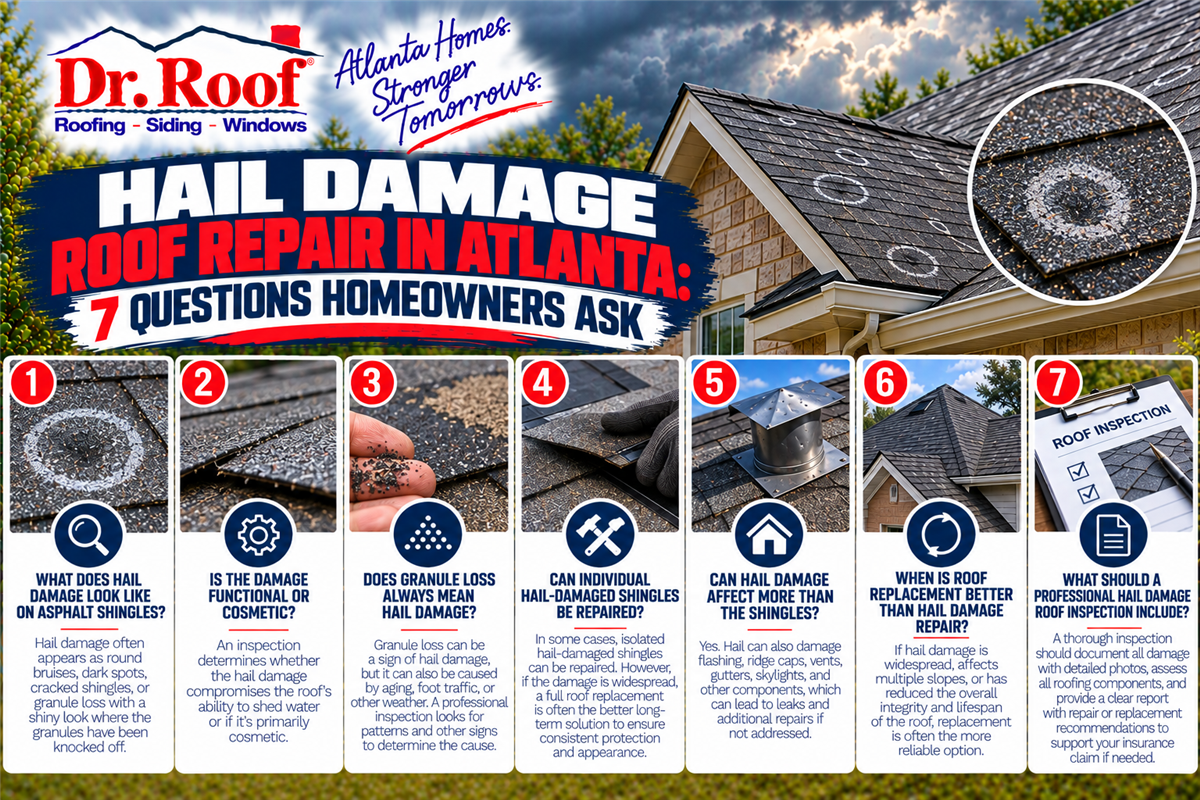
1. What Does Hail Damage Look Like on Asphalt Shingles?
Hail damage can appear differently depending on the size and hardness of the hailstones, wind conditions, roof slope, and type of roofing material.
Some impacts create noticeable marks, while others are difficult to identify without a professional inspection.
Common signs of potential hail damage include:
Circular or irregular impact marks
Localized shingle indentations
Missing granules around impact points
Exposed asphalt coating
Cracks in the shingle surface
Damaged or fractured shingle reinforcement
Impact damage to roof flashing or vents
Not every visible mark indicates that a shingle has lost its ability to protect the home.
A professional roofing contractor should evaluate whether the material has sustained damage that affects its intended performance.
What Is a Bruised Roof Shingle?
A bruised shingle may have damage beneath its visible surface.
Hail impact can compress or fracture the reinforcing material within an asphalt shingle.
In some cases, the resulting damage is associated with a localized depression or soft area.
However, determining whether a shingle has experienced this type of damage requires professional evaluation.
Homeowners should not climb onto the roof or attempt to press on shingles to identify bruising.
Can Hail Damage Be Invisible From the Ground?
Yes.
Certain forms of hail-related damage may not be recognizable from a normal ground-level viewing distance.
For example, a shingle may have localized surface damage that requires close inspection.
This is why a roof can appear intact after a storm while still having areas that deserve professional attention.
2. Is the Damage Functional or Cosmetic?
One of the most important distinctions in hail damage roof repair involves whether the impact has affected the roofing material's ability to perform its intended function.
Hail can cause different levels of damage.
What Is Functional Hail Damage?
Functional damage affects the condition or performance of a roofing component.
For asphalt shingles, examples may include:
Fractures in the reinforcing material
Significant cracking
Tears caused by impact
Damage that compromises water-shedding performance
Severe localized granule loss associated with impact damage
The Insurance Institute for Business & Home Safety has studied how hail-related dents and tears influence water leakage through asphalt shingles.
Its research demonstrates that the severity of the damage matters.
What Is Cosmetic Hail Damage?
Cosmetic damage generally refers to a change in appearance that does not necessarily compromise the roofing material's function.
A visible mark alone does not establish that a shingle needs replacement.
However, homeowners should not assume that every impact mark is harmless.
The condition of the roofing material must be evaluated.
Does Every Hail Mark Require Repair?
No.
Some surface marks may not require corrective work.
Other impacts may affect the shingle's protective characteristics.
A qualified roofing contractor should distinguish between actual roofing damage, ordinary wear, and conditions that do not require repair.
This helps homeowners avoid unnecessary work while addressing legitimate concerns.
3. Does Granule Loss Always Mean Hail Damage?
Asphalt shingles contain protective surface granules.
These granules help protect the asphalt coating from sunlight and contribute to the roofing material's durability.
However, granule loss can occur for several reasons.
Potential causes include:
Normal weathering
Manufacturing and handling
Physical abrasion
Foot traffic
Storm-related impact
Material deterioration
How Can Hail Cause Granule Loss?
When hail strikes a shingle, the impact may dislodge granules from a localized area.
Depending on the force of the impact, the exposed asphalt coating or underlying reinforcement may also become damaged.
Granule loss associated with significant impact damage deserves professional evaluation.
What Is the Difference Between Hail Damage and Normal Wear?
Normal granule loss often develops gradually as roofing materials age.
Hail-related damage may appear as localized impact marks.
However, distinguishing the two conditions is not always straightforward.
For example, an older roof may already have significant surface wear before a hailstorm occurs.
A professional inspection should evaluate the overall shingle condition rather than attributing every area of missing granules to the most recent storm.
Should Homeowners Collect Loose Granules?
You may notice roofing granules near drainage outlets or around the property.
This observation can be useful to mention during an inspection.
However, loose granules alone do not prove that hail caused functional roof damage.
The roofing contractor should evaluate the actual shingles.
4. Can Individual Hail-Damaged Shingles Be Repaired?
In some situations, hail damage is limited to a relatively small area.
When this occurs, replacing the affected shingles may be a practical option.
However, the surrounding roofing materials must remain suitable for a localized repair.
When Is a Targeted Repair Appropriate?
Repair may be considered when:
Damage affects a limited roof section
Surrounding shingles remain serviceable
Compatible replacement materials are available
The supporting decking is suitable
The repair can be integrated correctly
No broader roofing problems prevent reliable repair
For example, a localized group of damaged shingles may be replaceable without removing the entire roofing system.
The contractor should also inspect nearby materials to determine whether additional impacts are present.
What Does a Hail Damage Shingle Repair Involve?
Depending on the condition, a professional repair may include:
Identifying the damaged shingles.
Evaluating adjacent roofing materials.
Removing the affected shingles.
Checking exposed underlayment and decking.
Installing suitable replacement materials.
Restoring the surrounding roofing system.
Reviewing the completed work.
The exact repair process depends on the roofing product and installation requirements.
What If the Existing Shingles Are Brittle?
Deteriorated shingles may be difficult to manipulate without causing additional damage.
If the surrounding materials crack or cannot be integrated reliably with replacement shingles, a limited repair may not be practical.
The contractor should explain these conditions before recommending a larger repair or roof replacement.
5. Can Hail Damage Affect More Than the Shingles?
Yes.
Although asphalt shingles receive considerable attention after hailstorms, other roofing components can also experience impact damage.
A professional inspection may evaluate:
Ridge cap shingles
Roof vents
Chimney flashing
Plumbing vent flashing
Roof valleys
Metal roofing accessories
Skylight flashing
Other exposed roofing components
Why Does Flashing Matter?
Flashing helps direct water away from vulnerable roof transitions.
If hail damages or displaces flashing, water may enter around a chimney, roof penetration, or another transition.
The surrounding shingles may appear serviceable even though the flashing requires repair.
Can Roof Vents Be Damaged by Hail?
Yes.
Certain roofing ventilation components may show dents, cracks, or other impact damage.
Whether a component requires replacement depends on its material, construction, and actual condition.
A dent does not automatically establish that every roof vent has lost its function.
The contractor should identify whether the impact affects the component's performance.
What About Damage Beneath the Roofing Materials?
Significant impacts or subsequent water intrusion may create additional concerns.
Depending on the circumstances, the contractor may need to assess:
Underlayment
Roof decking
Roof penetrations
Visible signs of moisture
Supporting materials
Not every hailstorm causes concealed damage.
The inspection should determine whether further evaluation is necessary.
6. When Is Roof Replacement Better Than Hail Damage Repair?
Hail damage does not automatically mean that the entire roof needs replacement.
The appropriate solution depends on how much of the roofing system is affected and whether the damaged materials can be repaired reliably.
When Roof Repair May Be Sufficient
A targeted repair may make sense when damage is limited, surrounding materials remain serviceable, and compatible replacements can be installed correctly.
For example, a limited number of damaged shingles or one affected flashing component may be repairable.
When Roof Replacement May Be Appropriate
A full replacement may deserve consideration when:
Impact damage affects multiple roof slopes
Numerous shingles have sustained significant damage
Existing roofing materials are extensively deteriorated
The remaining shingles cannot be repaired reliably
Significant underlying damage is present
A localized repair cannot adequately restore the roofing system
Is There a Specific Number of Hail Hits That Requires Replacement?
There is no universal number of hail impacts that automatically requires every residential roof to be replaced.
The appropriate recommendation depends on the roofing product, type of damage, distribution of impacts, surrounding material condition, and other relevant factors.
A roofing professional should explain the physical evidence supporting the recommendation.
Does Roof Age Affect the Decision?
Yes, but age alone does not determine whether replacement is necessary.
An older roofing system may have deteriorated materials that make repairs more difficult.
A newer roofing system may still sustain significant hail damage.
The actual condition of the roof should guide the decision.
7. What Should a Professional Hail Damage Roof Inspection Include?
A professional inspection helps establish what was damaged and whether repairs are appropriate.
The evaluation should focus on the roofing system rather than assuming every visible mark was caused by hail.
Depending on the circumstances, the contractor may inspect:
Asphalt shingles
Ridge materials
Flashing
Roof penetrations
Roof valleys
Accessible decking conditions
Existing deterioration
Previous repairs
Signs of water intrusion
Should the Contractor Inspect Multiple Roof Slopes?
Yes, when appropriate to the reported storm and roof design.
Hail impacts can vary across a roof because of wind direction, slope orientation, surrounding structures, and other conditions.
Damage may be more noticeable in some sections than others.
A contractor should evaluate the relevant areas before determining the overall repair scope.
What Documentation Should You Request?
Useful documentation may include:
Photographs of identified damage
Locations of affected roof sections
Descriptions of damaged components
Observations about surrounding materials
Repair recommendations
Replacement recommendations when appropriate
A written estimate
The findings should distinguish actual observations from assumptions.
This gives homeowners a clearer understanding of the proposed work.
How Much Does Hail Damage Roof Repair Cost?
The cost depends on the specific damage and the work required.
For example, replacing several damaged shingles involves a different scope than repairing multiple roof slopes or rebuilding damaged flashing.
Factors that may affect pricing include:
Size of the damaged area
Number of affected shingles
Roofing material type
Roof pitch
Accessibility
Flashing repairs
Hidden damage
Labor requirements
Cleanup
There is no single price that applies to every hail-damaged roof.
A professional inspection and written estimate provide a more reliable basis for determining the cost.
Does Hail Damage Always Cause a Roof Leak?
No.
Some hail impacts may cause damage without immediately creating visible water intrusion.
Other impacts can compromise roofing materials in ways that increase the potential for leaks.
A roof may also have existing problems unrelated to the hailstorm.
Should You Wait Until Your Roof Leaks?
Not necessarily.
If a significant hailstorm has affected your property and roofing damage is suspected, arranging a professional assessment can help identify concerns before additional weather exposure occurs.
Waiting for a ceiling stain is not the only way to determine whether roofing materials need attention.
Does Homeowners Insurance Cover Hail Damage Roof Repairs?
Some homeowners insurance policies provide coverage for qualifying hail-related damage.
However, coverage is not automatic.
The outcome depends on:
Policy terms
Cause of the damage
Exclusions
Deductibles
Applicable coverage limits
Individual claim findings
What Should Homeowners Document?
If you suspect hail damage, record:
The approximate storm date
Visible roofing concerns
Interior water stains
Photographs taken from safe locations
Professional inspection findings
Repair estimates
Temporary protection expenses, if applicable
A roofing contractor may provide photographs and written findings describing the physical condition of the roof.
However, the insurance company determines coverage and claim payment.
A contractor cannot guarantee that hail damage will qualify for a full roof replacement.
What Should Atlanta Homeowners Do After a Hailstorm?
Once the storm has passed and conditions are safe, begin with a ground-level observation.
Look for visible roofing damage or fallen debris.
Do not climb onto the roof.
If water is entering the home, move belongings away from the affected area when it is safe.
Avoid electrical equipment or fixtures exposed to water.
Document visible concerns and arrange a professional roofing inspection.
How Soon Should You Schedule an Inspection?
When hail damage is suspected, it is reasonable to arrange an evaluation promptly.
Active leaks or exposed roofing materials may require more immediate attention.
Actual appointment availability depends on contractor scheduling and weather conditions.
How Dr. Roof Helps Atlanta Homeowners With Hail Damage Repairs
Dr. Roof has served Atlanta-area homeowners since 1988, providing professional roofing inspections, repairs, replacement, and storm-damage documentation support.
A professional assessment can help determine whether hail has damaged asphalt shingles, flashing, roof penetrations, or other components.
For storm-related concerns, Dr. Roof may provide photographs, written findings, and recommendations for repair or replacement.
Homeowners in Atlanta, Marietta, Alpharetta, Roswell, and surrounding communities can contact Dr. Roof to discuss a roofing evaluation.
The appropriate solution should be based on the condition of the roof rather than assuming that every hailstorm requires a complete replacement.
Make an Informed Decision About Hail Damage Roof Repair
Hail damage can range from minor surface changes to more serious roofing problems.
Some damaged shingles can be replaced individually, while widespread or extensive damage may require a more comprehensive solution.
The key is determining whether the impacts have affected the roofing materials' ability to perform as intended.
For Atlanta homeowners, professional inspection, clear documentation, and an appropriate repair plan provide a practical approach after a hailstorm.
If you suspect hail-related roof damage, contact Dr. Roof to schedule a professional assessment and discuss your repair options.
Can hail-damaged asphalt shingles be repaired?
Yes. Hail-damaged shingles can sometimes be replaced individually when the damage is localized and the surrounding roofing materials remain serviceable. A professional inspection should determine whether a targeted repair can restore the affected area.
What are the common signs of hail damage on a roof?
Potential signs include circular impact marks, localized granule loss, shingle indentations, cracking, damaged reinforcement, and impact damage to roofing accessories. Not every visible mark represents functional damage.
Does granule loss always mean a roof has hail damage?
No. Asphalt shingles can lose granules through normal weathering, handling, abrasion, deterioration, or storm impacts. A roofing professional should evaluate the pattern and condition of the shingles before identifying the cause.
Does hail damage always require a complete roof replacement?
No. Localized damage may be repairable when surrounding roofing materials remain suitable. Replacement may be appropriate when damage is widespread, shingles are extensively compromised, or repairs cannot be completed reliably.
Will homeowners insurance cover hail damage roof repairs?
Coverage depends on the homeowner's policy, the cause of the damage, exclusions, deductibles, and individual claim findings. Some hail-related damage may qualify, but the insurance company determines coverage and payment.
How soon should I have my roof inspected after hail?
Arrange a professional inspection promptly when hail damage is suspected. Active water intrusion or exposed roofing materials may require more immediate attention. Homeowners should document visible concerns from safe locations and avoid climbing onto the roof.
Subscribe to Dr. Roof's Blog






Comments