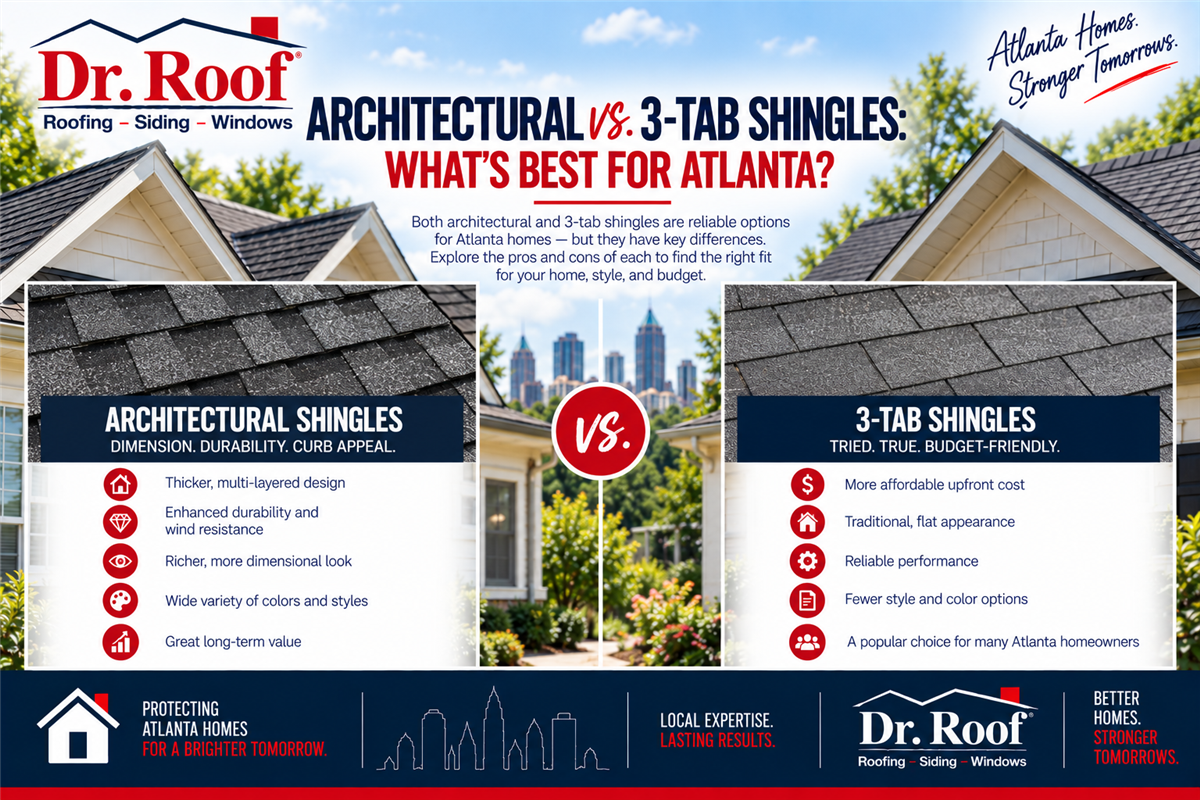
Choosing a new roof involves more than selecting a color. Atlanta homeowners also need to decide what type of shingle makes sense for the home, budget, appearance, and level of performance they want from the roofing system.
Two terms that often come up are 3-tab shingles and architectural shingles. Both are asphalt roofing products, but they differ in construction, appearance, available features, and the types of warranty options that may accompany specific products.
Understanding those differences can make conversations with a roofing contractor much easier and help you compare roofing proposals more confidently.
What Are 3-Tab Shingles?
3-tab shingles are a traditional type of asphalt shingle made with a single-layer design. Their lower edge is divided into tabs, creating the familiar flat and uniform pattern seen on many older asphalt-shingle roofs.
Their simple construction can make them an economical roofing option.
Homeowners who prefer a straightforward roof appearance or who are working within a more limited project budget may still consider 3-tab shingles. However, product availability, colors, warranties, and performance specifications vary by manufacturer.
What Are Architectural Shingles?
Architectural shingles, sometimes called dimensional or laminate shingles, use multiple layers of material laminated together.
That layered construction creates more visual depth than a traditional 3-tab roof. Rather than producing a consistently flat pattern, architectural shingles can create shadow lines and variations that resemble wood shakes or other dimensional roofing materials.
Architectural shingles have become a common choice for residential roofing and are available in a broad range of colors, profiles, and product lines.
Architectural vs. 3-Tab Shingles: 5 Important Differences
There is no single roofing product that is automatically right for every Atlanta home. These five differences can help homeowners understand what they are comparing.
1. Roof Appearance
One of the most noticeable differences is visual.
3-tab shingles generally create a flatter, more uniform roof surface. The repeating tab pattern provides a clean and traditional appearance.
Architectural shingles create greater dimension because of their laminated construction and varied patterns. Depending on the product and color, that can give the roof a more textured appearance.
For homeowners replacing a roof while also updating siding, trim, windows, or exterior paint, the additional style choices available with architectural shingles may be worth considering.
2. Shingle Construction
The two products are manufactured differently.
A typical 3-tab shingle uses a single-layer design. Architectural shingles are laminated products made with multiple layers.
That difference is important because homeowners sometimes assume every asphalt shingle is essentially the same product with a different pattern printed on top. In reality, shingle construction can vary considerably between product categories and manufacturers.
3. Available Performance Features
Roofing performance should always be evaluated at the product level rather than simply assuming that one category of shingle has a particular rating.
Depending on the manufacturer and product line, homeowners may find options offering enhanced wind performance, algae-resistance technology, impact-resistance ratings, reflective features, or other specialized characteristics.
Those features are not universal across every architectural shingle or every 3-tab shingle.
When comparing proposals, ask for the exact manufacturer and product name. That allows you to review the actual technical specifications rather than relying on broad labels such as “architectural” or “premium.”
4. Warranty Options
Warranty coverage can also differ significantly.
Some architectural roofing products may provide different warranty opportunities than basic 3-tab products, particularly when they are installed as part of a manufacturer-qualified roofing system.
However, warranty terms depend on the manufacturer, specific products used, installer credentials, registration requirements, and other conditions.
Homeowners should review the actual written warranty rather than assuming that every roof within a particular shingle category carries the same coverage.
5. Project Priorities and Budget
3-tab shingles may appeal to homeowners focused primarily on a simpler asphalt roofing option.
Architectural shingles may appeal to homeowners who place greater emphasis on dimension, color selection, available performance features, or enhanced roofing-system options.
The better choice depends on the house and the homeowner’s priorities.
A roofing recommendation should consider more than the shingle itself. Roof slope, ventilation, decking condition, flashing, underlayment, drainage, installation requirements, and local building requirements all contribute to the finished roofing system.
Which Shingle Type Makes Sense for an Atlanta Home?
Atlanta roofs can experience intense sun, heavy rain, wind, falling debris, and severe-weather events throughout the year. Because of those conditions, homeowners should evaluate the complete roofing system rather than choosing shingles based on appearance alone.
Questions worth discussing with a roofing professional include:
What exact shingle product is being recommended?
What wind and fire classifications apply to that product?
Are impact-resistant options available?
What algae-resistance features are offered?
What roofing accessories are required for the proposed system?
What manufacturer warranty options may apply?
How will ventilation, flashing, underlayment, and drainage be addressed?
These questions provide a much clearer comparison than simply asking whether architectural shingles are “better.”
What If You Currently Have a 3-Tab Roof?
Having 3-tab shingles now does not necessarily mean the replacement roof must use the same type.
When replacement becomes necessary, homeowners can discuss architectural shingles, other asphalt options, and alternative roofing materials with their contractor.
The existing roof should first be evaluated so the contractor can identify conditions involving the decking, flashing, ventilation, penetrations, and other components that may affect the replacement.
That assessment can help determine which roofing systems are appropriate for the property.
Product Choice Is Only Part of the Roofing Decision
Even a well-made shingle depends on proper installation.
Fastening, starter strips, underlayment, flashing, roof-deck preparation, ventilation, hip and ridge components, and installation around penetrations all influence how the completed system performs.
That is one reason contractor credentials matter when comparing roof replacement companies.
Dr. Roof has served the Atlanta area since 1988 and is both a GAF Master Elite Certified Contractor and a CertainTeed SELECT ShingleMaster. Those credentials allow homeowners to work with a contractor familiar with roofing systems from two major manufacturers while comparing products based on the needs of the individual home.
Dr. Roof can also discuss other roofing options, including DaVinci products, when a homeowner is considering a different aesthetic or roofing material.
Make the Decision Based on Your Home
For many homeowners, architectural shingles provide an appealing combination of dimensional appearance and product choices. For others, a simpler roofing option may fit the project better.
The important part is making the decision after comparing actual products rather than relying only on category names.
If you are considering roof replacement in the Atlanta area, Dr. Roof can inspect the existing roofing system, discuss available materials, and provide recommendations based on the condition and design of your home.
Q: Are architectural shingles the same as dimensional shingles?
A: Generally, yes. Architectural shingles are also commonly called dimensional or laminate shingles because their layered construction creates more depth and variation than traditional 3-tab shingles.
Q: Are 3-tab shingles still available?
A: Yes. Some manufacturers continue to offer 3-tab asphalt shingles. Product availability, colors, specifications, and warranty terms vary by manufacturer and market.
Q: Are architectural shingles always more wind resistant than 3-tab shingles?
A: Not necessarily. Wind ratings and warranty terms should be checked for the exact shingle and roofing system being considered. Homeowners should compare manufacturer specifications rather than relying only on the shingle category.
Q: Can I replace a 3-tab roof with architectural shingles?
A: In many situations, architectural shingles can be considered when replacing an existing 3-tab roof. A roofing professional should first evaluate the roof deck, ventilation, flashing, slope, and other system conditions to determine appropriate options.
Q: Which type of shingle is best for an Atlanta home?
A: There is no single best shingle for every Atlanta property. The right choice depends on the home, budget, desired appearance, product specifications, roofing-system design, and homeowner priorities.
Subscribe to Dr. Roof's Blog



Comments