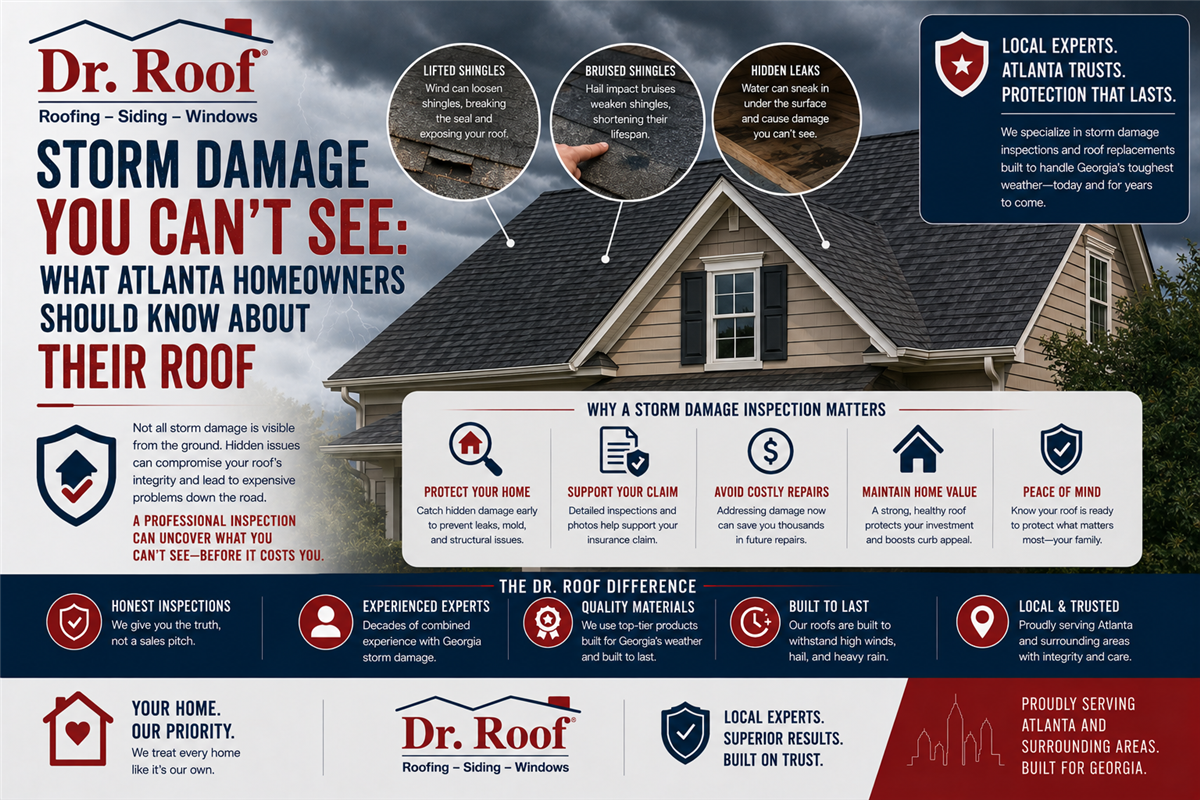
This article challenges the belief that roof storm damage is always obvious. For Atlanta homeowners, it explains the subtle but serious types of storm damage that are often overlooked after wind, hail, heavy rain, or falling debris.
For homeowners concerned about asphalt shingles, hidden leaks, or storm-related roof repair, working with an experienced Georgia roofing company like Dr. Roof can help uncover issues early and provide clear guidance for protecting the home.
The Hidden Threat: Beyond Obvious Roof Damage
Many homeowners assume that if a storm passes and there are no missing shingles, no tree limbs on the roof, and no active leaks inside the home, the roof must be fine.
Unfortunately, roof storm damage is not always that easy to spot.
A roof can look normal from the ground while still having lifted asphalt shingles, granule loss, bruised shingles, damaged flashing, loosened seals, gutter damage, or small openings around vents and roof penetrations.
These issues may not cause an immediate leak, but they can weaken the roofing system over time.
After severe weather, a casual glance from the yard is not enough to confirm that your roof is secure. A professional storm damage roof inspection can help identify hidden concerns before they lead to more serious water intrusion, roof repair needs, or interior damage.
Understanding the common types of storm damage is the first step toward protecting your home.
Unmasking the Root Causes: Subtle Damage Types
One of the most commonly overlooked types of roof storm damage is hail impact.
Many homeowners expect hail damage to look like large dents, holes, or broken shingles. In reality, hail often damages asphalt shingles in more subtle ways.
Hail can knock away protective granules from the shingle surface. These granules help protect the asphalt layer from sun, rain, and weather exposure. When granules are displaced, the shingle may become more vulnerable to aging, cracking, and moisture damage.
Hail can also bruise the shingle mat. These bruises may not be visible from the ground, but they can weaken the shingle and reduce its ability to protect the home.
Wind damage can be just as deceptive.
Strong winds may remove shingles, but they can also lift asphalt shingles without tearing them away completely. Once the seal is weakened, the shingle may settle back into place and appear normal from below.
Wind damage may include:
Lifted asphalt shingles
Creased shingle tabs
Broken shingle seals
Missing shingles
Loose ridge caps
Damaged flashing
Exposed nail heads
Wind-driven rain beneath shingles
Debris impact is another common concern after storms.
Large branches are easy to notice, but smaller debris can also damage the roof. Twigs, limbs, acorns, and windblown objects may scrape shingles, damage vents, loosen gutters, or create small punctures around vulnerable areas.
Heavy rain can also expose weak points in the roofing system.
If flashing, pipe boots, skylights, valleys, gutters, or roof penetrations are already worn or damaged, storm-driven rain may find a path inside.
These subtle issues can create slow leaks that remain hidden until water stains appear on ceilings, walls, or attic materials.
Why Overlooking Damage Matters: Real-World Impacts
Consider an Atlanta-area homeowner who experiences a hail and windstorm but sees no obvious damage afterward.
From the ground, the roof may look intact. There may be no missing asphalt shingles, no visible holes, and no immediate leaks.
However, a professional inspection may reveal granule loss, bruised shingles, lifted tabs, damaged flashing, or moisture entering near a roof penetration.
If these concerns are ignored, the roof may continue to deteriorate. Over time, small storm-related damage can lead to leaks, attic moisture, damaged insulation, weakened decking, ceiling stains, or repeated roof repair needs.
Water intrusion is one of the most serious risks.
A leak may start slowly and travel through the roofing system before it ever appears inside the living space. By the time a ceiling stain becomes visible, moisture may have already affected the attic, insulation, drywall, or structural materials.
Storms can also accelerate wear on older asphalt shingles.
A roof that was already aging may be pushed closer to failure after hail, wind, or heavy rain. Even if the storm does not cause obvious damage, it may worsen existing vulnerabilities.
That is why a professional storm damage roof inspection is important after severe weather, especially for older roofs or roofs with previous repair history.
A Systematic Approach to Roof Protection
Understanding roof storm damage requires more than checking for missing shingles.
A complete roof assessment should evaluate the full roofing system, including shingles, flashing, valleys, vents, gutters, attic areas, roof penetrations, and signs of water intrusion.
Dr. Roof has served Atlanta-area homeowners since 1988, giving our team decades of experience with Georgia weather and the way storms affect asphalt shingles and complete roofing systems.
As a GAF Master Elite Certified Contractor, Dr. Roof brings professional training, installation knowledge, and quality workmanship standards to roof inspections, roof repair, and roof replacement recommendations.
Our approach is focused on helping homeowners understand what happened to their roof, whether damage is present, and what steps may make sense next.
If storm damage is found, Dr. Roof can provide photos, written findings, and repair or replacement recommendations to help homeowners better understand the condition of their roof.
Putting Solutions into Practice: Our Inspection Process
When assessing a roof for common storm damage, a professional process matters.
Dr. Roof follows a thorough inspection approach designed to identify both visible and hidden concerns.
First, we begin with a safe exterior review. This may include looking for signs such as damaged gutters, fallen debris, loose flashing, missing shingles, dented vents, or shingle granules near downspouts.
Next, the roof is evaluated more closely when conditions allow. This helps identify concerns that cannot be seen from the ground, including granule loss, bruised asphalt shingles, creased tabs, lifted shingles, cracked pipe boots, damaged flashing, and punctures.
The inspection may also include related exterior components, such as gutters, siding, vents, skylights, fascia, and roof edges.
When appropriate, attic areas may be checked for signs of water intrusion, moisture stains, damp insulation, dark spots on decking, or ventilation concerns.
After the inspection, homeowners receive clear findings and practical recommendations.
Those recommendations may include targeted roof repair, storm damage roof repair, asphalt shingle replacement, flashing repair, gutter-related guidance, or roof replacement if the damage is more widespread.
If an insurance claim becomes part of the process, photos and written findings may help support the claim. Every policy and claim is different, and coverage decisions are made by the insurance company, but clear documentation can help homeowners communicate the roof’s condition more effectively.
The Principle of Proactive Protection
Unaddressed roof storm damage can create bigger problems over time.
Even minor damage can lead to moisture intrusion, weakened asphalt shingles, roof decking concerns, attic moisture, mold or mildew concerns, and interior damage if it is ignored.
Proactive inspection helps homeowners avoid relying on guesswork.
After a severe storm, it is better to know the condition of the roof than to assume everything is fine because damage is not visible from the ground.
A trusted Georgia roofing company can help homeowners identify common storm damage types, understand repair options, and make informed decisions about protecting the home.
Early action can help reduce the risk of more extensive roof repair needs later.
Securing Your Home: The Value of Expert Assessment
The myth that only obvious storm damage matters can leave homeowners vulnerable.
Missing shingles are only one possible sign of a storm-damaged roof. Hail bruising, granule loss, lifted asphalt shingles, damaged flashing, loosened seals, gutter damage, and hidden leaks can all affect the roof’s performance.
Dr. Roof provides professional roof inspections, roof repair, roof replacement, storm damage documentation support, and exterior home services throughout the Atlanta area.
As an experienced Georgia roofing company and GAF Master Elite Certified Contractor, Dr. Roof helps homeowners identify roof storm damage and understand the best next step for protecting their homes.
If your home has recently been through hail, strong wind, heavy rain, or falling debris, contact Dr. Roof to schedule a professional storm damage roof inspection and get clear guidance before hidden damage becomes a larger problem.
Frequently Asked Questions
Are small hailstones capable of causing significant common roof storm damage?
Yes, absolutely. Even seemingly small hailstones can cause substantial damage, particularly granular loss on asphalt shingles.
This erosion exposes the asphalt to UV rays, accelerating its degradation and significantly shortening the roof's lifespan, often without immediately visible signs of impact from the ground.
How long can subtle roof storm damage go unnoticed before causing serious problems?
Subtle damage, like creased shingles or loosened seals, can go unnoticed for months, or even years, before manifesting as a visible leak. During this time, water may slowly penetrate, causing unseen damage to the attic, insulation, and even structural components, leading to much more extensive and costly repairs later.
Does a roof's age make it more susceptible to common roof storm damage?
Yes, older roofs are generally more vulnerable. As roofing materials age, they become more brittle, less flexible, and their protective granules can loosen more easily.
This makes them significantly more susceptible to damage from even moderate winds and hail, accelerating their natural wear beyond typical expectations.
What should I do immediately if I suspect my roof has hidden storm damage?
If you suspect hidden storm damage, the most crucial first step is to contact a reputable, GAF Master Elite certified roofing contractor like Dr. Roof for a professional inspection.
Avoid climbing onto the roof yourself, as this can be dangerous and may cause further damage. Early detection is vital for effective repair and insurance claims.
How do roofing experts assist with insurance claims for less obvious storm damage?
Reputable roofing professionals provide comprehensive assistance with insurance claims, even for subtle or hidden common roof storm damage. Our expert team documents all findings with detailed reports and photographs, helping homeowners navigate the complex claims process.
We work to ensure that your insurance company fully understands the extent of the damage, facilitating a smoother and more successful claim outcome.
Subscribe to Dr. Roof's Blog





Comments