Choosing siding is not simply a matter of finding the color you like best.
The siding material affects how the exterior looks, how much maintenance it requires, how it responds to moisture and weather, how installation is handled, and how well it complements the architecture of the home.
For Atlanta homeowners, the best siding material depends on several factors rather than one universal winner.
Start by comparing your budget, maintenance preferences, home style, moisture exposure, desired appearance, existing wall conditions, and the performance characteristics of the exact siding products being considered.
Common residential options include vinyl, fiber cement, engineered wood, traditional wood, metal, and masonry-style exterior materials.
Here is how to decide which siding option makes the most sense for your home.
Choosing Siding: The Quick Answer
Before choosing a siding material, compare:
Climate and moisture exposure
Maintenance requirements
Architectural style
Material and installation cost
Resistance to pests and deterioration
Available colors and profiles
Exterior wall condition
Installation requirements
Manufacturer warranty
Contractor experience with the product
For many Atlanta homeowners, vinyl and fiber cement are two of the most practical materials to compare because they provide very different balances of maintenance, appearance, weight, installation, and performance.
The right answer depends on the individual property.
1. Start With Atlanta's Climate
Siding is one of the first exterior materials exposed to Atlanta weather.
Local homes may experience:
High humidity
Heavy rain
Strong thunderstorms
Wind
Intense summer sun
Tree debris
Seasonal temperature changes
Pollen and organic buildup
That makes moisture management particularly important.
The siding itself matters, but it is not the only layer protecting the wall.
A complete exterior assembly may also rely on:
Weather-resistant barriers
Flashing
Window and door details
Roof-to-wall transitions
Trim
Proper clearances
Gutters and drainage
Do not judge a siding system only by the panel or board visible from the outside.
Ask how the entire wall will manage water.
2. Decide How Much Maintenance You Want
Maintenance expectations differ significantly by siding material.
Some homeowners enjoy maintaining painted exterior finishes.
Others want an exterior that requires as little ongoing finish work as practical.
Understanding that preference early can narrow the choices considerably.
Lower-Maintenance Priorities
Homeowners looking for reduced routine finish maintenance often consider:
Vinyl
Fiber cement with factory-applied finishes
Metal
Some composite siding systems
Higher-Maintenance Materials
Traditional wood siding may require more attention to:
Paint or stain
Moisture exposure
Surface deterioration
Caulk and joints where applicable
Rot or pest concerns
No exterior product is truly maintenance-free.
Even lower-maintenance siding should still be inspected and cleaned according to manufacturer recommendations.
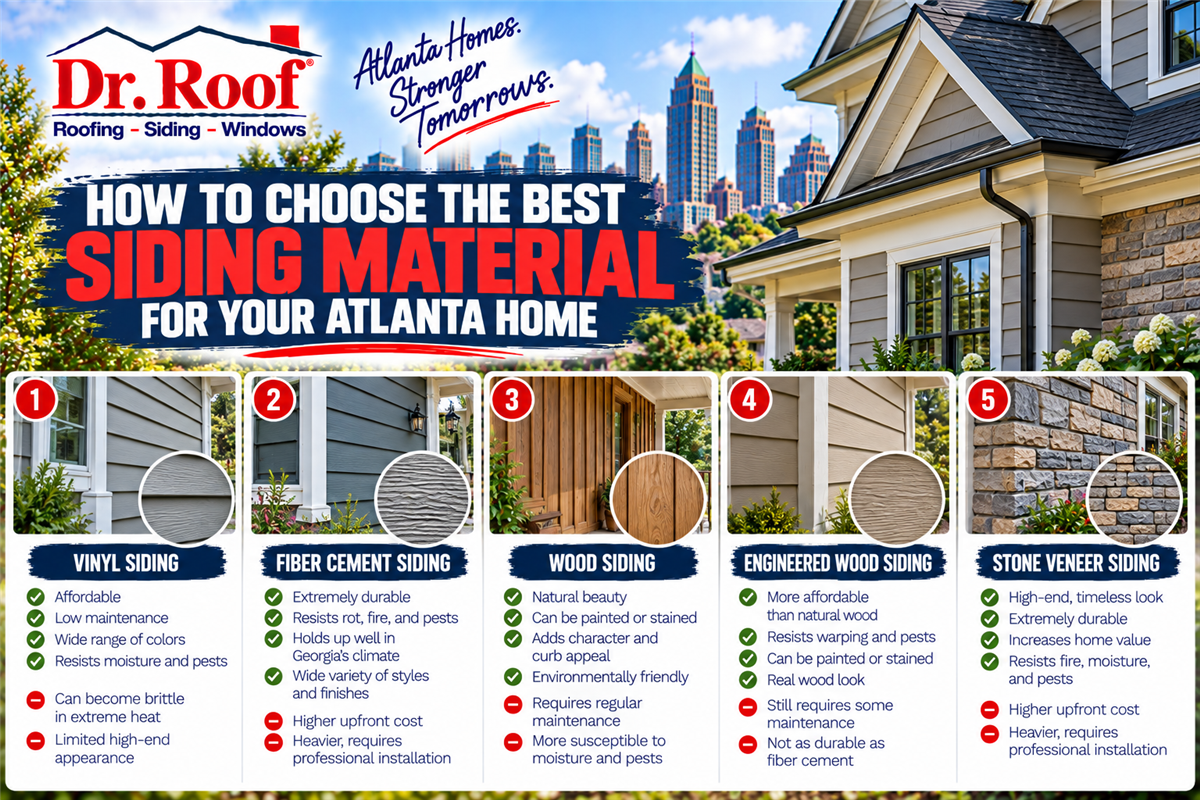
3. Compare Vinyl Siding
Vinyl is one of the most familiar residential siding materials.
It is manufactured in a wide range of colors, profiles, textures, and design styles.
Potential advantages can include:
Low routine maintenance
No routine painting for many products
Moisture resistance
Broad color selection
Lightweight construction
Multiple architectural profiles
Insulated product options
Vinyl can work well for homeowners who want a relatively straightforward exterior with limited finish maintenance.
What Should You Consider With Vinyl?
Vinyl siding needs to be installed in a way that allows for normal expansion and contraction.
Homeowners should also compare the actual product rather than treating every vinyl siding panel as identical.
Differences may include:
Panel thickness
Profile
Reinforcement
Finish
Color technology
Insulation
Wind-related specifications
Warranty
Dr. Roof offers CertainTeed vinyl siding options for Atlanta-area homeowners.
4. Compare Fiber Cement Siding
Fiber cement is a heavier manufactured cladding commonly used on traditional, Craftsman, farmhouse, and contemporary homes.
James Hardie is one of the best-known fiber cement manufacturers.
Fiber cement may appeal to homeowners who prioritize:
A substantial exterior appearance
Wood-inspired profiles
Moisture resistance
Pest resistance
Low-maintenance product options
Lap siding, panel, or shingle-style designs
Paintable or factory-finished choices
Because fiber cement is substantially heavier than vinyl, installation methods and contractor experience matter.
Dr. Roof is a James Hardie Elite Preferred Contractor and installs James Hardie siding in the Atlanta area.
Vinyl vs. Fiber Cement: Which Is Better?
Neither material is automatically better.
They serve different priorities.
Vinyl May Be a Better Fit If You Prioritize:
Lower routine finish maintenance
Lightweight construction
Broad color choices
A wide range of product levels
Avoiding routine repainting for many product lines
Fiber Cement May Be a Better Fit If You Prioritize:
A heavier exterior profile
Wood-inspired architectural details
Paintable options
Noncombustible fiber-cement products
Resistance to moisture and pests
James Hardie design options
The best comparison should use the exact products being proposed, not broad assumptions about entire material categories.
5. Consider Engineered Wood Siding
Engineered wood siding is designed to provide a wood-like appearance using manufactured wood-based material.
Depending on the product, homeowners may consider it because of:
Wood-style texture
Multiple profiles
Lower weight than some masonry or fiber-cement products
Paintable options
Availability in lap, panel, or specialty styles
Because engineered wood products vary considerably, compare the manufacturer's actual specifications, installation requirements, finish system, moisture-management details, and warranty.
Do not assume every engineered wood product performs the same way.
6. Consider Traditional Wood Siding
Natural wood remains attractive for homeowners who want authentic architectural character.
Common advantages can include:
Natural appearance
Paint and stain flexibility
Compatibility with historic homes
Repairability in some applications
Multiple species and profiles
The tradeoff is maintenance.
Wood requires careful moisture management and ongoing attention to its protective finish.
Potential concerns can include:
Rot
Pests
Peeling paint
Splitting
Swelling
Surface weathering
Atlanta homeowners considering natural wood should be comfortable with the maintenance that comes with it.
7. Consider Metal Siding
Metal siding can be used on both traditional and contemporary homes.
Products may include:
Aluminum
Steel
Specialty architectural metal systems
Potential advantages include:
Strength
Resistance to rot
Low-maintenance finishes on many products
Modern architectural options
Long panels and distinctive profiles
Considerations may include:
Denting
Scratching
Corrosion protection
Thermal movement
Product-specific installation requirements
Style compatibility
Metal can create a distinctive look, but homeowners should compare the exact product rather than treating all metal siding as one category.
8. Match the Siding to Your Home's Architecture
A technically strong siding material can still be the wrong design choice if it does not complement the house.
Atlanta-area homes include many architectural styles, such as:
Craftsman
Traditional
Colonial
Ranch
Tudor-inspired
Farmhouse
Contemporary
Custom homes
Different siding profiles create different visual effects.
Traditional Lap Siding
Lap siding works across many architectural styles and is available in multiple materials.
Board-and-Batten
Vertical board-and-batten profiles can create farmhouse, Craftsman, or modern designs.
Shingle-Style Siding
Shingle or shake-inspired siding is often used for accents, gables, and traditional architecture.
Panels
Larger panels can support contemporary or mixed-material exterior designs.
Do not choose material and profile separately.
Consider how the complete exterior will look once siding, trim, roofing, windows, and architectural details come together.
9. Think About Color Before Choosing the Material
Material affects which colors and finishes are available.
Vinyl siding typically uses manufactured color throughout or across the visible surface.
Fiber cement may be factory-finished or prepared for painting.
Wood is commonly painted or stained.
Metal products can use factory-applied finishes.
Before committing to a material, ask:
Which colors are available?
Can I see a physical sample?
How will the color look next to my roof?
Does it complement brick or stone?
How will trim be coordinated?
Is the finish factory-applied or field-applied?
Whenever possible, view siding samples outdoors.
Natural light can make a color look very different from how it appears on a computer screen or inside a showroom.
10. Compare Siding With Your Roof and Windows
Your siding is not viewed in isolation.
It sits next to:
Roof shingles
Window frames
Doors
Gutters
Soffit
Fascia
Brick
Stone
Trim
That means a siding choice should support the entire exterior palette.
For example, a homeowner planning roof replacement soon may want to coordinate both projects before making a final color decision.
Likewise, if windows will be replaced, frame colors may influence the siding and trim combination.
Thinking about the whole exterior can help avoid combinations that feel mismatched after installation.
Does Siding Improve Energy Efficiency?
Siding alone does not determine the energy performance of a wall.
The complete assembly matters.
Factors may include:
Wall insulation
Exterior insulation
Air sealing
Weather-resistant barriers
Window installation
Thermal bridging
Insulated siding products
Some vinyl systems are available with added insulation.
Fiber cement can also be used as part of a well-insulated wall system.
Instead of asking which siding is automatically the most energy efficient, ask what the complete proposed wall assembly includes.
What Should You Know About Siding and Moisture?
Managing water is critical regardless of siding material.
Siding is not usually intended to be the only defense against rain.
Water-management details around the wall can include:
Flashing
Weather-resistant barriers
Window openings
Doors
Exterior penetrations
Roof intersections
Deck connections
Clearances above grade
If existing siding is removed, the project can provide an opportunity to inspect underlying conditions that were previously hidden.
That makes the installation process just as important as the siding material itself.
Should Old Siding Always Be Removed?
The correct approach depends on the existing wall and the proposed siding system.
A contractor should evaluate:
Existing siding condition
Sheathing
Moisture concerns
Flatness of the wall
Manufacturer installation requirements
Flashing
Trim
Window and door transitions
Covering over an existing problem does not correct it.
If deterioration is present behind the siding, that issue should be identified and addressed as part of the project scope.
Why Contractor Experience Matters
Different siding materials require different installation techniques.
Fiber cement, vinyl, wood, and metal are not fastened or detailed in exactly the same way.
Installation can affect:
Material movement
Water management
Appearance
Clearances
Fastener placement
Trim
Joints
Warranty eligibility
Ask the contractor how frequently the crew installs the exact material you are considering.
Manufacturer credentials can also provide useful context when they are relevant to the product.
Dr. Roof is a James Hardie Elite Preferred Contractor for fiber-cement siding installations.
What Should Be Included in a Siding Proposal?
A siding proposal should provide enough detail to understand what will actually be installed.
Look for:
Manufacturer
Product line
Material
Profile
Color
Finish
Trim
Existing siding removal
Disposal
Weather-resistant barrier
Flashing details
Underlying repairs
Soffit and fascia work if applicable
Cleanup
Warranty information
A proposal that simply says "new siding" does not provide enough information for an apples-to-apples comparison.
How Should You Compare Siding Warranties?
Warranty terms vary by material, product, manufacturer, and finish.
Review the actual written documents for the products being proposed.
Questions to ask include:
What material is covered?
Is finish coverage separate?
Is labor included?
Are there maintenance requirements?
Is registration required?
Is coverage transferable?
What exclusions apply?
Who handles a warranty concern?
Do not choose a siding material solely because one brochure displays a larger warranty number.
The actual terms are more useful than the headline.
Which Siding Material Is Best for Low Maintenance?
Vinyl is frequently selected by homeowners who want minimal routine finish maintenance.
Fiber cement can also offer relatively low maintenance, particularly with factory-applied finish systems.
However, both materials still require periodic inspection and cleaning.
Homeowners should check:
Panels or boards
Trim
Flashing
Joints
Exterior penetrations
Areas near gutters
Lower walls exposed to splash-back
Low maintenance does not mean no maintenance.
Which Siding Material Is Best for a Traditional Home?
There is no single answer.
Traditional homes may work well with:
Fiber-cement lap siding
Vinyl lap siding
Wood siding
Shingle-style accents
Mixed siding profiles
The profile, trim, exposure, texture, and color can matter as much as the underlying siding material.
A physical sample or exterior visualization can make the decision easier.
Which Siding Material Is Best for a Modern Home?
Modern homes may use:
Smooth fiber-cement panels
Vertical siding
Metal panels
Board-and-batten
Mixed materials
Darker contemporary finishes
Again, material is only part of the design.
Panel dimensions, trim strategy, window placement, rooflines, and color all influence the final appearance.
How Dr. Roof Helps Atlanta Homeowners Compare Siding
Dr. Roof has served Atlanta-area homeowners since 1988 and provides siding installation and replacement services.
Homeowners can compare siding options that include CertainTeed vinyl products and James Hardie fiber-cement products.
Dr. Roof is also a James Hardie Elite Preferred Contractor.
A professional siding consultation can help homeowners consider:
Existing exterior condition
Moisture concerns
Material options
Maintenance preferences
Architectural style
Color
Profile
Installation requirements
Complete project scope
The goal should be to choose a siding system that fits the home rather than forcing every property into the same material.
Choosing the Best Siding Material for Your Atlanta Home
The best siding material is the one that fits your priorities and your property.
Vinyl may be attractive for homeowners who prioritize low maintenance, broad color selection, and straightforward exterior care.
Fiber cement may appeal to homeowners who prioritize dimensional appearance, moisture and pest resistance, noncombustible material options, and architectural flexibility.
Wood offers authentic character but usually requires more maintenance.
Engineered wood and metal add additional options with their own strengths and tradeoffs.
For Atlanta homeowners, the best decision starts with the complete exterior system.
Compare the exact siding product, maintenance requirements, wall condition, installation method, design, warranty, and contractor experience before making your final choice.
That approach provides a much more useful answer than simply asking which siding material is "best."
What is the best siding material for an Atlanta home?
There is no single best siding material for every Atlanta home. The right choice depends on maintenance preferences, budget, architecture, moisture exposure, appearance, existing wall conditions, installation requirements, and the specific products being compared.
Is vinyl or fiber cement siding better?
Neither is automatically better. Vinyl generally appeals to homeowners seeking low maintenance and broad color options, while fiber cement may appeal to homeowners prioritizing a substantial appearance, moisture and pest resistance, and additional architectural profiles.
Which siding requires the least maintenance?
Vinyl is commonly chosen for low routine finish maintenance because many products do not require painting. Fiber cement can also be relatively low maintenance, particularly when factory-finished. Both should still be periodically inspected and cleaned.
Does siding material affect energy efficiency?
Yes, but siding is only one part of the wall assembly. Insulation, exterior insulation, air sealing, weather-resistant barriers, windows, and installation details also influence energy performance. Compare the complete proposed wall system rather than the siding material alone.
What should I compare when getting siding estimates?
Compare the manufacturer, exact product line, material, profile, color, trim, removal of existing siding, weather-resistant barrier, flashing, underlying repairs, installation scope, cleanup, and warranty terms.
Does Dr. Roof install both vinyl and fiber cement siding?
Yes. Dr. Roof offers CertainTeed vinyl siding and James Hardie fiber-cement siding for Atlanta-area homeowners and is a James Hardie Elite Preferred Contractor.
Subscribe to Dr. Roof's Blog





Comments