When planning a roof replacement, most homeowners focus on choosing shingles, selecting colors, and reviewing warranty options.
However, one of the most important parts of the roofing system is hidden beneath the materials you see from the street.
Roof decking, also called roof sheathing, provides the supporting surface for the roof covering.
If the decking becomes deteriorated or structurally unsuitable, installing new shingles without correcting the problem may leave the roofing system with an inadequate foundation.
For Atlanta homeowners, understanding roof decking replacement options can help make unexpected findings during a roof replacement easier to manage.
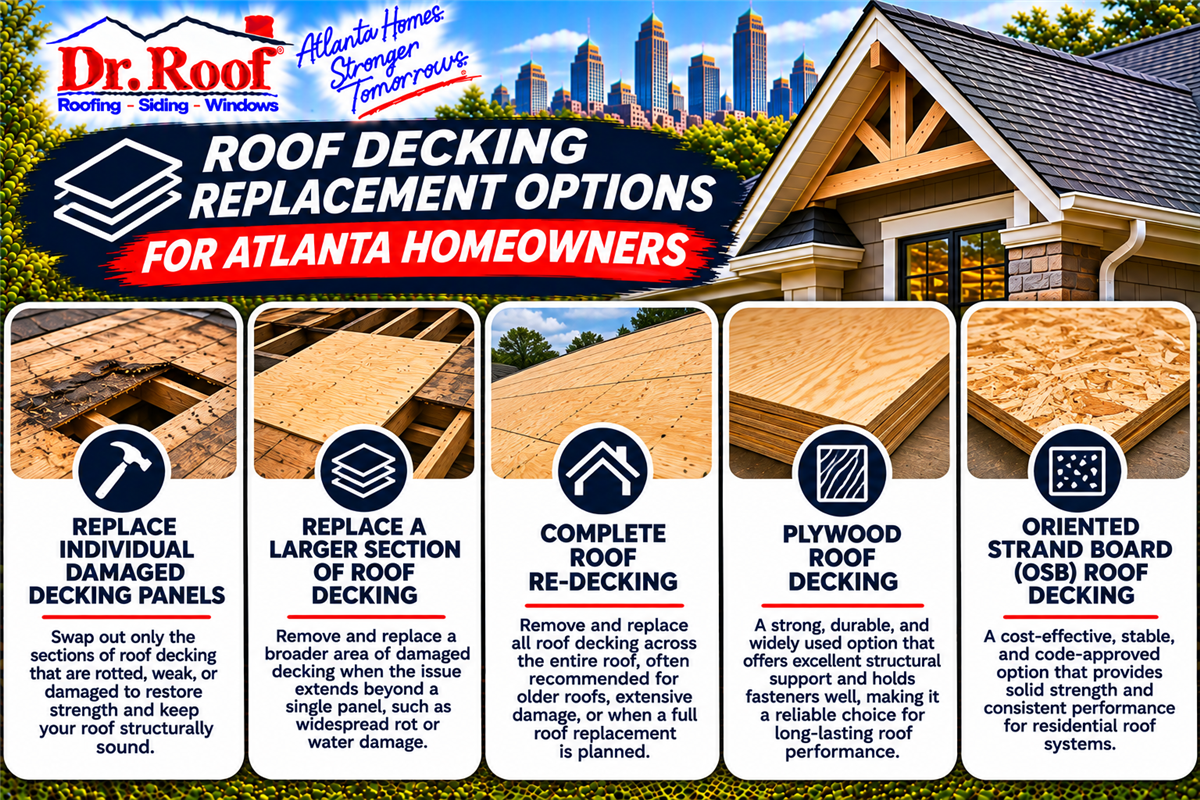
Roof decking replacement options generally include replacing isolated damaged panels, replacing larger affected sections, or installing new sheathing across the roof when the existing decking is unsuitable. Common replacement materials include properly rated plywood and oriented strand board (OSB). The correct approach depends on the extent of deterioration, roof structure, applicable building requirements, and roofing manufacturer specifications.
Not every roof replacement requires new decking.
The decision should be based on the condition of the existing materials.
Here's what Atlanta homeowners should know before approving roof decking replacement work.
What Is Roof Decking and Why Does It Matter?
Roof decking is the structural sheathing installed over the roof framing.
It provides a surface for attaching underlayment, shingles, and other roofing components.
On many residential homes, decking consists of plywood or oriented strand board panels.
Some older properties use individual wood boards.
What Does Roof Decking Do?
Roof decking helps:
Support roofing materials
Provide a surface for proper fastening
Transfer loads to the supporting roof structure
Maintain a suitable base for underlayment
Support the overall roof assembly
The decking must be suitable for the roofing materials installed above it.
Is Roof Decking the Same as Underlayment?
No.
Roof decking provides structural support.
Underlayment is installed over the decking as part of the roofing system's water-management assembly.
The shingles or other approved roof covering are then installed above the underlayment.
Each component serves a different purpose.
Why Is Decking Important During Roof Replacement?
A new roofing system needs an appropriate supporting surface.
If decking is deteriorated, inadequately fastened, or otherwise unsuitable, the contractor may need to correct it before installing the new roofing materials.
According to GAF, damaged roof sheathing may need to be removed and replaced before the remaining roof system components are installed.
How Do You Know if Roof Decking Needs Replacement?
Some decking problems are visible from an accessible attic.
Others remain concealed until the existing roof covering is removed.
What Are Common Signs of Damaged Decking?
Potential concerns include:
Significant wood rot
Delaminated panels
Holes or broken sections
Structural weakness
Deterioration associated with water intrusion
Significant localized sagging
Other conditions that make the material unsuitable
However, no single visual symptom automatically establishes the need for replacement.
Does a Water Stain Mean Decking Must Be Replaced?
Not necessarily.
Wood can retain discoloration after an earlier moisture event.
The contractor should evaluate whether the material remains structurally suitable.
For example, a dry, discolored panel may not require the same treatment as a severely deteriorated or delaminated panel.
The decision should reflect the actual condition.
Can All Decking Damage Be Found Before Tear-Off?
No.
Some sections remain hidden beneath shingles and underlayment.
A contractor may identify additional concerns after removing the existing roofing materials.
The replacement proposal should explain how those conditions will be evaluated and handled.
Option 1: Replace Individual Damaged Decking Panels
Localized replacement may be appropriate when deterioration affects only a limited portion of the roof.
For example, water entering through damaged flashing may affect nearby sheathing without compromising the entire roof deck.
How Does Localized Decking Replacement Work?
Depending on the structure, a contractor may:
Remove the roofing materials above the affected area.
Examine the exposed decking and supporting framing.
Remove unsuitable sheathing.
Install appropriately rated replacement material.
Secure the new decking according to applicable requirements.
Restore the underlayment and roofing system.
The exact method depends on the existing roof design.
Can Only Part of a Sheet Be Replaced?
Sometimes, but the replacement must have appropriate support and fastening.
A contractor should not assume any arbitrary cutout can be repaired without considering the framing beneath it.
The size and placement of the replacement section must suit the structural requirements.
When Is Localized Replacement a Good Option?
It may be appropriate when:
Damage is limited
Surrounding decking remains suitable
Supporting framing is sound
A reliable replacement can be installed
The new material meets applicable requirements
A professional evaluation should determine whether the proposed repair is sufficient.
Option 2: Replace a Larger Section of Roof Decking
Some damage extends beyond a single panel.
For example, prolonged water intrusion may affect several adjoining sheets.
In that situation, replacing only the most visibly damaged section may not correct the complete problem.
When Might a Larger Replacement Area Be Necessary?
Potential situations include:
Multiple deteriorated panels
Water damage extending across a roof section
Significant physical impact damage
Unsuitable sheathing around several roof penetrations
Related problems affecting adjacent material
The contractor should determine the actual boundaries of the affected area.
Does Replacing a Larger Section Mean Replacing the Entire Roof Deck?
No.
A contractor may recommend replacing multiple panels on one roof slope while retaining suitable decking elsewhere.
The important consideration is whether the remaining material can support the new roofing system.
How Should the Contractor Document the Work?
Homeowners can ask for photographs showing the exposed damage and the affected areas.
The contractor should explain which panels are unsuitable and why replacement is recommended.
If the work expands beyond the original agreement, the additional scope and cost should be addressed through the applicable approval procedure.
Option 3: Complete Roof Re-Decking
Complete re-decking involves replacing the existing roof sheathing across the relevant roof area.
This is a more extensive project than localized panel replacement.
However, full re-decking is not automatically required simply because the roof covering is being replaced.
When Might Full Re-Decking Be Appropriate?
A contractor may recommend broader replacement when:
Existing decking is extensively deteriorated
Large portions of sheathing are structurally unsuitable
The material cannot provide an acceptable fastening surface
The existing deck is incompatible with the proposed roofing system
Applicable requirements call for a different sheathing arrangement
The recommendation should be supported by the actual conditions.
Is Full Re-Decking Necessary for Every Older Home?
No.
An older home may have decking that remains suitable.
Age alone does not establish that every panel must be replaced.
The contractor should evaluate the material, framing, fastening, and relevant installation requirements.
Why Can Full Re-Decking Increase Project Cost?
Replacing the entire deck involves substantially more material removal and installation than correcting a small damaged area.
The work may require additional labor, panel materials, fasteners, disposal, and project time.
A written estimate should identify the proposed scope clearly.
Option 4: Plywood Roof Decking
Plywood is one of the established materials used for residential roof sheathing.
It consists of wood veneer layers bonded together.
Structural plywood products are available in different thicknesses, grades, and span ratings.
What Are the Benefits of Plywood Roof Decking?
Appropriately rated plywood can provide a suitable structural base for many residential roofing systems.
Potential considerations include:
Established structural performance
Different panel thickness options
Published span ratings
Compatibility with qualifying roof assemblies
Broad use in residential construction
However, the exact plywood product matters.
Not every sheet of plywood is suitable for roof decking.
What Should the Contractor Check?
The selected material must be appropriate for the spacing of the supporting framing and the intended roofing system.
The Engineered Wood Association, known as APA, provides guidance on structural plywood ratings and appropriate installation.
Homeowners should ask which plywood product is being proposed rather than assume all plywood panels have the same characteristics.
Is Plywood Always Better Than OSB?
Not necessarily.
Both plywood and OSB can be suitable roof sheathing materials when properly specified and installed.
The decision should be based on the actual structural and roofing requirements.
Option 5: Oriented Strand Board Roof Decking
Oriented strand board, commonly called OSB, is another widely used roof sheathing material.
OSB panels are manufactured from engineered wood strands bonded into structural panels.
Like plywood, OSB products are available with different ratings and specifications.
Why Is OSB Used for Roof Decking?
Appropriately rated OSB provides a structural base for residential roofing systems.
It is commonly considered because of its engineered construction, availability, and compatibility with many building applications.
However, the selected panel must meet the applicable requirements.
What Is an OSB Span Rating?
APA explains that rated sheathing panels include information about the spacing of supporting framing members.
For example, certain panel markings indicate the maximum recommended spacing for roof sheathing under specified conditions.
The actual panel selection must account for more than appearance or thickness alone.
Can OSB Be Used Under Asphalt Shingles?
Yes, when the OSB product is suitable for the roof assembly and meets the applicable structural, manufacturer, and building requirements.
The contractor should use the appropriate fastening and installation procedures.
Is OSB Automatically Cheaper Than Plywood?
Not always.
Material prices change by supplier, product specification, availability, and location.
Homeowners should compare actual project estimates rather than assume one material will always cost less.
What if Your Existing Roof Has Wood Plank Decking?
Some older homes have individual wood boards instead of modern plywood or OSB panels.
These boards can have different dimensions, spacing, and conditions.
Can New Shingles Be Installed Over Wood Plank Decking?
The answer depends on the selected roofing product, plank configuration, and applicable installation requirements.
Some existing plank decking may be suitable under certain conditions.
Other arrangements may require modification or replacement.
Why Do Gaps Between Boards Matter?
The existing deck must provide an appropriate fastening surface for the roofing system.
Wide gaps, damaged boards, or unsuitable support conditions can interfere with proper installation.
A contractor should evaluate whether the selected roofing materials can be attached as required.
Should Every Plank Roof Be Converted to Plywood or OSB?
Not automatically.
The appropriate recommendation depends on the existing construction and planned roofing system.
If new sheathing is necessary, the contractor should explain why and identify the material specification.
How Should New Decking Be Installed?
Roof decking installation involves more than placing sheets over rafters or trusses.
The supporting structure and panel specifications must work together.
Why Does Panel Spacing Matter?
Wood-based panels can expand and contract as moisture conditions change.
APA generally recommends spacing between adjacent structural panels to reduce the risk of buckling, subject to manufacturer instructions.
The exact installation should follow the applicable requirements.
Why Does Fastening Matter?
Decking must be attached to the supporting framing appropriately.
The fastening schedule, panel thickness, span rating, and structural conditions can influence the installation.
These details should be determined by the qualified installer.
Can Damaged Roof Framing Be Repaired as Part of Decking Replacement?
Sometimes, but framing damage is a separate concern from replacing sheathing.
If rafters, trusses, or other structural components appear compromised, additional professional evaluation may be necessary.
Decking replacement should not conceal unresolved structural problems.
Does Replacing Roof Decking Make a New Roof Last Longer?
Suitable roof decking is important because it provides the foundation for the roofing system.
Installing new shingles over damaged or inadequate sheathing can create problems with attachment and overall roof performance.
However, replacing decking does not guarantee a particular roof lifespan.
The performance of the complete roof depends on:
Roofing materials
Proper installation
Flashing
Underlayment
Structural suitability
Weather exposure
Maintenance
Other building conditions
The objective is installing the roofing system over a sound and suitable base.
How Much Does Roof Decking Replacement Cost in Atlanta?
The cost depends on the amount of decking being replaced and the actual installation requirements.
A localized replacement may involve significantly less work than full re-decking.
What Factors Affect Decking Replacement Pricing?
Important considerations include:
Number of panels requiring replacement
Plywood or OSB specifications
Roof pitch
Height and accessibility
Labor
Existing material removal
Fastening requirements
Disposal
Structural repairs if necessary
A professional estimate should identify the actual scope.
Should Decking Be Included in a Roof Replacement Quote?
The roofing proposal should explain how decking will be evaluated and handled.
Some contractors may include an allowance or specify separate pricing for additional replacement.
Others may provide a different arrangement.
Homeowners should ask what is included rather than assume all decking work is covered by the original price.
What Happens if More Damage Is Found During Tear-Off?
If additional unsuitable decking becomes visible, the contractor should document the condition and explain the required work.
The homeowner should understand the proposed change in scope and cost before additional work is authorized under the agreement.
How Can Homeowners Compare Decking Replacement Options?
Before approving work, ask the roofing contractor to explain the available alternatives.
Consider these questions:
Which decking areas are damaged or unsuitable?
Can localized replacement correct the problem?
Is larger section replacement necessary?
What would justify full re-decking?
Will plywood or OSB be used?
What panel specifications apply?
Are there any structural concerns?
How will hidden damage be documented?
What additional costs might arise?
How will the new roofing system be installed over the repaired deck?
These questions help clarify whether the recommendation is based on the condition of the roof.
Does Homeowners Insurance Cover Roof Decking Replacement?
Coverage depends on the cause of the damage and the individual insurance policy.
Some sudden covered losses may involve damage to roof decking.
However, deterioration caused by ordinary aging, maintenance problems, or prolonged unresolved leaks may be treated differently.
The insurance company determines coverage and payment under the policy.
A roofing contractor can document physical damage and recommend appropriate repairs but cannot guarantee insurance approval.
How Dr. Roof Helps Atlanta Homeowners Evaluate Roof Decking
Dr. Roof has served Atlanta-area homeowners since 1988, providing professional roofing inspections, repairs, replacement, and storm-damage documentation support.
Dr. Roof is a GAF Master Elite Certified Contractor and CertainTeed SELECT ShingleMaster.
During a roof replacement evaluation, homeowners can discuss the condition of their existing roofing materials and whether visible decking concerns require further attention.
If unsuitable decking is discovered during an approved project, the contractor should explain the findings and any necessary changes to the work.
Depending on the circumstances, Dr. Roof may provide photographs, written findings, and repair or replacement recommendations.
Homeowners can request a written roof replacement proposal and discuss how decking evaluation and potential replacement will be handled.
Choose the Right Decking Solution for Your New Roof
Roof decking is an important structural component of the residential roofing system.
When it remains suitable, complete replacement may not be necessary.
When damage is localized, individual panels or sections may be replaceable.
When deterioration is extensive or the existing sheathing is unsuitable, larger replacement or full re-decking may be appropriate.
For Atlanta homeowners, the best approach is evaluating the existing materials and choosing a solution that meets the roof's structural and installation requirements.
If you're planning a roof replacement in Atlanta, Marietta, Alpharetta, Roswell, Smyrna, or surrounding communities, contact Dr. Roof to request a professional roofing evaluation and discuss the decking and replacement options appropriate for your home.
Does every roof replacement require new decking?
No. Existing roof decking may remain suitable for continued use. A professional contractor should evaluate its condition, structural suitability, fastening, and compatibility with the selected roofing system before recommending replacement.
Can only damaged roof decking panels be replaced?
Yes, in some cases. Localized decking replacement may be appropriate when damage is limited and surrounding materials and framing remain suitable. The replacement must have appropriate structural support and fastening.
Is plywood or OSB better for roof decking replacement?
Both properly rated plywood and oriented strand board can be suitable for residential roof decking. The correct choice depends on panel specifications, framing support, roof design, applicable requirements, and roofing manufacturer instructions.
When is complete roof re-decking necessary?
Full re-decking may be appropriate when existing sheathing is extensively deteriorated, structurally unsuitable, or incompatible with the proposed roofing system. A professional evaluation should establish why replacing only selected areas would not be sufficient.
Can a roofer identify all decking damage before removing the old shingles?
Not always. Some deterioration remains concealed beneath shingles and underlayment. Additional problems may become visible during tear-off. The contractor should explain how unexpected damage will be documented and approved.
What affects the cost of roof decking replacement?
Pricing depends on the amount of material replaced, plywood or OSB specifications, roof accessibility, labor, removal and disposal, fastening requirements, and any necessary structural corrections. A written project-specific estimate is the most reliable basis for determining cost.
Subscribe to Dr. Roof's Blog




Comments