A leaking roof can create serious concerns for homeowners, especially when water begins appearing on ceilings, around attic spaces, or near interior walls.
During Atlanta's heavy rainstorms, even a relatively small roofing defect can become noticeable when water finds a path beneath the roof covering.
However, not every roof leak requires the same repair.
A damaged plumbing vent boot may need replacement, while a chimney leak could involve deteriorated flashing. Missing shingles, vulnerable roof valleys, and compromised underlayment can also require different solutions.
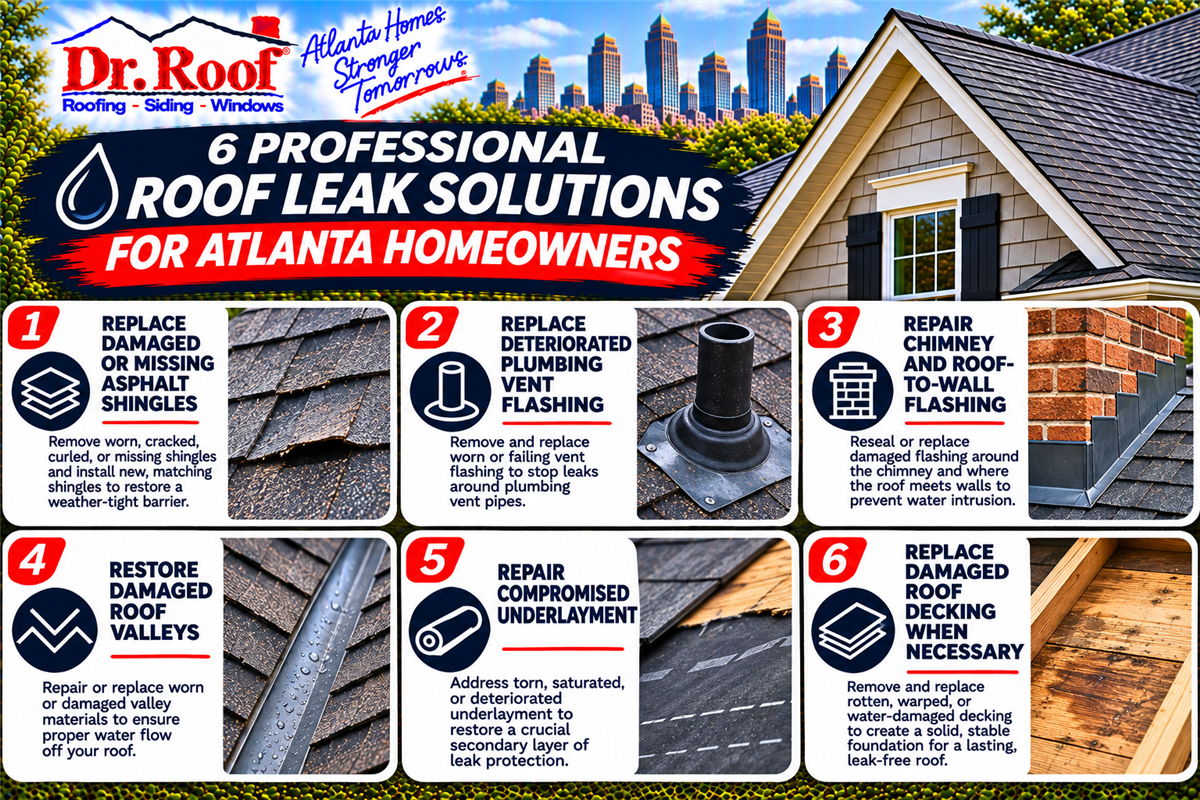
The most effective professional roof leak solution is to identify where water is entering and repair the affected roofing components. Common solutions include replacing damaged shingles, correcting plumbing vent flashing, repairing chimney and roof-to-wall flashing, restoring roof valleys, replacing compromised underlayment, and repairing damaged roof decking.
For Atlanta homeowners, understanding these options can make it easier to evaluate professional repair recommendations.
Here are six solutions roofing contractors may use to address residential roof leaks.
1. Replace Damaged or Missing Asphalt Shingles
Asphalt shingles form the primary water-shedding surface on many Atlanta homes.
When installed correctly, overlapping shingles direct rainwater down the roof.
However, storms, physical impacts, improper installation, or deterioration can compromise individual shingles.
How Can Damaged Shingles Create Roof Leaks?
Potential problems include:
Torn roofing materials
Significant cracks
Wind-creased shingles
Punctures caused by debris
Damaged ridge cap shingles
When shingles are compromised, the underlayment beneath them may experience additional weather exposure.
Although underlayment provides secondary protection, it is not intended to serve indefinitely as the primary roof covering.
How Does a Professional Repair Damaged Shingles?
A contractor may remove the damaged materials and install suitable replacement shingles.
The process generally involves accessing the affected fasteners, evaluating the exposed area, and integrating the new shingles with the existing roof.
Proper overlap, fastening, and sealing are important.
The contractor should follow the applicable manufacturer's repair and installation requirements.
Can a Few Missing Shingles Be Repaired Without Replacing the Roof?
Often, yes.
Individual shingle replacement may be practical when damage is localized and surrounding materials remain serviceable.
However, extensively deteriorated shingles may become difficult to remove without damaging nearby materials.
A professional inspection should determine whether the affected area can be repaired reliably.
2. Replace Deteriorated Plumbing Vent Flashing
Plumbing vent pipes extend through many residential roofs.
These penetrations require flashing to manage rainwater where the pipe passes through the roofing system.
The protective component is commonly called a pipe boot or plumbing vent flashing.
Why Do Plumbing Vent Boots Leak?
Depending on the product, some pipe boots contain flexible sealing materials that can deteriorate.
Potential problems include:
Cracked rubber collars
Split sealing components
Loose flashing
Damaged surrounding shingles
Incorrect installation
Openings around the pipe
When the flashing no longer provides appropriate protection, water may enter around the penetration.
What Is the Professional Solution?
A contractor may remove the deteriorated pipe boot and install a suitable replacement.
The new flashing must be integrated properly with the surrounding shingles.
Some replacement products use different designs and materials, so the appropriate choice depends on the pipe dimensions, roof slope, and roofing system.
Can Plumbing Vent Flashing Be Repaired With Sealant?
Sealants have legitimate roofing applications, but applying caulk around a deteriorated pipe boot does not necessarily provide a permanent solution.
For example, if the flexible collar has split, replacing the damaged component may be more appropriate than covering the crack.
The contractor should determine whether the existing flashing can be restored reliably.
3. Repair Chimney and Roof-to-Wall Flashing
Chimneys and roof-to-wall intersections are important areas to examine when investigating leaks.
These locations require flashing systems designed to direct water away from vulnerable transitions.
Why Are Chimney Leaks Difficult to Diagnose?
A chimney can contain several potential water-entry points.
Depending on the construction, the issue may involve:
Step flashing
Counterflashing
Open flashing seams
Damaged adjoining shingles
Previous improper repairs
Other chimney-related conditions
A roofing contractor must determine whether the leak originates from the roof flashing or another component.
What Is Step Flashing?
Step flashing consists of individual pieces integrated with successive shingle courses where the sloped roof meets a wall.
The pieces help direct water back onto the roof covering.
Counterflashing provides additional protection at certain transitions.
GAF emphasizes the importance of properly integrated step flashing and counterflashing.
How Is Damaged Flashing Repaired?
Depending on the problem, the contractor may need to remove adjacent shingles, replace damaged flashing pieces, and restore the overlapping roofing materials.
The work should correct how water moves through the transition.
Why Isn't Adding More Caulk Always the Answer?
A visible gap may be only one symptom of an improperly installed flashing assembly.
Applying sealant over the gap may not correct the water-entry pathway.
A professional repair should address the underlying defect.
For Atlanta homes with dormers, chimneys, and complicated rooflines, correctly functioning flashing is especially important during heavy rainfall.
4. Restore Damaged Roof Valleys
A roof valley forms where two sloped roof sections meet.
Valleys direct runoff from adjoining roof surfaces toward lower roof areas.
Because water from multiple slopes can pass through one concentrated location, the condition of the valley's roofing materials matters.
What Causes a Roof Valley to Leak?
Potential problems include:
Damaged valley flashing
Deteriorated shingles
Incorrect roofing material overlap
Compromised underlayment
Physical impact damage
Defective previous repairs
The appropriate repair depends on the valley design.
How Do Professional Roofers Repair Valleys?
A contractor may need to remove affected shingles and evaluate the underlying flashing or underlayment.
Damaged components can then be replaced using a suitable method for the existing roofing system.
For example, an open metal valley may require different work from a closed-cut asphalt-shingle valley.
Does Every Valley Leak Require Major Roofing Work?
Not necessarily.
A localized problem may be repairable.
However, more extensive deterioration may require rebuilding a larger section of the valley.
The contractor should explain whether the proposed work restores the complete affected water-management assembly.
5. Repair Compromised Underlayment
Underlayment is installed beneath many residential roof coverings to provide secondary moisture protection.
If shingles become damaged or displaced, the underlayment may be exposed to weather.
Depending on the condition, it may also require attention during a roof leak repair.
What Can Damage Roofing Underlayment?
Potential causes include:
Physical punctures
Improper installation
Prolonged exposure after shingles are lost
Previous defective repairs
Damage associated with a roof penetration
Other roofing problems
Not every exposed underlayment area is unsuitable.
The contractor should evaluate its actual condition.
How Is Underlayment Repaired?
In certain cases, the roofing contractor may remove the overlying shingles, correct the compromised underlayment, and restore the roof covering.
The materials must be compatible with the roofing system and installed according to applicable requirements.
Can New Shingles Be Installed Over Damaged Underlayment?
The contractor should not ignore compromised materials that require replacement.
Installing new shingles without addressing an underlying defect may leave the roofing assembly vulnerable.
The proposed repair should restore the necessary protective layers.
6. Replace Damaged Roof Decking When Necessary
Roof decking provides the supporting surface beneath the roofing materials.
Common residential decking products include plywood and oriented strand board.
When water intrusion continues for an extended period, the decking may become deteriorated.
Physical impacts can also damage the material.
What Are Possible Signs of Decking Damage?
Potential concerns include:
Wood rot
Holes or broken sections
Delamination
Significant moisture deterioration
Structural weakness
Localized sagging
Some problems may be identified from accessible attic areas.
Others remain concealed until roofing materials are removed.
Does Every Roof Leak Damage the Decking?
No.
A leak does not automatically mean the supporting wood requires replacement.
The extent of damage depends on the amount of moisture exposure, duration, material condition, and other factors.
Discoloration alone does not necessarily establish that decking is structurally unsuitable.
Can Only the Damaged Decking Be Replaced?
Sometimes.
If damage is limited to a particular section, the contractor may be able to replace the affected material without rebuilding the entire roof.
However, significant structural deterioration may require additional professional evaluation.
The new decking must meet applicable structural and roofing installation requirements.
How Do Roofers Find the Actual Source of a Leak?
Identifying the water-entry point is one of the most important parts of professional roof leak repair.
The location of a ceiling stain does not necessarily correspond to the exterior opening.
Water may travel along roof decking, rafters, or other materials before becoming visible indoors.
What Does a Roof Leak Inspection Involve?
Depending on the reported problem, the contractor may evaluate:
The location of interior water stains
Roof penetrations above the affected area
Shingle condition
Flashing
Roof valleys
Previous repair locations
Accessible attic conditions
Other possible water-entry pathways
The contractor may also ask when the leak occurs.
For example, leaks during wind-driven rainfall may require evaluating roofing transitions that are exposed under certain weather conditions.
However, the weather pattern alone does not establish a diagnosis.
Temporary Roof Patching vs. Permanent Leak Repair
Homeowners sometimes use the terms roof patching and roof repair interchangeably.
However, temporary protection and permanent corrective work are different.
What Is a Temporary Roof Patch?
Temporary protection may include professionally installed tarping or another suitable measure intended to reduce additional weather exposure.
These measures can help while permanent repairs are arranged.
What Is a Permanent Roof Leak Repair?
A permanent repair should correct the identified roofing defect.
That may involve replacing damaged shingles, flashing, underlayment, or other roofing components.
Simply covering the visible opening may not address the actual cause.
Can a Temporary Patch Become a Permanent Solution?
Not automatically.
A contractor should explain whether the proposed work is temporary or intended as a lasting repair.
The suitability of the repair depends on the materials and the surrounding roof condition.
Why Does My Roof Leak Only During Heavy Rain?
Some roofing defects become noticeable only under particular weather conditions.
Heavy rainfall can increase the amount of water moving through valleys and roof transitions.
Wind-driven rain may also reach vulnerable areas that remain relatively dry during lighter rainfall.
The rain does not necessarily create the roofing defect.
It may reveal a weakness that already existed.
A professional inspection can help identify whether the problem involves damaged shingles, flashing, or another component.
Is Every Ceiling Stain Caused by a Roof Leak?
No.
Interior moisture can originate from several sources.
For example, plumbing problems, condensation, or HVAC-related moisture may produce stains that resemble roof leaks.
A qualified roofing contractor can evaluate whether the visible evidence suggests water intrusion through the roofing system.
If no roofing defect is identified, additional investigation may be necessary.
Replacing shingles will not correct every type of interior moisture problem.
When Should a Leaking Roof Be Replaced Instead of Repaired?
Many residential roof leaks can be corrected without complete replacement.
However, replacement may deserve consideration when:
Roofing materials are extensively deteriorated
Multiple leaks continue developing
Widespread damage affects several roof sections
Existing shingles cannot be repaired reliably
Significant underlying deterioration is present
The decision should reflect the roof's actual condition.
A single leak does not automatically mean the complete roofing system has failed.
How Much Does Professional Roof Leak Repair Cost in Atlanta?
Roof leak repair costs depend on the damaged components and work required.
Replacing a deteriorated plumbing vent boot involves a different scope from reconstructing chimney flashing or repairing compromised decking.
Important pricing considerations include:
Type of damage
Roof pitch
Accessibility
Materials required
Labor
Underlying roofing conditions
Extent of water intrusion
Cleanup
A professional inspection and written estimate provide the best basis for determining the work needed.
There is no universal price that applies to every roof leak.
How Dr. Roof Helps Atlanta Homeowners With Leaking Roofs
Dr. Roof has served Atlanta-area homeowners since 1988, providing professional roofing inspections, repairs, replacement, and storm-damage documentation support.
As a GAF Master Elite Certified Contractor and CertainTeed SELECT ShingleMaster, Dr. Roof works with residential roofing systems that may require localized repairs or more extensive corrective work.
A professional roof evaluation can help identify concerns involving:
Damaged asphalt shingles
Chimney flashing
Plumbing vent flashing
Roof valleys
Underlayment
Roof decking
Other roofing transitions
Depending on the circumstances, Dr. Roof may provide photographs, written findings, and repair or replacement recommendations.
Homeowners can discuss the findings and request a written explanation of the proposed repair.
Get the Right Professional Solution for Your Roof Leak
A leaking roof does not always require complete replacement, but it should not be ignored.
Damaged shingles, failed pipe boots, deteriorated flashing, vulnerable roof valleys, and compromised underlying materials can all create water-entry points.
The appropriate solution begins with identifying which component is responsible.
For Atlanta homeowners, choosing a professional repair that corrects the underlying problem is more important than simply covering the visible symptom.
If your roof is leaking in Atlanta, Marietta, Roswell, Alpharetta, Smyrna, or surrounding communities, contact Dr. Roof to schedule a professional roofing evaluation and discuss the leak repair options appropriate for your home.
What are the most common professional solutions for a leaking roof?
Professional roof leak solutions may include replacing damaged shingles, correcting plumbing vent flashing, repairing chimney or roof-to-wall flashing, restoring roof valleys, and replacing compromised underlayment or decking. The appropriate repair depends on the source of water intrusion.
Can a roof leak be repaired without replacing the entire roof?
Often, yes. Localized problems involving shingles, flashing, or roof penetrations may be repairable when surrounding roofing materials remain serviceable. A professional inspection should determine whether a targeted repair is appropriate.
Can damaged plumbing vent flashing cause a roof leak?
Yes. Cracked sealing materials, deteriorated pipe boots, or improperly installed flashing may allow water to enter around plumbing vent penetrations. A contractor may recommend replacing the affected flashing component.
Is applying roof sealant a permanent solution for leaks?
Not necessarily. Roofing sealants have appropriate applications, but they cannot correct every defect. Damaged shingles, improperly installed flashing, or unsuitable underlying materials may require replacement or more extensive repairs.
Why is the ceiling stain not directly below the roof leak?
Water can travel along roof decking, framing, or other building materials before becoming visible indoors. The location of an interior stain does not always identify the exterior water-entry point.
When should an Atlanta homeowner request professional roof leak repair?
Homeowners should arrange an evaluation when they notice active water intrusion, new ceiling stains, damaged shingles, deteriorated flashing, or other evidence of a roofing problem. Avoid climbing onto a wet or damaged roof.
Subscribe to Dr. Roof's Blog






Comments