Discovering a roof leak or damaged shingles is stressful enough without the additional concern of how to pay for professional repairs.
Some roofing problems develop gradually, giving homeowners time to prepare. Others appear unexpectedly after strong winds, heavy rainfall, or falling debris.
When repairs are necessary, delaying the work because of cost concerns may leave damaged roofing materials exposed to additional weather.
Fortunately, homeowners may have several ways to manage roof repair expenses.
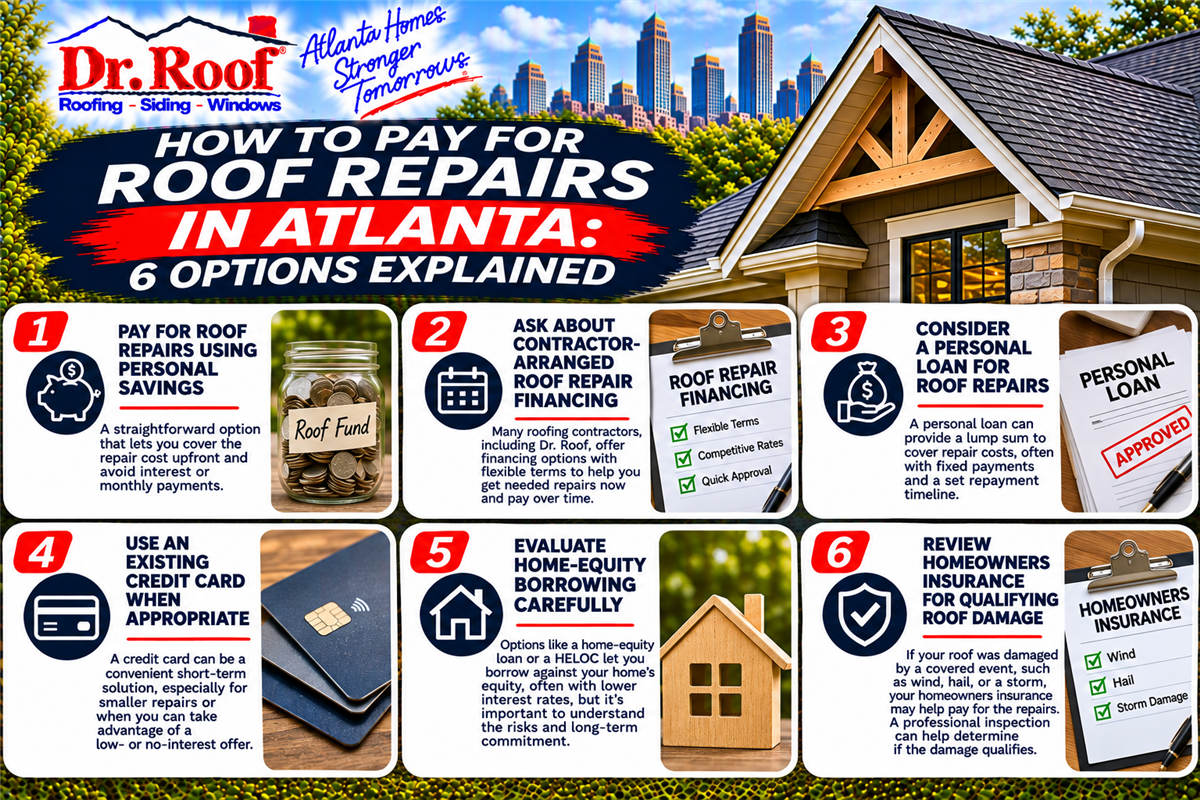
Atlanta homeowners can pay for roof repairs using personal savings, contractor-arranged financing, personal loans, existing credit cards, home-equity borrowing, or applicable homeowners insurance benefits for covered damage. Each option has different costs, eligibility requirements, and financial considerations.
The best choice depends on the repair estimate, household budget, available credit, and cause of the roofing damage.
Here are six options worth understanding before approving a roof repair project.
1. Pay for Roof Repairs Using Personal Savings
Using available savings is one way to pay for roof repairs without taking on new debt.
For homeowners who have set aside money for property maintenance, this may be a straightforward option.
What Are the Benefits of Paying Directly?
Paying with existing funds can help homeowners avoid:
Loan interest
Financing fees
New monthly debt payments
Credit application requirements
Long-term repayment obligations
However, paying directly is not automatically the best choice for every household.
Should You Use Your Emergency Savings?
That depends on your financial situation.
Using nearly all available savings for a roofing project may leave limited funds for other unexpected expenses.
Before deciding, consider the repair's urgency, the total proposed price, and how much money would remain available afterward.
Can a Small Roof Repair Be More Affordable Than Replacement?
Often, yes.
Localized repairs generally involve less work than replacing an entire roofing system.
For example, replacing a deteriorated plumbing vent boot may require a much smaller project than complete roof replacement.
However, the most appropriate solution depends on the roof's condition.
A professional inspection can determine whether targeted repairs are practical.
2. Ask About Contractor-Arranged Roof Repair Financing
Some roofing contractors work with financing providers to offer qualifying homeowners payment options.
These arrangements may allow a homeowner to complete an approved roof repair and repay the financed amount over time.
Does Dr. Roof Offer Financing for Roof Repairs?
Yes.
Dr. Roof's published financing information identifies the Wells Fargo Home Projects credit card as a financing option available for qualifying roofing projects, including roof repairs.
Financing is subject to credit approval and the applicable lender's terms.
Homeowners should contact Dr. Roof to verify current program availability and which repair projects qualify.
How Does Contractor-Arranged Financing Work?
The specific process depends on the financing provider.
Generally, it may involve:
Obtaining a professional roof repair estimate.
Reviewing available financing programs.
Applying for credit.
Receiving an approval or denial from the lender.
Reviewing the applicable financing agreement.
Using approved financing for eligible work.
The contractor should explain how the financing process relates to the repair contract.
Does Financing Mean the Repair Costs Less?
No.
Financing changes how a project is paid for, not necessarily the underlying cost of the work.
Interest charges, fees, repayment terms, and promotional conditions may affect the total amount ultimately paid.
A homeowner should review the complete financial agreement before accepting any offer.
What Should You Ask About Financing?
Important questions include:
Is credit approval required?
What annual percentage rate applies?
Are there account or financing fees?
Is the interest rate fixed or variable?
What is the repayment period?
What happens if a payment is late?
Are there promotional conditions?
Can the balance be paid early without a penalty?
Ask the lender or financing provider for the applicable written terms.
3. Consider a Personal Loan for Roof Repairs
A personal loan is another potential financing method.
Unlike financing arranged through a roofing contractor, a personal loan may be obtained independently through a bank, credit union, or other lender.
How Can a Personal Loan Be Used for Roof Repairs?
Depending on the lender and loan agreement, approved funds may be used to pay for home repairs.
For example, a homeowner could obtain an approved loan and use the proceeds to pay for replacing damaged shingles or repairing roof flashing.
What Should You Compare?
When reviewing personal loan offers, consider:
Annual percentage rate
Loan amount
Repayment period
Monthly payment
Origination or other fees
Total repayment cost
Early repayment terms
The lowest monthly payment does not automatically mean the least expensive loan.
A longer repayment period may increase the total interest paid, depending on the terms.
Should You Compare Independent Financing With Contractor Financing?
Yes.
The Consumer Financial Protection Bureau recommends researching borrowing options independently rather than relying exclusively on financing recommended by a contractor.
Comparing written offers can help homeowners understand their available choices.
No lender can guarantee approval, and offered terms depend on the applicant and lender.
4. Use an Existing Credit Card When Appropriate
Some homeowners consider using an existing credit card for a localized roof repair.
This may be practical for certain smaller projects when the homeowner understands the account's terms and can manage repayment.
However, credit cards can carry significant borrowing costs.
What Should You Check Before Paying for Roof Repairs With a Card?
Review:
Available credit
Purchase APR
Applicable fees
Expected repayment period
Monthly payment obligations
Promotional terms, if any
Consider the total repayment cost rather than focusing only on whether the available credit covers the repair.
Are Promotional Credit Card Offers Always Interest-Free?
No.
Different promotional offers operate differently.
Some have a temporary introductory APR.
Others use deferred interest, meaning interest may be assessed from the original purchase date if the balance is not paid according to the promotional terms.
The Consumer Financial Protection Bureau recommends reading these agreements carefully and understanding the amount necessary to pay the balance before the promotional deadline.
Is Paying Only the Minimum Payment Enough?
Not necessarily.
A minimum payment may keep an account current while allowing interest to accumulate or leaving a promotional balance unpaid at the end of the offer.
Review the actual repayment schedule.
Homeowners should avoid assuming a low advertised monthly payment represents the total cost of financing a roof repair.
5. Evaluate Home-Equity Borrowing Carefully
Some homeowners consider using a home-equity loan or home-equity line of credit to pay for home repairs.
These products use available equity in the property as collateral.
They can involve different repayment structures from unsecured personal loans.
What Is a Home-Equity Loan?
A home-equity loan generally provides a lump sum borrowed against the home's available equity.
The borrower repays the amount under the lender's agreement.
What Is a Home-Equity Line of Credit?
A home-equity line of credit, commonly called a HELOC, generally allows borrowing against available home equity up to an approved credit limit.
The terms may include variable interest rates or other conditions.
What Is the Biggest Risk?
Home-equity borrowing places the property at risk if the loan is not repaid.
The Consumer Financial Protection Bureau warns that borrowers who cannot meet their obligations may face foreclosure.
These products may also involve closing costs, fees, and other requirements.
Is Home-Equity Borrowing Appropriate for a Small Roof Repair?
Not necessarily.
For a relatively limited repair, the costs and risks of secured borrowing may outweigh its potential benefits.
Homeowners should compare alternatives and consult a qualified financial professional when appropriate.
The decision should reflect the repair's actual cost and the household's broader financial situation.
6. Review Homeowners Insurance for Qualifying Roof Damage
Homeowners insurance is not a financing product, but it may provide a source of payment when roofing damage qualifies under the policy.
This distinction is important.
Insurance coverage depends on the cause of the damage and the policy's terms.
What Types of Roof Damage May Be Covered?
Certain policies may cover qualifying sudden losses involving events such as wind or hail.
For example, shingles damaged during a covered storm may qualify for payment under the applicable policy.
However, coverage is not automatic.
What About Aging Shingles or Normal Deterioration?
Ordinary deterioration and maintenance-related conditions may be treated differently from covered sudden damage.
A roof that needs repair solely because materials have worn out may not qualify for the same treatment as a covered storm-related loss.
Homeowners should review their policy and contact their insurance provider.
Can Dr. Roof Help With Storm-Damage Documentation?
Dr. Roof provides professional roofing evaluations and storm-damage documentation support.
Depending on the circumstances, the company may provide photographs, written findings, and repair or replacement recommendations.
However, the insurance company determines coverage, deductibles, and claim payment.
No roofing contractor can guarantee insurance approval.
What Factors Affect the Cost of Roof Repairs in Atlanta?
Before choosing how to pay, homeowners should understand what determines the repair price.
Several factors can influence the scope.
Type of Roofing Damage
Replacing several damaged shingles involves different work from rebuilding chimney flashing or repairing deteriorated decking.
Roof Accessibility
A steep or multi-story roof may require different equipment and labor arrangements from an easily accessible roof section.
Material Requirements
Replacement materials must be suitable for the existing roofing system.
The selected products and availability can affect the estimate.
Hidden Damage
Some problems beneath the roof covering may only become visible during repair work.
For example, unsuitable roof decking may require corrective work before new roofing materials are installed.
Labor and Cleanup
The proposed price may also include removing damaged materials, installing replacements, and completing cleanup.
A professional written estimate is necessary to determine the appropriate project cost.
Should You Finance Roof Repairs or Wait Until You Have Enough Savings?
The decision depends on the roofing problem and your financial circumstances.
Some issues may be suitable for a planned repair appointment.
Others involve active water intrusion or exposed roofing materials that deserve prompt attention.
What if the Roof Is Actively Leaking?
If water is entering your home, contact a qualified roofing professional.
Temporary protective measures may be appropriate while you evaluate permanent repair and payment options.
Avoid climbing onto a damaged or wet roof yourself.
Can Delaying Repairs Increase the Amount of Work?
Sometimes.
A compromised roofing component may allow additional water exposure.
For example, continued leakage around a damaged pipe boot can affect nearby roofing materials.
However, the extent of damage depends on the actual condition.
An inspection can help determine whether the problem requires prompt corrective work.
Does Financing Make Every Repair Worthwhile?
No.
Financing should not replace an assessment of whether the proposed work is technically appropriate.
If the roofing system has widespread deterioration, repeatedly financing localized patches may not provide a suitable solution.
The contractor should explain whether repair or replacement is appropriate based on the roof's condition.
How Do You Compare Roof Repair Financing Options?
Before selecting a payment method, compare the complete financial picture.
| Payment Option | Key Consideration |
|---|---|
| Personal savings | Avoids borrowing but reduces available cash |
| Contractor-arranged financing | Check credit requirements, fees, APR, and repayment terms |
| Personal loan | Compare independent lender offers and total borrowing cost |
| Existing credit card | Review interest and promotional conditions |
| Home-equity borrowing | Consider fees and the risk to the property |
| Homeowners insurance | Available only for qualifying covered losses |
The most suitable option depends on your individual circumstances.
No single method is best for every homeowner.
What Should You Ask Before Signing a Roof Repair Contract?
Regardless of how the work will be paid for, the repair agreement should clearly explain the proposed project.
Ask:
What roofing damage was identified?
What permanent repair is recommended?
Are the materials and labor specified?
Is the full proposed price in writing?
How will hidden damage be handled?
What payment schedule applies?
Are financing terms separate from the repair agreement?
What warranty coverage is provided?
The Federal Trade Commission recommends reviewing contractor qualifications and written agreements carefully.
Homeowners should be cautious about high-pressure sales tactics or requests for payment before the work and terms are properly explained.
How Dr. Roof Helps Atlanta Homeowners Explore Roof Repair Options
Dr. Roof has served Atlanta-area homeowners since 1988, providing roofing inspections, repairs, replacement, and storm-damage documentation support.
As a GAF Master Elite Certified Contractor and CertainTeed SELECT ShingleMaster, Dr. Roof works with residential roofing systems that may require shingle repairs, flashing corrections, or other appropriate work.
The company offers complimentary roofing inspections and provides information about available financing options for qualifying projects.
Dr. Roof's published financing information identifies the Wells Fargo Home Projects credit card as a possible payment option, subject to approved credit and current lender terms.
Homeowners can request a written roof repair estimate and discuss available payment arrangements before authorizing work.
Make an Informed Decision About Paying for Roof Repairs
Unexpected roof repairs can create financial pressure, but homeowners have several potential ways to manage the cost.
Personal savings, credit products, qualifying contractor-arranged financing, and applicable insurance benefits each involve different considerations.
The most important starting point is identifying the actual roofing problem and obtaining a clear written estimate.
From there, compare the available payment methods based on total cost, repayment obligations, and household needs.
If your roof is leaking or damaged in Atlanta, Marietta, Roswell, Alpharetta, Smyrna, or surrounding communities, contact Dr. Roof to request a professional roofing evaluation and discuss your repair and payment options.
Can roof repairs be financed in Atlanta?
Yes. Some roofing companies offer financing through third-party lenders, subject to credit approval and applicable terms. Homeowners can also explore personal loans, existing credit cards, or other appropriate payment methods.
Does Dr. Roof offer financing for roof repairs?
Yes. Dr. Roof's official financing information identifies the Wells Fargo Home Projects credit card as a potential payment option for qualifying roof repairs. Credit approval and lender terms apply. Homeowners should confirm current program availability directly.
Is financing a roof repair more expensive than paying cash?
It can be. Financing may involve interest charges, fees, or other borrowing costs. The total expense depends on the credit agreement and repayment schedule. Paying with existing funds avoids new borrowing but reduces available savings.
Can homeowners insurance help pay for roof repairs?
Some policies provide coverage for qualifying sudden damage, including certain storm-related losses. Coverage depends on the policy, deductibles, exclusions, and individual claim. Ordinary wear or deterioration may not be covered.
What should I compare before accepting roof repair financing?
Compare the APR, fees, repayment period, monthly payments, total borrowing cost, promotional conditions, and consequences of late payments. Review the lender's written agreement before committing.
Should I delay a leaking roof repair until I can afford it?
Active roof leaks deserve professional evaluation because continued water intrusion may affect additional materials. If permanent repair cannot begin immediately, ask whether professional temporary protection is appropriate while reviewing payment options.
Subscribe to Dr. Roof's Blog



Comments