A newly replaced roof is an important investment in your home's protection.
After choosing roofing materials, preparing your property, and completing installation, you should feel confident that the new roofing system has been installed appropriately.
However, homeowners sometimes notice changes or concerns after the roofing crew leaves.
You might see shingles that have not fully sealed, small granules collecting around the property, differences in shingle appearance, or debris remaining near the work area.
Some of these observations can be normal characteristics of newly installed asphalt roofing materials. Others may indicate problems requiring professional attention.
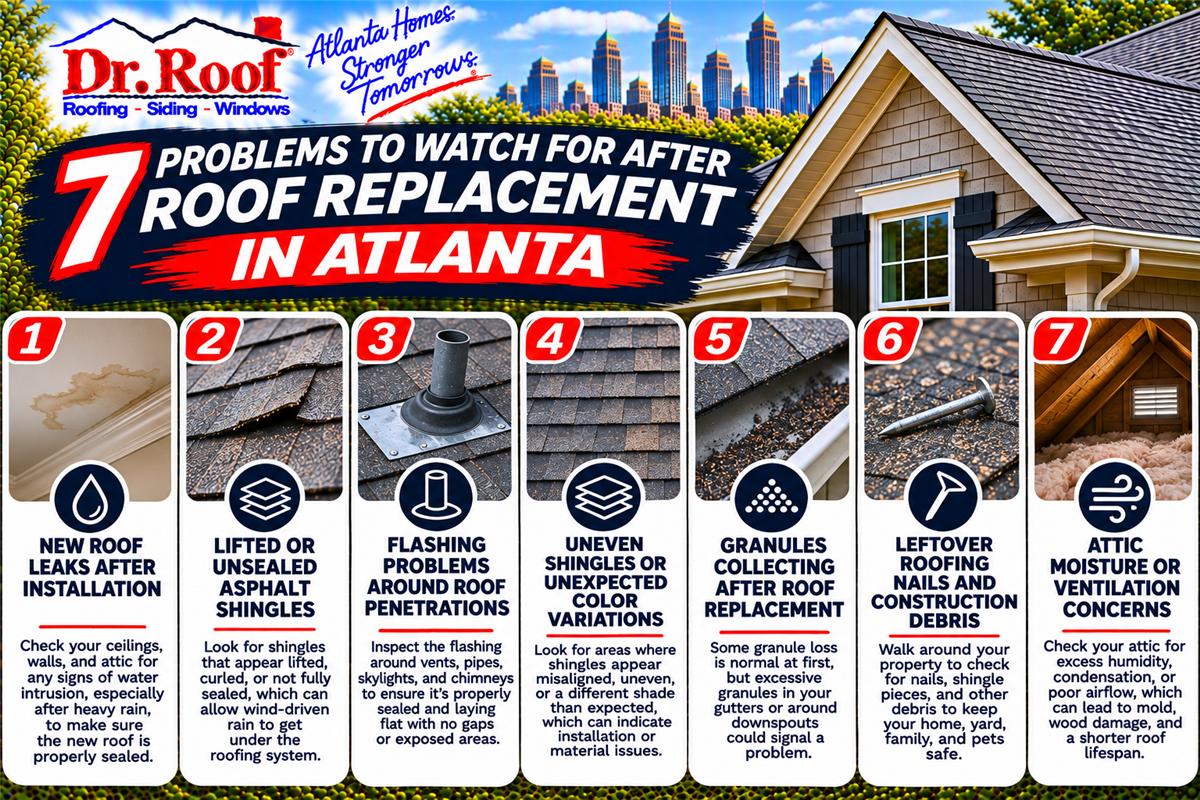
Common concerns after roof replacement include new leaks, lifted or unsealed shingles, damaged flashing, unusual shingle appearance, excessive granule loss, leftover construction debris, and attic moisture problems. Not every observation indicates defective installation, but new water intrusion, displaced roofing materials, or persistent irregularities deserve professional evaluation.
For Atlanta homeowners, understanding the difference between expected changes and potential problems can help protect the new roofing system.
Here are seven conditions to watch for after a residential roof replacement.
1. New Roof Leaks After Installation
Water entering a home after roof replacement deserves prompt attention.
A new roof should be installed to shed water appropriately, with flashing and other roofing components integrated according to the selected system's requirements.
If a leak develops, the cause should be investigated.
Why Would a Newly Replaced Roof Leak?
Potential roofing-related causes include:
Damaged or improperly installed flashing
Problems around roof penetrations
Incorrectly integrated roofing materials
Defective valley details
Physical damage after installation
Other water-entry pathways
However, a new ceiling stain does not automatically establish that the roofing contractor made an installation error.
Moisture may also originate from plumbing, condensation, or another building condition.
What Should You Do if Your New Roof Leaks?
Document the visible problem from a safe location.
Note when the leak occurred, which rooms were affected, and whether heavy rain or wind accompanied the event.
Contact the roofing contractor and request an evaluation.
Is a New Roof Leak Normal?
An active roof leak should not be dismissed as a normal adjustment to a new roofing system.
The cause needs to be identified.
Depending on the findings, the appropriate solution may involve correcting a roofing component, addressing subsequent damage, or investigating a non-roofing moisture source.
2. Lifted or Unsealed Asphalt Shingles
Some homeowners notice shingles that appear slightly raised after installation.
Asphalt shingles commonly include factory-applied sealant that helps bond overlapping courses together.
The adhesive generally requires suitable warmth and sunlight to activate.
Do New Shingles Seal Immediately?
Not always.
GAF explains that the sealant on many asphalt shingles is thermally activated.
Cool weather, shade, roof orientation, and other conditions can affect how quickly shingles seal.
This is particularly relevant when roofing work occurs during cooler periods.
Does an Unsealed Shingle Mean It Was Installed Incorrectly?
Not necessarily.
Delayed sealant activation does not automatically establish a manufacturing or installation defect.
However, shingles should still be installed according to the manufacturer's requirements.
Certain situations may require professional hand-sealing or another specified installation procedure.
When Should You Contact the Contractor?
Request an evaluation if you notice:
Shingles visibly lifting
Torn or creased materials
Displaced shingles
Wind damage before the shingles have sealed
Persistent irregularities that appear concerning
Do not climb onto the roof or attempt to glue shingles down yourself.
The contractor should determine whether the condition requires correction.
3. Flashing Problems Around Roof Penetrations
A roof replacement involves more than installing new shingles.
Flashing helps manage water around areas where the roof meets other building components.
These transitions deserve attention after installation.
Which Areas Are Important?
Depending on the roof design, flashing may be installed around:
Chimneys
Plumbing vent pipes
Roof-to-wall intersections
Dormers
Roof valleys
Other roofing penetrations
The flashing components must work with the surrounding roofing materials to direct water appropriately.
Can New Shingles Be Installed While Flashing Problems Remain?
A new roof covering does not automatically correct every existing flashing defect.
The contractor should determine which flashing assemblies require replacement or correction as part of the project.
For example, deteriorated chimney flashing may need more than a surface-level application of sealant.
What Are Signs of a Potential Flashing Problem?
Possible observations include:
Loose or visibly displaced metal
Openings at roofing transitions
New water stains near roof penetrations
Damaged surrounding shingles
Other visible defects
These symptoms do not establish the exact cause, but they justify professional evaluation.
Should All Flashing Be Replaced During Roof Replacement?
Not necessarily.
The appropriate scope depends on the existing materials, roofing design, and applicable installation requirements.
Homeowners should review the approved proposal to understand which flashing work was included.
4. Uneven Shingles or Unexpected Color Variations
After a roof replacement, homeowners may notice that certain shingles appear different from nearby sections.
Some differences are cosmetic.
Others can be related to installation or underlying roof conditions.
Is Some Color Variation Normal?
Yes, depending on the roofing product.
The Asphalt Roofing Manufacturers Association explains that newly installed shingles can display color shading because of manufacturing materials, viewing angles, lighting, and temporary surface conditions.
Some appearance variations may become less noticeable with natural weathering.
What Causes Shingle Color Differences?
Potential reasons include:
Different granule blends
Lighting conditions
Roof orientation
Temporary surface residue
Manufacturing-related appearance differences
Installation patterns
However, not every unusual pattern should be assumed to be cosmetic.
A contractor should evaluate persistent concerns.
What About Wavy or Buckled Shingles?
Visible buckling may involve different causes, including:
Uneven decking
Moisture-related movement
Wrinkled underlayment
Improperly seated fasteners
Distorted shingles
Other installation or structural conditions
ARMA identifies several possible causes of asphalt-shingle buckling.
Homeowners should not assume significant buckling will always disappear naturally.
When Should You Request an Inspection?
Contact the contractor if shingles appear persistently buckled, sharply raised, displaced, or unusually distorted.
Photographs taken from the ground can help explain the concern.
The contractor should determine whether the condition is cosmetic, temporary, or requires corrective work.
5. Granules Collecting After Roof Replacement
Asphalt shingles contain mineral granules embedded in their surface.
These granules help protect the asphalt coating from environmental exposure.
After installation, homeowners may notice loose granules collecting near the home.
Is Granule Loss Normal on a New Roof?
Some loose granules can be expected.
GAF explains that additional granules may be present from the manufacturing process.
These excess particles can separate during transportation, installation, and early weather exposure.
Limited initial shedding does not automatically indicate a defective roofing product.
When Is Granule Loss a Concern?
More significant or persistent granule loss may deserve evaluation.
Potential warning signs include:
Large areas of exposed asphalt
Noticeable roof color changes associated with missing granules
Significant granule shedding that continues
Other evidence of shingle damage
The contractor or manufacturer may need to determine whether the condition is within expected product behavior.
Should You Wash the Roof to Remove Loose Granules?
Homeowners should not attempt aggressive roof washing or walk on the roofing materials.
The roof surface should be handled according to manufacturer guidance.
If the appearance raises concerns, ask the contractor whether further evaluation is appropriate.
6. Leftover Roofing Nails and Construction Debris
Roof replacement involves removing existing materials and installing new components.
During this process, roofing nails, shingle pieces, packaging, and other debris may accumulate around the property.
Cleanup should be addressed in the approved project scope.
What Should Happen After Roof Installation?
Depending on the agreement, cleanup may involve:
Removing old roofing materials
Collecting construction debris
Checking work areas for loose fasteners
Removing equipment
Clearing designated access areas
The contractor should explain the cleanup responsibilities associated with the project.
What if You Find Nails in Your Yard?
Contact the roofing contractor and explain the concern.
Additional cleanup may be appropriate.
Avoid walking barefoot in areas where construction debris may remain.
Keep children and pets away from suspected debris.
Does Finding One Nail Mean the Roof Was Installed Incorrectly?
No.
A loose nail found on the ground does not automatically indicate a problem with the roofing materials installed above.
However, leftover fasteners are a property safety concern that should be addressed.
Should You Inspect the Roof Yourself for Missing Nails?
No.
Homeowners should not climb onto the new roofing system to investigate.
If you suspect fastening problems, ask the roofing contractor to perform an appropriate inspection.
7. Attic Moisture or Ventilation Concerns
Roof replacement can also involve components associated with attic ventilation.
Depending on the home, the project may include installing or modifying ridge vents or other roof ventilation products.
However, ventilation requirements depend on the existing attic design.
Can Ventilation Changes Affect Attic Conditions?
Yes.
In a traditionally vented attic, intake and exhaust ventilation should be designed to work together.
An inappropriate arrangement may affect airflow or moisture management.
However, not every attic is intended to be ventilated with outdoor air.
Some homes use conditioned or unvented roof assemblies.
What Signs May Require Further Evaluation?
Potential concerns include:
Persistent attic condensation
Damp roof decking
Unusual moisture accumulation
Visible ventilation obstructions
New moisture staining
Other changes after roofing work
These observations do not automatically prove the roof replacement caused the problem.
Can Attic Moisture Come From Another Source?
Yes.
Interior air leakage, plumbing problems, or other building conditions can contribute to attic moisture.
An investigation should determine the source before recommending changes.
Should More Roof Vents Automatically Be Added?
No.
Adding ventilation without evaluating the complete attic design can create an unsuitable arrangement.
The contractor should explain whether the existing system meets the requirements for the home and roofing materials.
Which Post-Replacement Changes May Be Normal?
Some observations can be consistent with the early period after installing asphalt shingles.
For example:
Limited shedding of excess manufacturing granules
Certain cosmetic color variations
Delayed activation of thermal shingle sealant under cool conditions
However, these observations should not be used to dismiss clear damage or persistent roofing concerns.
Homeowners should ask the contractor to explain anything that appears unusual.
Which Problems Should Be Reported Promptly?
Some conditions justify contacting the roofing contractor without unnecessary delay.
These include:
Active water intrusion
Visibly missing shingles
Displaced or torn roofing materials
Significant buckling
Loose flashing
Suspected structural concerns
Persistent moisture problems
Homeowners should not attempt elevated inspections or repairs themselves.
If structural instability or electrical hazards are suspected, avoid the affected area and seek appropriate assistance.
What Should You Do if You Notice a Problem After Roof Replacement?
A practical approach begins with documenting the concern and contacting the original roofing contractor.
Step 1: Record the Problem
Photograph visible conditions from safe locations.
Note when the issue first appeared and whether it followed a particular weather event.
Step 2: Review the Roofing Contract
Check which materials and installation details were included.
Review any applicable workmanship or manufacturer warranty documents.
Step 3: Contact the Contractor
Explain the concern and request an appropriate evaluation.
Provide photographs when useful.
Step 4: Understand the Findings
Ask whether the issue involves an installation condition, product characteristic, subsequent damage, or another cause.
Step 5: Review the Proposed Resolution
If corrective work is necessary, request an explanation of what will be done and which warranty or contract terms may apply.
A post-installation concern does not automatically mean that every component of the roofing system needs replacement.
Does a New Roof Warranty Cover Problems After Installation?
Coverage depends on the written warranty.
Some warranties address qualifying manufacturing defects.
Separate workmanship coverage or certain enhanced manufacturer warranties may address specified installation-related problems.
However, not every condition qualifies.
Storm damage, unrelated building problems, and other excluded causes may be treated differently.
Homeowners should review the applicable documents before assuming that a particular problem is covered.
A contractor or manufacturer may need to evaluate the condition to determine the appropriate remedy.
How Soon Should a New Roof Be Inspected Again?
A completed roofing project should include an appropriate final review.
Afterward, homeowners can perform safe ground-level observations and report developing concerns.
Further professional inspections may be appropriate after significant weather events or when damage is suspected.
The appropriate schedule depends on the roofing material, property conditions, and manufacturer guidance.
An inspection does not guarantee that future roofing problems will never occur.
However, it can help identify conditions that deserve attention.
How Atlanta Weather Can Reveal Post-Installation Problems
Atlanta-area homes experience heavy rainfall, strong winds, summer heat, and occasional hail.
These conditions can expose weaknesses in roofing systems.
For example, wind-driven rain may reveal a flashing defect, while strong winds can affect shingles that have not bonded appropriately.
However, the occurrence of a storm does not automatically establish that the roofing installation was defective.
A professional assessment should distinguish original installation concerns from subsequent weather damage.
How Dr. Roof Helps Atlanta Homeowners After Roof Replacement
Dr. Roof has served Atlanta-area homeowners since 1988, providing professional roofing inspections, repairs, and complete roof replacement services.
Dr. Roof is a GAF Master Elite Certified Contractor and CertainTeed SELECT ShingleMaster.
Homeowners who have questions about a completed roofing project can contact the company to discuss their concerns and applicable project documentation.
Depending on the circumstances, a professional evaluation may address:
Asphalt shingle condition
Flashing
Roof penetrations
Ridge materials
Visible water intrusion
Other roofing components
The appropriate findings and next steps depend on the actual roofing system and the concern reported.
Homeowners should retain the roofing contract, material information, warranty documents, and any correspondence about completed work.
Protect Your New Roof by Addressing Concerns Early
After roof replacement, not every unfamiliar appearance or material change indicates a problem.
Some newly installed shingles may experience normal cosmetic variations, initial excess granule shedding, or delayed sealant activation under certain weather conditions.
However, active leaks, displaced materials, significant buckling, and other persistent concerns deserve professional attention.
For Atlanta homeowners, the best approach is understanding what may be expected, documenting unusual conditions, and contacting the roofing contractor when an evaluation is necessary.
If you have questions about a recently replaced roof or are considering a new roofing system for your home, contact Dr. Roof to discuss a professional roofing consultation and the options appropriate for your property.
Is it normal for a new roof to leak after installation?
No. Active water intrusion after roof replacement should be investigated. Possible causes include flashing problems, roofing defects, subsequent damage, or unrelated moisture sources. The actual cause requires professional evaluation.
Why do some new asphalt shingles appear lifted or unsealed?
Many asphalt shingles contain thermally activated sealant that requires suitable warmth and sunlight to bond. Cool weather or limited sun exposure can delay sealing. However, visibly lifted, damaged, or displaced shingles should be evaluated by the contractor.
Is granule loss normal after installing a new asphalt-shingle roof?
Some initial shedding of excess manufacturing granules can be normal. However, significant or persistent granule loss, exposed asphalt, or visible shingle damage may require professional or manufacturer evaluation.
Should I be concerned about uneven or buckled shingles after replacement?
Persistent buckling or significant unevenness deserves evaluation. Possible causes include uneven decking, wrinkled underlayment, improperly seated fasteners, or distorted materials. Not every condition will resolve through normal weathering.
Can a new roof cause attic condensation problems?
Changes to a roofing or ventilation system can affect attic conditions, but condensation may also result from indoor air leakage or other building factors. A professional should identify the moisture source before recommending corrections.
What should I do if I find a problem after my roof replacement?
Document the issue from a safe location, review the roofing contract and warranty information, and contact the original contractor. Ask for an evaluation and a written explanation of any recommended corrective work.
Subscribe to Dr. Roof's Blog







Comments