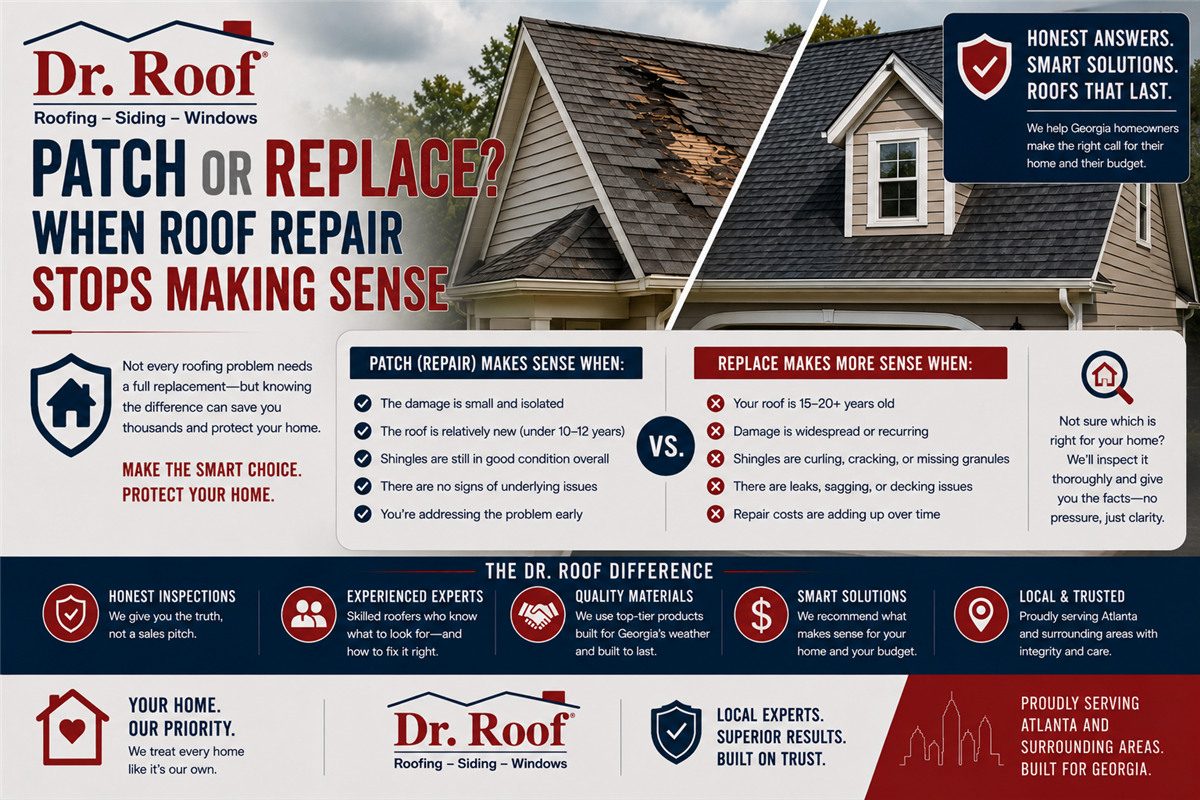
This guide helps Atlanta homeowners understand when ongoing roof repair may no longer be the most practical solution. It challenges the common belief that repeated patching is always the most cost-effective way to protect a roof.
For homeowners dealing with aging asphalt shingles, recurring leaks, storm damage, or widespread roof wear, this article explains when a full roof replacement may offer stronger long-term value. Working with an experienced Georgia roofing company like Dr. Roof can help homeowners make informed decisions about repair, replacement, and long-term home protection.
Challenging the Myth of Perpetual Roof Repair
Many homeowners in the Atlanta metropolitan area believe roof repair is always the most affordable and sensible first step.
In many cases, repair is the right choice.
A missing shingle, a cracked pipe boot, damaged flashing, or a small isolated leak may be addressed with targeted roof repair when the rest of the roofing system is still in good condition.
However, roof repair is not always the best long-term answer.
When a roof is aging, leaking repeatedly, or showing widespread asphalt shingle deterioration, constant patching can become frustrating and expensive. At that point, homeowners may be spending money on temporary fixes without solving the larger problem.
Knowing when to move from repair to replacement is an important part of protecting your home.
The Costly Truth: When Repairs Become a False Economy
The idea that “repair is always cheaper” can be misleading.
A single repair may cost less than a roof replacement, but repeated roof repair over several years can add up quickly. If each repair only addresses the latest visible problem, the roof may continue to fail in other areas.
This is especially common with older asphalt shingles.
As shingles age, they may lose granules, become brittle, curl, crack, or lift. Once deterioration becomes widespread, repairing one section may not prevent the next leak from appearing somewhere else.
Dr. Roof has served Atlanta-area homeowners since 1988, and our team has seen many homeowners get stuck in a cycle of recurring repairs.
The goal is not to replace a roof too soon. The goal is to understand when repair still makes sense and when replacement may provide better long-term protection.
A professional inspection from a trusted Georgia roofing company can help homeowners compare both options clearly.
Beyond Patching: Recognizing Systemic Roof Failure
Not every roof problem is isolated.
Sometimes a leak is only a symptom of a larger roofing system concern. A homeowner may notice a ceiling stain, missing shingle, or drip near a vent, but the underlying issue may involve widespread asphalt shingle wear, damaged underlayment, poor ventilation, soft decking, or repeated storm damage.
A roof is a full system. Asphalt shingles, flashing, underlayment, decking, ventilation, gutters, pipe boots, ridge caps, and roof penetrations all work together to protect the home.
If several parts of that system are failing at the same time, a small patch may not provide lasting protection.
Signs of systemic roof failure may include:
Recurring leaks in different areas
Widespread granule loss
Curling or brittle asphalt shingles
Missing shingles across multiple slopes
Repeated storm damage
Soft or damaged decking
Sagging roof areas
Poor attic ventilation
Moisture in the attic
Stains on ceilings or walls
Multiple previous patch repairs
Flashing failures in several locations
When these issues appear together, roof replacement may be the more reliable solution.
Key Indicators: Shifting from Repair to Replacement
The decision to move beyond roof repair depends on the condition of the entire roofing system.
One of the first factors to consider is age. Asphalt shingle roofs can last for many years, but every roof has a service life. If the roof is approaching the end of that life and repairs are becoming more frequent, replacement may offer better value than continued patching.
Another important factor is the spread of the damage.
If damage is localized to one area, repair may still be appropriate. But if multiple slopes show granule loss, curling shingles, exposed nails, missing shingles, or weather-related wear, the problem may be too widespread for a simple fix.
The condition of the roof decking also matters.
If there are soft spots, sagging areas, rot, or long-term water damage beneath the shingles, the roof may need more than surface-level repair.
Homeowners should also consider repair frequency. If the roof needs attention after every storm or every season, the cost and stress of ongoing repairs can become a sign that the roof is no longer performing reliably.
Key indicators that roof repair may no longer be viable include:
The roof is near the end of its expected service life
Leaks keep returning
Repairs are needed in multiple areas
Asphalt shingles are brittle, curling, or losing granules
Storm damage is widespread
Roof decking is soft or damaged
Attic moisture is present
Flashing is failing in several locations
Previous patch repairs are no longer holding
Repair costs are approaching the cost of replacement
The roof no longer provides consistent protection
A professional roof inspection can help determine whether the issue is repairable or whether replacement is the smarter long-term option.
Real-World Solution: A Marietta Homeowner's Smart Choice
Consider a homeowner in Marietta who has dealt with repeated roof repair needs over several years.
At first, each repair may seem manageable. One season, a leak appears near a vent. Later, another issue develops near a chimney. After a storm, missing asphalt shingles need to be replaced. Over time, the roof becomes a collection of temporary fixes.
During a comprehensive inspection, a roofing contractor may find that the problems are not isolated.
There may be widespread granule loss on sun-exposed slopes, brittle shingles, deteriorated flashing, soft decking, and evidence of previous patchwork.
In a situation like this, another targeted repair may stop one leak temporarily, but it may not address the roof’s overall condition.
A full roof replacement may provide a more dependable long-term solution by allowing the roofing system to be rebuilt with proper asphalt shingles, underlayment, flashing, ventilation, and installation practices.
The benefit is clarity.
Instead of continuing to pay for repeated roof repair, the homeowner can make an informed decision based on the full condition of the roof.
Dr. Roof's Expert Process for Informed Decisions
Understanding when to choose roof repair and when to consider roof replacement can feel overwhelming.
Dr. Roof helps simplify that decision with a clear inspection and recommendation process.
Comprehensive Roof Inspection: Dr. Roof evaluates the full roofing system, including asphalt shingles, flashing, underlayment, roof decking, pipe boots, vents, valleys, gutters, ventilation, attic moisture, and signs of storm damage.
Detailed Damage Assessment: Our team explains whether the damage appears localized or widespread. When concerns are found, photos and written findings can help homeowners better understand the roof’s condition.
Repair vs. Replacement Review: If repair is possible, Dr. Roof explains the recommended scope. If replacement may be the better long-term solution, our team explains why and outlines the factors affecting that recommendation.
Clear Cost and Value Discussion: Homeowners receive guidance on the potential benefits, limitations, and long-term value of each option. The goal is to help homeowners avoid spending money on repairs that may not last.
Warranty Guidance and Next Steps: Dr. Roof helps homeowners understand available warranty options based on the project scope, roofing system, and materials selected.
If storm damage is involved, Dr. Roof can also provide photos, written findings, and repair or replacement recommendations to help support the insurance claim process. Every policy and claim is different, and coverage decisions are made by the insurance company, but clear documentation can help homeowners communicate more effectively.
Long-Term Value: The Principles of Smart Roofing Investment
A smart roofing decision is not based only on the lowest immediate cost.
It is based on the condition of the roof, the likelihood of future problems, and the long-term protection of the home.
Roof repair may be the right choice when the damage is isolated, the asphalt shingles are still in good condition, and the rest of the roof is performing properly.
Roof replacement may be the better investment when the roof is aging, damage is widespread, leaks are recurring, or repairs are becoming more frequent.
The most important principle is to look at the full roofing system.
A trusted Georgia roofing company should explain what is happening, why it matters, and what options make sense for the home.
Dr. Roof’s goal is to provide honest recommendations, quality workmanship, and clear communication so homeowners can make confident decisions.
Proactive Protection: Securing Your Home for Decades
When a roof begins showing signs of consistent wear, homeowners should not rely on guesswork.
A deeper inspection can reveal whether the roof needs a targeted repair or whether replacement may be the stronger long-term solution.
Proactive roof care can help protect:
Asphalt shingles
Roof decking
Attic insulation
Ceilings and walls
Gutters and drainage
Fascia and soffits
Home value
Interior comfort
Long-term peace of mind
Dr. Roof has served Atlanta-area homeowners since 1988, providing roof repair, roof replacement, inspections, storm damage documentation support, and exterior home services.
As a GAF Master Elite Certified Contractor and experienced Georgia roofing company, Dr. Roof understands how Georgia weather affects asphalt shingles and complete roofing systems.
Our Make-It-Right mindset reflects our commitment to quality workmanship, clear communication, and helping homeowners choose the right solution for their home.
Making the Right Choice for Your Home's Future
Roof repair is often a smart solution, but it is not always the final answer.
When leaks keep returning, asphalt shingles are worn across multiple areas, storm damage is widespread, or the roof is nearing the end of its service life, continued patching may no longer make sense.
A full roof replacement can offer stronger long-term protection, better system performance, and greater peace of mind.
If you are unsure whether your roof needs repair or replacement, contact Dr. Roof to schedule a professional inspection. Our team can evaluate your roof, explain the findings, and help you choose the best next step for protecting your home.
Frequently Asked Questions
When does continuous roof repair actually become more expensive than replacement?
Continuous roof repair becomes more costly when cumulative expenses of multiple patches rival a new roof's upfront investment. This often happens when a roof nears its lifespan or has widespread, recurring issues.
A full replacement offers a single, long-term solution with comprehensive warranties. This often prevents future unexpected costs.
What are the most common hidden signs that suggest roof repair is insufficient?
Beyond obvious leaks, hidden signs include extensive granule loss, widespread curling or missing shingles, and dry rot in the roof decking. These indicators point to a compromised system.
Professional inspections can uncover these subtle yet critical issues. This guides homeowners towards the best course of action.
Can an aging roof truly be effectively repaired, or is it a false economy?
While minor repairs extend a new roof's life, constantly repairing an aging roof (over 20-25 years) often proves to be a false economy. Patching an old roof temporarily stops leaks but doesn't address systemic wear.
Eventually, a full replacement provides superior long-term value, structural integrity, and comprehensive warranty coverage.
How does widespread storm damage make roof repair less viable?
Widespread storm damage, like hail impact across large sections or significant wind damage, makes simple roof repair less viable. Extensive storm impact often compromises the entire roofing system's integrity.
A full replacement is usually necessary to ensure uniform protection and qualify for comprehensive insurance claims. This prevents future vulnerabilities.
What benefits does a full roof replacement offer compared to repeated roof repair?
A full roof replacement offers numerous advantages over repeated roof repair, including enhanced structural integrity, improved energy efficiency, and increased home value. A new roof comes with robust, long-term warranties on both labor and materials.
These are like those provided by Dr. Roof's GAF Master Elite certification. This eliminates recurring repair costs and provides unparalleled peace of mind for decades.
Subscribe to Dr. Roof's Blog




Comments