Planning for a roof replacement can feel overwhelming, particularly when homeowners receive estimates with substantially different prices.
One contractor may provide a single total, while another includes separate information about roofing materials, labor, decking, and warranty options.
Understanding what goes into the complete installation price can help you compare these proposals and prepare a realistic budget.
Dr. Roof's published general pricing guidance places the average roof replacement between $8,000 and $15,000, although smaller, larger, or more complicated projects may fall outside that range. The full installation price depends on roof size, roofing materials, labor, existing material removal, decking condition, flashing, ventilation, and other project-specific requirements.
These figures are general estimates, not guaranteed prices for individual Atlanta homes.
A professional evaluation and written proposal are necessary to determine the actual cost of your roof replacement.
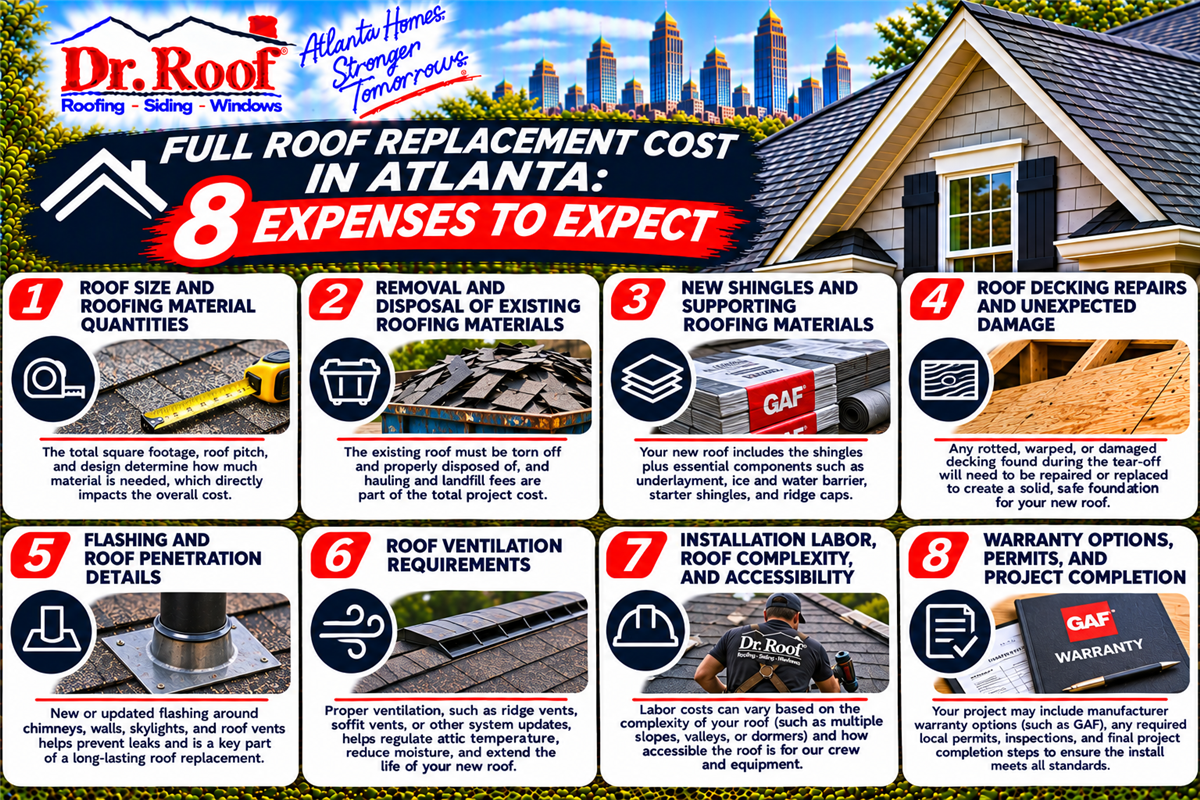
Here are eight expenses homeowners should understand when budgeting for a new roof.
1. Roof Size and Roofing Material Quantities
The amount of roofing material required is one of the most significant factors affecting the total replacement price.
Larger roofs generally require more shingles, underlayment, fasteners, and supporting roofing components.
However, the size of your home is not necessarily the same as the size of your roof.
Why Is Roof Square Footage Different From Home Square Footage?
The total roof surface area depends on several factors, including:
Roof pitch
Overhangs
Attached structures
Dormers
Roof extensions
Overall roof design
For example, two homes with similar interior square footage may have substantially different roof surface areas.
A steeper roof or a property with multiple architectural sections may require more roofing material.
What Is a Roofing Square?
Roofing contractors commonly measure materials using roofing squares.
One roofing square represents 100 square feet of roof surface area.
For example, a roof measuring 2,000 square feet contains 20 roofing squares before accounting for additional material requirements.
The final material quantity may also include allowances for cuts, overlaps, and installation waste.
An accurate roof measurement is therefore an important part of determining the complete installation price.
2. Removal and Disposal of Existing Roofing Materials
A complete roof replacement often involves removing the existing roof covering before installing new materials.
This process is commonly called roof tear-off.
What Does Roof Tear-Off Include?
Depending on the existing roofing assembly and proposed work, tear-off may include:
Removing existing shingles
Removing old underlayment
Removing unsuitable flashing components
Collecting removed roofing materials
Transporting debris
Disposal fees
The amount of work depends on the roof's construction and the materials being removed.
Why Does Tear-Off Affect the Replacement Price?
Removing existing roofing materials requires labor, equipment, debris handling, and disposal arrangements.
A roof with multiple layers of existing materials may require more removal work than a roof with a single layer.
Tear-off also allows the contractor to examine decking that was previously concealed.
Is Removal Included in Every Roof Replacement Estimate?
Homeowners should confirm this before signing an agreement.
A complete replacement proposal should explain whether existing material removal and disposal are included in the quoted price.
Do not assume that two estimates include the same tear-off scope simply because both are described as roof replacements.
3. New Shingles and Supporting Roofing Materials
Shingles are often the most recognizable component of a roof replacement estimate.
However, their cost represents only one portion of the complete roofing system.
How Does Shingle Selection Affect Pricing?
Different asphalt-shingle products have different designs, performance characteristics, appearance options, and warranty eligibility.
Homeowners may compare conventional asphalt shingles, architectural shingles, and designer roofing products.
Material costs depend on the exact manufacturer, product line, quantity, and availability.
What Other Roofing Materials Are Included?
Depending on the roofing system, a replacement may also require:
Underlayment
Leak-protection materials
Starter shingles
Ridge cap shingles
Roofing fasteners
Roof-edge metal
Appropriate flashing components
These materials contribute to the performance of the complete roofing assembly.
Comparing only the advertised shingle price can overlook important differences in the proposed installation.
Are Premium Shingles Always the Best Investment?
Not necessarily.
The appropriate roofing product depends on your budget, roof design, appearance preferences, and long-term ownership plans.
A premium product may offer different features, but proper installation and compatible supporting materials remain essential regardless of the selected shingle.
4. Roof Decking Repairs and Unexpected Damage
Roof decking provides the supporting surface beneath the roofing materials.
On many Atlanta-area homes, the decking consists of plywood, oriented strand board, or individual wood boards.
If portions of the decking are damaged or structurally unsuitable, they may need replacement before new shingles are installed.
Why Might Decking Increase the Total Price?
Decking deterioration may be associated with previous roof leaks, moisture exposure, physical damage, or other conditions.
Some problems are visible before construction begins, while others become apparent only after the old roofing materials are removed.
Correcting unsuitable decking can require additional materials, labor, fastening, and disposal.
Is Decking Replacement Included in the Original Quote?
It depends on the agreement.
Some roofing proposals include a limited decking allowance.
Others provide a separate price for replacement material if damaged areas are discovered during tear-off.
Homeowners should ask how additional decking work will be calculated and authorized.
Does Every Roof Replacement Require New Decking?
No.
Existing decking may remain suitable for continued use.
Replacing sound decking unnecessarily can increase project costs without addressing an actual roofing problem.
The contractor should explain which areas require corrective work and why.
5. Flashing and Roof Penetration Details
Flashing is installed around vulnerable roofing transitions to help direct water away from openings and joints.
These components are particularly important around chimneys, roof-to-wall intersections, valleys, plumbing vents, and skylights.
Why Does Flashing Affect Installation Pricing?
Homes with complicated roof designs may require more flashing materials and detailed installation work.
For example, a roof with several chimneys, dormers, and roof-to-wall intersections may involve more specialized work than a roof with relatively few transitions.
The condition of the existing flashing also influences the proposed replacement scope.
Can Existing Flashing Be Reused?
In some circumstances, existing components may remain suitable.
However, damaged, deteriorated, incompatible, or improperly installed flashing may require replacement.
The contractor should evaluate the actual conditions and follow applicable manufacturer instructions and installation requirements.
What Should Homeowners Ask About Flashing?
Review the estimate to determine which flashing components are included, which will be evaluated during installation, and whether additional work could affect the final price.
A proposal that includes comprehensive flashing work may differ substantially from one with a more limited scope.
6. Roof Ventilation Requirements
Ventilation can be an important consideration when replacing the roofing system on a home with a vented attic.
Existing ventilation components may need evaluation to determine whether they remain appropriate for the roof and attic design.
What Ventilation Expenses Might Be Included?
Depending on the property's construction, the proposed work may include replacing or installing ridge vents, intake ventilation components, or other suitable roof ventilation products.
Not every home requires the same ventilation arrangement.
Some homes use unvented attic assemblies with different design requirements.
Does Every Roof Replacement Require New Ventilation?
No.
Existing ventilation may remain suitable.
However, if the current arrangement is inadequate, damaged, or incompatible with the proposed roofing system, modifications may be necessary.
The roofing contractor should explain whether ventilation work is recommended and how it affects the total price.
Proper ventilation decisions should be based on the home's construction rather than a one-size-fits-all recommendation.
7. Installation Labor, Roof Complexity, and Accessibility
Professional installation represents a significant part of the complete roof replacement price.
Labor requirements vary considerably between properties.
What Makes a Roof More Complicated to Replace?
Potential factors include:
Steep roof slopes
Multiple stories
Numerous valleys and roof transitions
Difficult material access
Complicated roof architecture
Specialized roofing materials
Additional safety requirements
These conditions can influence how materials are transported, installed, and removed.
Why Can Two Similar-Sized Homes Have Different Roof Prices?
Consider two Atlanta-area homes with similar roof surface areas.
One has a relatively straightforward gable roof, while the other has steep slopes, multiple dormers, and several chimneys.
Although the amount of shingles required may be similar, the second property could involve more detailed installation work, flashing, access arrangements, and safety measures.
The total installation price therefore depends on more than square footage alone.
8. Warranty Options, Permits, and Project Completion
The final roof replacement price may also reflect additional project requirements that are not immediately visible in the finished roof.
What Warranty Expenses Should Homeowners Consider?
Roofing warranties vary depending on the manufacturer, contractor, selected materials, and installation requirements.
Certain enhanced manufacturer warranties may require qualifying roofing components or additional eligibility conditions.
Homeowners should confirm which warranty is included in the proposed price and whether alternative warranty options are available.
Are Permits Included in Roof Replacement Pricing?
Permit and inspection requirements depend on the property's jurisdiction and the scope of work.
Homeowners should ask whether applicable permit-related expenses are included in the estimate and who is responsible for arranging them.
What About Final Cleanup?
A complete roofing proposal should explain how removed materials and installation debris will be handled.
Ask whether disposal, jobsite cleanup, and the final project review are included in the quoted price.
These details help establish a clearer understanding of the complete project.
What Should a Full Roof Replacement Price Include?
The following table can help homeowners evaluate whether a proposal addresses the major components of a residential roofing project.
| Project Component | What to Confirm |
|---|---|
| Roof measurements | Total roof surface area and material quantities |
| Tear-off | Existing roofing material removal |
| Disposal | Transportation and debris handling |
| New shingles | Exact manufacturer and product line |
| Supporting materials | Underlayment, starter shingles, ridge caps, and fasteners |
| Roof decking | Included allowance or additional replacement pricing |
| Flashing | Locations and replacement scope |
| Ventilation | Evaluation and proposed modifications |
| Installation | Labor, equipment, and project access |
| Permits | Applicable requirements and responsibilities |
| Warranty | Coverage, eligibility, and included options |
| Cleanup | Debris removal and project completion |
Not every property requires every type of corrective work.
However, the written proposal should make clear what is included, excluded, or subject to additional evaluation.
What Unexpected Costs Can Arise During Roof Replacement?
Even a detailed estimate may need adjustment if previously concealed conditions become apparent during construction.
Common examples include unsuitable decking, hidden moisture damage, unexpected existing roofing layers, or structural concerns.
Before approving a project, ask your contractor:
How will unexpected damage be documented?
Is there a decking replacement allowance?
How are additional materials and labor priced?
Will I receive an explanation before additional work is authorized?
How are changes to the original agreement recorded?
A clear process for handling unexpected conditions can help reduce confusion during the installation.
Is an Online Roof Replacement Calculator Accurate?
An online roofing calculator can provide a useful starting point for budgeting.
Calculators may use estimated roof measurements, property information, material selections, or other assumptions to generate a preliminary price.
However, they may not identify every site-specific condition.
For example, an online estimate may not fully account for concealed decking deterioration, unusual flashing requirements, or difficult project access.
Homeowners can use the Dr. Roof roofing cost calculator to begin exploring potential project costs.
A professional evaluation remains the most reliable way to obtain a detailed installation price for your specific home.
Why Is the Lowest Roof Replacement Estimate Not Always the Best Value?
When comparing roofing proposals, homeowners should consider the scope of work as carefully as the price.
A lower estimate may involve different roofing products, fewer included components, limited flashing work, or different warranty provisions.
This does not automatically make the lower-priced proposal unsuitable.
However, comparing prices without understanding these differences can make it difficult to determine which project provides the appropriate roofing solution.
Ask each contractor to explain the complete scope, identify potential additional costs, and clarify applicable warranty terms.
The objective is selecting a suitable roofing system and professional installation that align with your budget and the condition of your home.
How Much Does Dr. Roof Charge for a Complete Roof Replacement?
Dr. Roof's published general pricing guidance identifies an average replacement range of $8,000 to $15,000, with actual costs varying according to the property and roofing products selected.
Some projects may cost less, while larger or more complicated installations may cost considerably more.
You can review additional pricing information on our frequently asked questions page.
Because every roof is different, Dr. Roof provides project-specific estimates rather than relying on one universal installation price.
During a roofing consultation, homeowners can discuss the condition of the existing roof, material preferences, necessary supporting components, and available warranty options.
Get a Complete Roof Replacement Estimate From Dr. Roof
Dr. Roof has served Atlanta-area homeowners since 1988, providing professional roofing inspections, repairs, and complete roof replacement services.
As a GAF Master Elite Certified Contractor and CertainTeed SELECT ShingleMaster, Dr. Roof brings manufacturer-specific roofing knowledge and local experience to residential projects.
Whether you are replacing an aging roof, addressing extensive storm damage, or planning a major home improvement, understanding the full installation price is an important first step.
From roof measurements and material selection to decking, flashing, and installation requirements, our team can help you evaluate the roofing options appropriate for your property.
If you live in Atlanta, Marietta, Alpharetta, Roswell, Smyrna, or surrounding communities, contact Dr. Roof to request a free roof replacement estimate and begin planning your roofing investment with greater clarity.
How much does a full roof replacement cost in Atlanta?
Dr. Roof's published general pricing guidance places the average roof replacement between $8,000 and $15,000. Actual costs may fall outside this range depending on roof size, materials, labor, accessibility, existing conditions, and project complexity. A professional estimate is necessary to determine the price for an individual home.
What is included in a full roof replacement installation price?
A complete installation price should explain existing roofing material removal, disposal, new roofing materials, labor, flashing, supporting components, and cleanup. The proposal should also clarify applicable permits, warranty options, and how additional decking repairs will be handled.
Why do roof replacement estimates vary between contractors?
Estimates may differ because of roofing material selection, labor requirements, installation scope, flashing work, decking allowances, warranty options, and business expenses. Homeowners should compare the included work rather than relying exclusively on the total price.
Can the cost of a roof replacement increase after installation begins?
Yes. Previously concealed conditions, such as damaged decking or unexpected existing roofing layers, may require additional work. The contractor should document these findings and explain the proposed changes and authorization process.
Does roof replacement pricing include removing the old shingles?
Many complete roof replacement proposals include tear-off and disposal, but homeowners should confirm these services in the written agreement. Removal requirements and costs depend on the existing roofing system and project scope.
Are online roof replacement cost calculators reliable?
Online calculators can provide preliminary budgeting estimates, but they may not account for concealed damage, unusual flashing requirements, or site-specific installation conditions. A professional roofing evaluation and written quote provide a more accurate project-specific price.
Subscribe to Dr. Roof's Blog





Comments