When your roof develops a leak, loses shingles, or shows signs of deterioration, scheduling a repair may seem like the most practical and affordable solution. In many situations, professional roof repairs can successfully address localized damage and help preserve the existing roofing system.
However, there comes a point when continued repairs may no longer provide a reliable or financially sensible solution.
For Atlanta homeowners, understanding when to stop repairing an aging or extensively damaged roof can help prevent unnecessary expenses, recurring water damage, and ongoing frustration.
Roof repair is no longer a viable option when widespread deterioration, recurring leaks, extensive decking damage, brittle shingles, or multiple failing roofing components prevent localized repairs from reliably restoring the roof's protective function. Replacement may also be more practical when ongoing repair expenses outweigh the benefits of maintaining an aging roofing system.
The decision should be based on the overall condition of the roof rather than its age or the cost of a single repair alone.
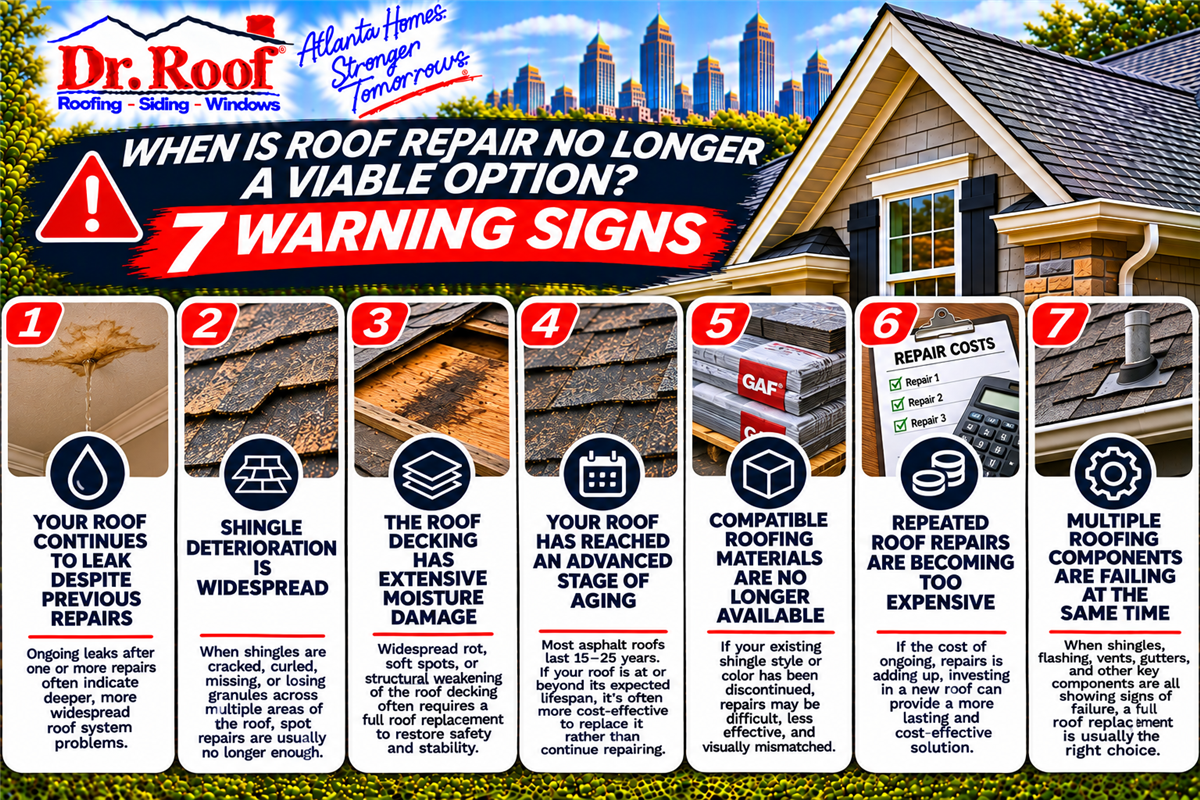
Here are seven warning signs that your roof may be beyond practical repair.
1. Your Roof Continues to Leak Despite Previous Repairs
An isolated roof leak does not necessarily mean you need a complete roof replacement.
Many leaks originate from specific problems, such as damaged flashing, missing shingles, or deteriorated plumbing vent boots. When the surrounding roofing materials remain in good condition, a targeted repair may be sufficient.
However, repeated water intrusion can indicate a more complicated problem.
Why Does My Roof Keep Leaking After Repairs?
Recurring roof leaks may result from:
An incorrectly identified water-entry point
Deteriorating roofing materials in multiple locations
Compromised underlayment
Widespread flashing problems
Moisture-damaged roof decking
Underlying installation deficiencies
If new leaks continue appearing in different areas, the roofing system may be experiencing broader deterioration rather than isolated damage.
When Do Recurring Leaks Justify Roof Replacement?
Replacement may become appropriate when a professional inspection determines that the roof has multiple deteriorating areas that cannot be addressed effectively through localized repairs.
For example, repairing flashing around a chimney may resolve one leak, but it will not correct deteriorating shingles or compromised roofing materials elsewhere.
When several unrelated problems continue developing, replacing the entire roofing system may provide a more comprehensive solution.
2. Shingle Deterioration Is Widespread
Asphalt shingles gradually experience wear from sunlight, rainfall, temperature changes, and other environmental conditions.
In Atlanta, prolonged summer heat, humidity, and seasonal thunderstorms contribute to the conditions residential roofs must withstand.
Although individual damaged shingles can often be replaced, widespread deterioration presents a different challenge.
What Are the Signs of Extensive Shingle Deterioration?
Common warning signs include:
Curling shingles across multiple roof sections
Widespread cracking
Excessive granule loss
Brittle or fragile shingles
Numerous missing shingles
Exposed asphalt surfaces
Multiple areas of displaced roofing materials
The location and extent of these conditions are important.
A few damaged shingles on an otherwise serviceable roof may justify a straightforward repair. Similar damage throughout multiple roof sections may indicate that the roofing materials are approaching the end of their useful service life.
Can Brittle Shingles Still Be Repaired?
Sometimes, but brittle shingles can make localized repairs more difficult.
Replacing an individual shingle often requires working with adjacent materials. If those surrounding shingles are too fragile, they may crack or become damaged during the repair process.
When a contractor cannot complete a repair without compromising nearby roofing materials, replacement may be the more dependable option.
3. The Roof Decking Has Extensive Moisture Damage
The visible shingles are only one part of your roofing system.
Beneath them is the roof decking, which provides the supporting surface for the roof covering and other roofing components.
When water intrusion continues without correction, the underlying wood may deteriorate.
What Are the Warning Signs of Roof Decking Damage?
Potential indicators include:
Visible sagging along the roof surface
Water stains on accessible attic wood
Deteriorated or decayed sheathing
Visible moisture damage beneath roofing materials
Deformation of the roof surface
These conditions require professional evaluation because their causes and severity can vary.
Can Damaged Roof Decking Be Repaired Without Replacing the Roof?
Yes, in some situations.
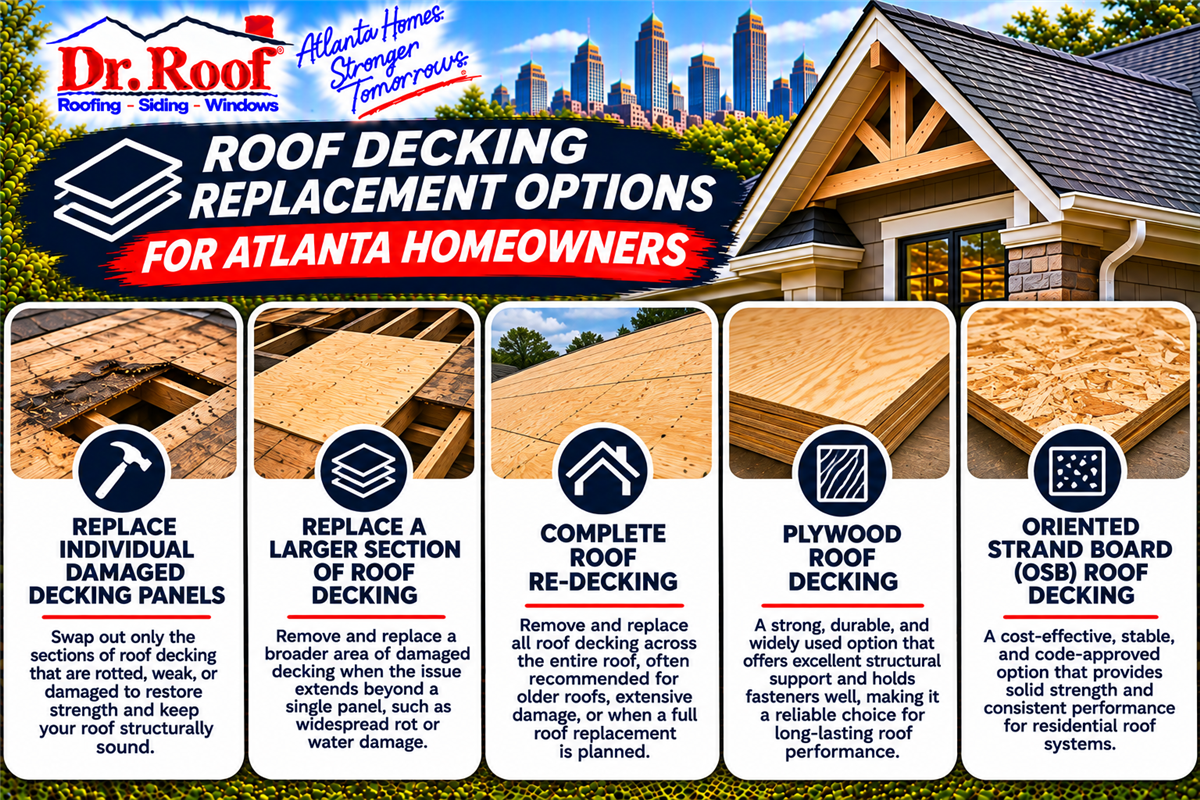
When decking damage is limited to a small area, a roofing contractor may remove the affected roofing materials, replace unsuitable decking, and restore that section.
However, if moisture damage affects multiple areas or large portions of the deck, localized repairs may no longer be practical.
A more extensive roofing project may be necessary to expose the affected materials and restore a suitable supporting surface.
If your roof appears to be sagging or structurally compromised, avoid the affected area and arrange a prompt professional assessment. Structural damage may also require evaluation by a qualified structural professional.
4. Your Roof Has Reached an Advanced Stage of Aging
Roof age is an important consideration when deciding whether another repair makes sense.
However, there is no single age at which every roof automatically requires replacement.
The condition of a roofing system depends on several factors, including its materials, installation, maintenance, previous damage, and exposure to weather.
Is It Worth Repairing an Older Roof?
It can be.
An older roof that remains generally serviceable may still benefit from a localized repair.
For example, replacing a deteriorated plumbing vent boot may be appropriate when the surrounding shingles remain suitable.
However, an aging roof with recurring leaks, widespread material deterioration, and an extensive repair history may no longer justify additional investment in patchwork repairs.
How Does Atlanta's Climate Affect Aging Roofs?
Residential roofs throughout Metro Atlanta experience prolonged summer heat, ultraviolet exposure, heavy rainfall, and occasional severe storms.
Over time, these conditions can contribute to roofing material deterioration.
Two roofs installed during the same year may age differently because of differences in installation quality, roof design, ventilation, tree coverage, and weather exposure.
Rather than relying exclusively on the installation date, homeowners should have the roof's actual condition evaluated.
5. Compatible Roofing Materials Are No Longer Available
A successful roof repair requires more than finding shingles that look similar to the existing roof.
Replacement materials must also be appropriate for the roofing system.
As shingles age, manufacturers may discontinue certain products, colors, dimensions, or designs.
This can make some repairs more challenging.
Can You Repair a Roof With Different Shingles?
In some circumstances, compatible replacement shingles may be available even if the original product has been discontinued.
However, the contractor must consider factors such as:
Shingle dimensions
Product design
Exposure requirements
Installation specifications
Compatibility with surrounding materials
Existing roof condition
A close color match alone does not establish that a replacement shingle is suitable.
Does a Shingle Color Mismatch Mean You Need a New Roof?
No.
Older shingles may change in appearance through years of weather exposure. Even a replacement shingle from the same product line may look different.
A cosmetic difference does not automatically justify replacement.
The more important concern is whether compatible materials can be installed without compromising the roof's performance.
If suitable repair materials are unavailable or the surrounding shingles cannot be worked with safely, a broader replacement may become necessary.
6. Repeated Roof Repairs Are Becoming Too Expensive
Homeowners often choose roof repair because it requires a smaller immediate investment than complete replacement.
While that can be a sensible decision, repeatedly paying for repairs on a deteriorating roof may become financially inefficient.
When Does Roof Repair Stop Making Financial Sense?
Consider the following questions:
How many repairs has the roof required recently?
Are new problems developing in different locations?
Does the proposed repair address the underlying cause?
What is the overall condition of the remaining roofing materials?
How extensive is the current repair estimate?
Is complete replacement likely to be necessary in the foreseeable future?
A single repair estimate does not always reveal the long-term financial picture.
For example, a homeowner may authorize several individual repairs over time, only to eventually require replacement because the surrounding roofing materials continue deteriorating.
Is There a Specific Cost Threshold for Roof Replacement?
There is no universal repair-to-replacement cost ratio that determines the right decision for every home.
Although industry guidance sometimes suggests comparing repair costs with replacement estimates, those comparisons should be considered alongside roof age, repair history, damage severity, and remaining serviceability.
The most economical immediate option is not always the most practical long-term solution.
A professional roofing evaluation can help homeowners compare the scope and limitations of each approach.
7. Multiple Roofing Components Are Failing at the Same Time
Your roof functions as a system rather than a collection of independent materials.
Shingles, underlayment, decking, flashing, roof penetrations, starter materials, and ridge components all contribute to its overall performance.
When several of these components are deteriorating simultaneously, repairing one area may leave other significant problems unresolved.
What Does Roofing System Failure Look Like?
A roof experiencing broader deterioration may have a combination of:
Worn or damaged shingles
Deteriorating flashing
Multiple water-entry points
Unsuitable decking
Compromised underlayment
Damaged roof penetration components
Moisture-management problems
These issues may also affect one another.
For example, damaged shingles can expose protective materials beneath the roof covering, while failing flashing can allow water to reach the supporting wood.
Why Might Complete Replacement Be More Effective?
A complete roof replacement allows the contractor to evaluate and address the roofing assembly more comprehensively.
Depending on the project, replacement may involve removing the existing roof covering, inspecting the exposed decking, correcting unsuitable materials, and installing compatible roofing components.
This approach may be more practical than attempting to restore multiple deteriorating sections independently.
However, the need for replacement should be established through a professional assessment rather than assumed from a single visible symptom.
Roof Repair vs. Roof Replacement: How to Know Which You Need
The following comparison can help homeowners understand when localized repairs remain appropriate and when replacement deserves consideration.
| Roof Repair May Be Appropriate | Roof Replacement May Be Appropriate |
|---|---|
| Damage is limited to one area | Damage affects multiple roof sections |
| Surrounding shingles remain serviceable | Shingles are extensively brittle or deteriorated |
| A leak has an identifiable, localized source | Multiple leaks continue developing |
| Decking damage is limited | Decking deterioration is widespread |
| Compatible replacement materials are available | Suitable repair materials are unavailable |
| The roof has a limited repair history | Repairs are becoming increasingly frequent |
| The overall roofing system remains functional | Multiple roofing components are failing |
These conditions provide general guidance rather than a definitive diagnosis.
Every roofing system should be evaluated according to its individual condition.
Can You Replace Only One Section of a Damaged Roof?
Sometimes.
Partial roof replacement may be appropriate when damage affects a distinct roof section while the remaining areas are still in suitable condition.
For example, a home addition or separate roof plane may experience deterioration independently of the main roofing system.
However, partial replacement requires careful consideration of:
Transitions between old and new roofing materials
Existing shingle compatibility
Flashing and underlayment integration
Water-shedding details
Applicable installation requirements
Available warranty coverage
A contractor should explain whether partial replacement can provide an appropriate solution without compromising the surrounding roof.
When deterioration extends across multiple connected areas, complete replacement may be more practical.
Can Storm Damage Make a Roof Beyond Repair?
Yes, depending on the severity and extent of the damage.
Atlanta-area thunderstorms can expose residential roofing systems to strong winds, hail, falling branches, and heavy rainfall.
While isolated storm damage may be repairable, extensive damage can require a broader restoration project.
A professional assessment may be necessary when storms cause widespread shingle damage, multiple roof openings, significant decking damage, or substantial water intrusion.
Dr. Roof can help homeowners evaluate storm-related roofing conditions and provide documentation when applicable.
However, whether homeowners insurance covers repair or replacement depends on the policy, cause of damage, and insurer's claim determination.
Storm damage alone does not guarantee coverage or approval for a complete roof replacement.
What Happens if You Keep Repairing a Roof That Needs Replacement?
Continuing to repair a roofing system with widespread deterioration may provide temporary relief without addressing the underlying problems.
Potential consequences include:
Recurring water intrusion
Additional decking deterioration
Damage to insulation and interior finishes
Increased cumulative repair expenses
Continued disruption from roofing problems
Reduced confidence in the roof's overall condition
These outcomes are not inevitable, but the risks become more concerning when the roofing system can no longer support reliable localized repairs.
This is why obtaining a comprehensive assessment is important before committing to another repair on a repeatedly failing roof.
What Should a Professional Roof Inspection Determine?
Before recommending repair or replacement, a roofing contractor should evaluate more than the most visible damaged area.
A professional roofing assessment may consider:
The condition of the existing shingles
Whether damage is isolated or widespread
Previous repair locations
Flashing and roof penetration conditions
Accessible decking and attic conditions
Evidence of active water intrusion
Availability of suitable repair materials
The practicality of restoring damaged sections
Homeowners should also ask their contractor to explain why the recommended approach is appropriate.
If replacement is recommended, ask which conditions make localized repair unsuitable.
A clear explanation can help you distinguish between a necessary replacement and a roofing problem that remains repairable.
How Dr. Roof Helps Atlanta Homeowners Decide Between Repair and Replacement
Dr. Roof has served Atlanta-area homeowners since 1988, providing professional roofing inspections, roof repairs, complete roof replacement, and storm-damage documentation support.
As a GAF Master Elite Certified Contractor and CertainTeed SELECT ShingleMaster, Dr. Roof brings manufacturer-specific roofing knowledge and decades of local experience to residential roofing projects.
Our approach begins with understanding the actual condition of your roofing system.
When localized repairs remain appropriate, homeowners can explore targeted solutions. When deterioration is widespread or reliable repairs are no longer practical, our team can explain available roof replacement options.
Whether you live in Atlanta, Marietta, Roswell, Alpharetta, Smyrna, or another surrounding community, a professional evaluation can help you make an informed decision based on your home's needs.
Know When It's Time to Stop Repairing Your Roof
Professional roof repair can be an effective way to address localized damage and preserve an otherwise serviceable roofing system.
However, recurring leaks, extensive shingle deterioration, widespread decking damage, material incompatibility, and increasing repair expenses may indicate that localized repairs are no longer a viable solution.
The goal is not simply to determine whether another repair is possible. It is to determine whether that repair can provide a meaningful and reliable solution for the condition of your roof.
If you're unsure whether your roof needs another repair or complete replacement, contact Dr. Roof to schedule a professional roofing evaluation.
Our team can help you understand your roof's condition, compare available solutions, and make a decision that supports the long-term protection of your Atlanta-area home.
When is roof repair no longer a viable option?
Roof repair may no longer be viable when widespread shingle deterioration, recurring leaks, extensive decking damage, incompatible repair materials, or multiple failing roofing components prevent localized repairs from reliably restoring the roofing system. A professional inspection should determine whether replacement is necessary.
Is it worth repairing an old roof?
Repairing an older roof can be worthwhile when damage is isolated and the surrounding roofing materials remain serviceable. However, an aging roof with widespread deterioration, frequent leaks, and an extensive repair history may be a better candidate for replacement.
How many times can you repair a roof before replacing it?
There is no universal limit to the number of roof repairs that can be completed. The decision depends on the roof's overall condition, repair history, damage severity, material compatibility, and whether additional repairs can provide a reliable solution.
Does a recurring roof leak mean you need a new roof?
Not necessarily. A recurring leak may result from an unresolved localized problem or an incorrectly identified water-entry point. However, multiple leaks developing across an extensively deteriorated roofing system may indicate that replacement is more appropriate.
Can roof repair become more expensive than replacement?
Repeated roof repairs can become financially inefficient when damage continues developing and the roofing system is approaching the end of its serviceability. Homeowners should compare cumulative repair expenses, current roof condition, and replacement estimates before making a decision.
Can damaged roof decking make roof repair unsuitable?
Yes. Although localized decking damage can sometimes be repaired, widespread deterioration or significant structural concerns may require a more extensive roofing project. A professional assessment is necessary to determine the appropriate repair or replacement scope.
Subscribe to Dr. Roof's Blog



Comments