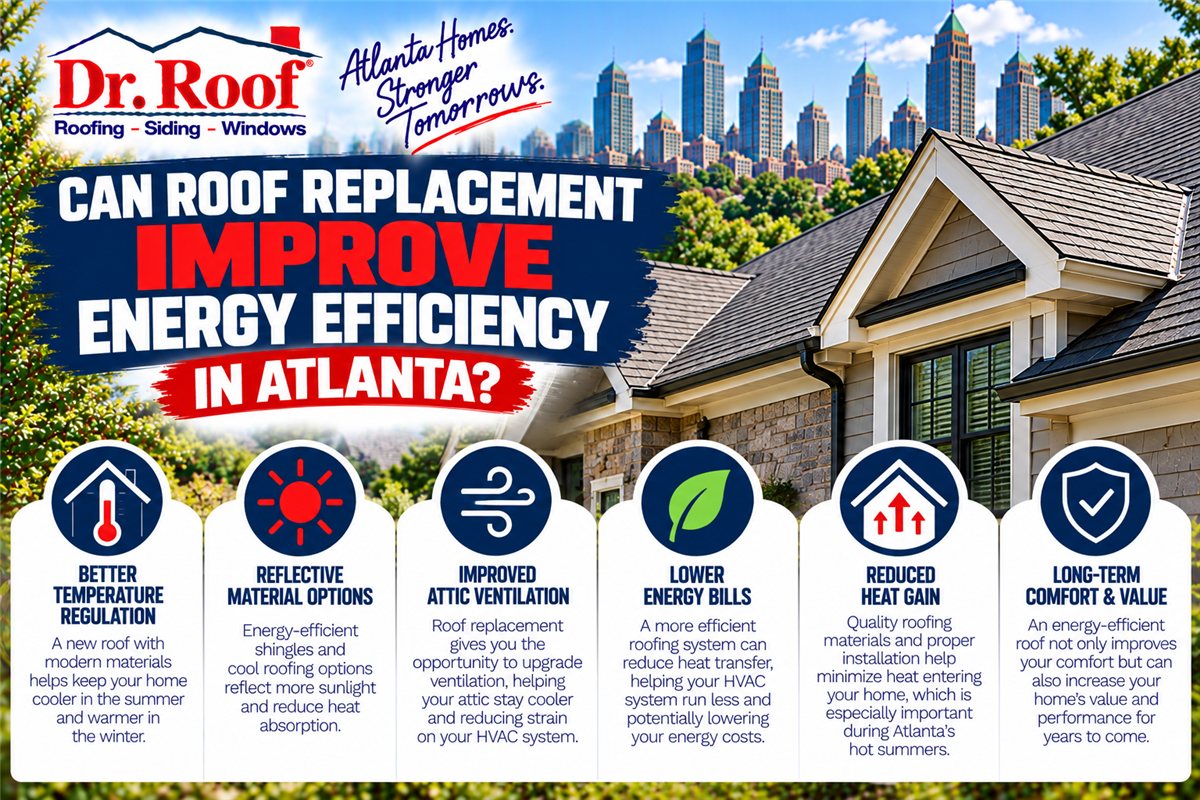
When Atlanta homeowners consider replacing their roofs, protecting the home from rain and storm damage is usually the first priority.
However, a roof replacement can also provide an opportunity to improve home energy efficiency.
Roof replacement may contribute to energy savings when homeowners select suitable reflective roofing materials and use the project to evaluate related concerns such as attic insulation, air leakage, and ventilation.
A new roof does not automatically reduce utility bills. The results depend on the selected materials, existing insulation, attic design, weather conditions, and overall home performance.
For Atlanta homeowners, understanding these factors can help turn a necessary roof replacement into a more informed long-term investment.
How Can Roof Replacement Improve Energy Efficiency?
Your roofing system influences how much solar heat reaches the building.
During warm weather, sunlight heats the roof surface. Some of that heat can move through the roof assembly and into the attic or occupied areas below.
The amount of heat reaching the living space depends on several factors, including:
Roof material
Solar reflectance
Thermal emittance
Insulation
Air sealing
Attic design
Ventilation
Building construction
Replacing a roof gives homeowners an opportunity to consider how the new roofing materials and existing building conditions work together.
Here are seven factors worth evaluating.
1. Choose Roofing Materials With Appropriate Solar Reflectance
One way roof replacement may contribute to energy efficiency is through the selection of roofing materials that reflect more sunlight.
Traditional roofing materials absorb a portion of the solar energy reaching their surfaces.
Cool-roof materials are designed to reflect more solar radiation and, depending on the material, release absorbed heat effectively.
This can help reduce roof surface temperatures during sunny weather.
What Is a Cool Roof?
A cool roof is a roofing system designed to reduce solar heat absorption through its surface properties.
Two important characteristics are:
Solar reflectance: How effectively a roofing surface reflects sunlight.
Thermal emittance: How effectively a surface releases absorbed heat.
ENERGY STAR explains that roofing materials with favorable reflectance and emittance characteristics can help reduce heat transfer into buildings.
Are Cool Roofs Useful in Atlanta?
Atlanta experiences warm summers, making solar heat management a relevant consideration for homeowners.
Reflective roofing materials may be useful for some homes, particularly when solar exposure and existing building conditions make roof heat gain significant.
However, the benefits vary.
A well-insulated home may respond differently from a home with insufficient attic insulation.
Homeowners should evaluate the roofing product and the condition of their home rather than assuming a reflective roof will produce a specific amount of savings.
2. Compare Roofing Product Performance Instead of Color Alone
Roof color can influence how much sunlight a roof absorbs, but color is not the only factor.
Some roofing products use reflective technologies that allow different color options to provide varying levels of solar reflectance.
This means homeowners should not assume that every light-colored shingle performs identically or that every darker roofing product has the same energy characteristics.
What Should Homeowners Compare?
When evaluating roofing materials, ask about:
Solar reflectance
Thermal emittance
Available product performance ratings
Roofing material type
Compatibility with the home's roof design
Manufacturer installation requirements
The Cool Roof Rating Council maintains a directory of roofing products and their radiative performance ratings.
These ratings can help homeowners make more informed comparisons.
Do Energy-Efficient Roofing Materials Have to Be White?
No.
Reflective roofing products are available in different materials and colors.
The important question is how the specific product performs, not simply how bright or dark it appears.
For homeowners who want to maintain a particular architectural style, comparing actual product ratings can be more useful than choosing based on color alone.
3. Evaluate Attic Insulation Before Replacing the Roof
Attic insulation is another important part of home energy performance.
Insulation helps slow the movement of heat between the living space and areas outside the home's conditioned envelope.
During summer, appropriate insulation can help limit heat entering the occupied space.
During winter, it can help reduce unwanted heat loss.
Does a New Roof Automatically Improve Insulation?
No.
Replacing shingles and underlayment does not automatically increase the insulation level of the home.
The roofing materials and attic insulation perform different functions.
However, a roof replacement is a useful time to ask whether the home's existing insulation should be evaluated.
An energy professional can assess whether insulation improvements are appropriate.
What Should Atlanta Homeowners Check?
Potential concerns include:
Insufficient insulation
Uneven insulation coverage
Compressed insulation
Gaps around attic penetrations
Wet or deteriorated insulation
Insulation blocking ventilation paths in a vented attic
The appropriate solution depends on how the attic is designed.
Insulation work may be a separate project from the roofing contract, so homeowners should confirm which services are included.
4. Consider Attic Air Sealing
Air leakage can affect how efficiently a home maintains comfortable indoor temperatures.
Even when insulation is present, gaps between conditioned and unconditioned areas may allow unwanted air movement.
Common attic air-leakage locations can include:
Plumbing penetrations
Electrical penetrations
Attic access openings
Ceiling-to-wall connections
Recessed fixtures
Duct and utility openings
Why Does Air Sealing Matter?
Uncontrolled air movement can contribute to unwanted heat transfer and indoor comfort problems.
Sealing appropriate openings can help improve the performance of the home's thermal boundary.
However, attic air sealing is not the same as sealing the exterior roof against rain.
These are two different functions.
The roofing system manages exterior water, while building-envelope air sealing addresses unwanted airflow.
Should Air Sealing Be Part of Roof Replacement?
Not every roofing project includes air sealing.
Homeowners can use the planning stage to determine whether an attic or home energy assessment would be beneficial.
If separate improvements are recommended, they should be coordinated with the appropriate professionals.
5. Review the Existing Attic Ventilation Design
Attic ventilation is another consideration during roof replacement.
In a traditionally vented attic, appropriate intake and exhaust ventilation help manage airflow through the attic space.
These systems are commonly associated with soffit intake vents and roof or ridge exhaust vents.
However, not every home has the same attic configuration.
Some homes have intentionally unvented or conditioned attic assemblies that require a different approach.
Can Improving Ventilation Reduce Energy Use?
Ventilation can influence attic conditions, but adding more vents does not automatically guarantee lower energy bills.
The appropriate ventilation design depends on the roof assembly, insulation strategy, and building configuration.
The contractor should evaluate the existing system before recommending changes.
What Should Homeowners Ask?
Useful questions include:
Is the attic intended to be vented or unvented?
Are the existing ventilation openings functioning properly?
Is insulation blocking any intended airflow paths?
Will the replacement roof change the existing ventilation design?
Are the proposed components appropriate for the attic configuration?
Ventilation should be evaluated as part of the complete roofing system rather than as an isolated upgrade.
6. Address Existing Roof and Moisture Problems
Roof replacement can also provide an opportunity to identify conditions that may affect the building envelope.
For example, an existing roof may have developed leaks that affected attic insulation or other materials.
Replacing the roof covering can address roofing defects, but damaged materials beneath the roof may also require attention.
Potential concerns include:
Moisture-damaged decking
Wet insulation
Deteriorated underlayment
Damaged roof penetrations
Improper flashing
Unresolved water-entry points
Why Does Moisture Matter?
Water intrusion can damage building materials and compromise the condition of insulation.
Before installing the new roofing system, the contractor should evaluate visible damage and determine whether affected roofing components need repair or replacement.
A new roof should not simply conceal existing problems.
Homeowners should also understand that roofing contractors may not perform every type of building-envelope or insulation repair.
Additional specialists may be needed depending on the condition discovered.
7. Evaluate the Complete Project Instead of Expecting Automatic Savings
A roof replacement is a significant home improvement project.
It is important to distinguish between a roofing upgrade that may reduce solar heat absorption and broader improvements to the home's energy performance.
For example:
Roofing material selection may influence solar heat gain.
Attic insulation helps resist heat transfer.
Air sealing helps reduce unwanted air movement.
Ventilation must be appropriate for the attic and roof design.
These components work together, but they are not interchangeable.
How Much Energy Can a New Roof Save?
There is no reliable universal savings percentage for every roof replacement.
Actual results depend on:
Existing roof characteristics
New roofing materials
Sun exposure
Local weather
Insulation levels
Building airtightness
Heating and cooling equipment
Attic configuration
Household energy use
Homeowners should be cautious about any claim that a particular roofing product will guarantee a specific utility bill reduction.
A home energy assessment can help identify which improvements are most relevant to the property.
Roof Replacement vs. Attic Insulation: Which Improves Energy Efficiency More?
These improvements address different parts of the home.
Roof replacement primarily restores or upgrades the exterior roofing system.
Attic insulation primarily helps control heat transfer through the insulated building assembly.
If a roof is damaged or deteriorated, replacement may be necessary regardless of the home's energy performance.
If the roof is in serviceable condition but the attic insulation is inadequate, insulation work may be a more direct energy-efficiency improvement.
When both projects are necessary, coordinating them can help homeowners evaluate the complete building system.
Are Metal Roofs More Energy-Efficient Than Asphalt Shingles?
The answer depends on the specific products being compared.
A reflective metal roofing product may have different solar performance characteristics than a conventional dark asphalt shingle.
However, metal roofing materials do not all have identical reflective properties.
Likewise, asphalt shingles are available with different surface characteristics.
A meaningful comparison should consider:
Specific product ratings
Solar reflectance
Thermal emittance
Roof construction
Insulation
Local climate
Installation requirements
Material type alone does not establish how much energy a homeowner will save.
Can Reflective Roofing Materials Affect Winter Heating?
Yes.
A reflective roof may reduce solar heat absorption during summer, but it can also reduce solar heat gain during colder periods.
The overall effect depends on climate and building conditions.
Atlanta homeowners should consider both cooling and heating needs.
That does not mean reflective roofing is unsuitable for Atlanta. It means annual energy performance should be evaluated rather than focusing only on summer roof temperatures.
What Questions Should You Ask About Energy Efficiency Before Roof Replacement?
Before selecting a new roofing system, consider asking your contractor:
Are reflective roofing options available for my roof?
What are the solar reflectance ratings of the products being considered?
How does my attic configuration affect the recommendation?
Will the existing ventilation system be evaluated?
Are any roofing components damaged by moisture?
Should a separate insulation or air-sealing assessment be considered?
What energy-related claims can be supported by product information?
These questions can help homeowners compare roofing proposals more effectively.
How Does Roof Design Influence Energy Performance?
Not every roof receives the same amount of sunlight.
Roof slope, orientation, tree coverage, and surrounding structures can affect solar exposure.
Attic design also matters.
For example, a house with a vented attic and insulation at the ceiling may behave differently from a house with insulation along the roofline.
A roofing recommendation should account for these characteristics when energy performance is part of the homeowner's priorities.
What About Energy Savings From Replacing an Old Roof?
The condition and design of the existing roofing system matter.
Replacing deteriorated shingles with similar new shingles does not automatically create a substantial energy-efficiency improvement.
The clearest opportunities arise when the project includes an appropriate change in roofing surface performance or when separate building-envelope issues are identified and corrected.
For this reason, homeowners should ask which specific part of the planned project is expected to influence energy use.
How Dr. Roof Helps Atlanta Homeowners Plan Roof Replacement
Dr. Roof has served Atlanta-area homeowners since 1988, providing professional roof inspections, repairs, and replacements.
Dr. Roof is a GAF Master Elite Certified Contractor and CertainTeed SELECT ShingleMaster.
When planning roof replacement, homeowners can discuss the available roofing materials, existing roof conditions, ventilation considerations, and the components included in the proposed installation.
Different roofing systems offer different characteristics, and selecting appropriate materials begins with understanding the home's design and the homeowner's priorities.
Any additional attic insulation or air-sealing improvements should be evaluated separately when necessary.
Make Energy Performance Part of Your Roof Replacement Planning
A roof replacement can contribute to improved home energy efficiency, but the benefits are not automatic.
The strongest opportunities involve making informed roofing material choices, evaluating existing building conditions, and coordinating appropriate improvements where needed.
For Atlanta homeowners, the goal should be a roof that protects the home while taking the building's overall performance into account.
Before choosing a new roofing system, contact Dr. Roof to discuss your roof replacement options and the considerations that matter most for your home.
Can replacing your roof lower energy bills?
Potentially. Roof replacement may contribute to lower cooling energy use when suitable reflective roofing materials reduce solar heat gain. Actual results depend on the home's insulation, attic design, weather, and other conditions. Savings are not guaranteed.
What roofing materials are best for energy efficiency?
Roofing materials with appropriate solar reflectance and thermal emittance characteristics may help reduce roof heat absorption. The best choice depends on the specific product, roof design, climate, and existing building conditions.
Does a new roof automatically improve attic insulation?
No. Installing new roofing materials does not automatically increase attic insulation. Insulation improvements are separate work unless specifically included in the project scope.
Can attic ventilation improve energy efficiency?
Appropriate attic ventilation can influence attic conditions, but additional ventilation does not automatically reduce energy use. The correct approach depends on whether the attic is vented or unvented and how the building assembly is designed.
Are reflective roof shingles available in different colors?
Yes. Roofing products with reflective characteristics are available in different colors and materials. Homeowners should compare actual product performance ratings rather than relying solely on appearance.
How can Atlanta homeowners make roof replacement more energy-conscious?
Homeowners can compare reflective roofing products, review existing attic conditions, ask about ventilation design, and consider a separate insulation or air-sealing assessment when appropriate. Recommendations should reflect the home's specific needs.
Subscribe to Dr. Roof's Blog




Comments