A roof does not need to start pouring water into your living room before replacement becomes worth considering.
In many cases, the signs develop gradually.
Repeated repairs, widespread shingle deterioration, recurring leaks, damaged decking, sagging areas, failing flashing, and problems across multiple roof sections can all indicate that another localized repair may no longer be the most practical solution.
For Atlanta homeowners, the decision should be based on the roof's overall condition—not a single age number or one cosmetic defect.
Some older roofs remain repairable. Some newer roofs can develop significant problems because of storm damage, installation issues, moisture, or other conditions.
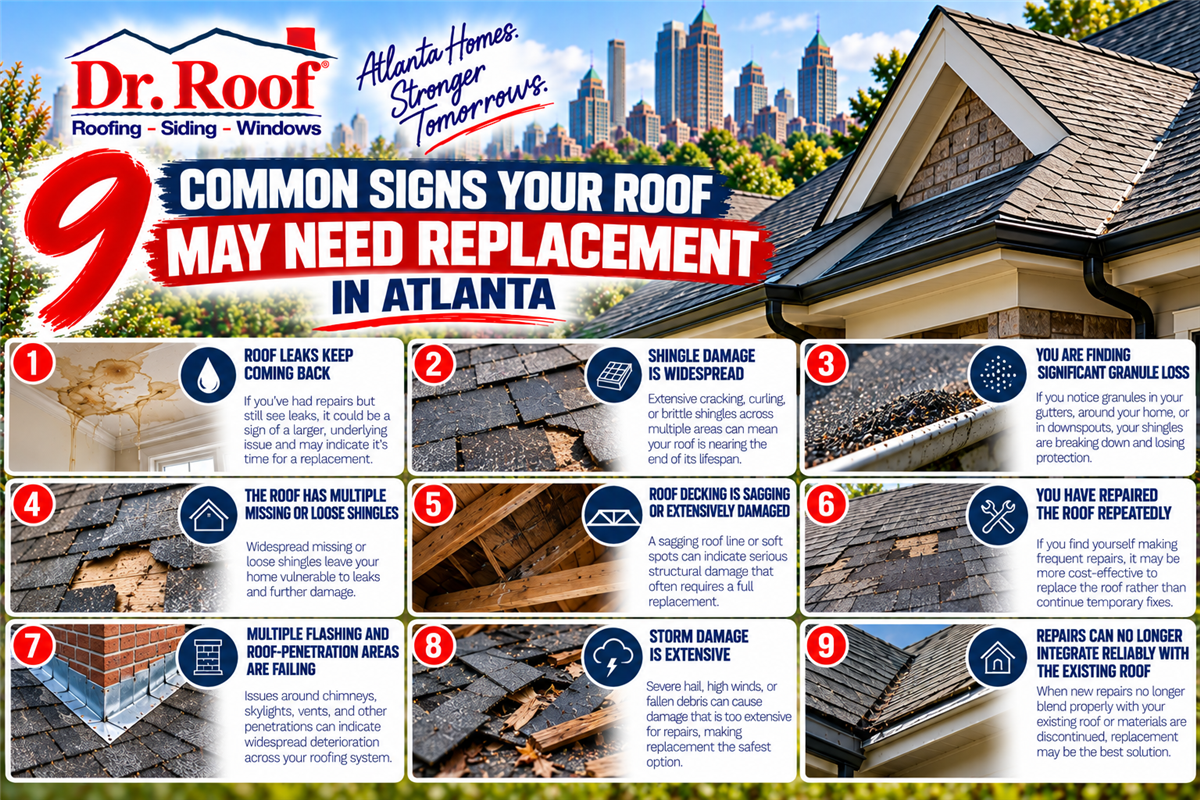
Here are nine common signs that it may be time to have your roof evaluated for replacement.
What Are the Common Signs a Roof Needs Replacing?
A roof may be approaching replacement when several problems are occurring at the same time or deterioration has become widespread.
Common signs include:
Frequent or recurring leaks
Widespread shingle deterioration
Large areas of missing or damaged shingles
Significant granule loss
Sagging or decking concerns
Repeated repair history
Multiple flashing or penetration failures
Extensive storm damage
Roofing materials that can no longer be repaired effectively
None of these signs should automatically be used as a stand-alone replacement diagnosis.
A professional inspection can determine whether the roof remains repairable or whether replacement is more practical.
1. Roof Leaks Keep Coming Back
One isolated roof leak does not automatically mean you need a new roof.
Many leaks originate from localized problems such as:
A damaged shingle
Failed flashing
A deteriorated pipe boot
A chimney transition
A skylight
A valley
Another roof penetration
Those problems may be repairable.
The situation becomes different when leaks continue returning despite previous repairs.
Why Do Recurring Leaks Matter?
Repeated leaks can indicate:
Multiple failing roof areas
Deteriorated materials
Aging flashing
Decking damage
Previous repairs that did not address the root cause
Broader roofing-system deterioration
If a contractor continually finds new leak sources across different roof sections, replacement may become more practical than repeatedly repairing isolated symptoms.
2. Shingle Damage Is Widespread
Several damaged shingles can often be repaired.
Widespread deterioration is a different concern.
Look for broad areas showing:
Curling
Cracking
Torn shingles
Brittle shingles
Lifted edges
Missing sections
Surface deterioration
Repeated wind damage
A roof with one damaged section may be a repair candidate.
A roof with similar deterioration across several slopes deserves a more complete replacement evaluation.
Why Does Brittleness Matter?
Roof repairs often require working around existing shingles.
If surrounding roofing materials have become brittle or fragile, removing and replacing one section may damage nearby shingles.
This can make effective localized repair more difficult.
A roofing professional should evaluate whether the existing material can still tolerate repair work.
3. You Are Finding Significant Granule Loss
Asphalt shingles have protective surface granules.
Some loose granules can be normal, especially with newly manufactured shingles or ordinary weather exposure.
However, broad surface deterioration or heavy granule loss can indicate that the shingles are losing part of their protective surface.
Homeowners may notice granules:
In gutters
Around downspout discharge areas
On patios
Around the foundation
In visibly bare areas on shingles
Does Granule Loss Automatically Mean Replacement?
No.
The amount, pattern, cause, and overall roof condition matter.
Granule loss can be associated with:
Normal weathering
Foot traffic
Physical abrasion
Hail impact
Material deterioration
A roofing professional should determine whether the condition is isolated or widespread.
4. The Roof Has Multiple Missing or Loose Shingles
Atlanta storms can bring strong wind capable of damaging roofing materials.
One or two missing shingles may sometimes be repaired.
When numerous shingles become loose or detach across several areas, the contractor should evaluate the overall condition of the roof.
Questions include:
Are the surrounding shingles still serviceable?
Are sealant bonds failing broadly?
Is fastening appropriate?
Is damage limited to one storm-exposed area?
Can compatible replacement shingles be obtained?
Are repeated wind events causing new damage?
If shingle loss keeps occurring across the roof, replacement may deserve consideration.
5. Roof Decking Is Sagging or Extensively Damaged
Roof decking forms the structural surface beneath the roofing material.
Decking problems deserve prompt evaluation.
Possible warning signs include:
Visible sagging
Soft areas
Moisture deterioration
Rot
Delamination
Sections damaged by long-term leaks
Homeowners may notice a sagging appearance from the ground or see deteriorated decking from an accessible attic.
Do not walk onto a sagging roof.
Does Damaged Decking Mean the Whole Roof Needs Replacement?
Not always.
A localized decking problem may be repaired during a targeted roofing project.
However, widespread decking deterioration can significantly increase the scope of work.
The contractor should also identify why the decking became damaged.
Installing new roofing materials without correcting the moisture source would not address the underlying problem.
6. You Have Repaired the Roof Repeatedly
Repairs are a normal part of maintaining many roofing systems.
The issue is frequency.
A roof may be ready for a replacement discussion when homeowners find themselves repeatedly repairing:
Different leaks
New shingle damage
Multiple flashing areas
Pipe boots
Valleys
Roof penetrations
Storm-damaged sections
Ask:
Are we repairing one isolated problem, or are we managing a roof that is failing in multiple locations?
That distinction matters.
If repair after repair is needed simply to keep the roofing system functional, it may be useful to compare continued repair with replacement.
7. Multiple Flashing and Roof-Penetration Areas Are Failing
Many roof leaks occur around transitions rather than through the middle of an intact shingle.
Potential trouble areas include:
Chimneys
Sidewalls
Dormers
Plumbing vents
Valleys
Roof-to-wall connections
One flashing failure may be repairable.
Multiple deteriorated transitions can indicate that more of the roofing system needs attention.
Can Flashing Be Replaced During a New Roof Installation?
Roof replacement provides an opportunity to evaluate and address flashing throughout the roofing system.
The exact work depends on the roof design, existing materials, applicable installation instructions, and condition of each transition.
Homeowners should ask which flashing is included in the replacement proposal rather than assuming every component will automatically be reused or replaced.
8. Storm Damage Is Extensive
Not every storm-damaged roof requires complete replacement.
Hail, strong wind, falling branches, and debris can sometimes create localized damage that can be repaired.
Replacement may deserve consideration when physical damage is widespread.
Potential storm-related concerns include:
Numerous missing shingles
Extensive wind damage
Widespread impact damage
Damaged decking
Multiple affected roof slopes
Broken flashing
Structural damage from falling debris
A professional inspection should document what was actually damaged.
What If Insurance Is Involved?
Dr. Roof may provide photographs, written findings, and repair or replacement recommendations for storm-related roofing concerns.
A roofing contractor can document the physical condition of the property.
Insurance coverage decisions belong to the insurance company and depend on the homeowner's specific policy and individual claim.
Storm damage does not guarantee insurance coverage or a particular claim outcome.
9. Repairs Can No Longer Integrate Reliably With the Existing Roof
Roof repair requires new materials to work with the roofing system that remains.
That can become more challenging when:
Existing shingles are brittle
The original product is discontinued
Profiles differ significantly
Materials break during repair
Previous repairs cover large areas
Surrounding materials are broadly deteriorated
Color differences alone do not determine whether a roof can be repaired.
The more important question is whether new roofing materials can be installed correctly within the existing system.
If the answer is no, replacement may become the more practical option.
Does Roof Age Alone Mean It Needs Replacement?
No.
There is no single age that automatically determines whether every roof needs replacement.
Roof performance can be influenced by:
Roofing material
Installation quality
Weather exposure
Storm history
Ventilation
Roof design
Maintenance
Previous repairs
Moisture conditions
Two roofs installed at the same time can be in very different condition years later.
Age is useful context, but physical condition should drive the decision.
How Do You Know Whether to Repair or Replace a Roof?
The repair-versus-replacement decision usually comes down to several questions.
Repair May Be Appropriate When:
Damage is localized
Surrounding materials remain serviceable
The leak source is identifiable
Decking damage is limited
Compatible repair materials are available
The roof has not required repeated repairs
Replacement May Be Worth Considering When:
Problems are widespread
Multiple leaks keep developing
Shingles are broadly deteriorated
Extensive decking damage exists
Repairs are becoming frequent
Large areas have storm damage
Materials can no longer be repaired reliably
A professional inspection should answer these questions before either option is recommended.
Does One Roof Leak Mean You Need a New Roof?
No.
A leak can result from one localized defect.
Possible examples include:
Damaged flashing
A cracked pipe boot
Several missing shingles
A small valley problem
A roof penetration
If the remaining roofing system is in serviceable condition, a targeted repair may resolve the problem.
The concern increases when leaks are recurring or appear in different parts of the home.
What About a Roof That Looks Fine From the Ground?
Ground-level appearance cannot reveal every roofing condition.
A roof can look relatively normal while still having:
Flashing damage
Wind-lifted shingles
Pipe-boot deterioration
Decking damage
Hidden moisture
Attic leaks
That is why homeowners should not rely only on curbside appearance when they suspect a roofing problem.
A professional evaluation provides a closer look at vulnerable areas.
What Happens During a Roof Replacement Inspection?
Before recommending replacement, a roofing contractor should evaluate the condition of the existing system.
Areas may include:
Shingles
Flashing
Valleys
Pipe boots
Roof penetrations
Ridge areas
Roof edges
Gutters
Visible decking
Ventilation
Attic conditions when accessible
The inspection helps determine whether problems are localized or widespread.
It also helps establish which components should be included in the replacement project.
What Should a Roof Replacement Estimate Include?
A useful roof replacement proposal should provide enough detail for homeowners to understand the scope.
Depending on the project, it may identify:
Roofing manufacturer
Shingle or roofing product
Existing-roof removal
Underlayment
Leak-protection components
Starter materials
Ridge materials
Flashing
Ventilation
Decking procedures
Cleanup and disposal
Warranty information
Homeowners should compare the complete scope rather than simply comparing the final price.
Two estimates using the same shingle may include very different roofing-system components and installation work.
Why Roof Decking Matters During Replacement
The roof covering is installed over decking.
If that surface is deteriorated or structurally unsound, the affected decking should be addressed before new roofing materials are installed.
Some decking conditions are not fully visible until the old roof covering is removed.
Ask the contractor in advance:
How decking will be inspected
How damaged areas will be documented
How additional work will be communicated
What approval process will be used
Clear expectations can help avoid surprises once tear-off begins.
What Role Does Attic Ventilation Play in Roof Replacement?
Roof replacement is also an opportunity to evaluate attic ventilation where applicable.
A traditionally vented attic typically depends on appropriate intake and exhaust ventilation.
The contractor should consider:
Existing intake
Existing exhaust
Blocked ventilation
Roof design
Attic configuration
Ventilation is part of the larger roofing system and should not be treated as an afterthought.
Not every attic is designed the same way, so recommendations should reflect the individual home.
How Dr. Roof Helps Atlanta Homeowners Evaluate Roof Replacement
Dr. Roof has served Atlanta-area homeowners since 1988 and provides roof inspections, repairs, and full roof replacement.
Dr. Roof is a GAF Master Elite Certified Contractor and CertainTeed SELECT ShingleMaster, with additional roofing options including DaVinci products when appropriate for the project.
A professional roof evaluation can help determine whether deterioration is localized enough for repair or broad enough that replacement deserves consideration.
That assessment may consider:
Roofing material
Leak history
Previous repairs
Flashing
Decking
Ventilation
Storm-related damage
Overall roof condition
The recommendation should match the actual condition of the home rather than relying on a universal age rule.
When Does Roof Replacement Make Sense?
A roof may need replacement when problems stop being isolated and begin affecting the roofing system as a whole.
Repeated leaks, widespread shingle damage, significant granule loss, sagging or damaged decking, multiple failing transitions, repeated repairs, and extensive storm damage are all reasons to schedule a professional evaluation.
For Atlanta homeowners, the important question is not simply:
"How old is my roof?"
It is:
"Can this roof still be repaired effectively, or have the problems become widespread enough that replacement is the more practical solution?"
A thorough inspection provides the information needed to answer that question and plan the next step with confidence.
What are the most common signs that a roof needs replacing?
Common signs include recurring leaks, widespread cracked or curled shingles, significant granule loss, numerous missing shingles, sagging or damaged decking, repeated repairs, multiple failing flashing areas, and extensive storm damage.
Does an old roof automatically need to be replaced?
No. Age is only one factor. Roofing material, installation quality, maintenance, weather exposure, storm history, ventilation, previous repairs, and current physical condition should all be considered before replacement is recommended.
Does one roof leak mean I need a new roof?
No. Many leaks come from localized problems such as damaged shingles, failed flashing, pipe boots, valleys, or penetrations. Replacement becomes more relevant when leaks repeatedly return or problems are widespread.
Can damaged roof decking be repaired without replacing the entire roof?
Localized decking damage may sometimes be repaired as part of a targeted roofing project. Extensive deterioration can require a broader scope. The moisture source should also be identified and corrected.
When is replacing a roof better than continuing to repair it?
Replacement may become more practical when repairs are frequent, multiple roof areas are deteriorating, leaks continue appearing, the existing material is too brittle for reliable repair, or significant decking or storm damage is present.
How does a roofer determine whether a roof needs replacement?
A professional typically evaluates the roofing material, flashing, penetrations, valleys, decking, leak history, previous repairs, ventilation, storm damage, and overall condition to determine whether problems are localized or widespread.
Subscribe to Dr. Roof's Blog



Comments