Knowing when your roof needs repair is not always as simple as spotting a missing shingle.
Some roof problems are obvious from the ground. Others first appear as a ceiling stain, moisture in the attic, loose flashing, deteriorated sealant, or a small leak that shows up only during certain weather conditions.
For Atlanta homeowners, assessing a roof for necessary repairs starts with looking for changes inside and outside the home, documenting anything unusual, and having questionable areas professionally inspected before a small roofing problem has an opportunity to become more extensive.
You should not climb onto the roof to perform your own close inspection.
Instead, homeowners can safely look for warning signs from the ground and from accessible interior areas.
Here are nine signs that can indicate your roof needs professional evaluation and possibly repair.
How Do You Assess a Roof for Necessary Repairs?
A basic roof assessment should consider the entire roofing system rather than shingles alone.
Look for signs involving:
Shingles or other roof coverings
Flashing
Roof penetrations
Valleys
Gutters and roof edges
Attic moisture
Interior ceiling stains
Roof decking
Previous repair areas
The goal is to identify whether there is a localized problem that can be repaired before it affects a larger portion of the roofing system.
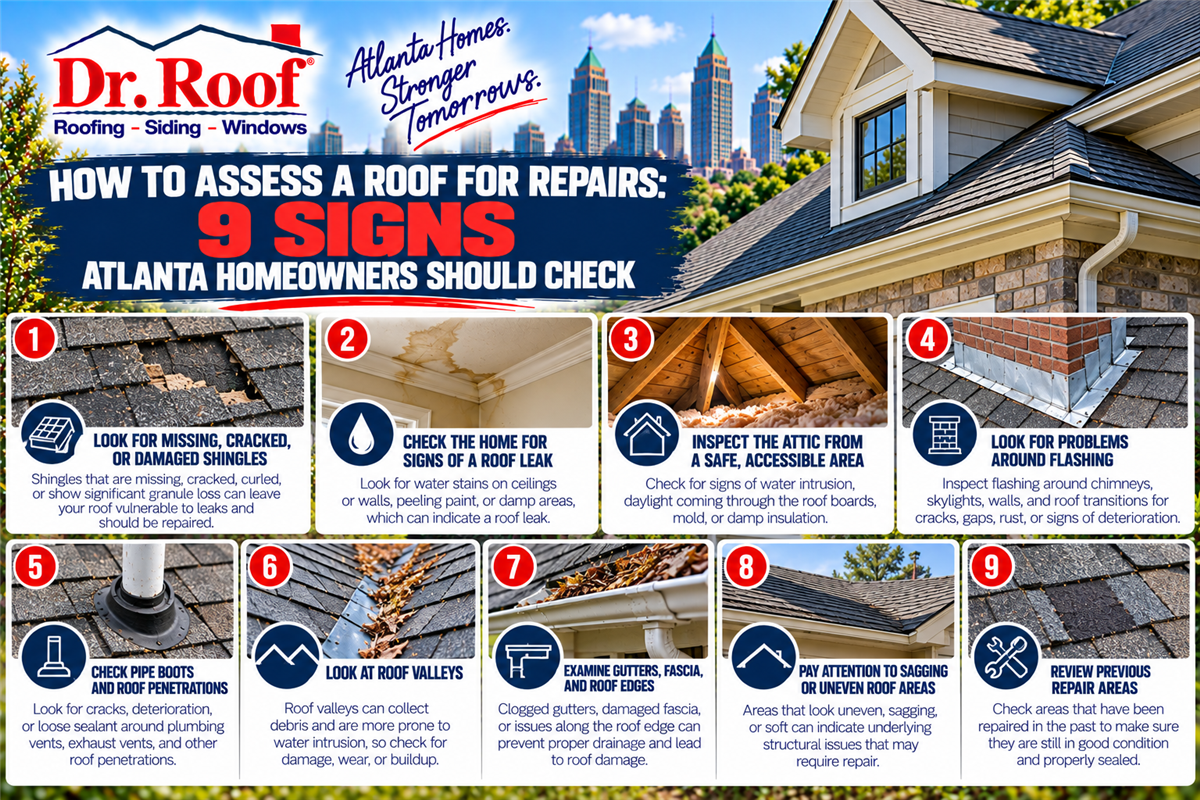
1. Look for Missing, Cracked, or Damaged Shingles
Shingle damage is one of the most recognizable signs that a roof may need repair.
From the ground, look for:
Cracked shingles
Torn tabs
Lifted edges
Wind-creased shingles
Areas that look noticeably different from surrounding roofing
Roofing material in the yard after a storm
Damage does not have to cover an entire roof to matter.
A small number of damaged shingles may create a localized vulnerability, particularly if the damage exposes underlying roofing components.
Can a Few Missing Shingles Be Repaired?
Often, localized shingle damage can be repaired when the surrounding roofing materials remain in serviceable condition and compatible replacement materials are available.
However, a contractor should evaluate why the shingles came loose.
Possible causes include:
Wind
Physical impact
Installation problems
Aging materials
Previous repair failure
Replacing the visible shingle without understanding the cause may not address the full problem.
2. Check the Home for Signs of a Roof Leak
Interior moisture is one of the strongest reasons to schedule a roof inspection.
Possible warning signs include:
Brown or yellow ceiling stains
Damp drywall
Peeling or bubbling paint
Water dripping during rain
Moisture around ceiling fixtures
Musty odors
Discolored attic materials
A roof leak does not always appear directly beneath the damaged area.
Water can travel along:
Roof decking
Rafters
Trusses
Pipes
Insulation
Other building materials
before becoming visible inside the home.
That means the location of the ceiling stain is a clue—not necessarily the location of the roof defect.
3. Inspect the Attic From a Safe, Accessible Area
If your attic is safely accessible, it can provide useful information about the underside of the roofing system.
Homeowners may notice:
Dark water stains
Damp insulation
Wet decking
Musty odors
Visible daylight through an unexpected opening
Sagging roof sheathing
Water marks around penetrations
Do not walk across exposed ceiling joists or enter areas that are unsafe.
If the attic does not have appropriate flooring or access, leave the evaluation to a professional.
Does Attic Moisture Always Mean the Roof Is Leaking?
No.
Moisture can also result from:
Condensation
Indoor air leakage
Improperly vented bathroom fans
Plumbing problems
HVAC-related moisture
Ventilation concerns
That is why diagnosis matters.
A roofing contractor should determine whether the moisture is entering from outside or developing from another source.
4. Look for Problems Around Flashing
Flashing helps manage water at vulnerable roofing transitions.
It may be installed around:
Chimneys
Skylights
Sidewalls
Dormers
Roof-to-wall intersections
Valleys
Plumbing vents
Other roof penetrations
Potential warning signs include:
Bent flashing
Loose metal
Missing sections
Rust or deterioration
Open gaps
Previous patching
Cracked sealant around vulnerable areas
Atlanta thunderstorms can bring heavy and wind-driven rain, making proper flashing especially important around transitions.
Can Flashing Be Repaired Without Replacing the Roof?
Sometimes.
Localized flashing problems may be repairable when the surrounding roofing system remains serviceable.
The contractor should determine whether the existing flashing can be corrected or whether affected shingles or nearby materials also need to be removed and replaced.
5. Check Pipe Boots and Roof Penetrations
Plumbing vents and other roof penetrations create openings through the roofing system.
These openings require properly installed flashing components.
A common example is a pipe boot surrounding a plumbing vent.
Potential problems can include:
Cracked rubber collars
Deteriorated seals
Loose flashing
Damaged shingles surrounding the penetration
Gaps
Previous temporary repairs
A small defect around a penetration can sometimes create a surprisingly persistent leak.
Because pipe boots and flashing components are relatively localized, these problems may be repair candidates when the remaining roof is in good condition.
6. Look at Roof Valleys
Roof valleys are the areas where two roof slopes meet.
They carry concentrated runoff toward the roof edge and gutters.
Because large volumes of water can travel through valleys during heavy Atlanta rain, these areas deserve attention.
Potential concerns include:
Missing shingles
Damaged valley materials
Debris accumulation
Leaves and pine needles
Visible deterioration
Previous patching
Loose materials
A valley problem may require more than simply replacing one shingle because the water-management details beneath and around the visible surface also matter.
A professional inspection can determine whether the valley needs cleaning, localized repair, or more extensive work.
7. Examine Gutters, Fascia, and Roof Edges
Your gutter system can provide clues about roof condition.
From the ground, look for:
Sagging gutters
Water overflowing during rain
Gutters pulling away from fascia
Roof granules collecting in gutters
Damaged fascia
Water stains around roof edges
Loose drip-edge components
Debris blocking drainage
A gutter problem does not automatically mean the roof needs repair.
However, poor drainage can expose roof edges, fascia, soffits, and exterior walls to unnecessary water.
Roof-edge conditions should be evaluated as part of the complete roofing system.
8. Pay Attention to Sagging or Uneven Roof Areas
A roof surface should not suddenly develop obvious dips or sagging areas.
From a safe ground-level location, look across the roofline for:
Visible depressions
Uneven sections
Sagging roof planes
Changes in the ridge line
Possible causes can include:
Decking deterioration
Long-term moisture exposure
Structural movement
Framing concerns
Previous damage
Sagging deserves professional evaluation.
This is not a condition homeowners should investigate by walking on the roof.
If significant structural movement is suspected, additional evaluation beyond ordinary roofing repairs may be necessary.
9. Review Previous Repair Areas
Older repair areas can provide useful information about the roof's current condition.
Ask yourself:
Has the same leak returned?
Has one area been patched repeatedly?
Are repairs becoming more frequent?
Are new problems appearing in different locations?
Is previous sealant cracking?
Are replacement shingles becoming difficult to match?
A previous repair that continues performing well is not automatically a concern.
Repeated failures in the same location can indicate that the underlying cause was never fully corrected.
Multiple new repair needs across the roof can also influence whether continued repairs remain practical.
What Roof Problems Can Usually Be Repaired?
Roof repair may be appropriate when the problem is localized and the surrounding roofing system remains serviceable.
Examples can include:
Several missing shingles
A damaged pipe boot
Localized flashing failure
A small leak source
Limited storm damage
A damaged roof penetration
Localized decking damage
A specific valley concern
The appropriate repair depends on what caused the problem and what materials are affected.
When Could a Roof Problem Require More Than a Repair?
A repair may become less practical when inspection reveals broader problems.
Potential indicators include:
Multiple active leaks
Widespread shingle deterioration
Extensive decking damage
Numerous failing flashing areas
Repeated repairs throughout the roof
Significant structural concerns
Large storm-damaged areas
That does not mean every older or damaged roof automatically needs replacement.
The contractor should explain why a particular condition can or cannot be repaired effectively.
How Do Roofers Find the Source of a Leak?
Finding a roof leak often requires looking beyond the visible interior stain.
A professional may evaluate:
Roofing materials above and around the suspected area
Flashing
Valleys
Pipe boots
Chimneys
Skylights
Roof-to-wall transitions
Attic conditions
Decking
Previous repair areas
The roofer may also ask when the leak occurs.
For example:
Only during heavy rain
Only during wind-driven rain
During every rainfall
After a particular storm
Those details can help narrow down possible entry points.
What Should You Check After a Storm?
Atlanta storms can expose or create roofing damage.
After strong wind, hail, or falling debris, homeowners can safely walk around the property and look for:
Missing shingles
Shingle pieces in the yard
Fallen branches
Damaged gutters
Loose flashing
New ceiling stains
Water intrusion
Visible impact damage
Do not climb onto a wet or storm-damaged roof.
A professional evaluation is safer and can identify conditions that are difficult to see from ground level.
What Should a Professional Roof Inspection Include?
The exact inspection varies by roof, but a useful evaluation may consider:
Roof covering condition
Flashing
Pipe boots
Valleys
Ridge areas
Roof penetrations
Roof edges
Gutters
Visible decking concerns
Attic conditions when accessible
Evidence of water intrusion
Previous repair areas
The purpose is to identify both the symptom and the likely cause.
A contractor should be able to explain what was observed and why a particular repair is recommended.
Questions to Ask Before Approving a Roof Repair
Before moving forward, consider asking:
What caused the damage?
Is the problem localized?
What materials need to be removed?
What materials will be installed?
Is any decking damaged?
Will flashing be repaired or replaced?
Are surrounding shingles still serviceable?
Is this area likely to require additional work soon?
What warranty applies to the repair?
Detailed answers can help homeowners compare repair proposals more accurately.
Can You Assess Your Roof Without Getting on It?
Yes.
In fact, homeowners should generally avoid walking on their roofs.
Useful observations can be made from:
The yard
The street
Ground-level windows
A safely accessible attic
Interior rooms
Binoculars or a camera with zoom can also help identify visible exterior concerns.
A roofing professional can perform the close inspection when needed.
How Dr. Roof Helps Atlanta Homeowners Evaluate Roof Repairs
Dr. Roof has served Atlanta-area homeowners since 1988 and provides professional roof inspections, roof repairs, roof replacement, and storm-damage documentation support.
A roof evaluation can help determine whether a problem involves:
Shingles
Flashing
Pipe boots
Valleys
Roof penetrations
Decking
Storm-related damage
Another part of the roofing system
When storm-related concerns are present, Dr. Roof may also provide photographs, written findings, and repair or replacement recommendations.
If an insurance claim is involved, coverage decisions remain with the insurance company and depend on the homeowner's policy and individual claim.
Assess the Roof Before the Problem Gets Bigger
You do not need to be a roofing expert to recognize that something has changed.
Missing shingles, ceiling stains, damaged flashing, attic moisture, failing pipe boots, valley problems, sagging areas, and recurring repairs are all reasons to take a closer look.
The key is avoiding assumptions.
A small stain does not automatically mean you need a new roof, and a roof that looks fine from the driveway may still have a repairable problem.
For Atlanta homeowners, the best approach is to document what you can safely see and schedule a professional evaluation when a concern appears.
The sooner the source is understood, the easier it is to determine whether the roof needs maintenance, a targeted repair, or a broader solution.
How can I tell if my roof needs repair?
Look for missing or damaged shingles, ceiling stains, attic moisture, damaged flashing, deteriorated pipe boots, valley problems, sagging areas, and recurring leaks. A professional inspection can determine the cause and extent of the problem.
Can a few missing shingles be repaired?
Often, yes. A small number of missing or damaged shingles may be repairable when surrounding materials remain in serviceable condition and compatible replacement materials are available. The roofer should also determine why the shingles became damaged or detached.
Does a ceiling stain always mean the roof is leaking?
No. Ceiling moisture can also come from plumbing, condensation, HVAC equipment, or other sources. If a roof leak is suspected, the roofing system and attic should be evaluated to identify the actual water-entry point.
Can roof flashing be repaired without replacing the whole roof?
Sometimes. Localized flashing problems around chimneys, walls, skylights, or penetrations may be repairable when surrounding roofing materials remain serviceable. The scope depends on the flashing condition and nearby roof components.
Should I climb onto my roof to check for damage?
No. Homeowners can safely check many warning signs from the ground and from accessible interior areas. Close roof inspection should be performed by qualified roofing professionals using appropriate safety equipment.
When is a roof repair no longer practical?
Replacement may deserve consideration when damage is widespread, multiple leaks are present, decking deterioration is extensive, repairs repeatedly fail, or problems affect numerous parts of the roofing system. A professional evaluation should determine the appropriate scope.
Subscribe to Dr. Roof's Blog






Comments