A roof that stays dry during light rain but begins leaking during a heavy downpour can be confusing.
If the roof handles ordinary rainfall, why does water suddenly appear on the ceiling when a stronger storm moves through Atlanta?
The answer often involves water volume, wind direction, drainage conditions, or an existing roofing weakness that becomes apparent only during more demanding weather.
Heavy rain does not necessarily create a new roofing problem. It may expose damaged flashing, worn pipe boots, deteriorated shingles, blocked drainage areas, or installation problems that were already present.
For Atlanta homeowners, identifying the actual source is essential because the visible interior leak may not be directly below the damaged roofing component.
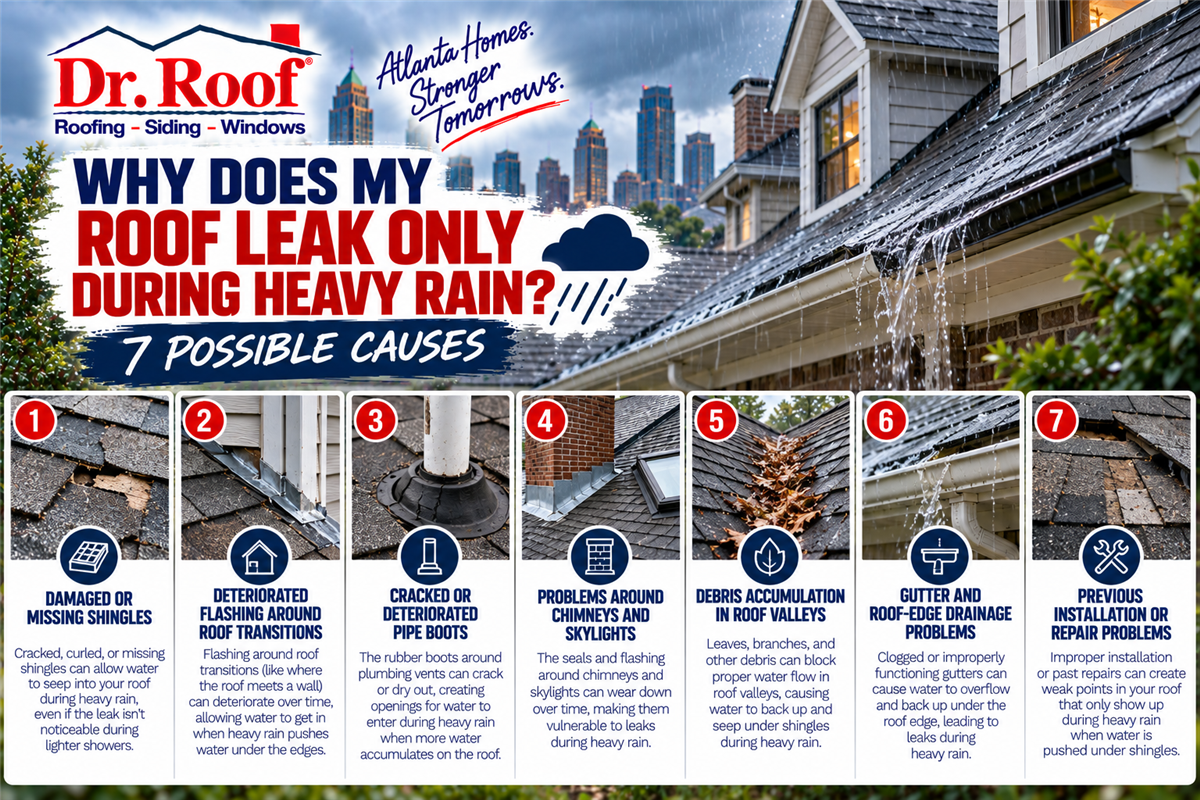
Here are seven possible reasons a roof leaks during heavy rain and what homeowners should do next.
Why Does a Roof Leak During Heavy Rain but Not Light Rain?
A roof may leak only during heavy rainfall because the roofing system is exposed to greater water volume, longer periods of moisture, or wind-driven rain entering vulnerable areas.
Common causes include:
Damaged or missing shingles
Deteriorated flashing
Failed pipe boots
Problems around chimneys or skylights
Debris-filled roof valleys
Drainage problems
Previous installation or repair defects
The exact cause depends on the roof's condition and how water moves across the structure.
A professional roof inspection can help determine whether the problem requires a localized repair or a more extensive solution.
1. Damaged or Missing Shingles
Asphalt shingles form the primary visible covering on many Atlanta-area roofs.
When properly installed and maintained, they help direct rainwater down the roof and toward the gutters.
However, damaged shingles may create openings or vulnerable areas.
Potential problems include:
Cracked shingles
Torn sections
Wind-related creases
Lifted edges
Improper fastening
Damage from fallen branches
During light rainfall, a damaged area may not allow enough water to produce an obvious interior leak.
Heavy rainfall or wind-driven rain can expose that weakness.
Can One Damaged Shingle Cause a Leak?
Yes, depending on its location and the condition of the surrounding roofing components.
A single damaged shingle near a vulnerable transition may contribute to water intrusion.
However, homeowners should not assume every leak requires complete roof replacement.
When damage is localized and the surrounding roofing remains serviceable, a targeted repair may be appropriate.
2. Deteriorated Flashing Around Roof Transitions
Flashing is one of the most important parts of a roofing system.
It helps manage water where different roofing surfaces or building components meet.
Flashing may be installed around:
Chimneys
Sidewalls
Roof-to-wall intersections
Skylights
Valleys
Roof penetrations
If flashing becomes loose, corroded, displaced, or improperly integrated with surrounding materials, water may enter during certain weather conditions.
Why Does Wind-Driven Rain Matter?
Rain does not always fall straight down.
During Atlanta thunderstorms, wind can push rain against roof transitions and exterior walls from different directions.
A flashing detail that appears to perform adequately during gentle rainfall may be exposed to water movement it cannot manage during a stronger storm.
A professional inspection should determine whether the flashing needs repair, replacement, or correction of an installation problem.
Simply adding surface sealant may not address the underlying defect.
3. Cracked or Deteriorated Pipe Boots
Plumbing vents extend through the roof and require properly installed flashing to keep water from entering around the penetration.
On many asphalt-shingle roofs, these penetrations use pipe boots or similar flashing assemblies.
Over time, components can deteriorate.
Warning signs may include:
Cracked rubber collars
Split boot material
Loose flashing
Failed seals
Deteriorated surrounding shingles
Water staining near the penetration
A small opening around a plumbing vent may allow water to enter during prolonged or heavy rainfall.
Does a Failed Pipe Boot Require a New Roof?
Not necessarily.
If the pipe boot is the primary problem and the surrounding roofing materials remain serviceable, replacing the defective component may be an appropriate repair.
The contractor should also inspect the surrounding shingles and decking for moisture-related damage.
4. Problems Around Chimneys and Skylights
Chimneys and skylights create transitions in the roofing system that require careful water management.
These areas often include several connected components.
For a chimney, potential concerns may involve:
Step flashing
Counterflashing
Masonry deterioration
Roof-to-chimney transitions
Previous repairs
For a skylight, possible concerns include:
Damaged flashing
Improper installation
Deteriorated seals
Water-management problems around the opening
A leak appearing near a skylight does not automatically mean the skylight itself has failed.
Water may be entering through a surrounding roofing or flashing detail.
Likewise, moisture near a chimney can involve the masonry, flashing, or roof assembly.
Why Is Professional Diagnosis Important?
Replacing an entire skylight or repairing chimney masonry without identifying the true water-entry point may not solve the problem.
The contractor should inspect the complete surrounding assembly before recommending a repair.
5. Debris Accumulation in Roof Valleys
A roof valley is the area where two roof slopes meet.
Valleys channel runoff from adjoining roof surfaces toward the lower roof edge.
During heavy rainfall, they may carry concentrated water flow.
Problems can develop when valleys contain:
Leaves
Pine needles
Branches
Other debris
Damaged shingles
Deteriorated flashing
Improperly installed roofing materials
Debris may interfere with normal drainage or conceal damage beneath it.
If valley materials have deteriorated, concentrated runoff may expose the weakness during heavier storms.
Why Atlanta Homes May Be Vulnerable
Many Atlanta neighborhoods have mature trees.
Leaves, pine needles, and storm debris can collect in roof valleys, particularly around complex rooflines.
Homeowners should avoid climbing onto the roof to remove debris.
A roofing professional can evaluate the valley and determine whether cleaning or repair is necessary.
6. Gutter and Roof-Edge Drainage Problems
Gutters collect roof runoff and direct it toward downspouts.
When they become clogged or damaged, water may overflow onto areas around the roof edge.
Potential signs include:
Overflowing gutters
Sagging sections
Blocked downspouts
Water running behind gutters
Damaged fascia
Staining beneath roof edges
Water collecting near exterior walls
Gutter overflow does not automatically mean water is entering through the roof.
However, drainage problems can contribute to water exposure around fascia, soffits, siding, and other exterior components.
Can a Gutter Problem Look Like a Roof Leak?
Yes.
Water entering near a roof edge or exterior wall may eventually appear on an interior ceiling or wall.
A professional inspection should determine whether the moisture originates from the roof covering, flashing, gutters, or another exterior component.
The repair should address the actual drainage or water-entry problem.
7. Previous Installation or Repair Problems
Some roof leaks are related to installation details rather than obvious storm damage.
Potential concerns include:
Improperly installed flashing
Incorrect fastener placement
Poorly integrated roofing materials
Inadequate water protection around penetrations
Defective previous repairs
Improper treatment of roof transitions
These issues may remain unnoticed until heavy rainfall exposes them.
For example, a previous repair may appear satisfactory during dry weather while still allowing water to enter under certain conditions.
Why Repeated Leaks Deserve Attention
If a roof continues leaking after several repairs, the original problem may not have been fully identified.
Instead of repeatedly treating the visible interior symptom, a professional should evaluate the roofing system and trace the likely source of water entry.
Why Does My Roof Leak Only When the Wind Blows?
Wind-driven rain can expose roofing weaknesses that ordinary rainfall does not.
Potential entry points include:
Lifted shingles
Damaged flashing
Roof-to-wall connections
Chimney transitions
Skylight flashing
Other exterior openings
The direction of the wind can also matter.
A homeowner may notice that a leak appears only when storms approach from a particular direction.
That observation can be useful during the inspection.
Tell the contractor when the leak occurs, where the stain appears, and whether wind seems to affect it.
Why Does a Ceiling Leak Appear Far From the Roof Damage?
Water does not always travel straight down.
After entering the roof assembly, moisture may follow:
Roof decking
Rafters
Framing members
Insulation
Other building materials
Water may then become visible at a ceiling joint, light fixture, or another opening.
That means the interior stain may be several feet away from the original entry point.
This is one reason a professional roof inspection should not focus exclusively on the section directly above the stain.
Could Attic Condensation Be Mistaken for a Roof Leak?
Sometimes.
Not every moisture problem in an attic originates from rain entering through the roof covering.
Condensation can occur when moisture-laden air reaches sufficiently cool surfaces.
Potential contributing factors include:
Air leakage from living spaces
Improperly vented bathroom exhaust fans
Moisture sources inside the home
Insulation problems
Inappropriate attic ventilation conditions
Condensation and rainwater intrusion can produce some similar symptoms.
A professional evaluation should distinguish between them before recommending roof repairs.
What Should You Do When Your Roof Starts Leaking?
The first priority is safety.
If water is near electrical fixtures, outlets, or wiring, avoid the affected area and seek appropriate professional assistance.
Also avoid standing beneath sagging or visibly damaged ceilings.
When conditions are safe:
Document visible water staining.
Note when the leak began.
Record whether wind or heavy rain was involved.
Keep people and belongings away from unsafe areas.
Contact a qualified roofing contractor.
Arrange an inspection to identify the water-entry source.
Do not climb onto a wet roof.
Wet shingles, loose materials, steep slopes, and storm damage can create serious fall hazards.
Does a Roof Leak Mean the Entire Roof Needs Replacement?
No.
Many roofing leaks involve localized defects that may be repairable.
Repair may make sense when:
The problem is limited
Surrounding roofing materials remain serviceable
The water-entry source can be corrected
Underlying damage is localized
Compatible repair materials are available
Replacement may deserve consideration when:
Roofing deterioration is widespread
Multiple areas are leaking
Extensive decking damage exists
Repeated repairs continue to fail
The roofing system can no longer be repaired effectively
The correct recommendation should follow a professional inspection.
What If the Leak Started After a Storm?
If a leak begins following strong wind, hail, or another severe weather event, a roof inspection can help document the observed conditions.
Dr. Roof may provide photographs, written findings, and repair or replacement recommendations when evaluating storm-related roofing concerns.
If an insurance claim is involved, the contractor can document physical damage and explain the proposed work.
Insurance coverage decisions belong to the insurance company and depend on the policy and individual claim.
A storm does not automatically establish that a particular repair or replacement will be covered.
How Dr. Roof Helps Atlanta Homeowners With Roof Leaks
Dr. Roof has served Atlanta-area homeowners since 1988 and provides professional roof inspections, roof repairs, roof replacement, and storm-damage documentation support.
A roofing evaluation can help identify whether a leak involves:
Shingles
Flashing
Pipe boots
Valleys
Chimneys
Skylights
Drainage
Underlying roofing materials
The appropriate repair should address the actual source rather than simply covering the visible symptom.
Finding the Cause of a Roof Leak After Heavy Rain
A roof that leaks only during heavy rainfall may have a vulnerability that becomes noticeable when the roofing system experiences concentrated runoff, prolonged rain, or wind-driven moisture.
Common causes include damaged shingles, flashing problems, deteriorated pipe boots, chimney or skylight transitions, debris-filled valleys, drainage concerns, and previous installation defects.
For Atlanta homeowners, the most useful next step is a professional inspection that identifies where the water is entering.
Once the source and extent of damage are understood, homeowners can make an informed decision about maintenance, targeted repair, or replacement.
Why does my roof leak during heavy rain but not light rain?
Heavy rainfall can expose existing roofing weaknesses because greater water volume, longer exposure, or wind-driven rain may reach vulnerable areas. Common causes include damaged shingles, deteriorated flashing, failed pipe boots, and problems around valleys or penetrations.
Can damaged flashing cause a roof leak during heavy rain?
Yes. Loose, deteriorated, or improperly installed flashing can allow water to enter around chimneys, skylights, roof-to-wall transitions, and other vulnerable areas, particularly during wind-driven rain.
Can clogged gutters cause water to enter my home?
Clogged gutters can cause overflow and unwanted water exposure around fascia, soffits, siding, and roof edges. However, gutter overflow does not automatically indicate a roof leak. An inspection should identify the actual water-entry pathway.
Why does my roof leak only when it rains and the wind blows?
Wind can push rain toward roof transitions, lifted shingles, damaged flashing, and other openings that may not be exposed during calm rainfall. The direction of the wind may help a roofing professional identify the source.
Does a roof leak mean I need a complete roof replacement?
No. Localized problems such as damaged flashing, shingles, or pipe boots may sometimes be repaired when surrounding materials remain serviceable. Widespread deterioration, repeated failures, or extensive decking damage may justify replacement.
What should I do if my roof starts leaking during a storm?
Keep people away from electrical hazards and unstable ceilings, document visible damage from a safe location, and contact a qualified roofing professional. Do not climb onto a wet or storm-damaged roof.
Subscribe to Dr. Roof's Blog







Comments