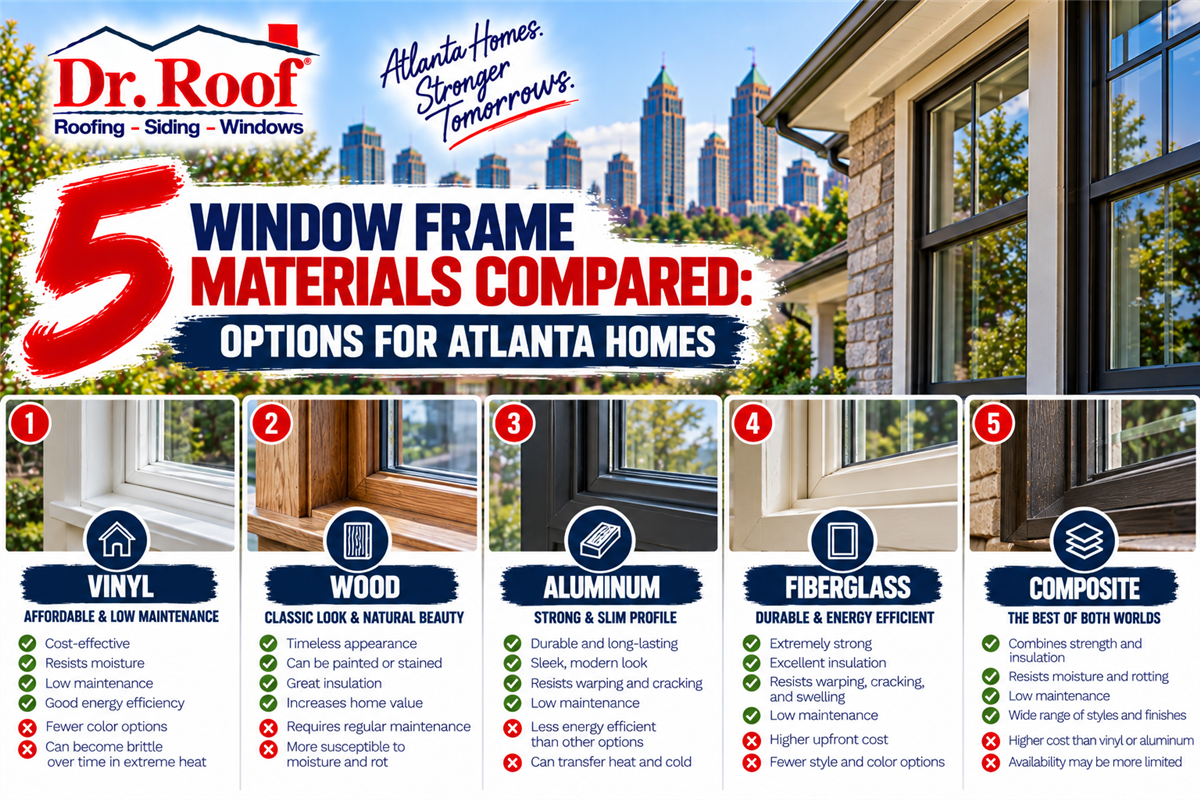
Choosing replacement windows involves more than deciding between double-hung, casement, or picture windows.
The frame material matters too.
Vinyl, fiberglass, wood, aluminum, and composite window frames each offer different combinations of thermal performance, maintenance, appearance, strength, moisture resistance, design flexibility, and cost.
For Atlanta homeowners, there is no single frame material that is automatically best for every property.
The stronger choice is the window that combines an appropriate frame, glass package, installation method, and independently rated whole-window performance for the home.
Here is how five common window-frame materials compare.
Window Materials: The Quick Answer
The five frame categories homeowners commonly encounter are:
Vinyl
Fiberglass
Wood
Aluminum or metal
Composite or hybrid
Vinyl is popular for low maintenance and moisture resistance.
Fiberglass provides strong dimensional stability and can support good thermal performance.
Wood offers a traditional appearance and good insulating characteristics but generally requires more maintenance.
Aluminum is strong and allows narrow profiles but conducts heat readily unless the design incorporates effective thermal breaks.
Composite and hybrid windows combine materials to balance appearance, durability, maintenance, and performance.
The frame alone does not determine whether a window is energy efficient.
Homeowners should also compare the NFRC ratings for the complete window.
1. Vinyl Window Frames
Vinyl window frames are commonly manufactured from PVC.
They are widely used in residential replacement projects because they require little finish maintenance and resist moisture.
Advantages of Vinyl Windows
Potential benefits include:
Low maintenance
No routine painting for many products
Moisture resistance
Broad availability
Multiple styles
Insulated frame designs on some products
A range of price and performance levels
Vinyl can be a practical option for Atlanta homeowners who want a relatively low-maintenance replacement window.
Considerations With Vinyl
Not every vinyl window is constructed the same way.
Differences can include:
Frame design
Internal chambers
Reinforcement
Glass package
Hardware
Weatherstripping
Installation system
That means homeowners should compare actual window ratings rather than assuming two vinyl windows will perform identically.
2. Fiberglass Window Frames
Fiberglass window frames are valued for strength and dimensional stability.
The material experiences relatively limited expansion and contraction compared with some other frame materials.
Advantages of Fiberglass Windows
Potential advantages include:
Structural strength
Dimensional stability
Moisture resistance
Low maintenance
Paintable options on some products
Good potential thermal performance
Relatively narrow frame designs on certain products
Fiberglass can appeal to homeowners who want a durable, low-maintenance frame while retaining design flexibility.
Considerations With Fiberglass
Fiberglass windows can occupy a different price category than many standard vinyl products.
Product availability, finish choices, and exact construction also vary by manufacturer.
The correct comparison should therefore include both the frame and the complete window assembly.
3. Wood Window Frames
Wood remains popular because of its traditional appearance and ability to complement many architectural styles.
It also has naturally lower thermal conductivity than ordinary metal framing.
Advantages of Wood Windows
Potential benefits include:
Traditional appearance
Interior warmth
Paint or stain flexibility
Compatibility with historic and custom architecture
Good insulating characteristics
Wood windows can be especially attractive in homes where interior trim and architectural details are part of the design.
Considerations With Wood
Wood requires moisture management.
Depending on the design and finish, homeowners may need to inspect:
Paint or stain
Exterior coatings
Joints
Water exposure
Signs of swelling
Rot
Finish deterioration
Clad-wood windows can reduce exterior maintenance by protecting the wood frame with another material on the exterior.
4. Aluminum and Metal Window Frames
Aluminum is strong, lightweight, and capable of supporting slim frame profiles.
That can make it attractive for contemporary architecture and large glass areas.
Advantages of Aluminum Windows
Potential benefits include:
High structural strength
Slim sightlines
Low routine finish maintenance
Resistance to wood rot
Contemporary appearance
Suitability for larger openings in some systems
The Thermal Conductivity Issue
Metal conducts heat more readily than vinyl, fiberglass, wood, or many composites.
Modern metal windows may use thermal breaks or other design features to reduce heat transfer through the frame.
That detail matters.
Atlanta homeowners comparing aluminum windows should evaluate the whole-window U-factor rather than assuming all metal windows perform the same way.
5. Composite and Hybrid Window Frames
Composite windows combine engineered materials, while hybrid windows may use different materials on the interior and exterior.
A common example is a wood interior paired with an exterior cladding material.
Advantages of Composite and Hybrid Windows
Depending on the design, possible benefits include:
Moisture resistance
Reduced exterior maintenance
Structural stability
Wood-inspired appearance
Paintable options
Strong thermal performance
Ability to combine different material strengths
Considerations With Composite Windows
"Composite" is a broad category.
Different manufacturers use different formulations and construction methods.
A homeowner should ask what the frame is actually made from rather than assuming all composite products have the same characteristics.
Which Window Material Is Most Energy Efficient?
Frame material matters, but homeowners should not select replacement windows based on frame material alone.
The energy performance of the complete unit can also be affected by:
Glass configuration
Low-e coatings
Gas fills
Spacers
Frame construction
Sash design
Weatherstripping
Air leakage
Installation
The National Fenestration Rating Council, or NFRC, provides standardized ratings that allow homeowners to compare complete window products.
What Is U-Factor?
U-factor measures heat transfer through the window.
Lower U-factor values indicate lower heat transfer.
Homeowners comparing replacement windows should look at the rated value for the complete window rather than relying only on statements such as "energy-saving glass."
What Is Solar Heat Gain Coefficient?
Solar Heat Gain Coefficient, commonly called SHGC, describes how much solar heat passes through the window.
Lower SHGC values reduce solar heat gain.
For Atlanta homes, solar exposure can vary significantly by window orientation, nearby trees, roof overhangs, shading, and home design.
The appropriate glass package should therefore be selected for the actual property rather than through a one-size-fits-all recommendation.
Why ENERGY STAR and NFRC Labels Matter
ENERGY STAR window requirements use certified performance ratings and vary by climate zone.
NFRC labels provide standardized performance information that makes it easier to compare one window with another.
Instead of asking only:
"Is fiberglass better than vinyl?"
homeowners can also ask:
"What are the U-factor and SHGC for these two complete windows?"
That produces a more useful comparison.
Which Window Material Requires the Least Maintenance?
Maintenance varies by product, but vinyl, fiberglass, aluminum, and many composite systems are generally selected partly for relatively low exterior maintenance.
Traditional unfinished or painted wood typically requires more finish attention.
Clad-wood designs can reduce exterior maintenance while retaining wood on the interior.
Homeowners should review manufacturer care requirements for the exact product being considered.
Which Window Material Is Best for Atlanta Humidity?
Humidity is only one factor.
Moisture-resistant frame materials such as vinyl, fiberglass, aluminum, and many composites can be attractive choices for humid climates.
Wood can also perform well when it is properly designed, finished, installed, and maintained.
The larger concern is preventing unwanted water from entering around the window opening.
That depends heavily on flashing and installation quality.
Why Window Installation Matters as Much as Material
A high-performing window can still develop problems if it is poorly installed.
Replacement-window installation may involve:
Preparing the opening
Leveling and squaring the unit
Flashing
Air sealing
Water management
Insulation around the frame
Exterior finishing
Interior finishing
The frame material cannot compensate for an installation that allows water or unwanted air movement around the opening.
Vinyl vs. Fiberglass Windows
These two materials are frequently compared.
Vinyl May Appeal to Homeowners Who Prioritize:
Low maintenance
Moisture resistance
Broad product availability
Numerous styles
A wide range of price points
Fiberglass May Appeal to Homeowners Who Prioritize:
Structural strength
Dimensional stability
Paintable options
Low maintenance
Narrower frame possibilities on some products
The better product should ultimately be determined by the complete window specifications and ratings.
Wood vs. Vinyl Windows
Wood and vinyl offer very different ownership experiences.
Wood May Be Preferred For:
Traditional interiors
Historic character
Paint or stain flexibility
Custom architectural design
Vinyl May Be Preferred For:
Lower routine finish maintenance
Moisture resistance
No routine exterior painting on many products
Broad replacement-window availability
Neither material wins every category.
The home's architecture and maintenance preferences should influence the decision.
Aluminum vs. Fiberglass Windows
Both materials can provide strong frames.
The main performance difference homeowners should understand is thermal conductivity.
Aluminum conducts heat readily, which makes thermal breaks and the overall window design particularly important.
Fiberglass generally has lower thermal conductivity and can be constructed with insulated cavities.
The NFRC U-factor provides a better comparison than judging the materials in isolation.
What About Composite Windows?
Composite products can be useful when homeowners want characteristics from more than one traditional material category.
For example, some designs emphasize:
Moisture resistance
Structural stability
Wood-like appearance
Paintability
Reduced maintenance
Because products differ significantly, homeowners should ask for the exact composition, warranty, maintenance requirements, and NFRC ratings.
Which Window Frame Looks Best?
Appearance is subjective.
Different homes call for different designs.
Atlanta-area architecture includes:
Traditional homes
Craftsman homes
Ranch homes
Colonials
Tudor-inspired homes
Contemporary properties
Custom homes
Wood may complement traditional interiors.
Dark fiberglass, composite, or aluminum frames may work well with contemporary architecture.
Vinyl offers numerous common residential profiles and finishes.
The frame should support both the home's appearance and performance goals.
What Should Atlanta Homeowners Compare Before Buying Windows?
Do not stop at frame material.
Compare:
Window style
Frame construction
Glass package
Low-e coating
U-factor
Solar Heat Gain Coefficient
Air-leakage performance
Hardware
Operation
Exterior finish
Manufacturer warranty
Installation method
This creates a true apples-to-apples comparison.
Does a More Expensive Frame Automatically Perform Better?
No.
Price can be influenced by:
Material
Brand
Glass
Hardware
Size
Customization
Finish
Installation requirements
Architectural design
A more expensive frame may offer features that matter to one homeowner but not another.
The goal should be selecting a window whose measurable performance, maintenance requirements, design, and installation fit the property.
Should Every Window in a House Use the Same Material?
Usually homeowners prefer visual consistency, but every opening does not necessarily need the same operating style.
A project may include:
Double-hung windows
Casements
Picture windows
Specialty shapes
Sliding windows
The chosen frame system should work across the required styles while maintaining a consistent exterior and interior appearance.
How Dr. Roof Helps Atlanta Homeowners Compare Replacement Windows
Dr. Roof has served Atlanta-area homeowners since 1988 and provides professional window replacement and installation.
A window consultation can help homeowners compare options based on:
Existing window condition
Home architecture
Desired appearance
Comfort concerns
Maintenance preferences
Glass performance
Window operation
Project scope
Rather than choosing based solely on the frame material name, homeowners can compare the complete replacement window and how it will be installed.
Choosing the Best Window Material for Your Atlanta Home
Vinyl, fiberglass, wood, aluminum, and composite windows can all be appropriate choices.
Vinyl emphasizes low maintenance and moisture resistance.
Fiberglass combines strength, stability, and good thermal potential.
Wood offers traditional appearance and design flexibility.
Aluminum provides structural strength and narrow profiles but requires careful attention to thermal design.
Composite and hybrid systems combine different material characteristics.
For Atlanta homeowners, the smartest comparison goes beyond the frame.
Evaluate the complete window's NFRC performance ratings, glass package, installation requirements, maintenance needs, warranty, and architectural fit before making the final decision.
What are the main window frame materials?
Common residential window frame materials include vinyl, fiberglass, wood, aluminum or other metal, and composite or hybrid materials. Each differs in maintenance, thermal characteristics, strength, moisture resistance, appearance, and price.
Is vinyl or fiberglass better for replacement windows?
Neither is automatically better. Vinyl can offer low maintenance, moisture resistance, and broad availability, while fiberglass offers strength, dimensional stability, and good thermal potential. Compare the complete window's NFRC ratings rather than the frame material alone.
Are wood windows energy efficient?
Wood has relatively low thermal conductivity and can be part of a high-performing window. Actual efficiency depends on the complete unit, including glass, spacers, seals, frame design, and installation.
Are aluminum windows energy efficient?
Aluminum is strong but conducts heat readily. Modern aluminum windows may use thermal breaks to reduce heat transfer. Homeowners should compare the complete window U-factor to evaluate actual thermal performance.
What window ratings should Atlanta homeowners compare?
Useful ratings include U-factor and Solar Heat Gain Coefficient, or SHGC. NFRC labels provide standardized performance information, while ENERGY STAR qualification uses certified performance criteria appropriate to climate zones.
Does window frame material matter more than installation?
Both matter. Frame material affects thermal behavior, maintenance, strength, and appearance, but even a high-performing window may underperform if flashing, air sealing, water management, or installation around the opening is inadequate.
Subscribe to Dr. Roof's Blog






Comments