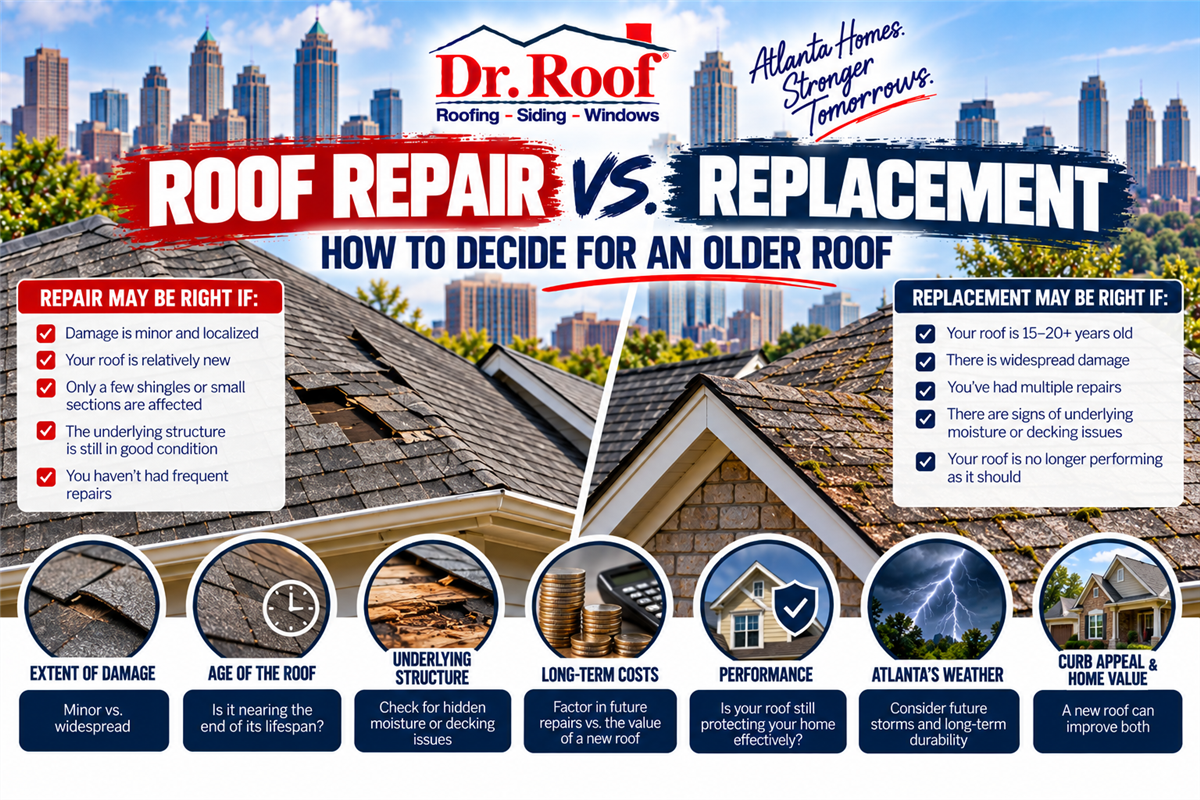
Finding a roof problem does not automatically mean an older roof needs to be completely replaced.
It also does not mean another repair is always the best decision.
For Atlanta homeowners, the choice between roof repair and roof replacement should be based on the roof's actual condition, the location and extent of damage, the condition of surrounding materials, the history of previous repairs, and whether a repair can restore reliable performance.
Age provides useful context, but it should not be the only deciding factor.
An older roof with one isolated, repairable problem may still be a repair candidate. A roof with widespread deterioration, recurring leaks, compromised decking, or problems across multiple components may make replacement more practical.
Here is how homeowners can evaluate the difference.
Roof Repair vs. Replacement: The Quick Answer
Roof repair may be appropriate when:
Damage is localized
Surrounding roofing materials remain serviceable
The source of a leak can be clearly identified
Decking remains sound
Compatible repair materials are available
The roof has not developed repeated problems
Roof replacement may deserve consideration when:
Damage affects multiple areas
Shingles or roofing materials are deteriorating broadly
Leaks repeatedly return
Decking damage is extensive
Multiple roofing components are failing
Previous repairs are no longer providing a practical solution
The decision should follow a roof inspection rather than a universal age rule.
1. Start With the Extent of the Damage
One of the most important questions is whether the problem is isolated or widespread.
A localized issue might involve:
A few damaged shingles
One leaking pipe boot
A limited flashing problem
A small storm-damaged area
One roof penetration
A localized decking concern
When the surrounding roofing materials remain in good condition, repairing that specific area may be reasonable.
The conversation changes when similar problems appear across multiple roof slopes or roofing components.
Widespread cracking, repeated missing shingles, deterioration in several valleys, multiple leaks, or broad material failure can make isolated repairs less practical.
2. Determine Where the Leak Is Actually Coming From
An interior ceiling stain does not automatically mean the entire roof has failed.
Roof leaks can originate from relatively small components.
Possible sources include:
Damaged shingles
Flashing
Pipe boots
Skylight transitions
Chimney flashing
Valleys
Roof penetrations
Previous repair areas
Water can also travel along decking, framing, or other materials before becoming visible inside the home.
That means the stain may not be directly below the entry point.
Before deciding between repair and replacement, the leak source should be diagnosed as accurately as possible.
If one defective component is responsible and the surrounding roof remains serviceable, a targeted repair may solve the problem.
3. Evaluate the Condition of the Roofing Material
The contractor should evaluate the roofing material around the damaged area, not simply the visible defect.
For an asphalt shingle roof, that may include looking for:
Cracking
Curling
Brittleness
Missing shingles
Significant surface deterioration
Wind-related creases
Previous repairs
Areas that no longer lie properly
A damaged shingle can often be replaced more successfully when nearby shingles remain flexible and serviceable.
Repair can become more difficult when surrounding materials are brittle, heavily weathered, or easily damaged during the repair process.
This is one reason roof condition matters more than simply counting how many shingles are missing.
4. Check the Roof Decking
Roof decking forms the structural surface beneath the roofing materials.
Its condition can significantly influence whether a localized repair makes sense.
Potential decking concerns include:
Rot
Soft areas
Delamination
Moisture deterioration
Sagging
Damage caused by long-term leaks
A small damaged decking section may sometimes be repaired locally.
More extensive deterioration can change the scope considerably.
The important step is identifying why the decking became damaged.
Replacing deteriorated wood without correcting the water-entry source does not solve the entire problem.
5. Consider Flashing, Valleys, and Roof Penetrations
Shingles receive most of the attention during roof evaluations, but many roof leaks occur around transitions.
A contractor should also inspect areas such as:
Chimneys
Sidewalls
Roof-to-wall intersections
Valleys
Plumbing vents
Skylights
Exhaust vents
Other roof penetrations
A repair may be practical when one flashing detail or penetration has failed while the rest of the roof remains serviceable.
If problems exist across numerous transitions or multiple areas have been repaired repeatedly, replacement may offer an opportunity to address the roofing system more comprehensively.
6. Look at the Roof's Repair History
One repair does not mean a roof is failing.
Repeated repairs deserve more attention.
Ask:
How many repairs have been completed recently?
Are the problems occurring in the same location?
Are new leaks appearing in different places?
Are old repairs beginning to fail?
Are replacement materials becoming difficult to match?
Are different components beginning to deteriorate at the same time?
If each repair solves a separate, isolated problem and the remaining roof stays serviceable, repairs may still make sense.
If homeowners are repeatedly fixing new problems throughout the roofing system, it may be time to compare the cost and practicality of continued repairs with replacement.
7. Consider Whether Replacement Materials Can Integrate Properly
A repair requires new material to integrate with the existing roofing system.
That can become more difficult when:
The original shingle is discontinued
The profile has changed
The existing roof is heavily weathered
Surrounding shingles are brittle
The repair requires disturbing a large area
Previous roofing layers complicate access
Color matching alone should not determine whether a repair is possible.
More importantly, the contractor should determine whether the replacement material can be installed properly within the existing roofing system.
Does an Old Roof Automatically Need Replacement?
No.
There is no universal age at which every roof must be replaced.
Roof performance can vary depending on:
Material
Installation quality
Ventilation
Weather exposure
Roof design
Maintenance history
Storm exposure
Previous repairs
Moisture conditions
Age should be considered alongside physical condition.
A professional inspection provides more useful information than relying solely on the installation date.
When Is Roof Repair Usually Worth Considering?
Repair often makes sense when the contractor can clearly identify a limited problem and correct it without disturbing large portions of otherwise serviceable roofing.
Examples can include:
Replacing several wind-damaged shingles
Repairing chimney flashing
Replacing a deteriorated pipe boot
Correcting a small valley concern
Repairing localized decking
Fixing one identifiable leak source
The contractor should explain exactly what is being repaired and why the surrounding roof can remain in place.
When Should Roof Replacement Be Considered?
Replacement deserves a closer look when the roofing system has problems that extend well beyond one repair area.
Potential indicators include:
Multiple active leaks
Widespread roofing deterioration
Extensive storm damage
Large areas of compromised decking
Repeated repair history
Numerous failing flashing details
Broad material brittleness
Repairs that cannot integrate reliably with the existing system
Replacement should not be recommended simply because it is the larger project.
The contractor should be able to explain which observable conditions make continued repair less practical.
Repair vs. Replacement After Storm Damage
Storm damage adds another layer to the decision.
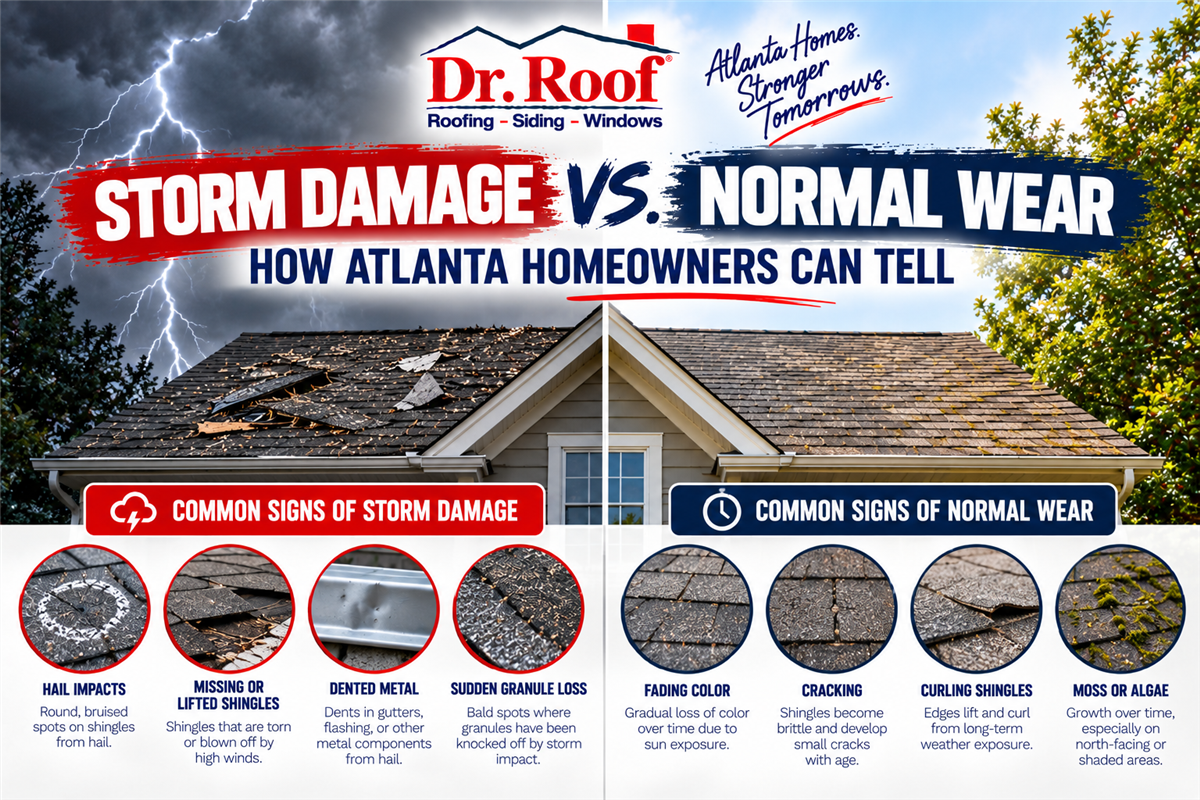
Wind, hail, falling debris, and severe thunderstorms can cause localized or widespread physical damage.
Dr. Roof may document storm-related roofing concerns with:
Photographs
Written findings
Repair recommendations
Replacement recommendations when appropriate
A localized storm problem may be repairable.
More extensive physical damage may lead to a replacement discussion.
If an insurance claim is involved, the roofing contractor can document roof conditions and proposed work, but insurance coverage decisions belong to the insurance company and depend on the homeowner's policy and individual claim.
Is Replacing the Roof More Cost-Effective Than Repeated Repairs?
Sometimes, but not always.
Homeowners should compare more than the cost of today's repair.
Consider:
How frequently repairs have been needed
Whether new problems continue appearing
The condition of the remaining roof
Whether replacement materials are compatible
Whether hidden deterioration is present
Whether another repair is expected to provide a durable solution
A modest repair on an otherwise serviceable roof may be the sensible choice.
Repeatedly repairing a broadly deteriorated roofing system may eventually become less practical.
Why a Roof Inspection Matters
The repair-versus-replacement decision depends on information homeowners usually cannot obtain from the driveway.
A professional evaluation may include:
Roofing materials
Flashing
Valleys
Penetrations
Pipe boots
Roof edges
Visible decking conditions
Ventilation
Attic conditions when accessible
Signs of storm impact
The inspection should identify what is wrong before determining how much work is appropriate.
Questions to Ask Before Approving a Roof Repair
Before proceeding with a repair, ask:
What caused the problem?
Is the damage localized?
What materials will be replaced?
What condition are the surrounding materials in?
Is decking repair necessary?
Can the repair material integrate with the existing roof?
Are there other areas likely to need attention soon?
What warranty applies to the repair?
Clear answers make it easier to understand whether the proposed repair is addressing the root cause.
Questions to Ask Before Approving Roof Replacement
If replacement is recommended, ask:
What conditions make repair impractical?
Is deterioration widespread?
Which roofing components are failing?
What materials are included in the replacement?
How will decking concerns be handled?
What flashing will be replaced?
How will ventilation be evaluated?
What warranty options apply?
A homeowner should understand why a replacement is being recommended before moving forward.
How Dr. Roof Approaches Repair vs. Replacement in Atlanta
Dr. Roof has served Atlanta-area homeowners since 1988 and provides roof inspections, roof repairs, roof replacement, and storm-damage documentation support.
Dr. Roof is a GAF Master Elite Certified Contractor and CertainTeed SELECT ShingleMaster.
The appropriate solution should depend on the condition of the individual roof.
Some homeowners need a focused repair.
Others have roofing systems with enough widespread deterioration that replacement deserves consideration.
A professional inspection helps establish which option makes sense for the property.
Choosing Between Roof Repair and Replacement
An older roof does not automatically need replacement, and a repair is not automatically the most economical choice.
The decision depends on the extent of damage, surrounding material condition, decking, flashing, leak history, previous repairs, and whether a localized repair can restore reliable performance.
For Atlanta homeowners, the best first step is to identify the actual problem.
Once the roof's condition is understood, repair and replacement can be compared based on evidence rather than assumptions.
Should an old roof always be replaced instead of repaired?
No. Age provides useful context, but roof condition matters more. An older roof with localized damage and serviceable surrounding materials may still be repairable, while widespread deterioration or recurring failures may make replacement more practical.
What roof problems can usually be repaired?
Localized problems such as several damaged shingles, a failed pipe boot, limited flashing damage, a small leak source, or localized decking deterioration may sometimes be repaired when the surrounding roof remains serviceable.
What signs suggest roof replacement should be considered?
Replacement may deserve consideration when damage is widespread, leaks repeatedly return, numerous roofing components are failing, decking damage is extensive, materials are broadly deteriorated, or continued repairs are becoming impractical.
Does one roof leak mean I need a new roof?
No. A roof leak can result from a localized problem such as damaged flashing, shingles, a pipe boot, valley, or penetration. A professional inspection should identify the source before repair or replacement is recommended.
Can storm damage be repaired instead of replacing the whole roof?
Sometimes. Localized storm damage may be repairable when surrounding roofing materials remain serviceable. More extensive wind, hail, debris, or decking damage may lead to consideration of replacement.
How does Dr. Roof determine whether to repair or replace a roof?
Dr. Roof can inspect the roofing system and evaluate shingles, flashing, penetrations, decking conditions, leak sources, storm-related concerns, and the overall condition of the roof before recommending an appropriate repair or replacement scope.
Subscribe to Dr. Roof's Blog




Comments