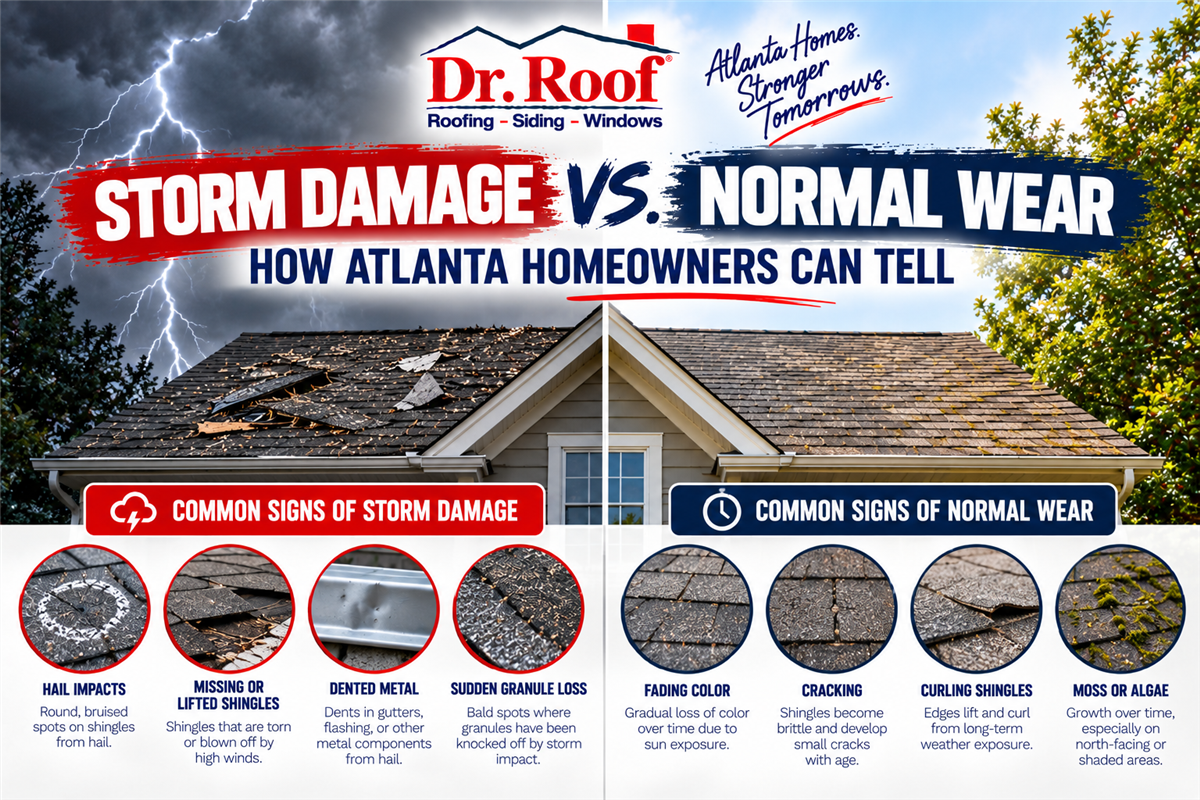
A damaged roof does not always reveal immediately whether the problem came from last night's storm or years of normal weather exposure.
That distinction matters.
Storm damage generally involves a specific weather event that causes sudden physical damage. Normal wear develops gradually as roofing materials experience sunlight, rain, temperature changes, ordinary wind exposure, and routine aging.
But homeowners should be cautious about diagnosing the cause themselves.
A missing shingle after high winds may point toward storm damage. Widespread gradual fading or weathering may look more like normal aging. Other conditions are much harder to classify without a professional inspection.
For Atlanta homeowners, the most useful approach is to compare the timing, pattern, location, and physical characteristics of the damage.
Storm Damage vs. Wear: The Quick Answer
The basic difference is:
Storm Damage
Storm damage is associated with a specific weather event, such as:
High winds
Hail
Falling branches
Wind-driven debris
Severe thunderstorms
Potential signs may appear suddenly or shortly after the event.
Normal Wear
Normal wear develops gradually from routine exposure and aging.
Examples can include:
Gradual fading
Generalized surface weathering
Slow sealant deterioration
Progressive wear around exposed areas
Aging-related material changes
The distinction is not always visually obvious.
A professional roof evaluation can help document the condition without assuming the cause before the inspection.
1. Timing Is One of the Most Useful Clues
Start with a simple question:
When did the problem appear?
Storm-related concerns are often connected to an identifiable event.
For example:
A leak begins immediately after a severe thunderstorm
Shingles are found in the yard after high winds
A branch lands on the roof
Gutters show fresh dents after hail
Flashing is visibly displaced after a storm
Normal wear usually develops less dramatically.
A homeowner may gradually notice:
Increasing discoloration
General surface weathering
Aging sealant
Slow deterioration around exposed components
Repeated small maintenance concerns
Timing does not prove the cause, but it provides useful context.
2. Storm Damage May Appear in Localized or Irregular Patterns
A weather event does not necessarily affect every part of the roof equally.
Wind direction, roof orientation, nearby trees, roof shape, and storm intensity can all influence where damage occurs.
Possible storm-related patterns include:
Missing shingles on one slope
Creased or lifted shingles
Localized impact marks
Dented metal components
Broken or displaced flashing
Punctures from branches
Damage around one roof edge
By contrast, normal weathering may appear more broadly across similarly exposed materials.
However, homeowners should not assume that every irregular mark is storm damage or that every widespread condition is aging.
Inspection is still necessary.
3. Wind Damage Can Be More Subtle Than Missing Shingles
Many homeowners associate wind damage only with shingles that have completely blown off.
Wind can create less obvious problems.
Potential conditions may include:
Lifted shingle edges
Broken sealant bonds
Creased shingles
Torn tabs
Displaced flashing
Damage around roof edges
Debris impact
A shingle may still be physically present while no longer lying or sealing as intended.
This is one reason a roof can look normal from the driveway after a storm while still deserving closer evaluation.
4. Hail Can Affect More Than the Shingles
Hail inspection should not focus exclusively on the roof covering.
Depending on storm conditions, signs of impact may also appear on:
Gutters
Downspouts
Roof vents
Flashing
Window components
Siding
Exterior metal surfaces
On asphalt shingles, a professional may evaluate conditions such as impact marks, displaced granules, surface bruising, or other physical changes.
Not every dark spot or missing granule proves hail damage.
Normal manufacturing conditions, foot traffic, aging, maintenance, and other factors can also affect shingle appearance.
That is why the pattern and surrounding evidence matter.
5. Normal Wear Usually Develops Gradually
Roofing materials are exposed to the environment every day.
Normal aging may involve gradual changes such as:
Surface fading
Generalized weathering
Progressive granule loss
Aging sealants
Minor surface changes
Wear around exposed components
These conditions usually do not begin during one identifiable storm.
The important word is gradual.
If a roofing condition has developed slowly over a long period, normal aging or maintenance-related deterioration may be part of the explanation.
That does not mean the issue should be ignored.
Normal wear can still require repair or replacement even when no storm caused it.
6. Previous Conditions Can Complicate the Diagnosis
A roof can have normal aging and storm damage at the same time.
For example, an older roof may already have:
Existing granule loss
Previous repairs
Weathered sealants
Brittle components
Aging flashing
Then a wind or hail event may create new damage.
Separating the existing condition from new storm-related changes can require careful documentation.
This is another reason homeowners should avoid simple conclusions such as:
"The roof is old, so none of the damage came from the storm."
or:
"There was a storm, so every problem must have been caused by it."
The actual roof condition can be more complicated than either assumption.
7. Interior Symptoms Do Not Always Reveal the Cause
A ceiling stain tells you water entered the building.
It does not automatically tell you why.
The source could involve:
Storm-damaged shingles
Aging flashing
A deteriorated pipe boot
Previous installation problems
Wind-driven rain
Damaged roof decking
An unrelated roof leak
Water can also travel along building materials before appearing inside.
That means the visible interior stain may not be located directly below the roof defect.
Professional diagnosis should identify the entry point before assigning a cause.
What Should You Check After an Atlanta Storm?
Homeowners can perform a safe visual review from the ground.
Look for:
Missing shingles
Shingles or roofing debris in the yard
Fallen branches
Dented gutters
Loose downspouts
Damaged flashing visible from the ground
Broken siding
Damaged exterior trim
New ceiling stains
Water entering the attic or living space
Avoid walking on the roof after a storm.
Wet surfaces, loose granules, damaged decking, debris, and steep slopes can create serious fall hazards.
Close roof inspection is better left to professionals with appropriate safety equipment.
Does Granule Loss Always Mean Storm Damage?
No.
Asphalt shingles contain protective surface granules, and some granule loss can occur for reasons unrelated to a specific storm.
Potential causes may include:
Normal weathering
Foot traffic
Manufacturing-related loose granules
Physical abrasion
Hail impact
Other mechanical damage
The pattern matters.
A professional roofer may evaluate whether the condition appears consistent with general weathering or a recent physical impact.
Homeowners should avoid using gutter granules alone as proof that a storm damaged the roof.
Are Curled Shingles Storm Damage?
Not necessarily.
Curling can develop from aging, heat exposure, ventilation-related conditions, material deterioration, or other long-term factors.
Wind can also lift or crease shingles.
Those are not identical conditions.
A roofer should evaluate the shape, location, surrounding materials, and recent weather history before drawing conclusions.
Why Documentation Matters After Severe Weather
If you suspect storm damage, documentation can help establish what was observed and when.
Useful records may include:
Photographs taken after the storm
The date of the weather event
Interior water stains
Exterior damage
Fallen debris
Contractor inspection findings
Written repair recommendations
Previous roof inspection records
Dr. Roof may provide photographs, written findings, and repair or replacement recommendations for storm-related roofing concerns.
Documentation helps homeowners understand the condition of the property regardless of whether an insurance claim is ultimately filed.
Storm Damage and Homeowners Insurance
Insurance coverage should never be assumed based only on the phrase "storm damage."
Policies differ.
Coverage can depend on:
The specific policy
Cause of loss
Policy exclusions
Deductible
Existing conditions
Documentation
Individual claim circumstances
Georgia insurance guidance notes that different policies cover different events and that homeowners should read their policy carefully.
A roofing contractor can inspect and document physical roof conditions.
The contractor does not determine whether the insurer will approve coverage.
That decision belongs to the insurance company under the applicable policy and individual claim.
Can a Roofer Tell You Whether Insurance Will Pay?
A roofing contractor can provide useful information about the roof.
That may include:
Photographs
Condition reports
Repair estimates
Replacement estimates
Documentation of visible storm-related concerns
However, a contractor should not guarantee:
Claim approval
Full replacement coverage
A particular insurance payment
That every repair will be covered
Insurance decisions belong to the insurer.
The roofer's role is to evaluate and document the physical condition of the property.
What If the Roof Has Both Wear and Storm Damage?
That situation is possible.
A roof does not stop aging simply because a storm occurs.
A professional inspection may identify:
Older weathering
Previous repairs
Existing deterioration
New wind damage
New impact damage
Other unrelated defects
The report should distinguish observable conditions as clearly as possible instead of treating the roof as though it has only one issue.
If an insurance claim is involved, the insurer will determine how policy terms apply to the documented conditions.
Repair vs. Replacement After Storm Damage
Storm damage does not automatically require complete roof replacement.
Repair may be appropriate when:
Damage is localized
Surrounding materials remain serviceable
Compatible materials are available
The damaged area can be corrected effectively
Replacement may deserve consideration when:
Damage is widespread
Numerous roof areas are affected
Underlying materials are compromised
Repair is not practical
Broader roof conditions also require attention
The recommendation should follow the inspection.
How Dr. Roof Evaluates Storm-Related Roofing Concerns
Dr. Roof has served Atlanta-area homeowners since 1988 and provides roof inspections, roof repairs, roof replacement, and storm-damage documentation support.
When storm damage is suspected, Dr. Roof may provide:
Photographs
Written findings
Repair recommendations
Replacement recommendations when appropriate
Project estimates
The purpose of the evaluation is to document the roof's physical condition and determine what work, if any, should be considered.
Insurance coverage decisions remain with the insurance company.
Storm Damage vs. Wear: Focus on the Evidence
The difference between storm damage and normal wear usually comes down to cause, timing, physical pattern, and the overall condition of the roofing system.
Storm damage is generally connected to a specific event.
Normal wear develops gradually.
But the two can exist together, and some conditions look similar to an untrained eye.
For Atlanta homeowners, the most useful next step after severe weather is not to guess from the driveway.
Document what you can see safely, note when the problem appeared, and have the roof professionally evaluated if damage is suspected.
That provides a much clearer basis for deciding whether the roof needs monitoring, maintenance, repair, or replacement.
What is the difference between storm damage and normal wear?
Storm damage is generally associated with a specific weather event that causes sudden physical damage. Normal wear develops gradually through aging and ordinary environmental exposure. Timing, damage patterns, surrounding evidence, and a professional inspection can help distinguish the two.
What are common signs of storm damage on a roof?
Possible signs include missing or lifted shingles, creased shingles, impact marks, damaged flashing, dented gutters or downspouts, fallen debris, punctures, and new leaks after severe weather. Not every visible condition automatically proves storm damage.
Does granule loss always mean hail damage?
No. Granule loss can result from normal weathering, abrasion, foot traffic, loose manufacturing granules, hail impact, or other causes. The pattern and surrounding evidence should be evaluated before attributing it to a storm.
Can a roof have normal wear and storm damage at the same time?
Yes. A roof may already have age-related deterioration when a new storm causes additional damage. A professional inspection can document existing conditions and newly observed physical damage as clearly as possible.
Does homeowners insurance automatically cover storm roof damage?
No. Coverage depends on the homeowner's specific policy, cause of loss, exclusions, deductible, documentation, and individual claim. Coverage decisions are made by the insurance company.
What should I do if I suspect storm damage to my roof?
Document visible conditions from a safe location, note when the storm occurred, protect the property from additional damage when it is safe to do so, review your insurance policy if a claim may be involved, and schedule a professional roof evaluation.
Subscribe to Dr. Roof's Blog







Comments