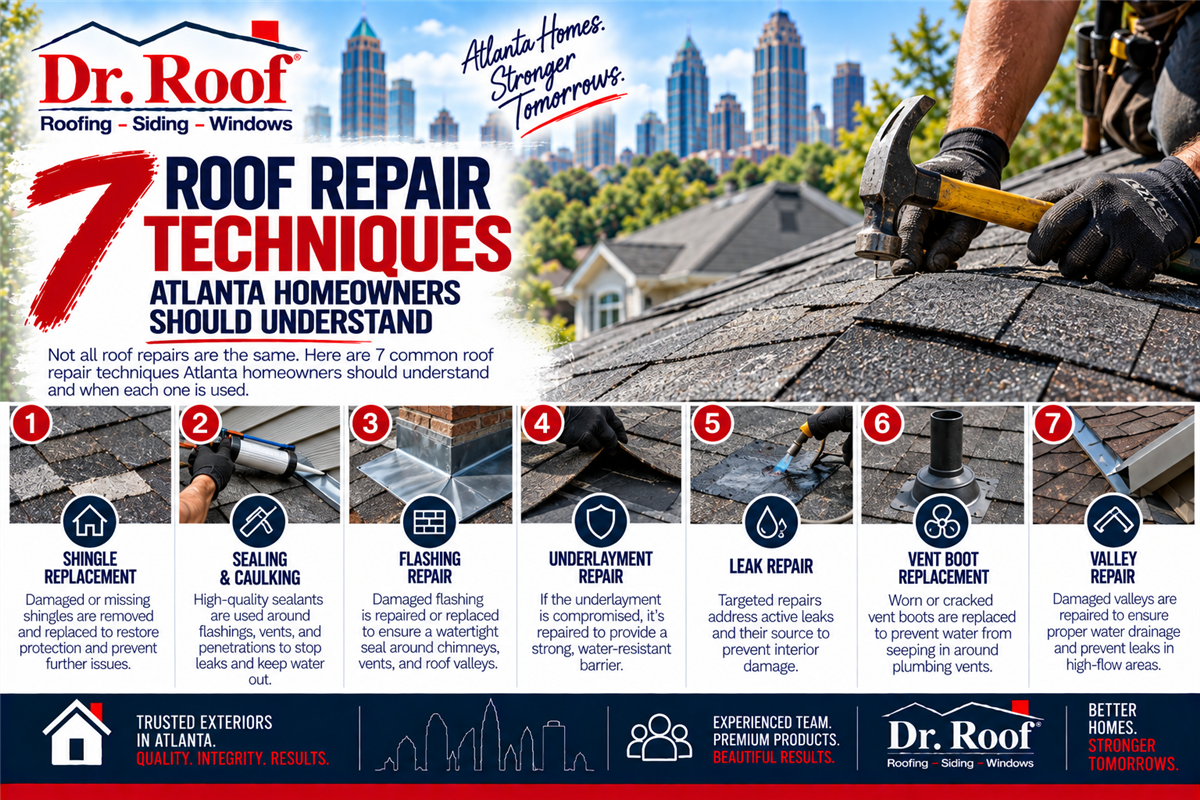
Roof repair is not one single procedure.
A missing shingle, failed flashing, deteriorated pipe boot, damaged roof deck, leaking valley, and storm puncture may all allow water into a home, but they are not repaired the same way.
That is why a professional roof repair should begin with diagnosis.
The contractor first needs to determine where the roofing system is failing, how extensive the damage is, whether surrounding materials are still serviceable, and whether a localized repair is appropriate.
For Atlanta homeowners, understanding the basic types of roof repair can make contractor recommendations much easier to evaluate.
Here are seven common roof repair techniques and when they may be considered.
Roof Repair Techniques: The Quick Answer
Common roof repair approaches include:
Replacing damaged shingles
Repairing or replacing flashing
Repairing roof penetrations and pipe boots
Correcting valley problems
Replacing deteriorated roof decking
Tracing and correcting localized leak sources
Temporarily stabilizing storm damage before permanent repairs
The correct method depends on the cause and extent of the problem.
A repair should address the source of the failure—not simply cover the visible symptom.
1. Damaged Shingle Replacement
Localized shingle replacement is one of the most familiar roof repair techniques.
It may be considered when individual asphalt shingles are:
Missing
Cracked
Torn
Lifted
Damaged by wind
Damaged by falling debris
Otherwise compromised in a limited area
The contractor needs to inspect more than the visible shingle.
Nearby shingles, fasteners, underlayment, and the roof deck may also need evaluation.
The replacement material should also be compatible with the existing roof.
An older roof can create another challenge: matching the exact shingle color, profile, or product may be difficult if the original product is discontinued or significantly weathered.
That does not automatically mean the entire roof must be replaced, but material compatibility should be part of the repair discussion.
2. Flashing Repair or Replacement
Flashing protects roof transitions and vulnerable intersections where water needs to be directed away from openings.
It is commonly found around areas such as:
Chimneys
Sidewalls
Roof-to-wall intersections
Skylights
Valleys
Certain roof penetrations
Flashing problems can develop because of corrosion, movement, improper installation, physical damage, failed surrounding materials, or previous repair attempts.
A flashing repair may involve removing surrounding roofing material so the damaged flashing can be corrected or replaced properly.
Simply applying sealant over a larger flashing problem may not address the underlying issue.
The contractor should determine why the flashing failed before choosing the repair method.
3. Pipe Boot and Roof Penetration Repair
Plumbing vents and other roof penetrations create openings through the roofing system.
Those openings require properly integrated flashing or boots to help keep water out.
Over time, components around a roof penetration may crack, loosen, deteriorate, or separate.
Potential signs of a penetration problem can include:
Water stains below the vent area
Deteriorated boot material
Cracked surrounding shingles
Loose flashing
Failed seals
Visible deterioration around the penetration
Repair may involve replacing the pipe boot or flashing assembly and integrating it properly with the surrounding roofing materials.
The surrounding shingles and roof deck should also be evaluated for moisture damage.
4. Roof Valley Repair
Roof valleys carry concentrated water runoff where two roof planes meet.
Because significant amounts of water can travel through these areas during Atlanta rainstorms, valley problems can create persistent leaks.
Possible valley concerns include:
Damaged shingles
Improperly cut shingles
Deteriorated underlayment
Damaged metal valley flashing
Debris accumulation
Previous installation problems
Fasteners placed in vulnerable locations
The appropriate repair depends on how the valley was originally constructed and which component is failing.
A contractor may need to remove roofing materials around the affected area to inspect the layers below.
Valley repairs should focus on restoring the water-shedding path rather than merely sealing the visible leak point.
5. Roof Decking Repair
The roof deck forms the structural surface beneath the roofing materials.
Decking can deteriorate when moisture repeatedly reaches the wood or when previous roofing problems remain unresolved.
Potential indicators may include:
Soft areas
Sagging
Rot
Delamination
Water-damaged wood
Deterioration discovered after shingles are removed
Damaged decking cannot simply be ignored and covered with new roofing material.
The affected section may need to be removed and replaced before the roof covering is restored.
The contractor should also identify the source of the moisture that damaged the deck.
Otherwise, replacing the wood without correcting the leak can allow the same problem to return.
6. Leak-Source Diagnosis and Localized System Repair
One of the most important roof repair techniques is not a specific material replacement.
It is accurate leak diagnosis.
Water can travel along decking, rafters, fasteners, insulation, and other building components before becoming visible inside the home.
That means the ceiling stain is not always directly below the roof defect.
A professional evaluation may include checking:
Shingles
Flashing
Valleys
Roof penetrations
Chimneys
Pipe boots
Attic conditions
Roof decking
Previous repairs
Once the actual entry point is identified, the contractor can determine which roofing component needs correction.
This is why simply applying roofing cement or sealant near an interior stain often fails to solve the problem.
The repair needs to address the water-entry source.
7. Emergency Stabilization Before Permanent Repair
Severe weather can create roof damage that cannot always be permanently repaired immediately.
A fallen branch, wind-damaged section, missing roofing materials, or active opening may need temporary stabilization first.
Temporary measures can be used to reduce additional water entry until permanent repairs can be safely completed.
This is different from a finished roof repair.
Emergency stabilization should be treated as a temporary protective measure while the contractor evaluates:
Structural safety
Decking condition
Roofing damage
Material availability
Permanent repair requirements
Homeowners should receive clear information about whether a storm-related repair is temporary or permanent.
Roof Repair vs. Roof Replacement: How Is the Decision Made?
Not every roof problem requires replacement.
A localized repair may make sense when:
Damage is limited
Surrounding roofing material remains serviceable
Compatible replacement materials are available
The roof system is otherwise functioning appropriately
The source of the problem can be corrected effectively
Replacement may deserve consideration when:
Damage is widespread
Multiple areas are failing
Decking deterioration is extensive
Repair materials cannot reasonably integrate with the existing system
Repeated leaks suggest broader roofing problems
The roof condition makes ongoing repairs impractical
There is no universal rule based on a single symptom.
The recommendation should follow the inspection.
Why Finding the Cause Matters More Than Patching the Symptom
A ceiling leak tells you that water reached the interior.
It does not tell you why.
The actual source might be:
Failed flashing
A pipe boot
Damaged shingles
A valley
A roof penetration
Deteriorated decking
Wind damage
Previous installation problems
If the cause is not identified, a surface patch may only delay the next leak.
A professional repair should answer two questions:
Where is the water entering?
Why did that area fail?
Those answers determine the repair technique.
Can Granule Loss Be Repaired?
Granule loss is different from a missing shingle or damaged pipe boot.
Asphalt-shingle granules are part of the manufactured surface of the shingle.
A contractor generally cannot restore a worn shingle by simply adding new granules to it.
Instead, the contractor should evaluate:
How widespread the granule loss is
Whether it is consistent with normal weathering
Whether impact damage is present
Whether the shingles remain serviceable
Whether localized replacement is practical
The condition of the roof should guide the recommendation.
Can Roof Sealant Fix a Leak?
Sometimes sealants are used as part of a properly designed roofing detail.
But sealant should not automatically be treated as the solution to every roof leak.
If flashing is damaged, a pipe boot has failed, shingles are missing, or decking is deteriorated, simply covering the area with sealant may not correct the underlying failure.
The repair method should match the roofing component that is actually damaged.
Why DIY Roof Repair Can Create Additional Problems
Roof repair involves more than finding a visible opening.
Improper repairs can:
Damage surrounding shingles
Trap moisture
Create new leak paths
Interfere with flashing
Use incompatible materials
Make later diagnosis more difficult
Working on a roof also creates serious fall hazards.
Homeowners can safely document visible concerns from the ground or inside the attic when conditions are safe, but complex roofing repairs are better evaluated by a professional contractor.
What Should Be Included in a Roof Repair Estimate?
A clear roof repair proposal should explain:
Where the problem was found
What caused the problem when identifiable
Which materials will be removed
Which materials will be installed
Whether decking repair is anticipated
Whether flashing is included
Whether the repair is temporary or permanent
Applicable workmanship or material warranty information
Cleanup responsibilities
If the proposal simply says "repair leak," ask for more detail.
The homeowner should understand which roofing component is actually being repaired.
How Dr. Roof Approaches Roof Repair in Atlanta
Dr. Roof has served Atlanta-area homeowners since 1988 and provides professional roof inspections and roof repair services.
Depending on the condition found, a repair may involve shingles, flashing, penetrations, valleys, decking, or other roofing-system components.
Dr. Roof is a GAF Master Elite Certified Contractor and CertainTeed SELECT ShingleMaster, providing experience with established asphalt roofing systems and manufacturer requirements.
When storm damage may be involved, Dr. Roof can also document visible roofing conditions and provide repair or replacement recommendations.
Insurance coverage decisions remain with the insurer according to the homeowner's policy and individual claim.
Understanding the Right Repair for Your Roof
The best roof repair technique is not the one that sounds simplest.
It is the one that addresses the actual source of the roofing problem.
A missing shingle requires a different solution than failed flashing. A deteriorated pipe boot requires a different approach than damaged decking. A leaking valley may require investigation below the visible roof surface.
For Atlanta homeowners, the first step should be a thorough roof evaluation.
Once the cause and extent of the problem are understood, the contractor can recommend a repair designed for that specific part of the roofing system.
What are the most common roof repair techniques?
Common techniques include replacing damaged shingles, repairing or replacing flashing, correcting pipe boots and roof penetrations, repairing valleys, replacing deteriorated decking, diagnosing localized leak sources, and temporarily stabilizing storm damage before permanent repair.
Does a roof leak always mean the roof needs to be replaced?
No. Some leaks can result from localized problems such as failed flashing, damaged shingles, or roof penetrations. Whether repair or replacement is appropriate depends on the source, extent of damage, and overall condition of the roofing system.
Can damaged roof flashing be repaired?
Yes, depending on the condition and location. A contractor may repair or replace damaged flashing and surrounding roofing materials. The goal is to restore the water-shedding detail rather than simply cover the area with sealant.
Can a damaged pipe boot cause a roof leak?
Yes. Pipe boots and other penetration flashings help protect openings through the roofing system. If those components deteriorate or separate, water may enter around the penetration and damage surrounding materials.
Can roof decking be repaired without replacing the entire roof?
Localized decking deterioration may sometimes be repaired by removing roofing materials in the affected area, replacing damaged deck sections, correcting the moisture source, and restoring the roofing system. The extent of deterioration determines whether a localized repair is practical.
How does a roofer determine which repair technique to use?
The contractor should first identify the source and extent of the problem. The condition of shingles, flashing, valleys, penetrations, decking, surrounding materials, and the overall roof system helps determine the appropriate repair method.
Subscribe to Dr. Roof's Blog








Comments